Author: Nancy, PANews
Last night, the air in Silicon Valley was thick with the smell of burning money.
$110 billion in funding, an $840 billion post-money valuation—the depth charge thrown by OpenAI not only shattered the ceiling for private tech companies but also plunged the global AI competition into an extremely brutal "folded space."
This is no longer a romantic tale of tech entrepreneurship but a high-stakes game concerning national destiny, computing supremacy, and the direction of civilization.
A Hundred Billion Dollars Poured into AI, OpenAI Becomes the Most Expensive Experiment
In tech history, OpenAI has set a staggering funding record.
On February 27, OpenAI announced a new massive funding round of $110 billion at a $730 billion valuation, directly pushing its post-money valuation to $840 billion. Compared to the $40 billion funding round a year earlier, this round has multiplied in size, setting a new record for private tech company funding. The capital bet on it has shifted from "betting on the future" to "locking in the future in advance."
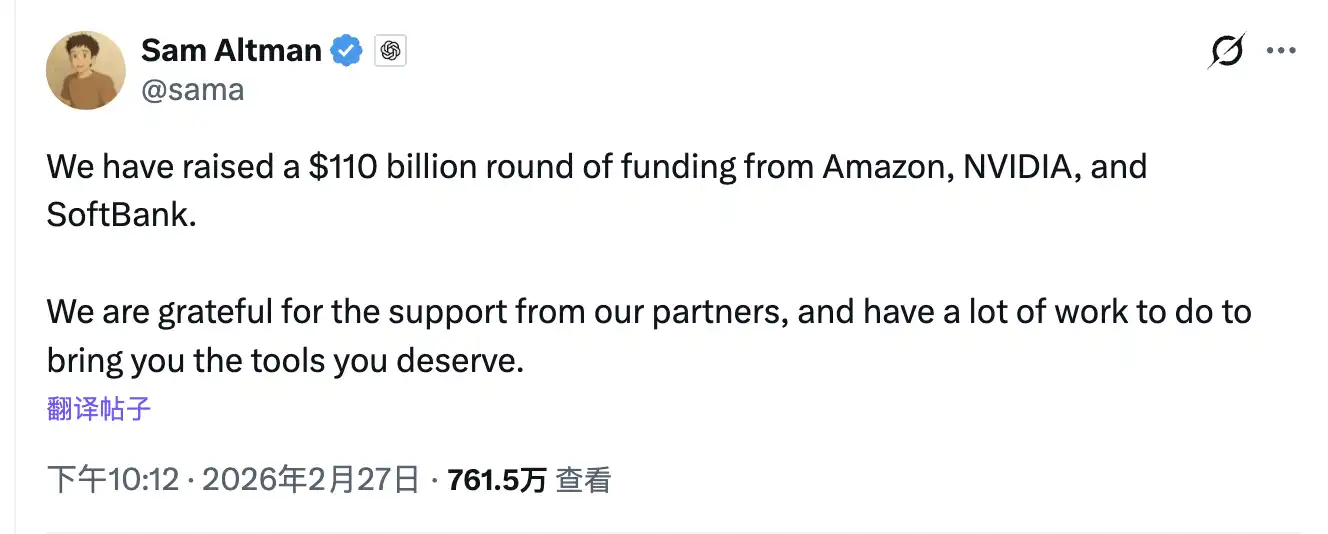
What does $110 billion mean?
This figure exceeds the annual GDP of medium-sized countries like Kenya, Venezuela, Luxembourg, and Panama. Even the global oil powerhouse Saudi Arabia has an annual GDP of about $1 trillion. OpenAI's single funding round is equivalent to roughly one-tenth of Saudi Arabia's annual output.
This amount is roughly equivalent to NVIDIA's annual revenue, close to half of SpaceX's current valuation, and the sum of the funding amounts of internet golden age giants like Uber, Didi, Alibaba, ByteDance, Tencent, and Meituan.

In the AI landscape, a single funding round of $110 billion is undoubtedly a watershed moment, overnight changing the entire industry's funding rules. In 2025, the total funding for AI startups broke through $200 billion, hitting a historical high, and OpenAI alone took over half of that in one night.
Such funding scale intensifies the arms race in the AI field. Top competitors must follow up with larger funding rounds; otherwise, they will gradually fall behind in the competition for computing power, models, and talent. However, the expansion of funding scale also brings higher valuation pressures and return requirements. When massive capital is concentrated and siphoned away, the funding window will inevitably narrow sharply. The valuation negotiation space for small and medium-sized AI enterprises shrinks, their survival cycles lengthen, and the risk of industry consolidation further increases, potentially leading to valuation bubbles, resource monopolies, and a decline in innovative vitality.
From this perspective, when capital bets with such enormous volume, AI is no longer just the protagonist of a tech narrative but truly transforms into the mainline asset of the capital era, becoming a battleground for giant capital gambles.
A Capital Gambit Around AGI, Three Giants Take the Field
The backers writing this $110 billion check are Amazon, NVIDIA, and SoftBank, assembling computing power, channels, and capital.
But this is not a simple funding round. Rather than mere financial transfusion, it is a strategic high-stakes bet centered on the prospects of AGI, deeply intertwined with technology, computing power, and commercial interests.
The most generous contributor this round is Amazon, which is both a key investor in OpenAI and its long-term strategic partner.
Out of a total commitment of $50 billion, an initial $15 billion has been confirmed, with the remaining $35 billion to be delivered in the coming months based on specific conditions. Trigger conditions include achieving AGI milestones or advancing an IPO by year-end. Additionally, the two parties signed an 8-year, $100 billion expansion agreement.
This model of exchanging capital investment for future computing power needs and technological priority is similar to OpenAI's previous cooperation logic with Microsoft. It is worth mentioning that OpenAI and Microsoft have a special clause: once AGI is achieved, Microsoft will lose access to the related technology (Note: In the new agreement signed in 2025, Microsoft's IP rights to models and products were extended to 2032).
SoftBank Group contributed $30 billion, with funds to be delivered in three installments in April, July, and October 2026. This staged arrangement is also interpreted as a risk hedge. SoftBank's role in this funding round is not just about providing money. Market消息称, OpenAI is expected to raise about another $10 billion from investors before March, including sovereign wealth funds and investment institutions, potentially pushing the overall valuation to $850 billion, and these potential investors are likely to enter through SoftBank's bridge.
SoftBank founder Masayoshi Son has frequently bet on AI in recent years, publicly stating that "the AI revolution is the most exciting and dynamic front-end trend of the future." Son visited Trump's Mar-a-Lago at the end of 2024, promising $100 billion in U.S. investments, and last year officially announced participation in "Stargate," a $500 billion AI infrastructure investment project in the U.S., serving as its chairman. SoftBank is responsible for financial obligations, while OpenAI handles operational responsibilities. To support OpenAI, Son even reluctantly sold off NVIDIA shares last year "with tears," using the proceeds for additional investment in OpenAI, becoming one of OpenAI's largest external investors.
NVIDIA, which had long预告 its investment,掏出了 $30 billion this time, replacing the $100 billion long-term cooperation commitment agreed upon last year. This also allows OpenAI to monopolize NVIDIA's production capacity in advance, creating an exclusive "internal循环 system." Any competitor outside this circle would have to queue until 2030 just to buy graphics cards.
This循环 model is seen as a typical supplier financing, essentially tech giants using capital binding to lock in long-term商业合作. It can be said that in this AI race, capital is no longer just a financial tool but a chip to lock in computing resources and seize discourse power.
The Race Between Technology and Capital, Considering an IPO at the Right Time
Behind the massive capital injection is not only a collective bet on the AGI track but also recognition of OpenAI's business growth.
According to official disclosures, OpenAI's flagship product ChatGPT now has over 900 million weekly active users, a number that stood at around 200 million 18 months ago; individual subscription users have surpassed the 50 million mark, hitting a historical high with a paid penetration rate of over 5%; paid商业 users exceed 9 million, including numerous enterprises and government agencies using ChatGPT or building products based on the OpenAI API.
However, behind the rapid growth is an expanding cash burn. OpenAI's revenue in 2025 was approximately $13 billion, with cash expenditures of $80 billion, meaning that for every dollar earned, about $0.62 of rigid cash outflow is burned. According to The Information, internal projections disclosed by OpenAI to investors show that cumulative cash burn by the end of 2029 will reach $115 billion, with profitability expected only by 2030. Meanwhile, OpenAI recently disclosed plans to invest a total of about $600 billion in computing power construction by 2030.
This means that if substantial profitability cannot be achieved in the short term, this astonishing "burn rate" forces OpenAI to continuously rely on transfusions to stay alive.
But more critically, OpenAI's once impregnable moat is loosening.
According to data from mobile analytics firm Apptopia, ChatGPT's app market share has declined from 69.1% in January 2025 to 45.3% in 2026. During the same period, Google's Gemini chatbot app's market share rose from 14.7% to 25.2%; Musk's Grok climbed to 15.2%, up from just 1.6% a year earlier.
With profitability challenges and strong competitors closing in, an IPO might become OpenAI's "lifesaving ammunition."
Currently, OpenAI's IPO timetable may be approaching. According to a recent Wall Street Journal report citing informed sources, OpenAI is paving the way for a Q4 2026 listing, has contacted Wall Street investment banks, and recruited a chief accounting officer and head of investor relations. Its founder Sam Altman最新 disclosed that he will consider going public at the appropriate time. If realized, this would be one of the most important IPO events in the tech industry in 2026.
This means Sam Altman is running blindfolded on the tightrope of an IPO. This is not just a race of technology but a life-and-death sprint against capital's patience.
And this target IPO at year-end might be the peak of this AI bubble, or perhaps the true beginning of the AGI era. But until then, everyone is holding their breath at the most expensive gambling table, waiting for the cards to be revealed.