Strategy Watch: February

insights.glassnodeОпубликовано 2026-03-03Обновлено 2026-03-03

Введение

Glassnode launches Strategy Watch, a monthly newsletter analyzing fund performance and allocation trends in digital assets. The February 2026 edition reports a sharp negative shift in capital flows for Bitcoin, Ethereum, and stablecoins since late October 2025, signaling weakening institutional demand and a defensive market regime. ETF and Digital Asset Trust (DAT) net flows have also softened, indicating slowing institutional interest. Additionally, Ethereum's DeFi Total Value Locked (TVL) has been declining since August 2025, reflecting reduced conviction in DeFi yields. The CME basis yield for both Bitcoin and Ethereum has compressed significantly, suggesting a pullback in institutional leverage and market-neutral strategies.

The full report is available in PDF format.

Access PDF version

Welcome to Strategy Watch

In a rapidly evolving market, where traders and funds chase returns amid volatility, while asset allocators seek data-driven conviction for long-term positioning, Glassnode occupies a unique vantage point. Our on-chain and wider market intelligence has served as a cornerstone for both groups since 2018, earning their trust through consistent, impartial data, analytics and research.

A core Glassnode belief is that genuine insight in digital assets comes from neutrality and depth, unbiased data that empowers decisions across the ecosystem. That is why we are thrilled to launch Strategy Watch, a new monthly newsletter dedicated to the analysis of fund-level performance and allocation trends in digital assets.

We hope to bring value by regularly delivering clear, high-signal analysis of capital flows, head-to-head strategy performance benchmarks, and the most important allocation moves actually being made by institutions and funds. But this is just the beginning. We are actively exploring ways to bridge these worlds further, and would love your feedback as Strategy Watch evolves.

Inside the Latest Strategy Watch

You'll find a wealth of insides spread across 6 sections:

  • Institutional Flow Monitor
  • Fund and SMA Performance
  • On-chain Vault Performance
  • Manager Monitor
  • Allocation Updates
in partnership with

The Premier Digital Assets Allocator Platform. Learn more


Institutional Flow Monitor

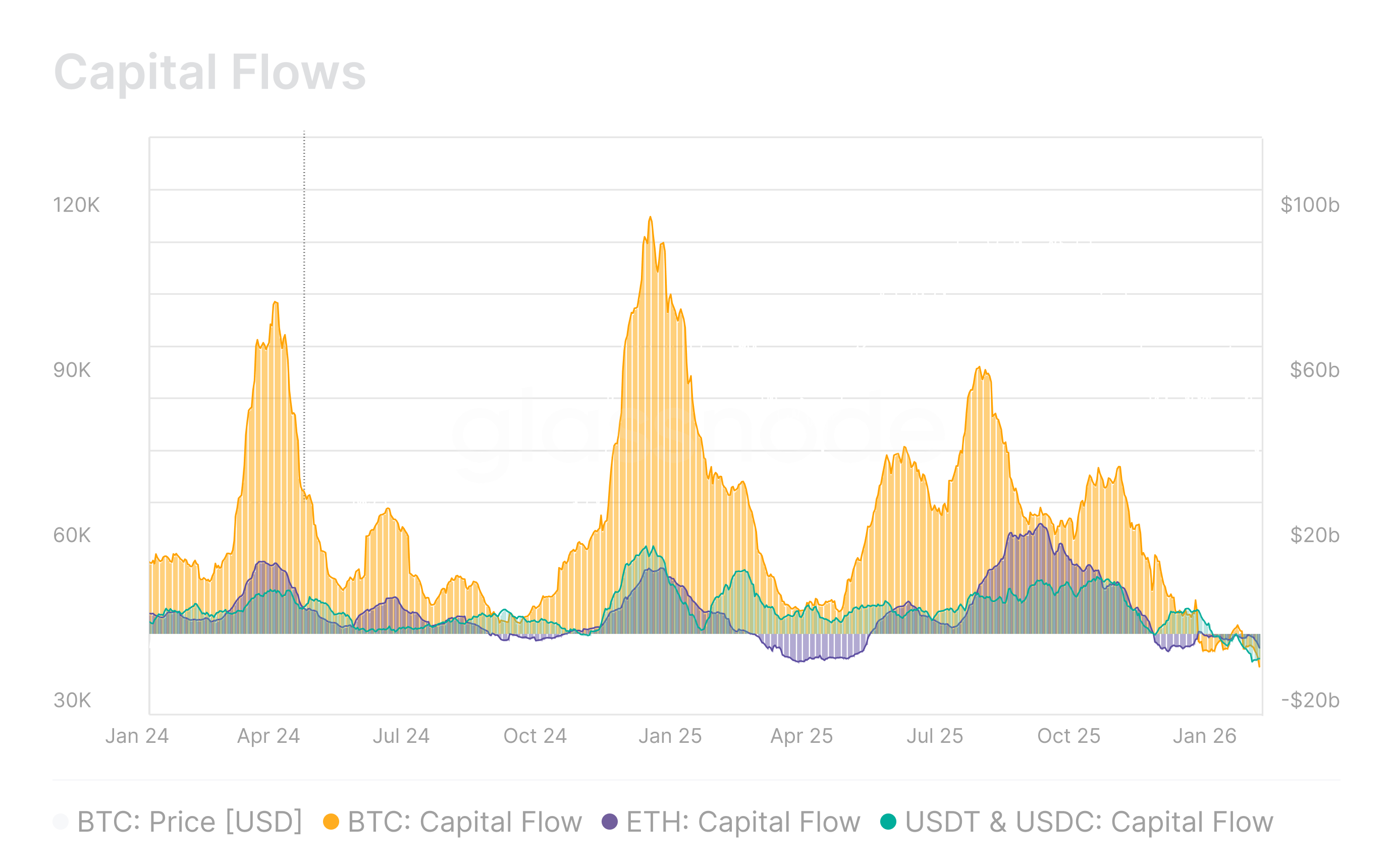
Since late October 2025, capital flows to BTC, ETH and Stablecoins have turned negative sharply.

Bitcoin, Ethereum, and Stablecoins have seen a clear slowdown in capital inflows, signalling weakening demand and a structural contraction in liquidity. All three assets have now shifted into net outflow, with Bitcoin at –$8.4B per month, Ethereum at –$3.8B, and stablecoins at –$6.4B. This broad-based drawdown across core crypto assets reflects a defensive regime, where institutional capital is de-risking rather than re-entering risk positions. This negative trend has further accelerated as of January 2026.
ETF & DAT Net Flows

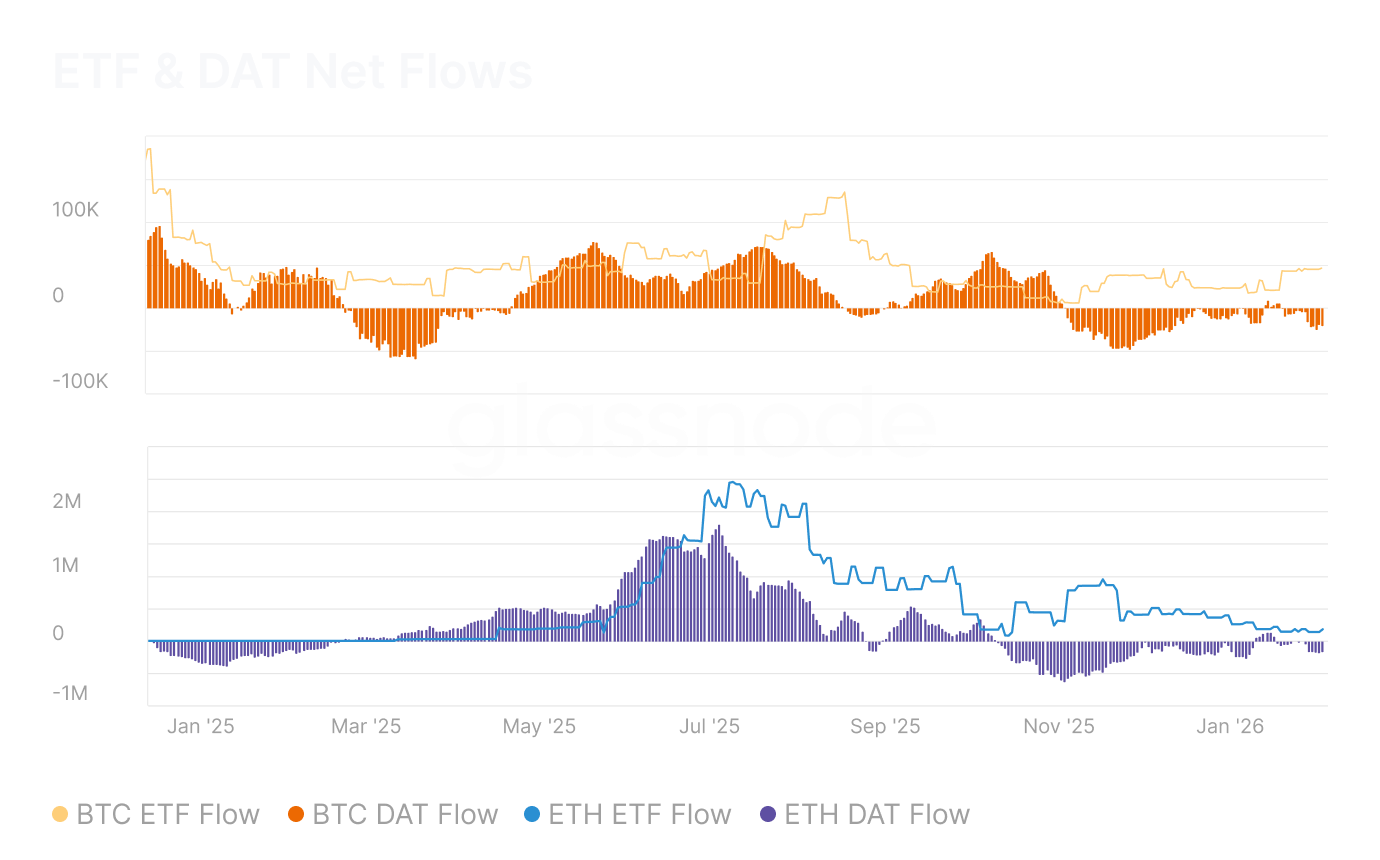
ETF & DAT net flows remain positive, but weakened, signalling slowing institutional demand.

Net flows into these vehicles act as a proxy for institutional demand. In Q4 2025 and early January, institutions were net sellers through the ETF channel, with Bitcoin ETF outflows approximating –35.8k BTC per month and Ethereum ETF flows around –257.6k ETH per month. Over the same period, DATs saw strong inflows in August 2025 driven by new product launches, but buy pressure has since softened; nonetheless, flows into DATs remain positive, indicating ongoing, albeit weaker, institutional interest via balance-sheet exposure.
DeFi TVL & Stablecoin Cap

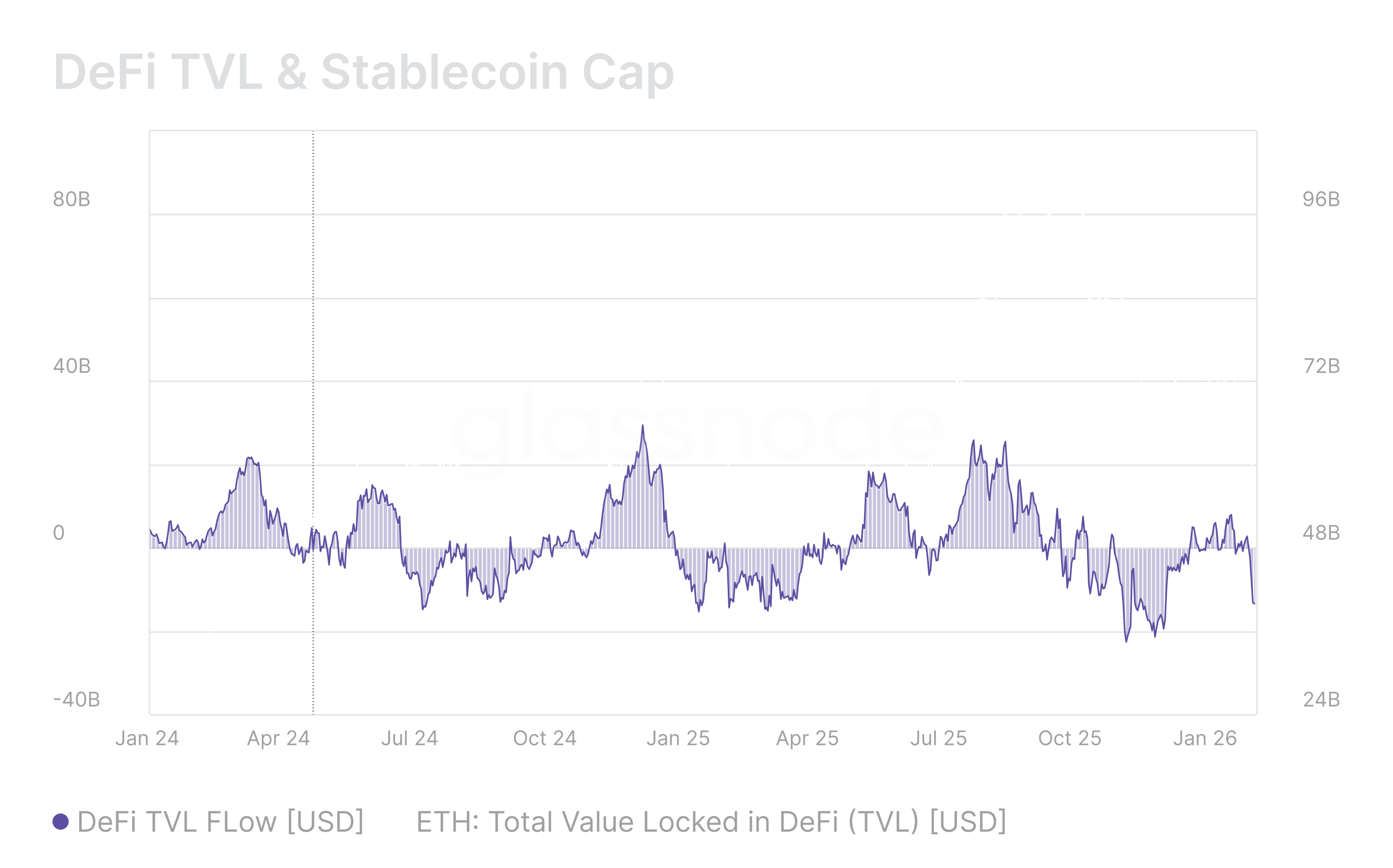
TVL on Ethereum has been declining since August 2025, signalling softer conviction in DeFi yield curves.

DeFi has served as another active playground for institutional capital through strategies such as liquidity provisioning, collateralized lending, and structured yield harvesting. Total Value Locked (TVL) on Ethereum, began to shrink from August 2025 onward, and is now declining at approximately –$15.3M per month. A contraction in TVL implies that larger allocators are withdrawing from on-chain financial services, reducing liquidity depth and signalling softer conviction in DeFi yield and risk-adjusted returns relative to alternative venues.
CME Basis Yield

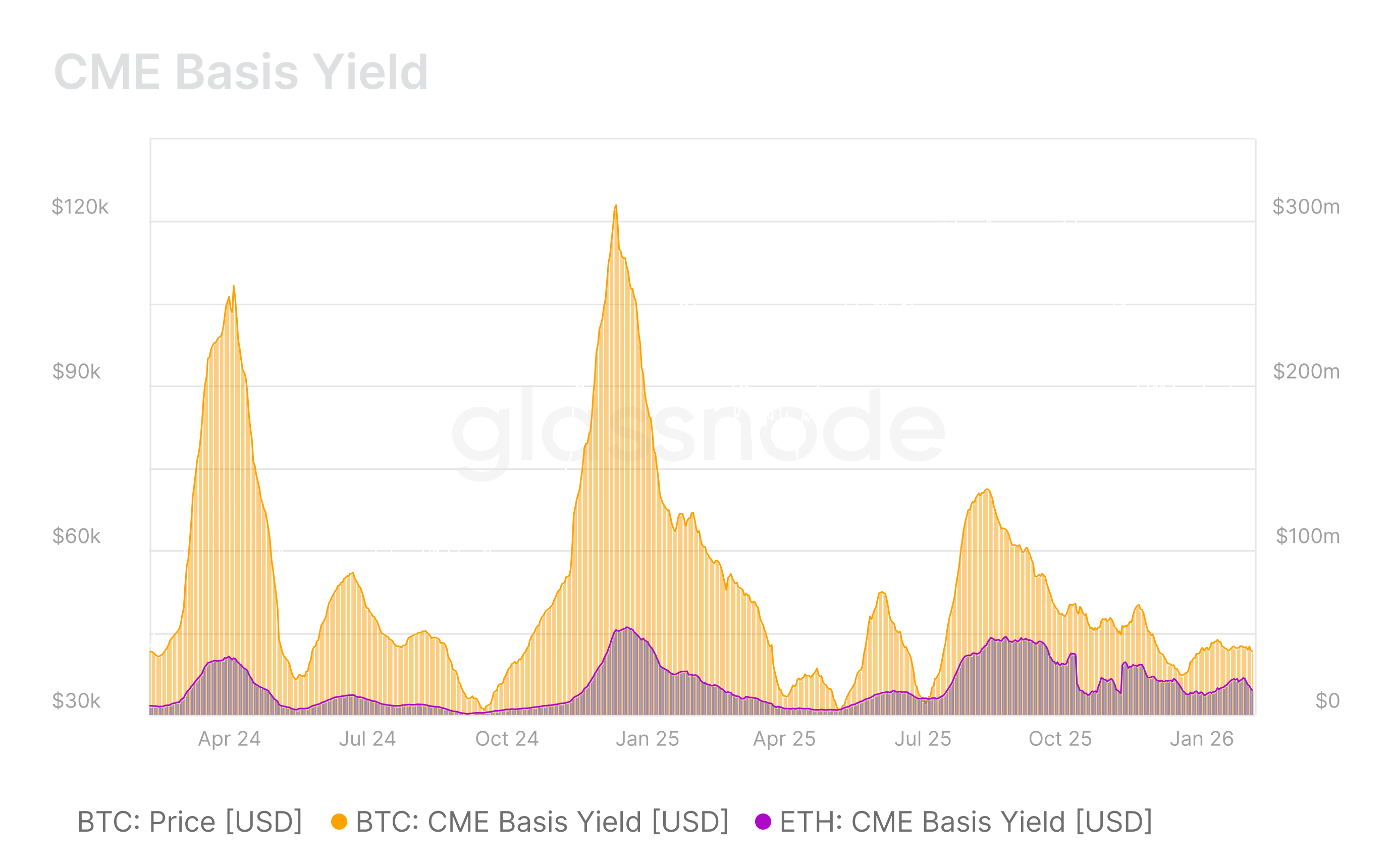
Contraction signals are waning incentive for market-neutral strategies.

Another key dimension of institutional engagement is the CME Basis Yield, which estimates the monthly dollar value earned by institutions from cash-and-carry strategies, capturing the premium between spot prices and CME calendar futures. Since August 2025, both Bitcoin and Ethereum have seen a sharp compression in this yield, with Bitcoin declining from approximately $136.6M to $38.6M per month, and Ethereum from $47.5M to $14.8M per month. This contraction rreflects reduced leverage deployment, softer futures demand, and a broader pullback in balance-sheet commitment amid tightening liquidity conditions.

Want to feature in the next edition of Strategy Watch? Share your updates on recent launches or milestones.

Submit an update

Disclaimer: This report does not provide any investment advice. All data is provided for information and educational purposes only. No investment decision shall be based on the information provided here and you are solely responsible for your own investment decisions.
Exchange balances presented are derived from Glassnode’s comprehensive database of address labels, which are amassed through both officially published exchange information and proprietary clustering algorithms. While we strive to ensure the utmost accuracy in representing exchange balances, it is important to note that these figures might not always encapsulate the entirety of an exchange’s reserves, particularly when exchanges refrain from disclosing their official addresses. We urge users to exercise caution and discretion when utilizing these metrics. Glassnode shall not be held responsible for any discrepancies or potential inaccuracies. Please read our Transparency Notice when using exchange data.

Связанные с этим вопросы

QWhat is the main purpose of Glassnode's new Strategy Watch newsletter?

AStrategy Watch is a monthly newsletter dedicated to the analysis of fund-level performance and allocation trends in digital assets, providing clear analysis of capital flows, strategy performance benchmarks, and institutional allocation moves.

QWhich three core crypto assets have experienced a shift into net capital outflows according to the report?

ABitcoin, Ethereum, and Stablecoins have all shifted into net outflow, with Bitcoin at -$8.4B per month, Ethereum at -$3.8B, and stablecoins at -$6.4B.

QWhat does the contraction in CME Basis Yield for Bitcoin and Ethereum indicate about institutional activity?

AThe contraction in CME Basis Yield indicates reduced leverage deployment, softer futures demand, and a broader pullback in balance-sheet commitment amid tightening liquidity conditions, showing waning incentive for market-neutral strategies.

QHow many sections is the Strategy Watch report organized into, and what are two of them?

AThe report is organized into 6 sections, including Institutional Flow Monitor, Fund and SMA Performance, On-chain Vault Performance, Manager Monitor, and Allocation Updates.

QWhat trend does the declining Total Value Locked (TVL) on Ethereum signal about institutional behavior in DeFi?

AThe declining TVL on Ethereum signals that larger allocators are withdrawing from on-chain financial services, reducing liquidity depth and showing softer conviction in DeFi yield and risk-adjusted returns relative to alternative venues.

Похожее

Dialogue with ViaBTC CEO Yang Haipo: Is the Essence of Blockchain a Libertarian Experiment?

"ViaBTC CEO Yang Haipo: Blockchain as a Hardcore Libertarian Experiment" In a deep-dive interview, ViaBTC CEO Yang Haipo reframes the essence of blockchain, arguing it is not merely a new technology or infrastructure but a hardcore libertarian experiment. This experiment, born from the 2008 financial crisis and decades of cypherpunk ideology, tests a fundamental question: to what extent can freedom and self-organization exist without centralized trust? The discussion highlights the experiment's verified outcomes. On one hand, it has proven its core value of censorship resistance, providing critical financial lifelines for entities like WikiLeaks and individuals in hyperinflationary or sanctioned countries via tools like stablecoins. However, Yang points out a key paradox: the most successful product, USDT, is itself a centralized compromise, showing users prioritize a less-controlled pipeline over pure decentralization. On the other hand, the experiment has exposed the severe costs of this freedom—a "dark forest" without safeguards. Events like the collapses of LUNA, Celsius, and FTX, resulting in massive wealth destruction and prison sentences for founders, underscore the system's fragility and the inherent risks of an unregulated environment. Yang observes that despite decentralized protocols, human nature inevitably recreates centralized power structures, speculative frenzies, and narrative-driven cycles (from ICOs to Meme coins), where emotion and belonging often trump technological substance. Looking forward, he believes blockchain's future is significant but niche. Its real value lies in serving specific, real-world needs for financial sovereignty and bypassing traditional controls, not as a universal infrastructure replacing all centralized systems. For the average participant, Yang's crucial advice is to cultivate independent judgment. True freedom is not holding a crypto wallet, but possessing a mind resilient to groupthink and narrative hype in a high-risk, often irrational market.

marsbit11 мин. назад

Dialogue with ViaBTC CEO Yang Haipo: Is the Essence of Blockchain a Libertarian Experiment?

marsbit11 мин. назад

Торговля

Спот
Фьючерсы
活动图片