‘Death markets!’ U.S lawmaker slams Polymarket bets on lost U.S soldiers in Iran

ambcryptoОпубликовано 2026-04-05Обновлено 2026-04-05

Введение

U.S. lawmaker Seth Moulton strongly criticized the prediction market platform Polymarket for allowing users to bet on the fate of a missing American soldier in Iran-downed aircraft, calling it a "disgusting death market." He also accused former President Donald Trump, an investor in Polymarket, of potentially profiting from access to non-public intelligence. Polymarket quickly removed the market, citing integrity violations and launched an internal review. This incident is part of a broader pattern; the platform previously faced scrutiny when insiders reportedly earned over $1.2 million from contracts related to U.S. strikes in Iran and the death of its former leader. Senator Chris Murphy announced plans to introduce legislation to make such markets illegal, highlighting growing ethical and regulatory concerns around prediction platforms.

Polymarket is under scrutiny for supporting markets that speculate on deaths.

On Friday, U.S. House representative and senatorial aspirant Seth Moulton (D-MA) lashed out at the prediction site for encouraging “disgusting death markets.”

There is an ongoing search and rescue operation for a missing American service member whose plane was shot down over Iran. Their safety is unknown. They could be your neighbor, a friend, a family member. And people are betting on whether or not they’ll be saved.
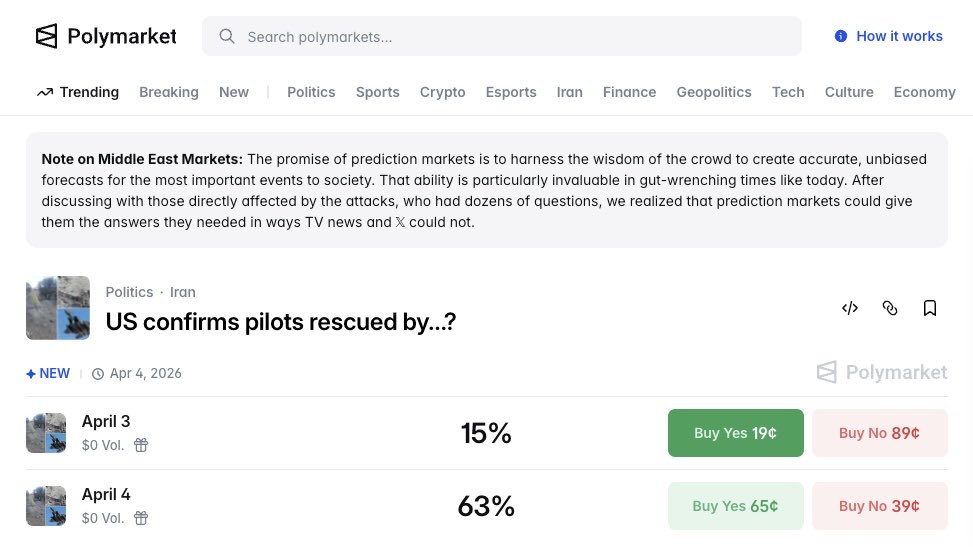
Source: Polymarket

He also criticized President Donald Trump for benefiting from the “death markets,” claiming his access to classified intelligence.

Quick reminder too that Donald Trump is an investor in this dystopian death market and may have access to intelligence that isn’t public yet.

Polymarket removes the alleged ‘death market’

Polymarket quickly archived the market, stating that it did not meet its “integrity standards.” The firm clarified that it was investigating how the market “slipped through its internal safeguards.”


Source: X/Polymarket

Well, this wasn’t the first time Polymarket or prediction markets have faced scrutiny over such markets. In fact, many traders reportedly benefited from Ali Khamenei, the former Supreme Leader of Iran, killed during U.S. and Israeli attacks.

In fact, on Polymarket, an account made over $460K in profits trading contracts related to Iran strikes and Khamenei’s ouster.
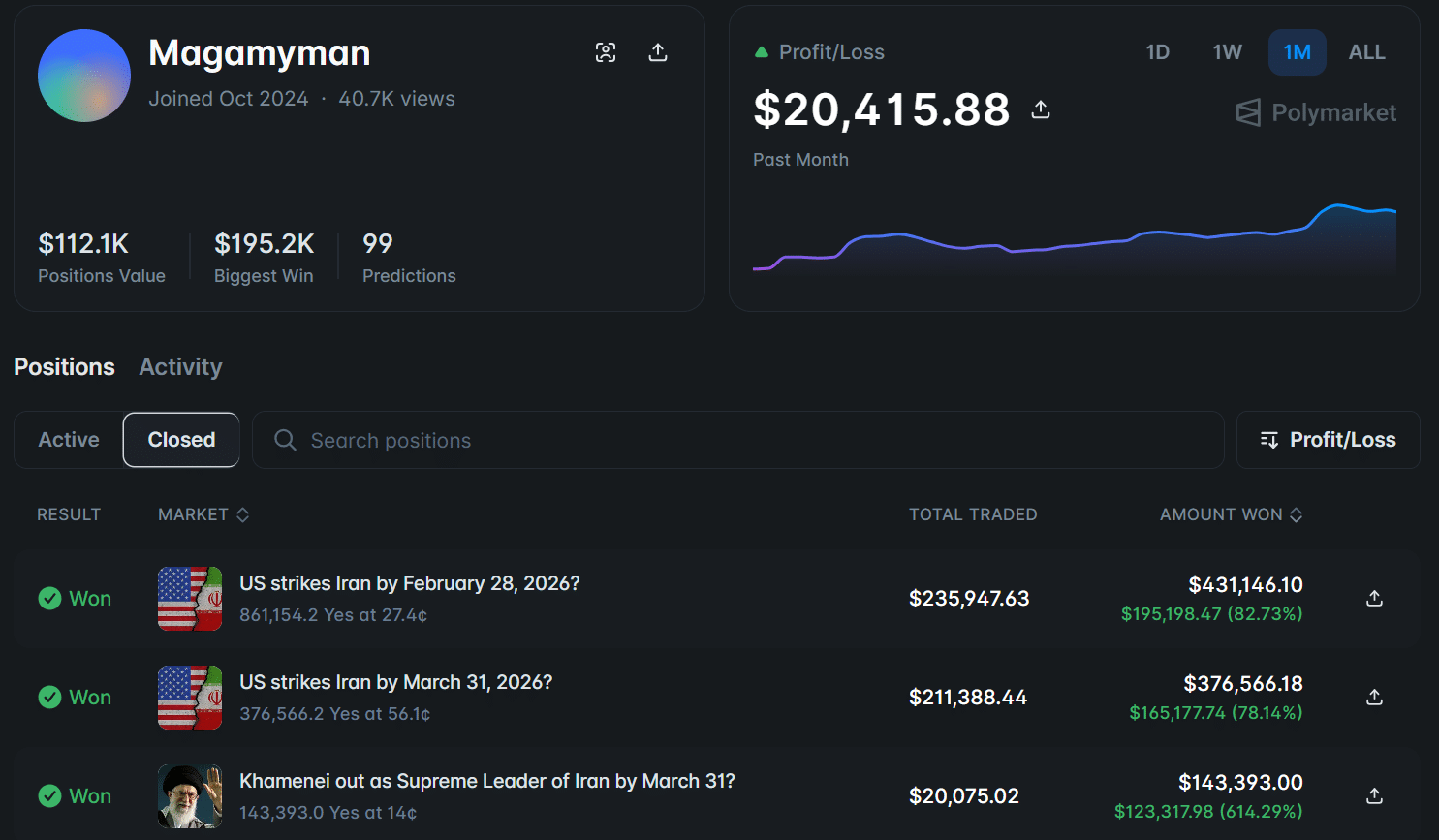
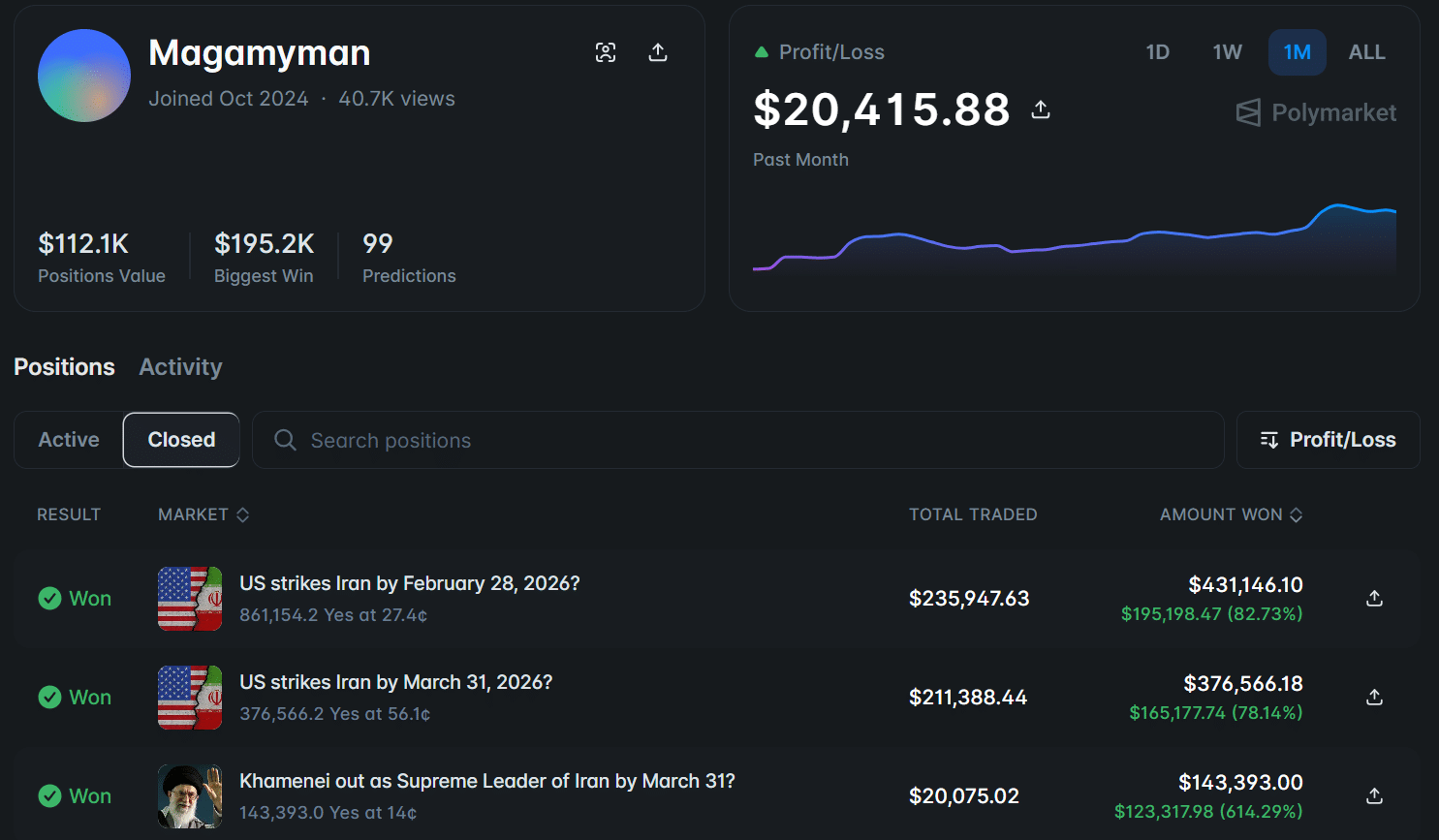
Source: Polymarket

On-chain analytics firm Bubblemaps estimated that 12 insiders made over $1.2 million from the Iran strikes and the subsequent death of its former leader. Most of the wallets were funded 24 hours before and bought the “US strikes Iran by February 28, 2026” contract hours before it happened.

Reacting to the raging ‘death markets’ and alleged insiders, Senator Chris Murphy (D-CT) slammed,

It’s insane this is legal. People around Trump are profiting off war and death. I’m introducing legislation ASAP to ban this.

Kalshi, another prediction site, also faced similar scrutiny and a class lawsuit after it failed to pay $54M to traders betting on Khamenei’s ouster.

Overall, prediction markets have become a multi-billion-dollar segment as speculation interest surges across sports, politics, and other sectors.

That said, apart from the rising ethical questions, the fight between the CFTC and states on who should oversee prediction markets could also stifle the sector’s growth in the U.S.


Final Summary

  • A U.S. lawmaker has slammed prediction site Polymarket for its ‘death markets’ targeting stranded soldiers in Iran.
  • There has been growing criticism against the prediction market amid the ongoing West Asia crisis.


Связанные с этим вопросы

QWhy did U.S. lawmaker Seth Moulton criticize Polymarket?

AHe criticized Polymarket for encouraging 'disgusting death markets' that allowed people to bet on the fate of a missing American service member whose plane was shot down over Iran.

QWhat action did Polymarket take regarding the controversial market?

APolymarket archived the market, stating it did not meet its integrity standards, and is investigating how it slipped through internal safeguards.

QHow much profit did an account make from trading contracts related to Iran strikes and Khamenei's ouster on Polymarket?

AAn account made over $460,000 in profits from trading those contracts.

QWhat did Senator Chris Murphy announce in response to the 'death markets'?

ASenator Chris Murphy announced he is introducing legislation to ban such markets, stating it is insane that it is legal for people to profit off war and death.

QWhat broader issue is mentioned that could stifle the growth of prediction markets in the U.S.?

AThe fight between the CFTC and states over who should oversee prediction markets could stifle the sector's growth in the U.S.

Похожее

Will Quantum Computing Kill Bitcoin and Mining? Is This Alarmist?

The article addresses the recurring concern that quantum computing could break Bitcoin's encryption and disrupt mining. It references a Google Quantum AI white paper from March 2026, which suggests that the resources needed for a quantum computer to crack Bitcoin’s elliptic curve digital signature algorithm (ECDSA) have been reduced by about 20 times. Under ideal conditions, such an attack could theoretically derive a private key from a public key in roughly 9 minutes using 500,000 physical qubits. However, the threat is not immediate. Current quantum processors, like Google’s Willow (105 qubits) or IBM’s Condor (~1,121 qubits), are far from the scale required. The risk primarily targets transaction signatures—especially during the brief window when a transaction is broadcast but not yet confirmed, or when public keys have been historically exposed. It is estimated there is only a 10% probability of a “quantum break” by 2032. The impact on mining is considered negligible. Research indicates that quantum mining would require astronomically high qubit counts and energy—far exceeding entire national grids—making it economically and physically infeasible. The broader solution lies in post-quantum cryptography (PQC). Standards like ML-DSA and SLH-DSA are being developed, and Bitcoin improvement proposals such as BIP 360 aim to reduce quantum vulnerability by modifying transaction structures to avoid exposing public keys. While quantum computing poses a future risk to all public-key encryption systems—not just Bitcoin—the cryptocurrency ecosystem has time to adapt. Upgrades and migration to quantum-resistant algorithms are underway, ensuring the network evolves ahead of the threat.

marsbit43 мин. назад

Will Quantum Computing Kill Bitcoin and Mining? Is This Alarmist?

marsbit43 мин. назад

5 Minutes to Make AI Your Second Brain

This article introduces a powerful personal knowledge management system combining Claude Code and Obsidian, designed to function as an "AI second brain." Unlike traditional RAG systems that perform temporary, one-off retrievals, this system enables AI to continuously build and maintain an evolving knowledge wiki. The architecture consists of three layers: a raw data layer (notes, articles, transcripts), an AI-maintained structured knowledge base that builds cross-references, and a schema layer that governs organization and system logic. Core operations are Ingest (bringing in external information), Query (instant knowledge access), and Lint (checking consistency and fixing issues). The system's power lies in creating a "compound interest" effect for knowledge: it reduces cognitive load by offloading the tasks of connecting, organizing, and understanding information to AI, while simultaneously improving the accuracy and contextual consistency of the AI's outputs. The setup process is quick, requiring users to download Obsidian, create a vault (knowledge repository), configure Claude Code to access that vault, and apply a specific system prompt. Advanced tips include using a browser extension to easily add web content, maintaining separate vaults for work and personal life, and utilizing the "Orphans" feature to identify unlinked ideas. The main drawbacks are the need for visual thinking, a commitment to ongoing maintenance, and local storage usage. Ultimately, the system transforms scattered information into a reusable, interconnected network of knowledge.

marsbit2 ч. назад

5 Minutes to Make AI Your Second Brain

marsbit2 ч. назад

Торговля

Спот
Фьючерсы
活动图片