Treasury’s GENIUS Act Report Backs Mixers, But Wants a New ‘Hold Law’ For Crypto

bitcoinistОпубликовано 2026-03-09Обновлено 2026-03-09

Введение

The U.S. Treasury's GENIUS Act report acknowledges the legitimate privacy benefits of cryptocurrency mixers for lawful users, such as protecting personal or business transactions. However, it highlights the misuse of these tools by illicit actors like North Korean cyber units and ransomware groups to launder funds. To address this, the report proposes a new "digital-asset-specific hold law" that would allow regulated platforms to temporarily freeze suspicious transactions, giving law enforcement time to act without disrupting legitimate privacy-focused usage. The report is part of a broader effort to balance financial innovation and security under the GENIUS Act framework.

Treasury sent Congress its GENIUS‐Act‐mandated report on “innovative tools” to fight crypto‐enabled illicit finance.

A Crypto’s “Hold Law” And A Privacy Paradox

In a 32-page report submitted to the US Congress this March, the U.S. Treasury Department has endorsed lawful uses of crypto mixers (a service that takes in cryptocurrency from many different users, mixes all those coins together, and then sends each user back an equivalent amount from the pool, but from different addresses than the ones they used to deposit) in favor of privacy.

However, it has also urged lawmakers to create a new “digital‐asset‐specific hold law” so platforms can freeze suspicious funds.

Mixers, Privacy And DPRK

The report notes favorably that mixing and similar tools “can be used by lawful users seeking to enhance financial privacy on public blockchains,” including for “protecting sensitive information about personal wealth, business transactions, or charitable donations from public view. It adds that Treasury “recognizes that privacy‐enhancing technologies, including mixers and other obfuscation tools, may serve legitimate purposes when used by compliant actors in line with applicable AML/CFT requirements.”

On the other side, the same report also stresses that North Korea’s cyber units and major ransomware crews rely on mixers, cross‐chain bridges, and rapid swaps as core infrastructure to launder massive hauls from hacks and fraud. The report cites billions of dollars in stolen digital assets tied to DPRK actors and details how those funds are pushed through mixers and into stablecoins before being bridged and cashed out, using the same tools that ordinary users might pick for privacy.

What The “Hold Law” Would Do

Therefore, to tackle this paradox, the report proposes a “hold law” that would ensure that legitimate, clean, users keep their privacy while unlawful or suspicious activity can be addressed. Under the proposal, crypto exchanges and other regulated platforms would gain a clear and legal “pause button” for suspicious funds. The report recommends that “Congress establish a digital‐asset‐specific statutory ‘hold’ authority” that would allow platforms “to temporarily retain or delay the movement of digital assets associated with suspected illicit activity while appropriate legal process is pursued.” Firms could temporarily hold or delay those assets when strong red flags appear, with statutory cover for doing so.

The idea would be to give law enforcement time to act against ransomware crews, large fraud schemes, or state‐sponsored hackers, while limiting the tool to narrowly defined, high‐risk cases so routine customer flows are not frozen by default.

TradFi and Legacy media have often linked mixers to money laundering, with Tornado Cash as the obvious cautionary tale. Ethereum co‐founder Vitalik Buterin has repeatedly argued that mixers are neutral tools, even saying he used Tornado Cash to make a private donation to Ukraine, and is now backing ‘compliant’ designs like Privacy Pools that aim to protect on‐chain privacy without commingling with known dirty funds.

Another Piece On The GENIUS Act Puzzle

The report is part of the broader GENIUS Act framework, the law Trump signed to create a federal regime for payment stablecoins and push “innovative” tools against illicit finance. It fulfills a mandate for Treasury to spell out how AI, digital identity, and blockchain analytics should be used under a risk‐based AML approach.

The report also proposes a preferred tech stack (AI, digital ID, blockchain analytics, APIs) that regulated platforms should deploy under a risk‐based AML approach.
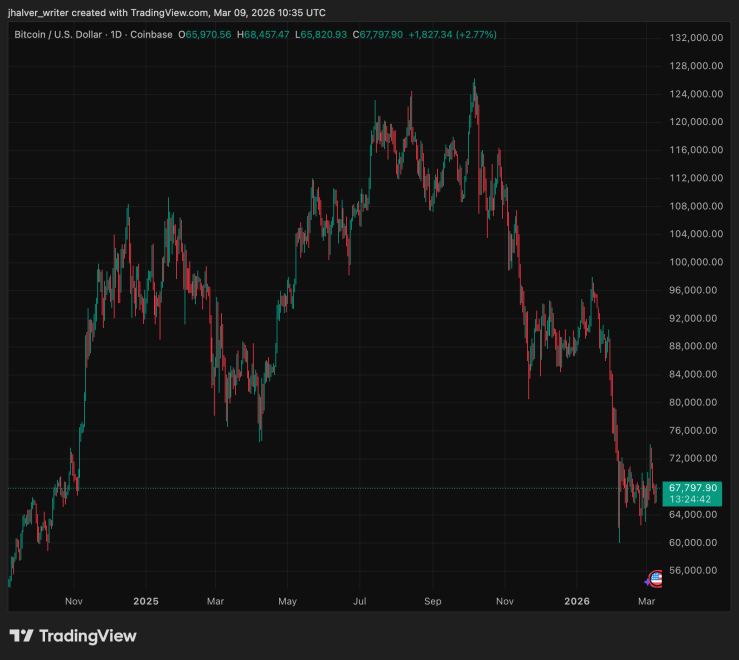
BTC's price trends to the downside on the daily chart. Source: BTCUSD on Tradingview

Cover image from ChatGPT, BTCUSD chart from Tradingview

Связанные с этим вопросы

QWhat is the main purpose of the GENIUS Act report submitted by the U.S. Treasury Department?

AThe GENIUS Act report outlines 'innovative tools' to fight crypto-enabled illicit finance, endorsing lawful uses of crypto mixers for privacy while proposing a new 'hold law' to freeze suspicious funds.

QHow does the report view the use of crypto mixers by lawful users?

AThe report recognizes that mixers and other privacy-enhancing technologies can serve legitimate purposes for lawful users seeking financial privacy, such as protecting sensitive information about personal wealth or business transactions, when used in compliance with AML/CFT requirements.

QWhat specific legislative measure does the Treasury Department recommend to address suspicious crypto transactions?

AThe Treasury Department recommends that Congress establish a digital-asset-specific statutory 'hold' authority, allowing platforms to temporarily retain or delay the movement of digital assets associated with suspected illicit activity while legal process is pursued.

QAccording to the report, how do malicious actors like North Korea's cyber units utilize crypto mixers?

ANorth Korea's cyber units and ransomware crews use mixers, cross-chain bridges, and rapid swaps as core infrastructure to launder massive amounts of stolen digital assets, often pushing funds through mixers into stablecoins before cashing out.

QWhat broader framework is this report a part of, and what additional tools does it propose for regulated platforms?

AThe report is part of the GENIUS Act framework, which aims to create a federal regime for payment stablecoins and combat illicit finance. It proposes a tech stack including AI, digital identity, blockchain analytics, and APIs for regulated platforms under a risk-based AML approach.

Похожее

Dialogue with Bitwise CIO: Quantum Computing and AI Threats Overhyped, Bullish on the 'Big Four' of Crypto

Matt Hougan, CIO of Bitwise, which manages $15 billion in crypto assets, shares his market outlook in a recent podcast. He believes the market peak will occur around December 2024, not when Bitcoin hits $125k, and expects a slower, more grinding recovery from the bear market. The next bull run will likely be less volatile and more gradual. Hougan attributes Bitcoin’s recent sharp decline to long-term holders selling in anticipation of the four-year cycle, not derivatives. While derivatives can amplify short-term volatility, he argues they eventually translate into physical demand. He also notes that Bitcoin’s underperformance compared to gold is due to central banks buying gold aggressively post-2022, not a failure of Bitcoin’s value proposition. He remains long-term bullish, citing Bitcoin’s greater upside potential. According to Hougan, retail investors are largely tapped out, and the current market is driven by slower, steadier institutional inflows via ETFs. This may lead to a more stable but less dramatic bull market. He sees stablecoins and tokenization as major growth drivers, bringing billions into the crypto ecosystem. He dismisses quantum computing as an overblown risk, noting Bitcoin can adapt, and views AI as ultimately beneficial—whether it boosts productivity or triggers inflationary monetary responses. Hougan is optimistic about Ethereum, Solana, and Chainlink, dubbing BTC, ETH, SOL, and LINK the “big four” of crypto. He advises young investors to avoid meme coins, diversify into crypto index products, and focus on long-term horizons rather than short-term noise.

marsbit7 мин. назад

Dialogue with Bitwise CIO: Quantum Computing and AI Threats Overhyped, Bullish on the 'Big Four' of Crypto

marsbit7 мин. назад

Exclusive Interview with FinAI: Pioneering Order in the Era of Agent Economy

Interview with FinAI: Pioneering Order in the Age of Agent Economy AI is rapidly evolving from "tool-based intelligence" to "autonomous intelligence." While tools like ChatGPT amazed us just two years ago, agents like OpenClaw can now independently perform complex real-world tasks. As AI transitions from a "human assistant" to an "autonomous participant" in economic activities, a new challenge arises: how to establish economic rules among AI agents. FinAI, a startup founded by veterans from top tech firms, is addressing this by building financial infrastructure for AI agents based on Web3 technologies like x402 and ERC-8004. Their solution focuses on three core pillars: - **Payment Capability**: Enabling microsecond-level payments between agents via the x402 protocol to complete economic transactions autonomously. - **Identity System**: Introducing KYA (Know Your Agent), a verifiable identity framework similar to KYC, to ensure compliance and security. - **Credit System**: Establishing a trust-based reputation system using historical data like transaction quality and refund records. FinAI aims to offer these capabilities via APIs/Skills for both Web2 agent developers (via subscriptions) and Web3 users (through链上 integrations). The platform prioritizes Agent-friendly design, optimizing interfaces for seamless integration. With its first autonomous payment already processed in 2026, FinAI expects profitability within the year. By leveraging blockchain’s efficiency (e.g., near-instant settlements at 1/300 the cost of traditional systems) and addressing合规 concerns through KYA and quantum加密 wallets, FinAI positions itself as a first-mover in shaping the future of agent-to-agent economies.

marsbit12 мин. назад

Exclusive Interview with FinAI: Pioneering Order in the Era of Agent Economy

marsbit12 мин. назад

Exclusive Interview with FinAI: Pioneering Order in the Era of Agent Economy

Interview with FinAI: Pioneering Order in the Agent Economy Era AI is rapidly evolving from "tool-based intelligence" to "autonomous intelligence." While tools like ChatGPT impressed with dialogue just two years ago, agents like "Lobster" OpenClaw can now independently execute complex real-world tasks. This shift means AI's role in the economy is transitioning from a "human assistant" to an "autonomous participant." We will soon commonly see assistant agents handling chores, research agents finding financial opportunities, and commercial agents comparing global supplier quotes and placing orders—often transacting with other agents. A critical question emerges: How is economic order established among AI agents? FinAI, an AI startup with a team from major tech firms, argues that for an autonomous AI economy to function, agents need core infrastructural capabilities: payment ability, an identity system, and a credit system. Currently, most agents lack independent payment functionality; they can perform tasks but not finalize transactions. FinAI is building financial infrastructure for AI agents using Web3 technology stacks like x402 and ERC-8004. Their solution is threefold: 1. **Payment:** Utilizing the x402 protocol to enable microsecond-level payments between agents, creating a complete economic闭环 (closed loop). 2. **Identity:** Introducing a KYA (Know Your Agent) concept, akin to KYC, using ERC-8004 to provide agents with verifiable, compliant identities. 3. **Credit:** Establishing a reputation system based on agents' transaction history and task performance to serve as a trust foundation for future AI经济活动 (economic activities). These capabilities will be packaged into APIs/Skills for agents to调用 (call). FinAI's primary customers are Web2 agent application developers, who will pay via API subscriptions, and Web3 users, for whom agent skills will be integrated into various on-chain financial scenarios. The company plans to take a very low, friendly transaction fee on agent-to-agent tasks but does not intend to profit heavily from end-users, aiming instead to incubate a mature agent marketplace. FinAI chose Web3 infrastructure out of practical necessity. Traditional payment systems are too slow and expensive for the micro-payment demands of agent economies. Stablecoin-based settlements on-chain can complete transactions in seconds at a fraction of the cost (approximately 1/300th of traditional systems). While traditional clients have compliance and security concerns, FinAI addresses these with its full-stack capabilities, including identity gateways, payment systems, quantum-encrypted wallets, and its KYA framework. Founded in August 2025, FinAI has progressed rapidly, completing its first autonomous payment order in 2026 and expecting to be profitable within the year. Rechard, the founder, believes the key competitive advantage in this nascent field is being the first to establish a complete, operational system. Furthermore, FinAI is designing its services to be "Agent-friendly"—optimizing its APIs and interfaces for agents, the primary decision-makers who will automatically seek the most cost-effective and easiest-to-integrate services. Just as e-commerce spurred third-party payment and mobile internet spurred digital wallets, the rise of AI agents may催生 (give rise to) a new economic system. FinAI aims to be the pioneer building the foundational order for this new Agent-to-Agent economy.

Odaily星球日报25 мин. назад

Exclusive Interview with FinAI: Pioneering Order in the Era of Agent Economy

Odaily星球日报25 мин. назад

Торговля

Спот
Фьючерсы
活动图片