Crypto’s Capitol Hill Crisis: How The ‘Shadow Deposit’ War Held The CLARITY Act Hostage

bitcoinistОпубликовано 2026-02-21Обновлено 2026-02-21

Введение

The crypto market is facing persistent selling pressure and fragile sentiment, struggling to regain momentum amid tightening liquidity and macro uncertainty. A key regulatory development is the potential passage of the CLARITY Act by end of April, which aims to define roles for the SEC and CFTC, and establish clearer rules for exchanges, custody, and AML/KYC. However, progress has stalled due to debates around yield-bearing stablecoins. Crypto firms distinguish between issuer-paid interest and platform rewards, while traditional banks push for tighter restrictions to prevent deposit outflows. Legislative complexity is increasing with multiple bills needing reconciliation, complicating the timeline. Even if passed, regulatory clarity will emerge gradually, meaning uncertainty will persist in the near term.

The crypto market is entering a critical phase as persistent selling pressure and rising fear continue to dominate sentiment across digital assets. Price action has remained fragile in recent weeks, with both major cryptocurrencies and altcoins struggling to regain sustained momentum. Investors are increasingly cautious as liquidity tightens, volatility persists, and macro uncertainty weighs on risk appetite. While corrective phases are not unusual after strong rallies, the current environment suggests the market is still searching for stability rather than transitioning into a clear recovery.

A recent CryptoQuant report highlights a significant regulatory development that could influence longer-term market structure. Ripple CEO Brad Garlinghouse recently indicated there is roughly a 90% probability that the CLARITY Act will pass by the end of April. The Digital Asset Market Clarity Act aims to define the regulatory boundary between the SEC and CFTC, establish clearer registration frameworks for exchanges and brokers, formalize custody and asset segregation rules, and codify AML and KYC requirements.

Progress has slowed primarily due to debate around stablecoin yield products. While some proposals restrict issuers from paying interest, banks argue that exchange-based rewards may function as indirect yield instruments. Meanwhile, on-chain data shows yield-bearing stablecoin supply expanding rapidly since late 2024, highlighting growing structural demand.

Regulatory developments are increasingly shaping sentiment across the crypto market, and recent analysis suggests that the rapid growth of yield-bearing stablecoins has intensified political and financial tensions. Crypto firms are attempting to draw a distinction between interest paid directly by issuers and rewards distributed through exchanges or platforms, arguing that these mechanisms serve different economic functions.
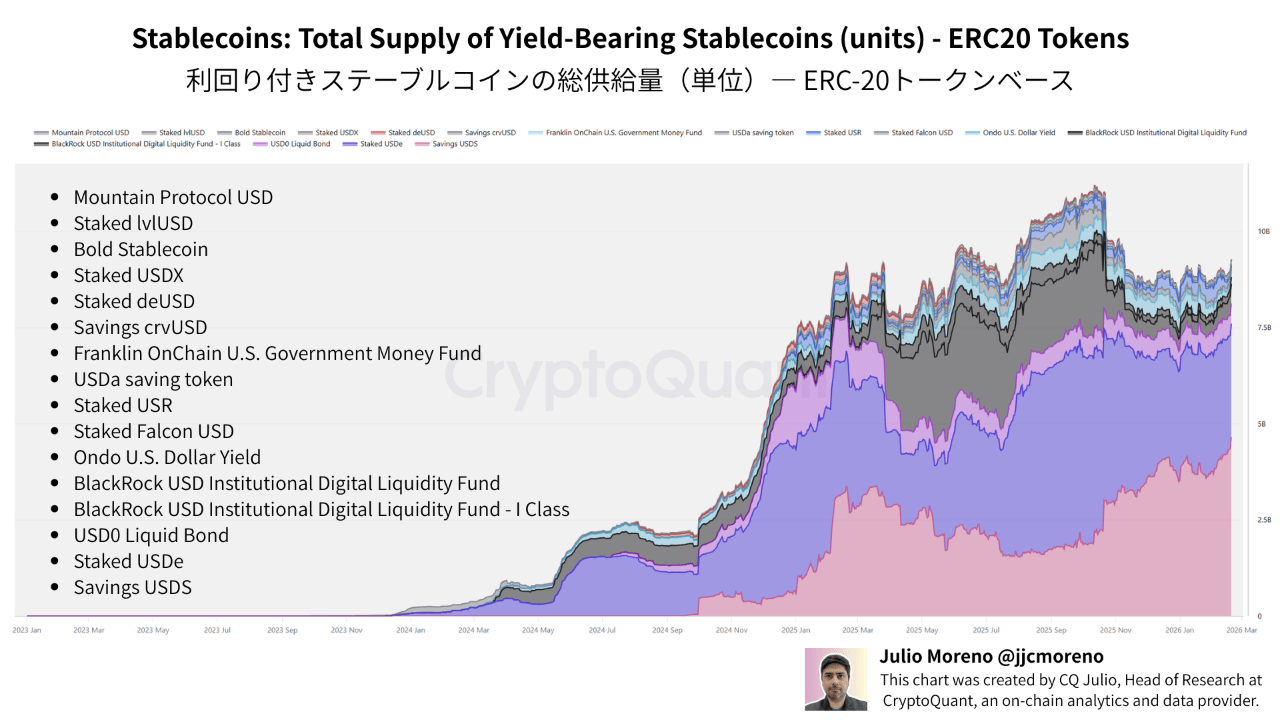
Total Supply of Yield-Bearing Stablecoins | Source: CryptoQuant

Traditional banks, however, are advocating for tighter restrictions, concerned that such products could accelerate deposit outflows from the conventional financial system. Until compromise language is formally codified in legislation, momentum within the Senate remains uncertain.

At the same time, legislative complexity continues to increase. The Senate Agriculture Committee has already advanced a separate text focused primarily on Commodity Futures Trading Commission oversight. This creates a scenario in which multiple legislative packages will eventually need to be reconciled. Bipartisan vote requirements, questions around federal versus state regulatory authority, and unresolved provisions related to decentralized finance further complicate the timeline. These factors suggest that even broadly supported frameworks may face procedural delays.

If enacted, the Digital Asset Market Clarity Act could reduce regulatory risk premiums in the short term while gradually reshaping market structure over the longer horizon. However, clarity is unlikely to emerge instantly. Historically, regulatory transitions unfold sequentially — first through political signaling, then formal rulemaking, and ultimately enforcement. Until that process matures, regulatory uncertainty will remain embedded in the market environment.


Связанные с этим вопросы

QWhat is the main reason for the slowdown in progress of the CLARITY Act according to the article?

AThe progress has slowed primarily due to debate around stablecoin yield products, with disagreements over whether issuers should be restricted from paying interest and concerns about exchange-based rewards functioning as indirect yield instruments.

QWhat did Ripple CEO Brad Garlinghouse indicate about the probability of the CLARITY Act passing?

ABrad Garlinghouse indicated there is roughly a 90% probability that the CLARITY Act will pass by the end of April.

QHow are traditional banks responding to yield-bearing stablecoin products?

ATraditional banks are advocating for tighter restrictions on yield-bearing stablecoin products, concerned that they could accelerate deposit outflows from the conventional financial system.

QWhat does the chart in the article show about yield-bearing stablecoins?

AThe chart shows the total supply of yield-bearing stablecoins expanding rapidly since late 2024, highlighting growing structural demand for these products.

QWhat are the three sequential phases through which regulatory transitions historically unfold according to the article?

ARegulatory transitions historically unfold sequentially through political signaling, then formal rulemaking, and ultimately enforcement.

Похожее

Will Quantum Computing Kill Bitcoin and Mining? Is This Alarmist?

The article addresses the recurring concern that quantum computing could break Bitcoin's encryption and disrupt mining. It references a Google Quantum AI white paper from March 2026, which suggests that the resources needed for a quantum computer to crack Bitcoin’s elliptic curve digital signature algorithm (ECDSA) have been reduced by about 20 times. Under ideal conditions, such an attack could theoretically derive a private key from a public key in roughly 9 minutes using 500,000 physical qubits. However, the threat is not immediate. Current quantum processors, like Google’s Willow (105 qubits) or IBM’s Condor (~1,121 qubits), are far from the scale required. The risk primarily targets transaction signatures—especially during the brief window when a transaction is broadcast but not yet confirmed, or when public keys have been historically exposed. It is estimated there is only a 10% probability of a “quantum break” by 2032. The impact on mining is considered negligible. Research indicates that quantum mining would require astronomically high qubit counts and energy—far exceeding entire national grids—making it economically and physically infeasible. The broader solution lies in post-quantum cryptography (PQC). Standards like ML-DSA and SLH-DSA are being developed, and Bitcoin improvement proposals such as BIP 360 aim to reduce quantum vulnerability by modifying transaction structures to avoid exposing public keys. While quantum computing poses a future risk to all public-key encryption systems—not just Bitcoin—the cryptocurrency ecosystem has time to adapt. Upgrades and migration to quantum-resistant algorithms are underway, ensuring the network evolves ahead of the threat.

marsbit6 ч. назад

Will Quantum Computing Kill Bitcoin and Mining? Is This Alarmist?

marsbit6 ч. назад

Торговля

Спот
Фьючерсы

Популярные статьи

Как купить S

Добро пожаловать на HTX.com! Мы сделали приобретение Sonic (S) простым и удобным. Следуйте нашему пошаговому руководству и отправляйтесь в свое крипто-путешествие.Шаг 1: Создайте аккаунт на HTXИспользуйте свой адрес электронной почты или номер телефона, чтобы зарегистрироваться и бесплатно создать аккаунт на HTX. Пройдите удобную регистрацию и откройте для себя весь функционал.Создать аккаунтШаг 2: Перейдите в Купить криптовалюту и выберите свой способ оплатыКредитная/Дебетовая Карта: Используйте свою карту Visa или Mastercard для мгновенной покупки Sonic (S).Баланс: Используйте средства с баланса вашего аккаунта HTX для простой торговли.Третьи Лица: Мы добавили популярные способы оплаты, такие как Google Pay и Apple Pay, для повышения удобства.P2P: Торгуйте напрямую с другими пользователями на HTX.Внебиржевая Торговля (OTC): Мы предлагаем индивидуальные услуги и конкурентоспособные обменные курсы для трейдеров.Шаг 3: Хранение Sonic (S)После приобретения вами Sonic (S) храните их в своем аккаунте на HTX. В качестве альтернативы вы можете отправить их куда-либо с помощью перевода в блокчейне или использовать для торговли с другими криптовалютами.Шаг 4: Торговля Sonic (S)С легкостью торгуйте Sonic (S) на спотовом рынке HTX. Просто зайдите в свой аккаунт, выберите торговую пару, совершайте сделки и следите за ними в режиме реального времени. Мы предлагаем удобный интерфейс как для начинающих, так и для опытных трейдеров.

1.0k просмотров всегоОпубликовано 2025.01.15Обновлено 2025.03.21

Как купить S

Sonic: Обновления под руководством Андре Кронье – новая звезда Layer-1 на фоне спада рынка

Он решает проблемы масштабируемости, совместимости между блокчейнами и стимулов для разработчиков с помощью технологических инноваций.

2.1k просмотров всегоОпубликовано 2025.04.09Обновлено 2025.04.09

Sonic: Обновления под руководством Андре Кронье – новая звезда Layer-1 на фоне спада рынка

HTX Learn: Пройдите обучение по "Sonic" и разделите 1000 USDT

HTX Learn — ваш проводник в мир перспективных проектов, и мы запускаем специальное мероприятие "Учитесь и Зарабатывайте", посвящённое этим проектам. Наше новое направление .

1.7k просмотров всегоОпубликовано 2025.04.10Обновлено 2025.04.10

HTX Learn: Пройдите обучение по "Sonic" и разделите 1000 USDT

Обсуждения

Добро пожаловать в Сообщество HTX. Здесь вы сможете быть в курсе последних новостей о развитии платформы и получить доступ к профессиональной аналитической информации о рынке. Мнения пользователей о цене на S (S) представлены ниже.

活动图片