Ethereum’s first ZK-rollup, ZKsync Lite, to be retired in 2026

cointelegraphОпубликовано 2025-12-08Обновлено 2025-12-08

Введение

ZKsync Lite, the first zero-knowledge rollup on Ethereum, will be retired in 2026 as part of a planned phase-out. Launched in 2020 by Matter Labs, it served as a proof-of-concept for fast transfers and NFT minting but did not support smart contracts. The team confirmed that user funds remain safe and withdrawals will continue uninterrupted. Development shifted to ZKsync Era, a zkEVM with smart contract support, in early 2023. ZKsync Lite currently holds nearly $50 million in assets but has seen minimal recent activity. The deprecation does not affect other ZKsync products, and migration details will be shared soon.

ZKsync Lite, the first-ever zero-knowledge (ZK) rollup network to launch on Ethereum, will be deprecated next year, its team says, as it has fulfilled its purpose.

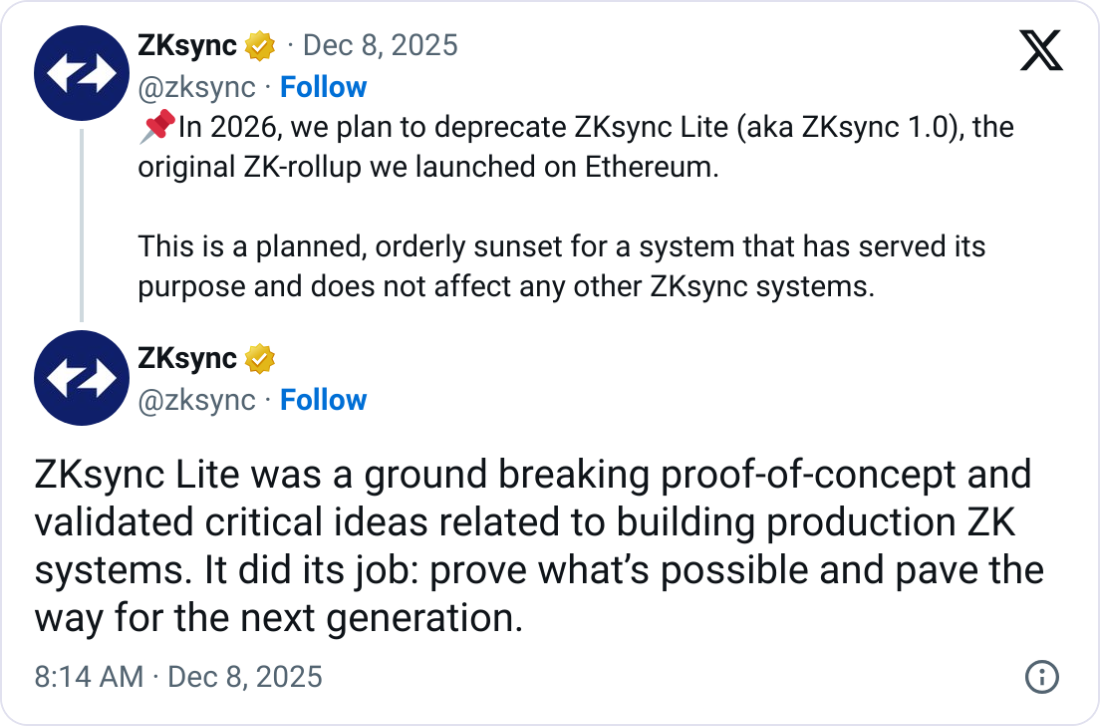
“In 2026, we plan to deprecate ZKsync Lite (aka ZKsync 1.0), the original ZK-rollup we launched on Ethereum,” ZKsync wrote to X on Sunday. “This is a planned, orderly sunset for a system that has served its purpose and does not affect any other ZKsync systems.”

It added that ZKsync Lite “was a groundbreaking proof-of-concept and validated critical ideas related to building production ZK systems.”

“It did its job: prove what’s possible and pave the way for the next generation.”

Technology company Matter Labs launched ZKsync Lite in 2020, designed for fast transfers and minting non-fungible tokens (NFTs). However, it didn’t support smart contracts, which limited its use.
Source: ZKsync

The network was the first to use validity proofs that instantly proved if a transaction was valid, before transactions were bundled up and sent to the Ethereum mainnet for final validation.

Matter Labs stopped development on ZKsync Lite in early 2023 after launching its zero-knowledge Ethereum Virtual Machine (zkEVM) that supported smart contracts, ZKsync Era.

ZKsync said that no immediate action was required from ZKsync Lite users, and the network is operating as usual. “Funds remain safe, and withdrawals to L1 will keep working through the process,” it added.

Its other products are similarly unaffected, and the team said it would share “concrete details, dates, and migration guidance soon” for ZKsync Lite.

Related: Privacy tools are rising behind institutional adoption, says ZKsync dev

Just under $50 million is currently bridged to the network, according to DefiLlama, but L2BEAT data shows it has only seen just over 330 user operations in the past day.

By comparison, ZKsync Era has a total value locked of $36.4 million and has seen over 22,000 user operations over the past day.

It comes as the blockchain could be undergoing more changes. Last month, ZKsync co-creator Alex Gluchowski proposed overhauling its ZKsync (ZK) governance token to prioritize “economic utility,” tying the token to the network’s fees.

Magazine: What are native rollups? Full guide to Ethereum’s latest innovation

Похожее

Stablecoins at a Crossroads: Clear Regulations Drive Adoption, Systemic Risks Remain

Stablecoins are at a critical juncture, with regulatory clarity driving their rapid evolution from crypto trading tools to mainstream payment and settlement infrastructure. The U.S. GENIUS Act and the EU’s MiCA framework have established federal and regional standards for issuance, reserves, and auditing, accelerating their adoption. Market capitalization has surpassed $300 billion, with USD-pegged stablecoins dominating, though euro and other fiat-backed alternatives are growing. Use cases are expanding significantly, with enterprises adopting stablecoins for cross-border payments, payroll, and treasury management due to their 24/7 availability and low transaction costs. They are increasingly integrated into traditional finance as settlement and custody solutions. However, systemic risks remain. USD-pegged stablecoins face potential de-pegging risks, insufficient reserve transparency, and high centralization, which could trigger liquidity crises. Large holdings of sovereign bonds or fixed-income assets may also impact bond markets and monetary policy. The IMF has warned about financial stability risks and dollarization concerns. For stablecoins to mature into reliable, compliant, and interoperable digital infrastructure—rather than just survive—they require transparent issuance mechanisms, robust regulatory coordination, and effective systemic risk controls.

cointelegraph_中文22 мин. назад

Stablecoins at a Crossroads: Clear Regulations Drive Adoption, Systemic Risks Remain

cointelegraph_中文22 мин. назад

Торговля

Спот
Фьючерсы
活动图片