nGRND Gold Protocol Games Surpasses 855K Participants With $6M in Rewards Before Token Launch

TheNewsCryptoОпубликовано 2026-06-02Обновлено 2026-06-02

Введение

The nGRND Gold Protocol, a Web3 initiative backed by verified in-ground gold reserves, reports strong growth for its sponsored mobile games 'Gold Fest' and 'Dig It', surpassing 855,000 participants across 200+ countries. These games, designed to introduce mainstream audiences to asset-backed digital economies, have awarded approximately $6 million in ecosystem rewards ahead of the protocol's Token Generation Event (TGE). The framework uses a proof-of-stake utility model, with rewards sustained by the protocol's gold treasury and revenues from alternative land use, avoiding traditional mining extraction. The preserved gold assets are subject to third-party audits for transparency. Following the successful first season, Season 2 for both games is underway, with the project planning to expand into eight participation streams like Governance, Impact, and Play, further integrating ESG and UN Sustainable Development Goals (SDGs).

nGRND.io, known as the nGRND Gold Protocol, a Web3 and blockchain initiative backed by a treasury of verified in-ground preserved gold and revenue generated from monetisation of preserved gold sites, has reported growing participation across its sponsored mobile gaming titles, Gold Fest and Dig It.

According to the protocol, the two games have collectively attracted more than 855,000 players across over 200 countries. The platform attributes this growth to its proof-of-stake utility rewards framework, which is designed to encourage continued user participation through digital incentives.

The milestone comes ahead of nGRND’s planned Token Generation Event (TGE) and is being positioned by the project as an indicator of early user engagement and platform traction prior to token issuance.

The participant base was driven by distinct titles designed to introduce mainstream audiences to asset-backed digital economies. Gold Fest, developed by GAMEE, a subsidiary of Animoca Brands and recently acquired by Alpha Compute Corporation, attracted 549,000 participants. Dig It, operated by gaming studio Funny Till U Die Ltd., drew 306,000 players via its Telegram-based interface. Across both platforms, Daily Active Users (DAUs) averaged over 220,000, indicating strong retention beyond initial sign-up spikes.

Participants in the inaugural season accrued approximately $6 million in ecosystem rewards that are designed to convert into nGRND Gold Protocol tokens, with redemption schedules governed by the protocol’s proof-of-stake utility framework. Unlike speculative play-to-earn (P2E) models, nGRND.io structures its rewards around its treasury of preserved gold, distributions from monetisation of alternative land use and other sustainability revenues.

Reward recipients will be eligible to receive one of three unique NFTs, which will unlock soul-bound NFTs featuring unique attributes, rewards and bonuses tied to their participation in the nGRND Gold Protocol proof-of-stake framework. Participants in nGRND.io sponsored games, Discord quests, and future ecosystem initiatives may also receive unique collectible NFTs, badges and boosts granting additional rewards within the protocol.

Gold-Backed Framework and Audit Structure

The nGRND framework sets itself apart by anchoring its ecosystem with verified, in-ground preserved gold resources in its treasury that is used to sustain the staking rewards for Token holders. To ensure transparency and address common industry concerns regarding asset validation, the protocol’s preserved gold treasury is subject to nGRND Inc.’s rigorous third-party auditing in accordance with National Instruments’s such as NI 43-101 and other industry and government approved reporting and verification processes.

“nGRND.io is introducing a new framework for a gold-based utility with participation sustained by real monetised value without extraction or environmental decimation” said Professor Lisa Wilson, CEO and Co-Founder. “As an innovative gold protocol built for Web3 and to distribute value using the blockchain layer, nGRND provides active staking rewards sustained by distributions from the realised appreciation of gold in our treasury, plus ESG and SDG measured alternative land-use monetisation of preserved sites and other sustainability-driven initiatives that strengthen the long term utility of the nGRND Gold Protocol. The Protocol connects real world business and sustainability with Web3.”

Following the success of the first season, Dig It has already launched Season 2 with upgraded gameplay mechanics designed to deepen engagement. Gold Fest is scheduled to begin its second season in early Q3 2026. Both programs are expected to conclude their initial phases by Sept. 30, 2026, at which point reward claims will begin to be processed. The project is currently supported by the TON Foundation, with further expansion planned across additional blockchain networks, including Base.

Looking beyond gaming, nGRND.io is preparing to expand its proof-of-stake network into eight operational participation streams, including Governance, Impact, Play, Learn, Advocate, Refer, Wellbeing, and a dedicated channel for AI Agents. These mechanisms will enable participants in the staking programme to increase reward multipliers and receive distributions from the rewards pool that is sustained by revenues generated from initiatives that have measured impact against ESG and the United Nations 17 Sustainable Development Goals (SDGs) targets, plus other initiatives on the preserved gold sites.

By connecting Protocol gold treasury holdings, preserved gold sites, and network partners with a scalable utility-driven framework, nGRN.io delivers modernised digital participation in the gold sector. The protocol leverages blockchain infrastructure to provide provenance and to create accessible, transparent opportunities for participation and distribute real value without requiring traditional mining extraction.

About nGRND Gold Protocol

The nGRND Gold Protocol is a blockchain-enabled digital participation and rewards network that distributes value on a blockchain sustained by verified preserved in-ground gold resources and alternative land use monetisation aligned to measured ESG and SDG impact. The protocol connects our gold treasury holding preserved gold, preserved gold sites, ecosystem partners, and participants through a scalable utility-driven framework that supports engagement, sustainability initiatives, digital participation streams, staking opportunities, and ecosystem-based rewards.

Built to modernise participation in the gold sector, the nGRND Gold Protocol leverages transparency, ESG and SDG measured targets and principles, and blockchain infrastructure to create new forms of interaction around preserved gold without requiring traditional mining extraction. The protocol is designed to support long-term ecosystem growth through strategic partnerships, gamification initiatives, digital commerce integrations, and community participation models.

The nGRND Gold Protocol aims to bridge the legacy gold industry with the emerging digital economy by creating accessible, transparent, and participation-driven and rewarded opportunities supported by preserved gold and network engagement.

For more information, please visit https://ngrnd.io

TagsCrypto MarketGameGoldWeb3

Связанные с этим вопросы

QWhat is the nGRND Gold Protocol and what is its unique backing?

AThe nGRND Gold Protocol is a Web3 and blockchain initiative. Its unique feature is that it is backed by a treasury of verified, in-ground preserved gold and revenue generated from the monetization of those preserved gold sites, as well as other sustainability-driven initiatives.

QHow many participants have the games 'Gold Fest' and 'Dig It' collectively attracted, and what was the total value of rewards accrued?

AThe two games, 'Gold Fest' and 'Dig It', have collectively attracted more than 855,000 players. Participants in the inaugural season accrued approximately $6 million in ecosystem rewards.

QHow does nGRND's reward framework differ from traditional play-to-earn (P2E) models?

AUnlike speculative play-to-earn models, nGRND structures its rewards around its treasury of preserved gold, distributions from monetization of alternative land use, and other sustainability revenues, rather than purely speculative token mechanics.

QWhat are the eight operational participation streams that nGRND.io plans to expand its proof-of-stake network into?

AThe eight planned participation streams are Governance, Impact, Play, Learn, Advocate, Refer, Wellbeing, and a dedicated channel for AI Agents.

QHow does the nGRND Gold Protocol ensure transparency and validation of its preserved gold assets?

AThe protocol's preserved gold treasury is subject to rigorous third-party auditing by nGRND Inc., conducted in accordance with National Instruments such as NI 43-101 and other industry and government-approved reporting and verification processes.

Похожее

SaaS Battle Royale: The Survivors Who Win All Share One Common Trait

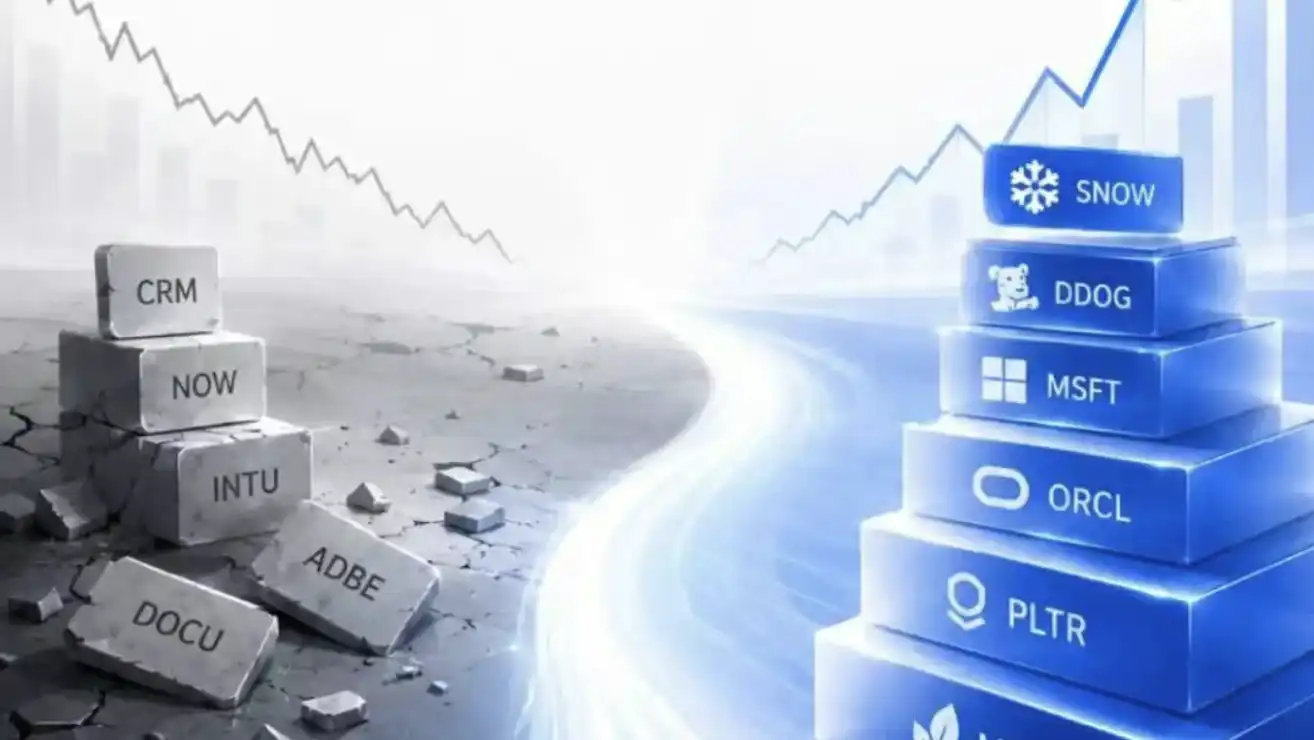
**Summary** The AI revolution has triggered a "SaaS apocalypse," forcing a brutal market shakeout. The key dividing line is the pricing model. Companies like Snowflake and Datadog, which charge based on consumption (e.g., data processed or compute used), are thriving. AI workloads actively *generate* more demand for their services, fueling growth. Datadog's accelerating revenue is a prime example. Microsoft and Palantir, as platform/ecosystem players, also benefit by acting as essential channels for AI deployment. In contrast, traditional SaaS firms built on per-seat or per-task licensing (e.g., Intuit, Adobe) face direct pressure, as AI threatens to automate the very human tasks their software supports. Companies like Salesforce, a per-seat giant, are caught in the middle. While showing strong AI monetization (e.g., its Agentforce platform) and experimenting with consumption-based "Flex Credits," its stock remains under pressure, illustrating that the market rewards *completed* transitions, not just the intent. The recent Microsoft Build conference underscored key trends: AI is evolving from an assistant to an autonomous "agent," and platform providers like Microsoft are consolidating their control. The market's recovery is highly selective, focused on identifying which companies are "fed by AI" versus "eaten by AI." Future focus will be on the diffusion of this recovery to transforming companies and the real-world adoption data of AI agents like Microsoft Copilot.

marsbit9 мин. назад

SaaS Battle Royale: The Survivors Who Win All Share One Common Trait

marsbit9 мин. назад

Trend in US Stocks: Jensen Huang's One Sentence Triggers $47 Billion Surge; Google Raises Funds for First Time in 20 Years

U.S. markets reached record highs on June 2nd, but the real story was the intensifying AI arms race, now pivoting from chip supremacy to a scramble for capital to fund compute infrastructure. The day highlighted two stark realities: Nvidia CEO Jensen Huang's endorsement of Marvell Technology as the "next trillion-dollar company" at Computex fueled a historic 32.5% surge, adding $47 billion to its value. Conversely, Alphabet announced its first equity raise in two decades—an $80 billion plan—signaling that even its massive cash flow can't keep pace with soaring AI capital expenditures, forecast to exceed $180 billion in 2026. While the S&P 500 closed above 7,600 for the first time, led by tech and semiconductor stocks (SOXX +5.79%), sector performance was mixed. Alphabet's 4% drop dragged down communications services, illustrating market anxiety over the unsustainable cost of the AI buildout. Hewlett Packard Enterprise soared 25% on stellar earnings, proving AI's benefits extend beyond chip designers to infrastructure providers. Beneath the index highs, concerns linger over extreme concentration in a few AI stocks and geopolitical tensions. The focus now shifts to upcoming economic data, particularly Friday's nonfarm payrolls, which could challenge the market's current "ignore rates, chase AI" mentality.

marsbit41 мин. назад

Trend in US Stocks: Jensen Huang's One Sentence Triggers $47 Billion Surge; Google Raises Funds for First Time in 20 Years

marsbit41 мин. назад

Can DeepSeek Save China One Trillion Dollars?

"DeepSeek and the $1 Trillion Infrastructure Question" The article examines whether DeepSeek's AI optimization breakthroughs could potentially save China $1 trillion in future AI infrastructure costs. The analysis begins with Nvidia's upcoming Vera Rubin AI platform, costing ~$7.8 million, where memory (HBM4/LPDDR5X) constitutes $2 million—a 435% cost increase in one year, highlighting how AI hardware spending is shifting toward expensive memory components. DeepSeek's approach works in the opposite direction. Through three key technical innovations showcased in DeepSeek V4, the company dramatically improves hardware efficiency: 1. **Memory Compression (MLA)**: Re-engineers the attention mechanism to compress long-context memory (KV Cache) by over 90%, drastically reducing expensive HBM usage. 2. **Selective Activation (MoE)**: Employs Mixture-of-Experts architecture where only a small fraction of parameters (e.g., 49B out of 1.6T in V4-Pro) are activated per token, allowing most parameters to reside in cheaper memory/SSD. 3. **Computation Caching**: Reuses previously computed results via cache hits, replacing expensive GPU computations with cheap memory reads. Combined, these optimizations allow the same hardware to produce approximately 4x more tokens, effectively reducing required hardware investment by 75%. DeepSeek's pricing reflects this: a 10-billion token workload costs ~$522 monthly versus ~$9,000-$10,000 for competitors. The $1 trillion savings projection stems from McKinsey's estimate that global AI infrastructure will require ~$5.2 trillion investment by 2030. As China's daily token consumption grows toward quadrillions, even marginal efficiency gains scale massively. With a conservative 4x throughput improvement, China could avoid building tens of thousands of AI data centers equivalent to ~7 trillion RMB ($1 trillion) in saved investment. Critically, this strategy shifts dependency from scarce, expensive GPU/HBM—where China lags—toward more accessible storage, caching, and systems engineering where domestic suppliers like CXMT are gaining strength. Rather than "replacing Nvidia," DeepSeek rebalances AI's value chain away from monolithic hardware dependency. Ultimately, DeepSeek's technical breakthroughs could lower the barrier to AI adoption across Chinese industries by making advanced capabilities affordable at scale—transforming who can access next-generation AI.

marsbit1 ч. назад

Can DeepSeek Save China One Trillion Dollars?

marsbit1 ч. назад

Торговля

Спот
Фьючерсы
活动图片