Russian Lawmaker Predicts Bitcoin Collapse While Smart Money Rotates into Layer 2 Utility

bitcoinistОпубликовано 2026-02-10Обновлено 2026-02-10

Введение

A Russian lawmaker, Anatoly Aksakov, predicts Bitcoin's collapse due to its lack of state backing, contrasting with strong institutional investment flows. Meanwhile, capital is rotating into Layer 2 infrastructure like Bitcoin Hyper ($HYPER), which integrates Solana Virtual Machine (SVM) to enable high-speed smart contracts on Bitcoin. The project has raised over $31.3M in its presale, attracting significant whale activity. This shift aims to address Bitcoin's scalability issues, adding utility beyond "digital gold" and supporting decentralized applications. Despite regulatory skepticism, market data indicates growing investor confidence in Bitcoin's Layer-2 evolution.

Trusted Editorial content, reviewed by leading industry experts and seasoned editors. Ad Disclosure

Quick Facts:

  • ➡️ Russian official Anatoly Aksakov predicts Bitcoin’s collapse due to lack of state backing, though market data contradicts this outlook.
  • ➡️ Bitcoin Hyper counters utility concerns by integrating the Solana Virtual Machine (SVM) to bring high-speed smart contracts to Bitcoin.
  • ➡️ Sophisticated investors have poured over $31.3M into the project’s presale, signaling a shift toward Layer 2 infrastructure.
  • ➡️ Whale wallets are actively accumulating, with recent on-chain activity showing seven-figure positioning in the protocol.

Anatoly Aksakov, Chairman of the Russian State Duma Committee on Financial Market, is at it again. He has once again targeted the world’s leading cryptocurrency, asserting that Bitcoin is ‘destined to collapse.’

As a vocal fan of the Digital Ruble, Aksakov argues that without state backing, decentralized assets simply can’t survive the long haul. It’s a bold stance, especially given Russia’s mixed signals, legalizing industrial mining for tax revenue while strictly banning crypto for buying your morning coffee.

Headline-grabbing doom predictions from central bankers are nothing new (sound familiar?), but the market isn’t flinching. Institutional flows into Bitcoin products remain strong, suggesting investors see this as protectionist noise rather than serious analysis. Yet, Aksakov accidentally hits on a real issue: utility.

If Bitcoin wants to be more than just ‘digital gold’ and survive the pressures Aksakov describes, it has to evolve beyond simple storage.

Traders aren’t fleeing; they’re building. We’re seeing a massive capital rotation into high-performance infrastructure layers. Why? Because the base layer is slow and expensive. Liquidity is aggressively hunting for speed and programmability.

That’s where Bitcoin Hyper ($HYPER) enters the picture, a project aiming to bridge Bitcoin’s ironclad security with the execution speed modern finance actually demands.

Learn more about $HYPER here.

The First SVM-Powered Bitcoin Layer 2 Redefines Scalability

The main knock against Bitcoin, that it’s too rigid for mass adoption, is being fixed.

Bitcoin Hyper ($HYPER) addresses this not by altering the base layer, but by expanding it. By integrating the Solana Virtual Machine (SVM) directly as a Bitcoin Layer 2, the network allows for sub-second finality while keeping settlement anchored to Bitcoin’s proof-of-work. In plain English: it’s fast, but it’s still Bitcoin-secure.

This opens up a massive design space for developers. Before now, building complex DeFi or gaming apps on Bitcoin was a nightmare due to Script limitations. With the SVM, Bitcoin Hyper lets devs write in Rust and deploy dApps with Solana-like speeds, thousands of transactions per second, without leaving the Bitcoin ecosystem.
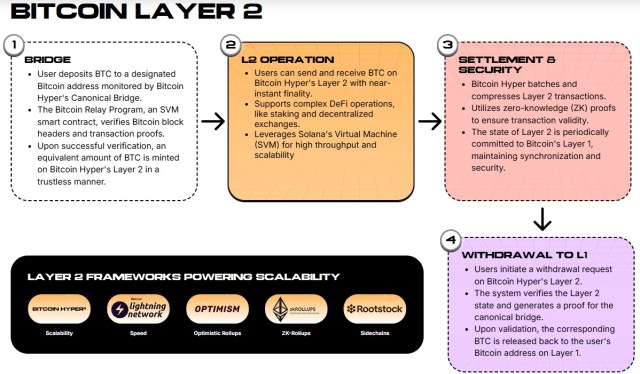
The liquidity implications are huge. A Decentralized Canonical Bridge lets holders actually use their $BTC in high-frequency trading or yield protocols instead of letting it gather dust. This utility effectively counters the ‘collapse’ narrative by turning Bitcoin from a passive rock into a programmable, active capital base.

Get your $HYPER today.

Smart Money Accumulates $31M as Whales Target Infrastructure

While regulators argue over theory, on-chain data shows where the smart money is actually going. The demand for Layer 2 infrastructure isn’t hypothetical.

According to the official presale page, Bitcoin Hyper has already raised $31.3M, signaling strong conviction from early-stage investors betting on the ‘fat protocol’ thesis applied to Bitcoin L2s.
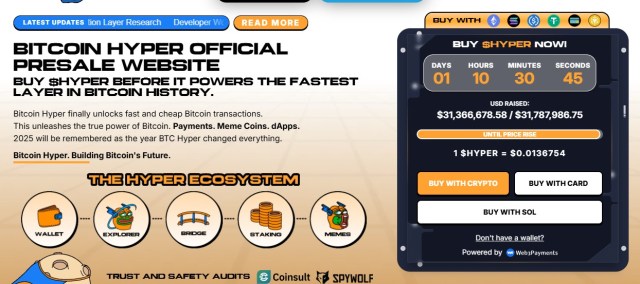
With tokens currently priced at $0.0136754, the project is attracting high-value participants hedging their Bitcoin bets. Smart money is moving.

Etherscan data confirms the trend: two high-net-worth wallets recently scooped up $1M+ worth of tokens, with the largest single buy hitting $500K. This kind of accumulation often happens right before retail catches on, large holders positioning themselves before the wider market grasps the full implications of SVM on Bitcoin.

It’s not just about price appreciation, either. The protocol offers immediate staking after the Token Generation Event (TGE). For yield-focused investors currently priced out of Ethereum’s mainnet (low APYs, high gas), this is a serious draw. By tackling the security-scalability-decentralization trilemma, this Layer 2 is shaping up to be a major liquidity sink for the next cycle.

Buy $HYPER here.

This article is for informational purposes only and does not constitute financial advice. Cryptocurrency investments are volatile and high-risk. Always conduct your own due diligence before investing.

Editorial Process for bitcoinist is centered on delivering thoroughly researched, accurate, and unbiased content. We uphold strict sourcing standards, and each page undergoes diligent review by our team of top technology experts and seasoned editors. This process ensures the integrity, relevance, and value of our content for our readers.

patrubogdan

Follow

Full Profile

Related Posts

AI Can’t Save the Market Alone, But It Can Transform It: How SUBBD Token Redefines Content Economics

Solana’s Low Fees Create Strong Competition for Base, BNB, and Polygon and Fuel SUBBD Token

Chainlink Founder Sergey Nazarov Identifies 3 Trends That Will Define the Cryptosphere as Hyper Token Soars

Bitcoin Demand Plunges Per CryptoQuant, Yet Maxi Doge Endures

Crypto Markets Catch A Breather As Outflows Begin To Slow: Analysts

SUBBD Token’s Massive Projected Impact on the Content Creation Market in 2026

Связанные с этим вопросы

QWhat is Anatoly Aksakov's prediction about Bitcoin and what is his reasoning?

AAnatoly Aksakov, Chairman of the Russian State Duma Committee on Financial Market, predicts that Bitcoin is 'destined to collapse.' His reasoning is that without state backing, decentralized assets cannot survive in the long term.

QHow does Bitcoin Hyper aim to address Bitcoin's limitations?

ABitcoin Hyper ($HYPER) aims to address Bitcoin's limitations by integrating the Solana Virtual Machine (SVM) as a Bitcoin Layer 2. This allows for sub-second transaction finality and high-speed smart contracts while keeping settlement secured by Bitcoin's proof-of-work, thus adding programmability and scalability.

QWhat evidence from the market contradicts Aksakov's bearish outlook on Bitcoin?

AMarket data contradicts Aksakov's outlook, showing strong institutional flows into Bitcoin products. Furthermore, sophisticated investors have poured over $31.3 million into the Bitcoin Hyper presale, indicating a shift of capital into Bitcoin Layer 2 infrastructure rather than a flight from Bitcoin itself.

QWhat significant on-chain activity is mentioned regarding the Bitcoin Hyper token ($HYPER)?

ASignificant on-chain activity shows that high-net-worth 'whale' wallets are actively accumulating $HYPER tokens. Recent data indicates two wallets made seven-figure purchases, with the largest single buy hitting $500,000.

QWhat utility does the Bitcoin Hyper Layer 2 provide for Bitcoin holders?

ABitcoin Hyper provides utility for Bitcoin holders through a Decentralized Canonical Bridge. This allows holders to use their $BTC in high-frequency trading and yield-generating protocols on the Layer 2, transforming Bitcoin from a passive store of value into an active, programmable capital base.

Похожее

Pharos Establishes RealFi Alliance to Promote Institutional-Grade On-Chain Execution Standardization for RWA

Pharos Network has launched the RealFi Alliance, a strategic ecosystem initiative aimed at unifying institutional asset issuers, financial infrastructure providers, and on-chain builders. The alliance seeks to standardize and scale the execution framework for real-world assets (RWA), moving beyond isolated pilots. Founding members include Chainlink, Asseto Finance, Ember, Faroo, LayerZero, R25, Re7 Labs, TopNod, and Centrifuge. The alliance addresses systemic issues like fragmented liquidity, inconsistent infrastructure standards, and regulatory disconnects by creating a unified operational layer where RWAs remain active, composable, and capable of supporting institutional workflows. It operates on four core pillars: Asset Enablement (bringing real-world value on-chain securely), Infrastructure & Compliance (leveraging Pharos’s parallel execution and built-in compliance modules), Liquidity & Utility (designing clear functional use cases like staking and yield mechanisms), and Market Transparency (establishing trust through clear risk and return benchmarks). Pharos CEO Wish Wu emphasized that the goal is to create a unified environment for assets to operate at scale with institutional reliability. The upcoming Pharos mainnet will launch as a ready-to-use financial environment with integrated liquidity and compliance standards. The alliance plans to expand in structured batches, selecting new members based on asset quality, technical maturity, and ecosystem synergy. Pharos is a financial-grade Layer 1 blockchain designed for RealFi, combining modular architecture, parallel execution, and built-in compliance modules. It is developed by a team with backgrounds from Ant Group and is backed by investors like Hack VC and Faction VC.

marsbit3 мин. назад

Pharos Establishes RealFi Alliance to Promote Institutional-Grade On-Chain Execution Standardization for RWA

marsbit3 мин. назад

Bank of Korea Urges Bank-Led Won Stablecoin Issuance

The Bank of Korea (BOK) has urged that the issuance of Korean won-pegged stablecoins should be led by commercial banks, warning that private issuance could undermine monetary policy and create foreign exchange and financial stability risks. In a report submitted to the National Assembly, the central bank described stablecoins as "currency-like substitutes" and emphasized that their rollout must consider broader economic impacts, not just industrial profits. The BOK expressed concerns that stablecoins could be used to circumvent foreign exchange regulations and stressed that non-bank issuers might conflict with Korea’s separation of banking and commerce principles. It recommended that banks, which are subject to strict regulatory standards, should be the primary issuers, with any expansion beyond banks proceeding cautiously after risk assessments. The report reflects ongoing debates among policymakers about who should be allowed to issue won stablecoins and echoes the BOK’s previous warnings on the matter. While acknowledging stablecoins' potential role in the digital asset revolution, the bank proposed structural safeguards, including a bank-focused consortium model and a statutory interagency policy body for oversight. The BOK cited the U.S. GENIUS Act as an example of cross-agency supervision. However, this bank-led approach has faced opposition from industry members, including some policymakers, who argue that clearer rules for issuers could sufficiently mitigate risks.

TheNewsCrypto13 мин. назад

Bank of Korea Urges Bank-Led Won Stablecoin Issuance

TheNewsCrypto13 мин. назад

The War Between Stablecoins and Banking May Not Actually Exist

The article argues that the perceived war between stablecoins and traditional banking is largely illusory, drawing a parallel to the "Javon's Paradox" where technological efficiency (like ATMs) expands, rather than shrinks, an industry. From the supply side, blockchain and stablecoins are dismantling fragmented global payment infrastructures, replacing them with a single, open ledger. This drastically reduces the cost and complexity of offering financial services, enabling companies like Sling Money to operate globally with a small team. Examples like M-Pesa in Kenya and UPI in India show that lowering transaction costs to near zero leads to a massive expansion in financial inclusion, serving previously unbanked populations. On the cost side, the piece highlights the immense compliance burden on banks, which spend hundreds of billions annually on tasks like auditing and reconciling opaque transactions across correspondent banks. Shared ledger technology directly solves this by providing a single source of truth, eliminating reconciliation layers. Projects like J.P. Morgan's Onyx and the Canton Network demonstrate how banks are using this technology to achieve near-instant settlement and free up trapped capital. The convergence of these forces—lower barriers to entry and reduced internal operational costs—points to a future where more financial services are available to more people at a lower cost, much like cloud computing democratized access to computing power. The conclusion is that stablecoins will not destroy the banking system but will instead become a foundational infrastructure upon which more products are built, ultimately expanding the entire market.

Odaily星球日报18 мин. назад

The War Between Stablecoins and Banking May Not Actually Exist

Odaily星球日报18 мин. назад

Торговля

Спот
Фьючерсы

Популярные статьи

Как купить LAYER

Добро пожаловать на HTX.com! Мы сделали приобретение Solayer (LAYER) простым и удобным. Следуйте нашему пошаговому руководству и отправляйтесь в свое крипто-путешествие.Шаг 1: Создайте аккаунт на HTXИспользуйте свой адрес электронной почты или номер телефона, чтобы зарегистрироваться и бесплатно создать аккаунт на HTX. Пройдите удобную регистрацию и откройте для себя весь функционал.Создать аккаунтШаг 2: Перейдите в Купить криптовалюту и выберите свой способ оплатыКредитная/Дебетовая Карта: Используйте свою карту Visa или Mastercard для мгновенной покупки Solayer (LAYER).Баланс: Используйте средства с баланса вашего аккаунта HTX для простой торговли.Третьи Лица: Мы добавили популярные способы оплаты, такие как Google Pay и Apple Pay, для повышения удобства.P2P: Торгуйте напрямую с другими пользователями на HTX.Внебиржевая Торговля (OTC): Мы предлагаем индивидуальные услуги и конкурентоспособные обменные курсы для трейдеров.Шаг 3: Хранение Solayer (LAYER)После приобретения вами Solayer (LAYER) храните их в своем аккаунте на HTX. В качестве альтернативы вы можете отправить их куда-либо с помощью перевода в блокчейне или использовать для торговли с другими криптовалютами.Шаг 4: Торговля Solayer (LAYER)С легкостью торгуйте Solayer (LAYER) на спотовом рынке HTX. Просто зайдите в свой аккаунт, выберите торговую пару, совершайте сделки и следите за ними в режиме реального времени. Мы предлагаем удобный интерфейс как для начинающих, так и для опытных трейдеров.

411 просмотров всегоОпубликовано 2025.02.11Обновлено 2025.03.21

Обсуждения

Добро пожаловать в Сообщество HTX. Здесь вы сможете быть в курсе последних новостей о развитии платформы и получить доступ к профессиональной аналитической информации о рынке. Мнения пользователей о цене на LAYER (LAYER) представлены ниже.

活动图片