Ripple Unveils Whitepaper On Institutional Digital Asset Trading

bitcoinistОпубликовано 2026-02-27Обновлено 2026-02-27

Введение

Ripple has released a whitepaper proposing a Digital Prime Brokerage (DPB) model to address structural inefficiencies in institutional crypto trading. The paper argues that the current market suffers from fragmented liquidity, siloed collateral, and multiplied credit risks, forcing institutions into multiple bilateral relationships. The proposed DPB model centralizes credit intermediation, enables T+1 net settlement, and unbundles execution, custody, and credit. This would replace complex bilateral exposures with a single counterparty, significantly improving capital efficiency and reducing operational risks. For example, net settlement could cut fund movements by nearly 90%. Ripple suggests crypto should adopt elements from traditional FX markets, with the XRP Ledger potentially facilitating early settlement. The DPB is presented as flexible infrastructure to support institutional adoption, moving beyond the current exchange-centric model.

Ripple has published a new whitepaper arguing that institutional crypto market structure still lacks the settlement, credit and risk infrastructure needed to support large-scale participation. In the paper, Ripple says digital assets need a Digital Prime Brokerage model built around centralized credit intermediation, aggregated liquidity and T+1 net settlement if the market is to mature beyond its exchange-centric architecture.

Ripple’s Managing Director for Middle East & Africa Reece Merrick announced the whitepaper via X: “Traditional finance meets digital assets, but the bridge can still be a little shaky. Managing a matrix of exchanges and bilateral risks isn’t just a headache, it’s an inefficiency tax on your capital. The new Ripple whitepaper introduces the Digital Prime Broker (DPB) model, transforming complex risk into a streamlined 1:1 relationship.”

Ripple Targets Crypto Market Fragmentation

The whitepaper, titled The Blueprint for Institutional Digital Assets Trading, frames today’s OTC crypto market as structurally inefficient compared with foreign exchange. Ripple argues that institutions are still forced to operate across fragmented venues where execution, custody and credit are bundled together, collateral is siloed, and firms must maintain multiple bilateral relationships. The paper identifies three main frictions: multiplied credit risk, trapped capital and fragmented asset risk.

Ripple’s core claim is that crypto should borrow more directly from FX market structure. “This paper explains why digital asset markets require a prime brokerage–style model that features centralized credit intermediation, netted T+1 settlement, and the unbundling of execution, custody, and credit into clearly defined roles,” the paper says. It adds that the Digital Prime Broker, or DPB, should function as “core shared infrastructure” that can be tuned to different client requirements rather than forcing everyone into a single rigid model.

Under that framework, a client would execute one master agreement with a prime broker, while trades done with approved liquidity providers and market makers would be given up to that broker. Ripple argues this replaces a web of bilateral exposures with a single contractual counterparty, simplifying legal, compliance and settlement workflows while reducing failure risk across venues.

The paper leans heavily on capital efficiency. Ripple says the current market still relies on gross settlement or full prefunding, which forces repeated intraday asset transfers and leaves collateral stranded across exchanges. In one example, it says a client buying 100 BTC and selling 80 BTC during the same cycle would only need to settle 20 BTC net under a T+1 model, cutting gross fund movements by roughly 89%.

It also argues that the existing system hides financing costs rather than removing them. Ripple says offshore exchanges and bilateral liquidity providers often apply default swap rates of around 11%, roughly 7% above the risk-free rate, implying a daily funding cost of about 1.92 basis points, or $192 per $1 million per day. In Ripple’s telling, a DPB model would make those costs explicit instead of embedding them in spreads or subsidizing them through interest-free client collateral.

The paper also includes outside support from XTX Markets COO Mike Irwin, who writes: “A Digital Prime Brokerage model will enable institutional participants, including retail aggregators, to reduce operational risk, unlock trapped capital, and scale growth. As clients increasingly favor net-settled, prime-based structures, liquidity providers and venues will have to adapt. Adoption, however, will depend on prime brokers supporting specific client needs and constraints rather than enforcing a rigid, one-size-fits-all model.”

XRP is present, but not as the main story. Ripple says the XRP Ledger could support early settlement through onchain credit lines that fund obligations ahead of the standard T+1 net settlement cycle, with funding costs charged transparently to the party requesting early liquidity. That makes XRP part of the proposed plumbing, but the whitepaper’s main thesis is broader: institutional crypto still needs better market structure before it can look more like mature finance.

At press time, XRP traded at $1.4129.
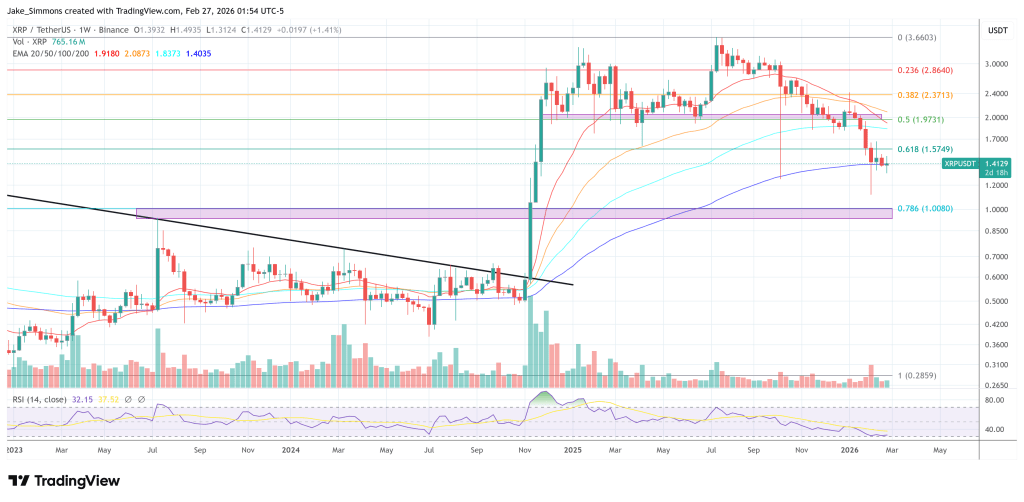
XRP hovers above the 200-week EMA, 1-week chart | Source: XRPUSDT on TradingView.com

Связанные с этим вопросы

QWhat is the core problem Ripple identifies in the current institutional crypto market structure?

ARipple identifies that the institutional crypto market structure lacks the necessary settlement, credit, and risk infrastructure, leading to inefficiencies, multiplied credit risk, trapped capital, and fragmented asset risk due to its exchange-centric, fragmented architecture.

QWhat is the name of the new model proposed in Ripple's whitepaper and what are its three key features?

AThe new model is called the Digital Prime Broker (DPB). Its three key features are centralized credit intermediation, aggregated liquidity, and T+1 net settlement.

QAccording to Ripple, how does the current gross settlement system negatively impact capital efficiency?

AThe current gross settlement system forces repeated intraday asset transfers and leaves collateral stranded across exchanges. For example, a client buying 100 BTC and selling 80 BTC would need to settle a net of only 20 BTC under a T+1 model, cutting gross fund movements by approximately 89%.

QHow does Ripple suggest the XRP Ledger could be used within its proposed Digital Prime Broker model?

ARipple suggests the XRP Ledger could support early settlement through onchain credit lines that fund obligations ahead of the standard T+1 net settlement cycle, with funding costs charged transparently to the party requesting early liquidity.

QWhat does Mike Irwin, COO of XTX Markets, say is a key factor for the adoption of a Digital Prime Brokerage model?

AMike Irwin states that adoption will depend on prime brokers supporting specific client needs and constraints rather than enforcing a rigid, one-size-fits-all model.

Похожее

Торговля

Спот
Фьючерсы

Популярные статьи

Как купить S

Добро пожаловать на HTX.com! Мы сделали приобретение Sonic (S) простым и удобным. Следуйте нашему пошаговому руководству и отправляйтесь в свое крипто-путешествие.Шаг 1: Создайте аккаунт на HTXИспользуйте свой адрес электронной почты или номер телефона, чтобы зарегистрироваться и бесплатно создать аккаунт на HTX. Пройдите удобную регистрацию и откройте для себя весь функционал.Создать аккаунтШаг 2: Перейдите в Купить криптовалюту и выберите свой способ оплатыКредитная/Дебетовая Карта: Используйте свою карту Visa или Mastercard для мгновенной покупки Sonic (S).Баланс: Используйте средства с баланса вашего аккаунта HTX для простой торговли.Третьи Лица: Мы добавили популярные способы оплаты, такие как Google Pay и Apple Pay, для повышения удобства.P2P: Торгуйте напрямую с другими пользователями на HTX.Внебиржевая Торговля (OTC): Мы предлагаем индивидуальные услуги и конкурентоспособные обменные курсы для трейдеров.Шаг 3: Хранение Sonic (S)После приобретения вами Sonic (S) храните их в своем аккаунте на HTX. В качестве альтернативы вы можете отправить их куда-либо с помощью перевода в блокчейне или использовать для торговли с другими криптовалютами.Шаг 4: Торговля Sonic (S)С легкостью торгуйте Sonic (S) на спотовом рынке HTX. Просто зайдите в свой аккаунт, выберите торговую пару, совершайте сделки и следите за ними в режиме реального времени. Мы предлагаем удобный интерфейс как для начинающих, так и для опытных трейдеров.

689 просмотров всегоОпубликовано 2025.01.15Обновлено 2025.03.21

Sonic: Обновления под руководством Андре Кронье – новая звезда Layer-1 на фоне спада рынка

Он решает проблемы масштабируемости, совместимости между блокчейнами и стимулов для разработчиков с помощью технологических инноваций.

2.0k просмотров всегоОпубликовано 2025.04.09Обновлено 2025.04.09

HTX Learn: Пройдите обучение по "Sonic" и разделите 1000 USDT

HTX Learn — ваш проводник в мир перспективных проектов, и мы запускаем специальное мероприятие "Учитесь и Зарабатывайте", посвящённое этим проектам. Наше новое направление .

1.6k просмотров всегоОпубликовано 2025.04.10Обновлено 2025.04.10

Обсуждения

Добро пожаловать в Сообщество HTX. Здесь вы сможете быть в курсе последних новостей о развитии платформы и получить доступ к профессиональной аналитической информации о рынке. Мнения пользователей о цене на S (S) представлены ниже.

活动图片