"Internet Queen's" Fund Leads Investment, AI Music Unicorn Valued at $5.4 Billion

marsbitОпубликовано 2026-06-04Обновлено 2026-06-04

Введение

AI music generation leader Suno announced a $400 million Series D funding round on Wednesday, valuing the company at $5.4 billion. The round was led by Mary Meeker's Bond Capital, with participation from other major investors like IVP and Lightspeed Venture Partners. This marks a doubling of Suno's valuation from $2.45 billion just seven months prior. Suno's platform allows users to create complete songs from text prompts and has amassed over 2 million subscribers, progressing toward an annual recurring revenue target of $300 million. The company's journey reflects a shift in the music industry's stance on AI tools, evolving from legal battles with major record labels to securing a licensing deal and collaboration with Warner Music. CEO Mikey Shulman stated the new capital will accelerate hiring, product development, and ambitious new projects. Suno plans to expand its current workforce of 200 by up to 70% by year-end. The funding underscores strong investor confidence in the AI music sector, solidifying Suno's position as the highest-valued company in the field.

AI music generation leader Suno announced on Wednesday that it has completed a $400 million Series D funding round,with a post-money valuation reaching $5.4 billion (approximately RMB 36.5 billion).
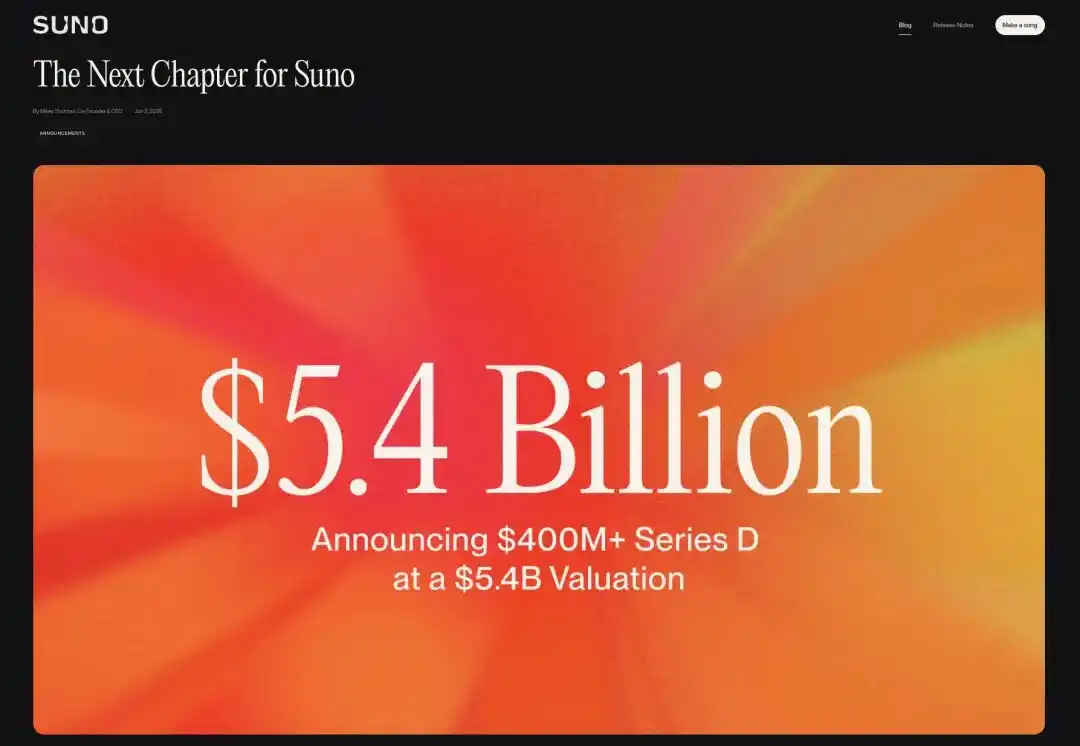
(Source: Company website)

The announcement shows that this round of financing was led by Bond Capital, founded by "Internet Queen" Mary Meeker. Other well-known institutions such as IVP, Union Square Ventures, and Lightspeed Venture Partners also participated in this round.

Suno's previous funding round occurred last November, when the company raised $250 million at a valuation of $2.45 billion. Its valuation doubled in just seven months, demonstrating investors' optimistic expectations for the "AI + music" sector and making Suno the highest-valued company in this field.

As one of the most common AI music generation tools on creative platforms like YouTube and Bilibili, Suno allows users to create music from scratch through text prompts. Users can specify music style, timbre, instruments, and lyrics, and the system can almost instantly generate complete digital audio works.

The company reached the milestone of over 2 million subscription users in February this year. At that time, the company also disclosed it was progressing towards an Annual Recurring Revenue (ARR) level of $300 million.

From "Industry Pariah" to "Taking the Stage"

Suno's series of developments in recent years not only reflect the rapid progress of AI-generated music technology but also bear witness to the shift in attitude from the traditional music industry towards AI tools.

As the "ChatGPT of the music industry," Suno initially gained popularity by allowing anyone to generate complete music with simple prompts. As the volume of AI-generated music surged, the three major record companies (Universal, Sony, Warner) all sued Suno for copyright infringement in 2024.

Times have changed, and with more and more professional creators using AI tools, the industry's attitude has also shifted.

Late last year, Suno reached a settlement with Warner Music and obtained copyright licensing from the latter. The two parties plan to launch a collaborative AI generation product in the coming months, similar to Suno's current tool but with added capabilities for using and referencing Warner songs.

In Wednesday's latest announcement, Suno also mentioned that, as usual, this round of financing received investments from artists, producers, songwriters, and industry executives, but did not disclose specific names.

Co-founder and CEO Mikey Shulman told media on Wednesday that the company decided to raise funds again after receiving interest from external investors following the previous funding round.

To justify its soaring valuation, Suno not only needs to excel as an application for professional musicians but also needs to attract millions of "non-musicians" to create songs—similar to how Anthropic's Claude Code enables people who have never coded to build websites and applications.

Shulman revealed that the company plans to use the funds to accelerate hiring, develop new products, and further drive growth on top of a strong start to the year. Suno currently has about 200 employees and plans to expand its workforce by up to 70% by year-end.

"Having more capital means we can operate the company differently and attempt some bolder projects," Shulman said.

This article is from the WeChat public account "Venture Daily," author: Shi Zhengcheng

Связанные с этим вопросы

QWho is the lead investor in Suno's latest $400 million funding round, and what is the company's new post-money valuation?

AThe lead investor in Suno's latest $400 million Series D funding round is Bond Capital, founded by 'Queen of the Internet' Mary Meeker. The company's new post-money valuation is $5.4 billion.

QHow has Suno's valuation changed in the last 7 months, and what does this indicate about the 'AI + music' sector?

ASuno's valuation has doubled in the last 7 months, from $2.45 billion in November to $5.4 billion. This rapid growth indicates strong investor optimism and high expectations for the 'AI + music' sector.

QWhat is Suno's core product, and what key user milestone did the company achieve earlier this year?

ASuno's core product is an AI music generation tool that allows users to create complete music tracks from scratch using text prompts. Earlier this year, the company surpassed 2 million paying subscribers.

QHow did the relationship between Suno and major record labels evolve, and what specific agreement was recently announced?

AThe relationship evolved from initial lawsuits for copyright infringement by the three major labels (Universal, Sony, Warner) to collaboration. Suno recently announced a settlement and licensing deal with Warner Music Group, and they plan to launch a co-developed AI music product together.

QWhat does Suno plan to do with the new funding, particularly regarding company growth and development?

ASuno plans to use the new funding to accelerate hiring, develop new products, and fuel further growth. The company, which currently has about 200 employees, aims to increase its workforce by up to 70% by the end of the year.

Похожее

SpaceX, OpenAI, Anthropic: The Three AI Giants Racing for IPO, Which One Is Worth Betting On?

SpaceX, OpenAI, and Anthropic are poised for historic IPOs within weeks, potentially raising a combined $180 billion—a sum exceeding the entire internet bubble's fundraising. The hosts of the Limitless Podcast argue this isn't just individual company financing but an unprecedented capital concentration for AI infrastructure, driven by an insatiable need for compute, data centers, power, and chips. SpaceX's IPO is notable for reportedly changing market index rules to allow faster inclusion, potentially funneling trillions in passive retirement funds into its stock, despite its unproven space-based data center business model. In contrast, Anthropic demonstrates explosive growth, with ARR reportedly hitting $45 billion and approaching profitability, fueled by strong enterprise adoption of products like Claude Code. Google's separate $80 billion raise highlights the immense capital pressure, even for giants. The discussion acknowledges bubble risks but leans optimistic. The hosts contend the massive spending is building essential physical infrastructure for the next technological era. A key bottleneck isn't capital but the real-world limits of chip manufacturing and construction speed. As long as demand for AI compute outstrips supply, this investment cycle represents a foundational build-out rather than a purely financial bubble. All three companies are seen as foundational bets on the future, with Anthropic often cited as the most immediately compelling due to its proven revenue trajectory.

marsbit2 ч. назад

SpaceX, OpenAI, Anthropic: The Three AI Giants Racing for IPO, Which One Is Worth Betting On?

marsbit2 ч. назад

From 'Old Guys' to 'New Favorites': How AI Is Revaluing Old Infrastructure from Dell to Nokia?

From "Vintage Tech" to "New AI Darlings": How AI Revalues Old Infrastructure One year ago, tech giants like Dell, Nokia, Cisco, and Western Data were seen as slow-growth, low-valuation stories, far from the AI spotlight dominated by players like Nvidia. Now, these legacy tech stocks are gaining market attention, sparking debate on whether this is genuine industry revaluation or a temporary narrative. As AI moves from model parameters to real-world data centers, the market is recognizing companies with proven delivery and infrastructure capabilities. This shift marks a change in the AI investment thesis: from pure model and GPU focus to the complex systems engineering required for deployment. Companies like Dell, HPE, and Corning are being revalued not for being "sexy" AI innovators, but for their decades of accumulated expertise in supply chains, enterprise delivery, and infrastructure—assets that have become critical in the AI buildout phase. The revaluation is unfolding across three key infrastructure lines: 1. **Servers & System Integration:** Dell and HPE are emerging as crucial system integrators or "general contractors" for AI data centers, translating GPU orders into complete, deployable server racks integrated with power, cooling, and networking. 2. **Networking & Connectivity:** AI's scale demands robust high-speed connections. Corning (fiber optics), Nokia (AI-RAN, 6G), and Cisco (data center switches) are gaining importance for enabling efficient data transfer within and between AI clusters. 3. **Storage:** Beyond high-speed memory (HBM/DRAM), the AI data explosion is driving demand for high-capacity hard drives (HDDs) from companies like Western Digital and Seagate to handle training data, logs, and cold storage cost-effectively. For this revaluation to be substantive and not just a narrative, three criteria are key: 1) Concrete AI-related order and revenue growth (e.g., Dell's AI server sales), 2) Upward revisions to company financial guidance, and 3) Sustainable improvements in profit quality, not just top-line revenue spikes. In essence, AI's transition to a real construction phase is re-pricing "old assets" against "new demand." The opportunity, however, is selective. Only those legacy firms that are demonstrably integrated into the capital expenditure chains of data center and enterprise AI deployment are likely to experience a true "logic re-rating" rather than just a temporary valuation bounce.

marsbit2 ч. назад

From 'Old Guys' to 'New Favorites': How AI Is Revaluing Old Infrastructure from Dell to Nokia?

marsbit2 ч. назад

The Merger of Codex and ChatGPT Marks the Beginning of a Major Reshuffle in Programming Tools

OpenAI is shifting its strategic focus from ChatGPT to Codex, merging them along with the browser tool Atlas into a unified desktop super-app. This move signals an internal belief that Codex, originally a programming tool, represents the next evolution of AI more than conversational models like ChatGPT. Over the past year, Codex's weekly active users have surged past 5 million. The key distinction is that while ChatGPT answers questions, Codex executes tasks. Enterprises increasingly value this ability to get work done over simply receiving advice. Consequently, Codex is attracting professionals beyond developers, including analysts, bankers, marketers, and product managers. OpenAI's reorganization and increased investment in Codex stem from recognizing that the future of AI competition lies in execution capabilities, not just conversation. The company is launching role-specific plugins (e.g., for data analysis, sales, design) to transform Codex into a broad knowledge work platform that automates and redefines white-collar workflows. Beyond being a tool, Codex reflects OpenAI's ambition to redefine software. New features like "Sites"—which generates interactive websites from documents—and collaborative "Annotations" aim to create a paradigm where the AI understands the goal and handles the tools and steps, functioning more like a digital colleague than traditional software. The ultimate goal is a unified experience where the user cares only about the completed task.

marsbit2 ч. назад

The Merger of Codex and ChatGPT Marks the Beginning of a Major Reshuffle in Programming Tools

marsbit2 ч. назад

Торговля

Спот
Фьючерсы
活动图片