Hoskinson Outlines Cardano Funding Overhaul For 2026

bitcoinistОпубликовано 2026-03-12Обновлено 2026-03-12

Введение

Charles Hoskinson, founder of Cardano, has outlined a significant shift in the ecosystem's funding strategy for 2026. He argues that the treasury has historically over-invested in infrastructure (nodes, scaling) while underfunding utility (DApps, DeFi) and user experience (wallets, onboarding, marketing). This imbalance has resulted in many applications struggling with low user activity, TVL, and revenue. Hoskinson's proposed solution is a treasury-backed investment model, replacing grants. The treasury would take ownership stakes in selected projects, requiring strategic alignment, oversight, and partial revenue-sharing in return. This model aims to foster consolidation, as he states the ecosystem cannot sustain numerous similar projects, like 25 DEXs, at current adoption levels. He also emphasized rectifying Cardano's "uncool" public narrative by properly funding content creators and ambassadors. The core message is that Cardano must transition from an "infrastructure game" to a "utility and experience game" with coordinated, strategic intent to drive adoption.

Charles Hoskinson says Cardano’s 2026 budget debate is no longer really about whether the ecosystem should fund itself, but how. In a March 10 video, the Cardano founder argued the network has spent too long overweighting infrastructure while underinvesting in the applications, user experience and narrative needed to turn technical capacity into adoption.

Hoskinson framed the ecosystem as three layers: infrastructure, utility and experience. Infrastructure covers the core rails: nodes, languages and scaling components such as Hydra while utility is the actual DApp and DeFi stack, and experience is the user-facing layer of wallets, onboarding, content and brand. His argument was that Cardano has historically lived too heavily in the first category.

“Historically, Catalyst and the Cardano treasury was over represented here and under represented here,” he said, referring to infrastructure versus utility and experience. “Not enough money for experiences, not enough money for utility [...] there’s not a lot of money for the content creators. There’s not a lot of money for the people actually building the interfaces into Cardano utilities.”

That imbalance, in Hoskinson’s telling, now collides with a harsher reality: many applications are not performing well enough to sustain themselves. He pointed to monthly active users, total value locked, daily transactions and revenue as the relevant scorecard, then delivered a blunt assessment of the current state of the ecosystem.

“All of these on Cardano, they’re not doing well. You’re lying if you say they are,” he said. “There are a lot of DApps and DeFi in the Cardano ecosystem that are losing money. They don’t have a lot of users. They don’t have a lot of TVL.”

Cardano Must Rethink Funding In 2026

His proposed solution is not more grants in the traditional sense, but a treasury-backed investment structure. Rather than handing out what he called “free money,” Hoskinson suggested Cardano create a weighted index of selected ecosystem tokens, with the treasury taking ownership stakes in funded projects. In return, those projects would accept oversight, operating expense reductions, strategic alignment, and partial revenue-sharing back to the treasury through ADA purchases.

“No free money. Sorry, that’s bad behavior,” he said. “It is a strategic investment. You give something, you get something.” He added that the treasury’s goal would be to recoup the initial outlay over time as usage and valuations improve, saying the investment could potentially “pay itself back probably one to three years.”

That model also implies a more politically difficult step: consolidation. Hoskinson argued Cardano cannot support large numbers of similar products at current adoption levels, particularly across DeFi. “We can’t have 25 DEXs at our current adoption level in volume. It’s not sustainable,” he said. “There needs to be a consolidation by category one to three. And that’s what you have when you pick winners and losers.”

Alongside utility, Hoskinson spent significant time on what he described as Cardano’s neglected experience layer. He said the ecosystem has failed to compensate ambassadors, influencers and content creators, leaving Cardano exposed to a hostile public narrative. “Cardano is considered to be the uncool chain,” he said. “Ghost chain. Nobody uses Cardano. Cardano is a dead project [...] Why do you hear it? You hear it because there’s nobody on the other side of the argument.”

He tied that brand problem directly to user growth, arguing that better wallets, simpler onboarding, stronger aggregator channels and more deliberate marketing are prerequisites for turning infrastructure into actual network activity. He also said Cardano should focus its strategic identity on areas where he believes it can differentiate, particularly Bitcoin DeFi and privacy, rather than trying to beat larger rivals on cost, liquidity or raw user count.

The broader message was that the governance system now faces a practical test. Hoskinson said the ecosystem must stop treating every treasury request as a fragmented bidding war and start acting with coordinated intent. “It’s not an infrastructure game anymore,” he said near the end of the broadcast. “It’s a utility and experience game.”

At press time, ADA traded at $0.2590.
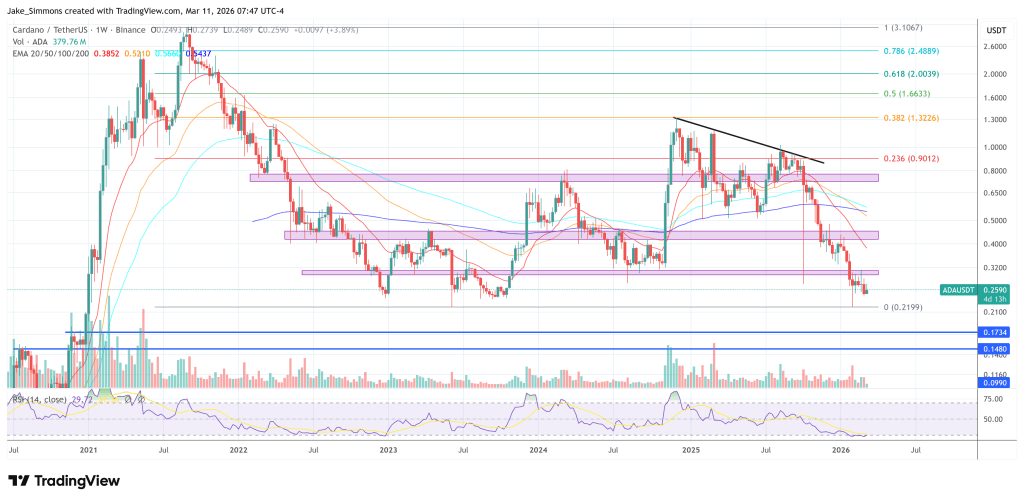
ADA hovers below key resistance, 1-week chart | Source: ADAUSDT on TradingView.com

Связанные с этим вопросы

QWhat are the three layers of the Cardano ecosystem as outlined by Charles Hoskinson?

AThe three layers are infrastructure (core rails like nodes and scaling components), utility (the DApp and DeFi stack), and experience (the user-facing layer of wallets, onboarding, content, and brand).

QAccording to Hoskinson, what is the main problem with the current funding model in Cardano's Catalyst treasury?

AThe treasury has historically been overrepresented in funding infrastructure and severely underrepresented in funding utility and experience, leading to a lack of support for applications, user interfaces, and content creators.

QWhat is Hoskinson's proposed alternative to traditional grants for funding projects in 2026?

AHe proposes a treasury-backed investment structure where the treasury takes ownership stakes in selected projects through a weighted index of ecosystem tokens, requiring oversight, cost reductions, strategic alignment, and partial revenue-sharing in return.

QWhy does Hoskinson believe consolidation is necessary in the Cardano ecosystem, particularly in DeFi?

AHe argues that at current adoption levels, it is unsustainable to support a large number of similar products, such as 25 DEXs, and that the ecosystem needs to consolidate to one to three leaders per category.

QHow does Hoskinson link Cardano's 'brand problem' to its user growth challenges?

AHe states that the ecosystem has failed to compensate ambassadors and content creators, leading to a hostile public narrative that labels Cardano as 'uncool' or a 'ghost chain,' which hinders user adoption. Better marketing and user experience are needed to counter this.

Похожее

Binance Rarely Publishes Article to Regulate Market Makers, Targeting 'Active Market Making' Manipulation Tactics

Binance has published a rare official blog post outlining red lines for market makers in the crypto space. While not explicitly naming any specific projects, the article is widely seen as targeting the controversial "Active Market Maker" model, where market makers borrow large amounts of tokens from projects to artificially pump prices before dumping them on retail traders. The post defines legitimate market making as providing balanced buy and sell orders to maintain liquidity and stable prices. It then lists six key risk signals, including: selling tokens contrary to vesting schedules; one-sided selling; coordinated dumping across platforms; high volume without price movement; extreme volatility in low liquidity conditions; and imbalanced volume and liquidity. Binance explicitly prohibits practices such as large-scale dumping that causes abnormal price declines, profit-sharing and guaranteed return arrangements, collusion with third parties to manipulate prices, and unclear token lending agreements. The article is believed to be a response to recent market manipulation incidents, such as the extreme volatility seen with SIREN token, where a single entity allegedly controlled 88.5% of the supply, leading to a 131% pump followed by a 59% crash. Binance warns it will take swift action against violations, including blacklisting offending market makers, and has provided a channel for reporting misconduct.

Odaily星球日报6 мин. назад

Binance Rarely Publishes Article to Regulate Market Makers, Targeting 'Active Market Making' Manipulation Tactics

Odaily星球日报6 мин. назад

Delphi Labs Founder: Two Weeks Deep in China's AI, Shenzhen Hardware Shocks Me, Software Valuations Scare Me

Delphi Labs co-founder José Maria Macedo spent two weeks in China meeting AI founders, VCs, and public company CEOs. His key takeaways: - **Hardware ecosystem in Shenzhen is impressive**, with systematic reverse-engineering of Western products and rapid iteration cycles. Companies like Bambu Lab are highly profitable and scaling fast. - **Software ecosystem is weaker than expected**. Chinese open-source models are strong, but closed-source models lag behind Western counterparts. GPU access remains constrained, and revenue gaps are significant (e.g., Anthropic’s $6B ARR vs. Chinese model companies at tens of millions). - **Founder profiles are highly accomplished** (top universities, Big Tech experience) but often lack rebellious, original vision. The education and VC systems favor execution over true innovation. - **Valuation bubbles exist** at both early and late stages. Some private AI companies are valued at 400x ARR, far exceeding Western multiples. Humanoid robotics is also overheating, with many pre-revenue companies targeting high-valuation IPOs. - **Information asymmetry favors Chinese founders**, who are highly informed about Western markets and tech trends. Many are building globally first, combining Chinese engineering with Western go-to-market strategies. Macedo believes the real alpha lies in finding non-traditional founders who break the "resume template" optimized by local VCs.

marsbit8 мин. назад

Delphi Labs Founder: Two Weeks Deep in China's AI, Shenzhen Hardware Shocks Me, Software Valuations Scare Me

marsbit8 мин. назад

Wall Street Collectively Pessimistic About 2026: Could an Oil Crisis Trigger an Economic Recession?

In late March, multiple major financial institutions—Moody's Analytics, Goldman Sachs, J.P. Morgan, and EY-Parthenon—raised their 12-month recession probability forecasts for the U.S. to over 30%. Moody’s gave the highest estimate at 48.6%, followed by EY-Parthenon at 40%, J.P. Morgan at 35%, and Goldman Sachs at 30%. A key common factor is the sharp rise in oil prices, with Brent crude surpassing $100 per barrel in early March—the first time in four years—due to supply disruptions in the Strait of Hormuz, a critical global oil transit route. Historical data indicates that four out of the five major oil price shocks since the 1970s led to economic recessions. Although the current price increase of around 80% is the smallest among them, the scale of supply disruption is described by the IEA as the largest since the 1970s energy crises. J.P. Morgan estimates that every sustained 10% increase in oil prices reduces U.S. GDP growth by 15–20 basis points. Larry Fink, CEO of BlackRock, outlined two extreme outcomes: either geopolitical resolution leads to oil prices falling to $40 and global growth, or prolonged conflict keeps prices above $100—possibly near $150—triggering a global recession. He ruled out a 2008-style systemic financial meltdown, citing stronger bank buffers. Beyond oil, declining consumer confidence and weak employment data are amplifying concerns. The convergence of pessimistic forecasts from different methodological approaches may itself influence economic behavior, potentially becoming a self-fulfilling prophecy as businesses and consumers become more cautious.

marsbit18 мин. назад

Wall Street Collectively Pessimistic About 2026: Could an Oil Crisis Trigger an Economic Recession?

marsbit18 мин. назад

Торговля

Спот
Фьючерсы

Популярные статьи

Как купить S

Добро пожаловать на HTX.com! Мы сделали приобретение Sonic (S) простым и удобным. Следуйте нашему пошаговому руководству и отправляйтесь в свое крипто-путешествие.Шаг 1: Создайте аккаунт на HTXИспользуйте свой адрес электронной почты или номер телефона, чтобы зарегистрироваться и бесплатно создать аккаунт на HTX. Пройдите удобную регистрацию и откройте для себя весь функционал.Создать аккаунтШаг 2: Перейдите в Купить криптовалюту и выберите свой способ оплатыКредитная/Дебетовая Карта: Используйте свою карту Visa или Mastercard для мгновенной покупки Sonic (S).Баланс: Используйте средства с баланса вашего аккаунта HTX для простой торговли.Третьи Лица: Мы добавили популярные способы оплаты, такие как Google Pay и Apple Pay, для повышения удобства.P2P: Торгуйте напрямую с другими пользователями на HTX.Внебиржевая Торговля (OTC): Мы предлагаем индивидуальные услуги и конкурентоспособные обменные курсы для трейдеров.Шаг 3: Хранение Sonic (S)После приобретения вами Sonic (S) храните их в своем аккаунте на HTX. В качестве альтернативы вы можете отправить их куда-либо с помощью перевода в блокчейне или использовать для торговли с другими криптовалютами.Шаг 4: Торговля Sonic (S)С легкостью торгуйте Sonic (S) на спотовом рынке HTX. Просто зайдите в свой аккаунт, выберите торговую пару, совершайте сделки и следите за ними в режиме реального времени. Мы предлагаем удобный интерфейс как для начинающих, так и для опытных трейдеров.

882 просмотров всегоОпубликовано 2025.01.15Обновлено 2025.03.21

Как купить S

Sonic: Обновления под руководством Андре Кронье – новая звезда Layer-1 на фоне спада рынка

Он решает проблемы масштабируемости, совместимости между блокчейнами и стимулов для разработчиков с помощью технологических инноваций.

2.1k просмотров всегоОпубликовано 2025.04.09Обновлено 2025.04.09

Sonic: Обновления под руководством Андре Кронье – новая звезда Layer-1 на фоне спада рынка

HTX Learn: Пройдите обучение по "Sonic" и разделите 1000 USDT

HTX Learn — ваш проводник в мир перспективных проектов, и мы запускаем специальное мероприятие "Учитесь и Зарабатывайте", посвящённое этим проектам. Наше новое направление .

1.7k просмотров всегоОпубликовано 2025.04.10Обновлено 2025.04.10

HTX Learn: Пройдите обучение по "Sonic" и разделите 1000 USDT

Обсуждения

Добро пожаловать в Сообщество HTX. Здесь вы сможете быть в курсе последних новостей о развитии платформы и получить доступ к профессиональной аналитической информации о рынке. Мнения пользователей о цене на S (S) представлены ниже.

活动图片