Soaring Export Data for Memory Chips, Market Is Redefining the Valuation Anchor for Memory Stocks

marsbitОпубликовано 2026-06-22Обновлено 2026-06-22

Введение

Korean storage export data for the first 20 days of June shows substantial year-on-year increases in both value and price-per-kilogram for categories like DRAM, NAND, and SSDs. This signals a potential shift beyond simple demand recovery, indicating rising prices and a product mix shift towards higher-value items, possibly influenced by AI infrastructure needs. A key point is that the surge in price-per-kilogram is not simply a uniform chip price hike. It reflects a combination of actual price increases and, more importantly, an export structure increasingly dominated by high-value-density products like HBM (High-Bandwidth Memory) and advanced DRAM, which are critical for AI servers. This suggests AI-driven demand may be spilling over from just HBM into broader memory markets. SK Hynix stands to benefit directly due to its leading HBM position. For Samsung and Micron, the implication is potential for greater margin elasticity if the tightness in high-end memory spreads to enterprise SSD and NAND prices. However, the storage sector remains cyclical. Risks include supply expansion, inventory changes, and potential slowdowns in broader AI capital expenditure. Ultimately, while the strong export data supports upward revisions for storage company earnings and fuels discussion of an "AI infrastructure bottleneck premium," a definitive valuation shift from a cyclical to a structural story depends on upcoming quarterly reports. Investors need confirmation from SK Hynix, Samsung, a...

TL;DR

Korea's export value and price per kilogram for multiple memory categories in the first 20 days of June showed significant year-on-year growth, sparking renewed market discussion on whether memory manufacturers are gaining a premium due to AI infrastructure bottlenecks.

The importance of this development lies not just in it being another set of semiconductor export figures, but in that it touches upon two variables of greatest concern to investors simultaneously: shipment value is rising, and the export value per unit weight is also rising. The former points to demand strength, while the latter points to a migration towards higher-value products in terms of pricing and product mix. For memory stocks, this holds more significance than simply "selling more," as it impacts revenue, gross margins, and the potential for EPS upgrades.

Over the past year, the market has already accepted HBM (High-Bandwidth Memory) as a scarce resource in AI servers. The debate is whether this scarcity is merely driving up prices for a few high-end products, or if it has begun to spill over into the broader DRAM, NAND, and SSD memory supply chain. If it's the former, memory stocks remain more akin to a cyclical recovery trade. If it's the latter, the valuation anchor for SK Hynix, Samsung, and Micron could partially shift from "inventory cycle" towards "AI infrastructure bottleneck."

The Korean data provides a strong signal, not a definitive conclusion. Especially the breakdown by category and price per kilogram for the first 20 days of June are, for now, better suited as preliminary observations from aggregated social media sources and cannot be directly treated as official, complete confirmation. Their value lies in moving a narrative-driven question to a stage where it can be cross-verified with trade value, price indicators, and company guidance.

Korean Exports Give the Market a Price Signal

The most direct implication of this dataset is that the memory upswing may not be just a shipment volume recovery; prices and product mix are also becoming more premium.

Preliminary export data for Korea from June 1 to 20 shows export values for multiple categories like DRAM, NAND/Flash, MCP, and SSD all in high year-on-year growth territory. Among them, export value for DRAM (excluding modules) increased nearly fourfold year-on-year, while DRAM (including modules) increased over threefold. Export values for NAND/Flash and SSD also grew significantly. Of greater market interest was the price per kilogram, with some DRAM and NAND-related categories showing year-on-year increases exceeding 500%.
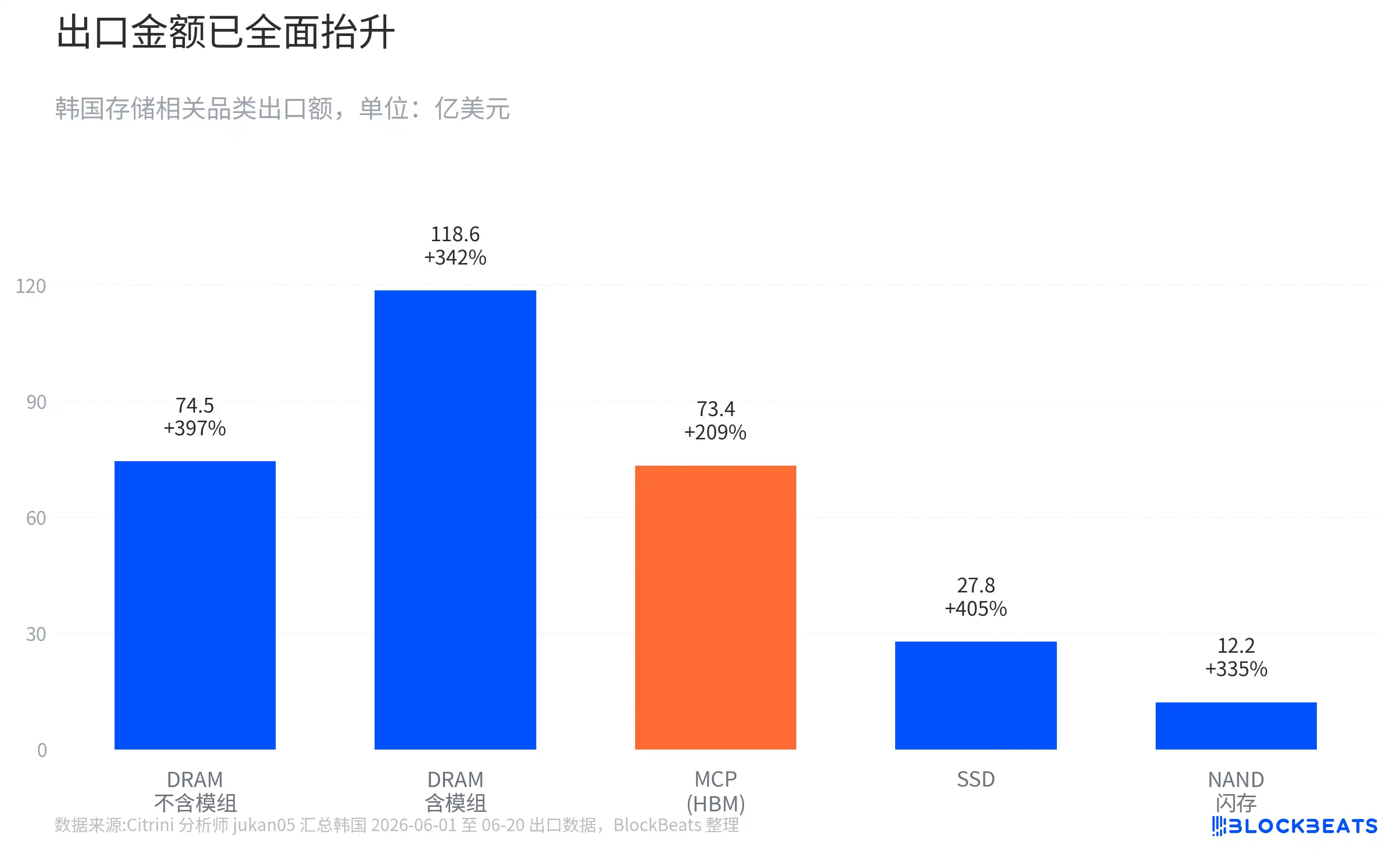
These numbers need to be viewed with context. The first 20-day data is more like a mid-month snapshot of Korean trade data, useful for indicating direction and slope but not the final full-month figure. The classification of sub-categories may also not perfectly align with product definitions understood by investors, making direct extrapolation to full-year earnings models unsuitable.

A more stable reference comes from already published May data. According to Korean media reports based on official data, Korea's total exports in May reached $87.75 billion, up 53.2% year-on-year; semiconductor exports hit $37.16 billion, up approximately 169% year-on-year, a new monthly record, accounting for 42.3% of total exports. Exports of computers and related equipment also saw substantial growth, which media linked to demand for AI server SSDs. Preliminary exports for June 1-10 were also strong, with total exports at $28.6 billion, up 86% year-on-year, and semiconductor exports around $11 billion, up more than threefold.

This makes the social-media-aggregated data for the first 20 days of June more than just an isolated signal. It forms continuity with the prior official export trends. For investors, continuity is more important than a single-month spike, as it determines whether earnings upgrades can evolve from a one-time surprise into adjustments to models over multiple quarters.

Soaring Price Per Kilogram Does Not Mean Chips Got Five Times More Expensive

The most easily misinterpreted aspect of this data is directly translating the soaring price per kilogram into "each chip got several times more expensive." A more accurate description is that the price per kilogram reflects the combined effect of price increases, a shift towards more premium product mixes, and statistical definitions.

Some categories in Korean export data use weight to calculate average unit prices. For bulk commodities, this metric is straightforward. But for semiconductors, the value difference for the same kilogram of goods can be vast. One kilogram of low-end memory chips versus one kilogram of HBM, high-capacity DRAM, or complex packaging products are not on the same level in terms of value density. The rise in price per kilogram can come from price increases for the same products, or from a shift in export structure towards higher-value products.
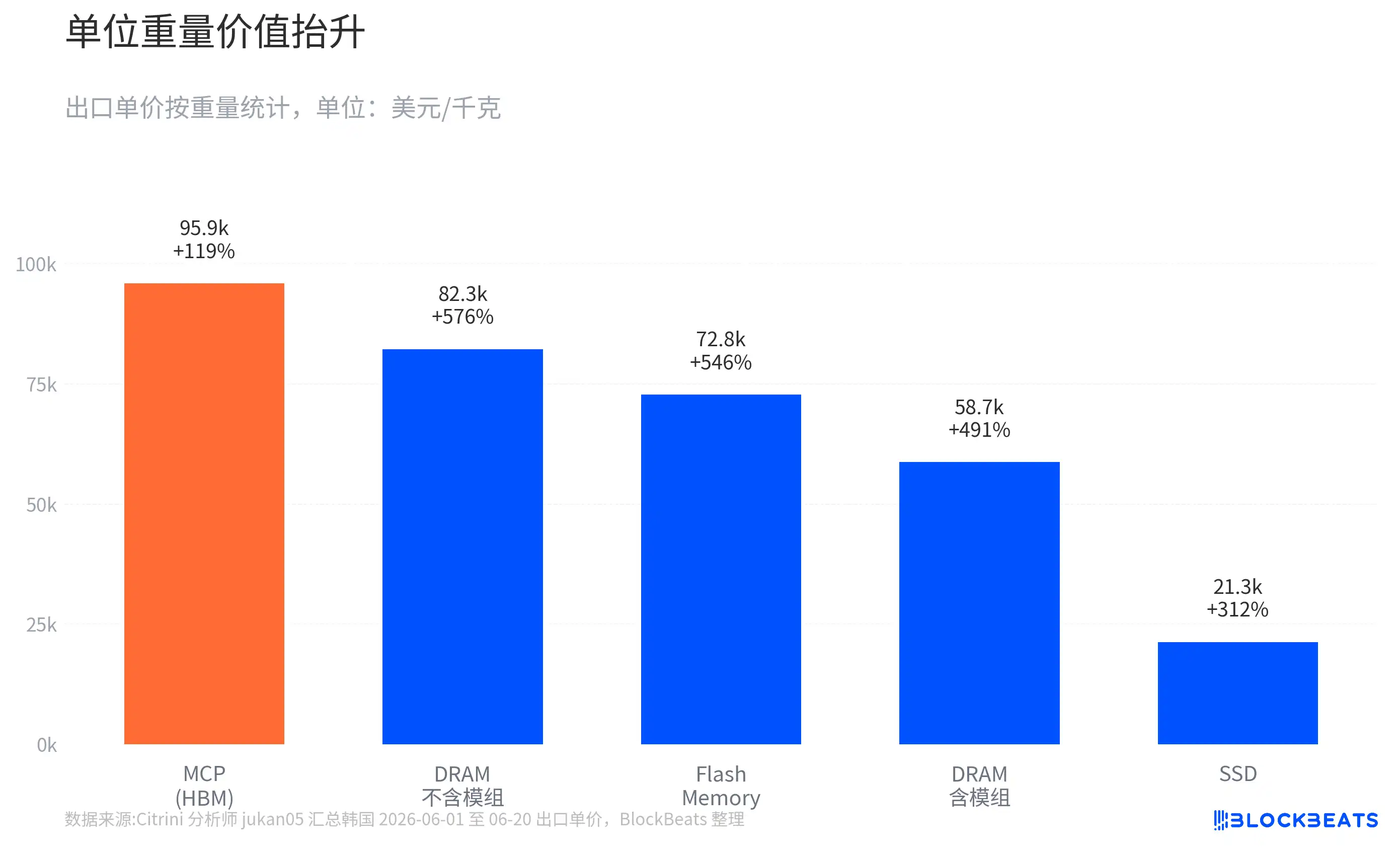
This is precisely the core of the AI trade. AI servers require memory systems with higher bandwidth, larger capacity, and lower latency; HBM and high-end DRAM have far greater value density than standard memory products. When the share of these products in the export structure rises, the average export value per kilogram is pushed higher. What the market is seeing is not a uniform fivefold price increase for all memory chips, but rather a combination of rising high-end product share and price increases that is changing the revenue quality of the memory chain.

The MCP definition also requires particular caution. The market often uses MCP as a proxy indicator for observing HBM-related trends because HBM often involves multi-chip stacking and packaging. However, MCP (Multi-Chip Package) is not synonymous with narrow-sense HBM; it may also include other multi-chip packaging products. Strong MCP export value and unit prices can support the directional judgment of "strong demand for high-end packaged memory" but cannot be directly written as HBM export value.

This qualification does not weaken the data's value; on the contrary, it makes it more suitable for investment judgment. The truly useful conclusion is not exactly how much a specific product increased in price, but that multiple memory categories are simultaneously showing increases in both value and unit value, indicating that AI demand may no longer be confined to the isolated island of HBM. It is, through capacity allocation, product mix, and customer procurement, influencing the broader memory pricing system.

HBM Shortage Changes Memory Makers' Pricing Position

Looking at HBM alone, the market already knows it's tight. The new question is why an HBM shortage would affect DRAM, NAND, and SSD.

The mechanism is not complex. Memory manufacturers have limited advanced capacity, R&D resources, and customer qualification capabilities. When NVIDIA and cloud providers continuously lock in high-value products like HBM and high-capacity DRAM, manufacturers will prioritize allocating resources to directions with higher returns and stronger order visibility. This can keep supply of high-end products persistently tight and may also indirectly squeeze the supply elasticity for ordinary DRAM, NAND, and SSD.
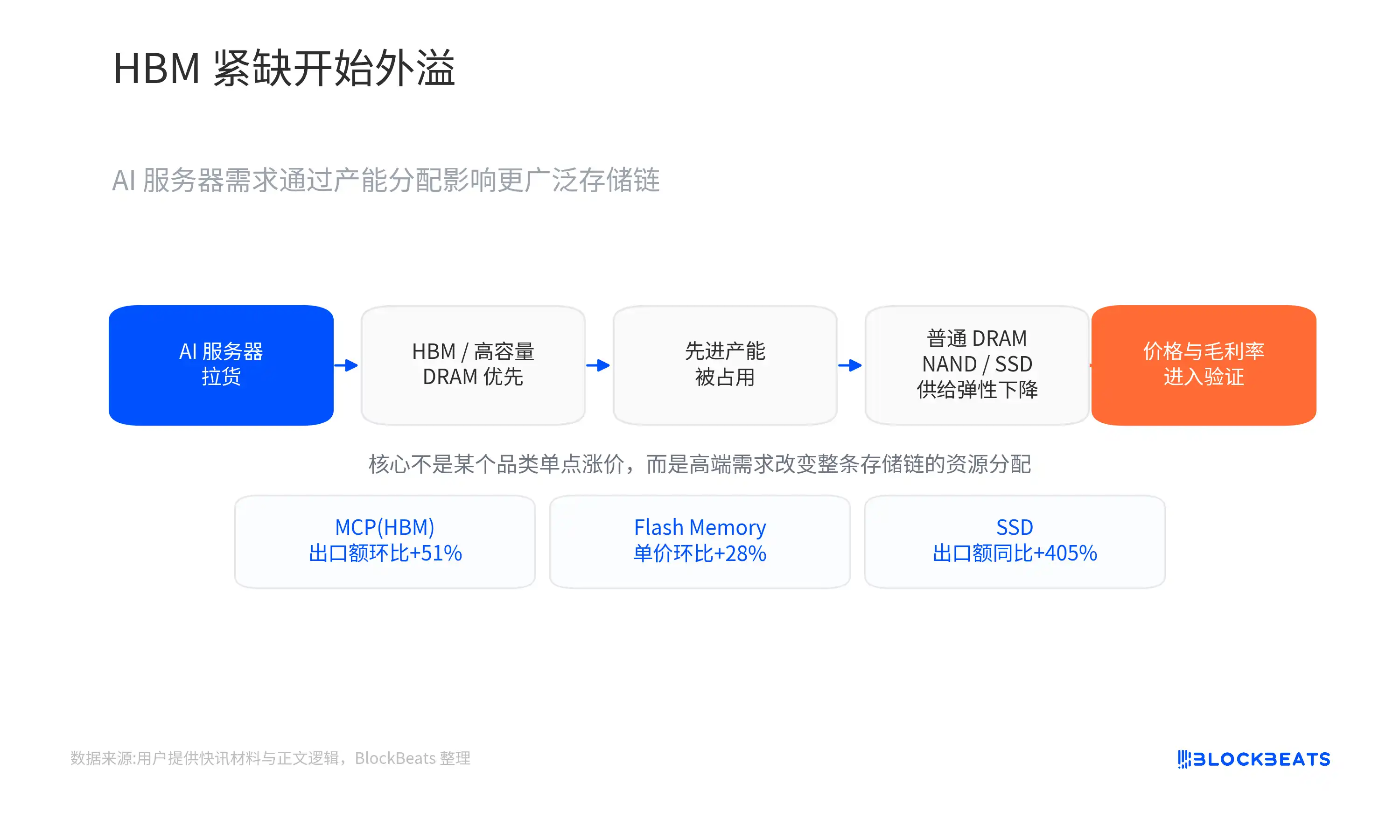
SK Hynix is the most direct beneficiary of this logic. The market widely believes its HBM share is in a leading position. According to industry reports and brokerage research, SK Hynix has relatively high HBM capacity visibility for 2026, with customer demand exceeding supply capability and growth in high value-added product sales. For a memory maker, customer pre-booking of capacity and growth in high-value product sales changes not just next quarter's revenue but also the market's assessment of its pricing power. The core issue for traditional cyclical stocks is how long prices can rise; for bottleneck assets, the core issue is how much premium customers are willing to pay for secured supply.

The logic for Samsung and Micron differs slightly. Samsung has greater scale in NAND and overall memory capacity while still catching up on high-end HBM customer qualifications. Micron benefits from the expansion of high-end memory demand and supply chain diversification. For these two companies, the market is trading not on them having fully replicated SK Hynix's HBM pricing power, but on the premise that if HBM tightness spills over to high-end DRAM, enterprise SSD, and NAND prices, their gross margin leverage could be stronger than in the previous cycle.

Intel CEO Pat Gelsinger (Note: Correction based on provided text - "陈立武" is likely a phonetic translation for "Pat Gelsinger" in this context) mentioned in a No Priors interview, in essence, that AI infrastructure bottlenecks are spreading from GPUs to areas like memory, CPUs, optical interconnects, power conversion, advanced packaging, and materials. The key point here is not to reframe the issue as Intel's strategy, but to illustrate a larger backdrop: constraints in AI data centers are no longer just about a single GPU; any component limiting cluster expansion and efficiency may gain new pricing power.

Memory is one of the earlier segments observed through trade data. No matter how powerful the GPU, it needs sufficient memory bandwidth and capacity to feed data. As inference and intelligent agent tasks increase, system requirements for memory, storage, and scheduling resources become more complex. The value of the Korean export data lies precisely in grounding the macro-level judgment of "AI infrastructure bottleneck diffusion" into observable changes in memory export value and unit value.

Memory Stocks Still Face Cyclical Constraints

For investors, this memory rally resembles a combination of "accelerating real-world demand plus future earnings re-rating," rather than a pure narrative play. The export data shows there is real-world support for demand and prices; what the market is truly buying is whether 2026 revenue, gross margins, and EPS will continue to be revised upwards.

If subsequent earnings reports validate this line, SK Hynix's valuation premium is the easiest to explain: leading HBM share, customer lock-ins, and high-value product ramp jointly constitute higher visibility. For Samsung, the key lies in whether catching up in high-end HBM translates into actual orders, and whether NAND and SSD prices gain broader support. Micron needs to demonstrate that price increases for high-end DRAM and data center storage can translate into gross margins and guidance.

The risk lies precisely here. Memory remains a strongly cyclical industry; supply expansion, inventory changes, and customer procurement rhythms all affect prices. Preliminary 20-day export data can signal a steeper slope but cannot prove full-year certainty. Rising price per kilogram can indicate higher value density but cannot fully separate the proportion attributable to average selling price increases versus product mix changes. Strong MCP data can serve as a proxy signal related to HBM but cannot be directly equated to HBM exports.

Another risk comes from AI capital expenditure itself. If the pace of investment in power, cooling, packaging, or overall compute infrastructure slows, memory demand would also be affected. Bottleneck diffusion is both the reason for memory gaining a premium and a potential constraint. When other parts of the system become bottlenecks first, the pace of memory demand release could also be delayed.

Earnings Reports Will Determine Whether the Valuation Anchor Can Shift

Ultimately, this re-rating must land on company financials, not remain at the trade data level. The official full-month June export data will first give the market a more complete confirmation: whether the high growth in the first 20 days continues, whether price indicators remain elevated, and whether the strength in NAND and SSD is merely driven by short-term large orders.

More critical verification will come from the Q2 and Q3 earnings reports of SK Hynix, Samsung, and Micron. The market needs to see continued delivery on HBM shipments and prices, simultaneous improvement in DRAM and NAND average selling prices, and data center SSD demand driving gross margin improvement—not just showing up in revenue scale. If gross margins and guidance fail to match the slope suggested by the export data, the re-rating could quickly revert to a cyclical trade.

A more prudent judgment at present is that Korea's first 20-day memory export data is strong enough to support the market in upgrading profit leverage estimates for memory makers and revisiting the discussion on AI infrastructure bottleneck premium. However, it is not yet sufficient to prove the memory industry has decoupled from its cycle. What determines whether the valuation anchor can shift is not how high a single year-on-year number is, but whether prices, product mix, and profit margins can all hold up simultaneously over the coming quarters.


Связанные с этим вопросы

QWhy is the strong growth in both export value and kilogram-unit price of Korean memory in the first 20 days of June significant for investors?

AIt's significant because it touches on two key investor variables simultaneously. The increase in export value points to demand strength, while the rising value per kilogram indicates both price increases and a product mix shift towards higher-value items. For memory stocks, this combination is more valuable than just selling more units, as it impacts revenue, gross margin, and the potential for upward EPS revisions.

QWhat does the surge in kilogram-unit price in Korea's export data actually reflect, and how could it be misinterpreted?

AThe surge in kilogram-unit price reflects the combined effects of price increases, a shift towards a more high-value product mix, and statistical methodology. It does not simply mean 'each chip is several times more expensive.' A kilogram of high-end products like HBM or high-capacity DRAM has a much higher value density than a kilogram of standard memory chips. The metric rises due to both higher prices and a greater proportion of these premium products being exported, which is a core aspect of the AI investment thesis.

QHow could HBM (High Bandwidth Memory) supply tightness potentially affect broader memory markets like DRAM, NAND, and SSD?

AHBM tightness affects broader markets through resource allocation. Memory manufacturers have limited advanced production capacity, R&D resources, and customer certification capabilities. When NVIDIA and cloud providers continuously lock in high-value products like HBM and high-capacity DRAM, manufacturers prioritize allocating resources to these areas with higher returns and stronger order visibility. This can keep supply of premium products tight and may indirectly constrain the supply elasticity for standard DRAM, NAND, and SSDs, influencing their pricing.

QAccording to the article, what is the key difference for a memory stock between being viewed as a 'cyclical recovery trade' versus an 'AI infrastructure bottleneck' asset?

AThe key difference lies in the nature of pricing power and valuation. A 'cyclical recovery trade' is primarily concerned with how long prices can rise within a typical supply-demand cycle. In contrast, an 'AI infrastructure bottleneck' asset is evaluated based on the premium customers are willing to pay for guaranteed supply of a critical component that limits AI cluster expansion and efficiency. The latter implies a more structural and potentially sustained pricing advantage linked to AI infrastructure demands.

QWhat ultimately needs to happen for the memory sector's valuation anchor to potentially shift from 'inventory cycle' to 'AI infrastructure bottleneck,' according to the article's conclusion?

AThe shift must be validated by corporate financial reports, not just trade data. Key verification will come from the Q2 and Q3 earnings reports of SK Hynix, Samsung, and Micron. The market needs to see continued delivery on HBM shipments and pricing, synchronized improvement in DRAM and NAND average selling prices (ASP), and gross margin expansion driven by data center SSD demand. If gross margins and corporate guidance do not align with the growth trajectory suggested by export data, the valuation re-rating could quickly revert to a standard cyclical trade.

Похожее

Неделя Криптовалюты Канады возвращается 20–26 июля, прославляя будущее Web3, цифровых активов и ИИ

Неделя криптовалюты в Канаде возвращается 20–26 июля 2026 года уже в шестой раз. Это крупнейшее в стране недельное собрание конференций, сетевых мероприятий и встреч сообщества, посвященных криптовалюте, цифровым активам и искусственному интеллекту (ИИ). Ключевым событием недели станет конференция Blockchain Futurist Conference 21–22 июля в Торонто. Неделя откроется конференцией Web3TO 20 июля. В программу также войдут популярные мероприятия: посвященный ИИ Agentic Day (21 июля), VIP-мероприятие Cayman Finance Rum Bar Experience и закрытый Compliance Breakfast для обсуждения регулирования (22 июля). В общей сложности в течение недели пройдет более 50 различных мероприятий, включая воркшопы, нетворкинг-сессии, встречи сообществ и книжные подписания. Инициатива проводится при поддержке спонсоров, включая Stablecorp и QCAD в качестве официального партнера по стейблкоинам. Основатель Трейси Лепаруло подчеркивает, что Неделя криптовалюты в Канаде — это место, где сообщества Web3, цифровых активов и ИИ объединяются для сотрудничества и создания будущего. Полное расписание и регистрация доступны на сайте CanadaCryptoWeek.com.

TheNewsCrypto5 мин. назад

Неделя Криптовалюты Канады возвращается 20–26 июля, прославляя будущее Web3, цифровых активов и ИИ

TheNewsCrypto5 мин. назад

Неиспользуемый Mac тоже может приносить деньги? Знакомимся с децентрализованной сетью AI-инференса Darkbloom от Eigen Labs

Новая сеть Darkbloom от Eigen Labs позволяет использовать неактивные компьютеры Mac с чипами Apple Silicon для децентрализованных вычислений ИИ-вывода (инференса). Сеть состоит из пользователей, координатора и провайдеров (владельцев Mac). Ключевая особенность — проверяемая конфиденциальность на аппаратном уровне с использованием Secure Enclave, что предотвращает доступ провайдеров к данным запросов. Экономическая модель отличается от традиционной: провайдеры получают 100% доходов от вычислений, так как аппаратная часть уже существует, а основные затраты — на электроэнергию. Цены в сети примерно на 50% ниже, чем у основных API-агрегаторов. В настоящее время доходы невелики (лидер получает менее $6 в день), но ожидается их рост с увеличением спроса и поддержкой более сложных моделей. Для участия требуется Mac на Apple Silicon с macOS 14+, установка клиента Darkbloom и стабильное интернет-соединение. Сеть находится в стадии альфа-тестирования, доступна на платформе OpenRouter с моделями Gemma 4 и GPT-OSS.

marsbit12 мин. назад

Неиспользуемый Mac тоже может приносить деньги? Знакомимся с децентрализованной сетью AI-инференса Darkbloom от Eigen Labs

marsbit12 мин. назад

Институциональные лидеры и лидеры цифровых активов собираются на конференции Blockchain Futurist Conference для обсуждения будущего финансов

Конференция Blockchain Futurist Conference возвращается 21-22 июля 2026 года, собрав лидеров отрасли для обсуждения будущего финансов. Основные темы включают цифровые активы, стейблкоины, токенизацию, искусственный интеллект и регулирование. Мероприятие, являющееся крупнейшим в Канаде событием в сфере Web3 и ИИ, предназначено для нетворкинга и демонстрации инноваций. В программе — ключевые дискуссии с участием представителей канадского парламента, регулирующих органов, компаний Shakepay, JPMorgan, Mastercard, Bloomberg и других. Спикеры обсудят институциональное внедрение цифровых активов, соответствие требованиям и роль таких технологий, как стейблкоины, в современной финансовой системе. Спонсор AiraPay представит новую платежную инфраструктуру, объединяющую традиционные банковские системы и цифровые активы. Отдельные форумы, такие как «House of Intelligence», будут посвящены пересечению финансов, ИИ и технологий конфиденциальности. Invest Hong Kong проведет воркшоп о роли Гонконга как центра для инноваций в области цифровых активов. Дополнительные сессии затронут токенизацию реальных активов, цифровую идентичность и децентрализованные финансы (DeFi). Конференция соберет тысячи участников из технологической, финансовой и цифровой отраслей, чтобы исследовать трансформацию финансовых систем под влиянием новых технологий.

TheNewsCrypto15 мин. назад

Институциональные лидеры и лидеры цифровых активов собираются на конференции Blockchain Futurist Conference для обсуждения будущего финансов

TheNewsCrypto15 мин. назад

Какие крипто-ниши уже «съедают» AI-агенты?

Если несколько лет назад вы были глубоко вовлечены в криптоиндустрию, то сейчас наверняка заметили, как изменилась атмосфера. Основное внимание привлекают только две вещи: ИИ и агенты. Общее мнение таково, что отрасль активно оптимизируется под обслуживание ИИ-агентов, что вытесняет продукты, рассчитанные на прямое человеческое взаимодействие. Однако не все направления одинаково подвержены этому влиянию. В одних сферах агенты уже доминируют, в других они сосуществуют с людьми, а в третьих человек по-прежнему незаменим. **Сферы, где доминируют ИИ-агенты:** * **Торговля деривативами (перпетуальные контракты):** Здесь правит скорость и круглосуточное исполнение. Наглядный пример — конкурс Aster, где все ИИ-агенты выжили, а 43% людей понесли убытки. * **Арбитражная торговля (MEV):** Это практически полностью автоматизированная сфера. Боты сканируют мемпулы блокчейнов для извлечения прибыли. * **Оптимизация доходности (Yield Farming):** Большинство новых DeFi-протоколов создаются с расчётом на автономных агентов, которые показывают более высокую эффективность. * **Спот-трейдинг и управление портфелем:** По оценкам, до 65% глобального объёма торговли криптовалютами уже приходится на автоматизированных ботов. **"Пограничные" сферы (агенты + люди):** * **Прогнозные рынки:** В краткосрочных операциях и арбитраже агенты значительно эффективнее. Однако в долгосрочных прогнозах, требующих адаптации к изменениям, человек сохраняет преимущество. * **DeFi-кредитование:** Хотя такие процессы, как ликвидация залогов, полностью автоматизированы, ключевые решения о займах и депозитах по-прежнему принимают люди. **Сферы, где доминирует человек:** * **Стабильные монеты и платежи:** Основной объём транзакций связан с реальными людьми, использующими стейблкоины для переводов и платежей в повседневной жизни, особенно в развивающихся странах. * **Кошельки:** Это последний и критически важный рубеж, где необходимо человеческое решение и подпись для подтверждения транзакции. **Человеческий верификационный слой:** По мере роста числа агентов возрастает ценность доказательства того, что за действием стоит человек. Такие проекты, как World (с AgentKit), t54, Self Protocol и Kite AI, создают инфраструктуру для безопасного взаимодействия между людьми и автономными агентами, обеспечивая подотчётность и предотвращая злоупотребления. **Вывод:** Хотя ИИ-агенты явно выигрывают в сферах, требующих скорости и автоматизации (трейдинг, MEV, yield), человек остаётся незаменим в областях, где важны суждение, доверие и реальный контекст (платежи, идентификация, окончательное утверждение решений). Будущее, скорее всего, за симбиозом, где агенты эффективно выполняют задачи, но под контролем и с верификацией со стороны человека.

Foresight News17 мин. назад

Какие крипто-ниши уже «съедают» AI-агенты?

Foresight News17 мин. назад

После 11-кратного роста за год отчетность Micron станет проверкой на прочность для рынка памяти в ИИ

После роста акций Micron в 11 раз за год до $1134, их финансовый отчет, который будет опубликован 24 июня, стал решающим испытанием для рынка акций, связанных с памятью для ИИ. Ожидания Уолл-стрит чрезвычайно высоки: прогнозируется рост прибыли на акцию примерно на 932% и выручки на 270% в годовом исчислении, в основном за счет высокопропускной памяти (HBM), мощность которой на 2026 год уже распродана. Аналитики в течение трех месяцев резко повышали прогнозы, что создает риск падения акций даже при хороших, но не дотягивающих до завышенных ожиданий результатах. Ключевым показателем в отчете станет валовая маржа, которая, согласно прогнозам, достигнет рекордных 81%. Однако решающим для направления акций после публикации будут не данные за прошедший квартал, а прогноз компании на следующий, а также детали по объемам поставок HBM и мощностям на 2027 год. Исторически именно в моменты наивысших ожиданий сектор памяти наиболее уязвим для коррекции.

marsbit22 мин. назад

После 11-кратного роста за год отчетность Micron станет проверкой на прочность для рынка памяти в ИИ

marsbit22 мин. назад

Торговля

Спот
Фьючерсы
活动图片