Who Will Take Over After SpaceX's IPO?

marsbitОпубликовано 2026-06-12Обновлено 2026-06-12

Введение

SpaceX is set to go public on June 12 with a $1.8 trillion valuation, but only about 5.56 billion shares (4.2% of the total) will be initially available for trading. Buy-side pressure is expected in three distinct waves. First, the IPO subscription at a fixed $135 per share, which is oversubscribed by nearly 4 times. Second, immediate secondary market trading post-listing. Third, and most significant, the forced buying by passive index funds. The Nasdaq 100 index has modified its rules to include SpaceX just 15 trading days after its IPO, despite its small float, which will compel hundreds of tracking funds to buy large quantities of stock. However, this initial supply shortage will not last. A staged lock-up release is designed for the approximately 54% of shares held by VCs, early employees, and other insiders (excluding Elon Musk's 42%, which is locked for 366 days). Releases begin after the Q2 earnings report, with subsequent unlocks at multiple intervals up to 180 days post-IPO. This means selling pressure from insiders will gradually increase throughout the latter half of the year. A key counterbalance is scheduled for mid-December during the Nasdaq 100's annual rebalancing. By then, the public float will have expanded significantly, forcing index funds to buy more shares, potentially providing institutional support after months of insider selling.

Author: BitalkNews

On June 12, SpaceX will go public with a valuation of $1.8 trillion, but only about 556 million shares will actually enter circulation, corresponding to a float market cap of approximately $75 billion, which is about 4.2% of the total valuation.

In the initial phase of listing, the free float will be extremely small, but buying demand will arrive in three consecutive waves.

The first wave is the IPO subscription on June 12. Institutions and retail investors will buy the newly issued 556 million shares at a fixed price of $135. About 70% will be allocated to institutional investors, and 30% will be reserved for retail investors—a retail allocation three times higher than in a typical large IPO. Ordinary investors can subscribe through platforms like Robinhood and Fidelity. Current subscription demand has already exceeded $250 billion, nearly 4 times oversubscribed.

The second wave is trading in the secondary market after the opening. After the IPO subscription is completed, the stock will start trading on NASDAQ. The opening price is highly likely to be above $135. Prices during this phase will be determined by market supply and demand.

The third wave is the forced buying by passive funds, which is the most noteworthy aspect. The Nasdaq 100 is one of the most important stock indices in the U.S., containing the 100 largest non-financial stocks, including Apple, Nvidia, and Microsoft. Globally, over $600 billion in funds track this index, and they are required to hold each stock according to its weight in the index.

Normally, a newly listed company must wait several months to qualify for inclusion, but NASDAQ has specifically modified its rules for SpaceX, allowing fast-track inclusion just 15 trading days after listing. It has also removed the original 10% minimum free-float requirement and introduced a new weighting rule: even though SpaceX's actual free float is only 5%, the index will calculate its weight as up to 3 times that, or 15%. Once the inclusion takes effect, hundreds of funds tracking the index will need to buy SpaceX shares within a few days. With a float of only $75 billion, the concentrated influx of buying demand in a short period can easily drive up the price. These funds do not consider valuation or make judgments; they buy when the rules dictate.

These three waves of buying demand will occur almost seamlessly within the first month after listing.

However, this supply-demand imbalance will not last forever.

SpaceX has not adopted the traditional 180-day lock-up period common in IPOs. Instead, it has designed a phased release mechanism.

To understand this mechanism, we first need to grasp the post-IPO shareholding structure: The newly issued IPO shares account for about 4.2% of the total shares. Elon Musk personally holds about 42%, while the remaining approximately 54% is held by VCs, early employees, and other internal shareholders. The newly issued portion becomes tradable upon listing. Musk's shares are fully locked for 366 days and will not move. The phased unlocking applies only to the middle 54%.

Specific timeline:

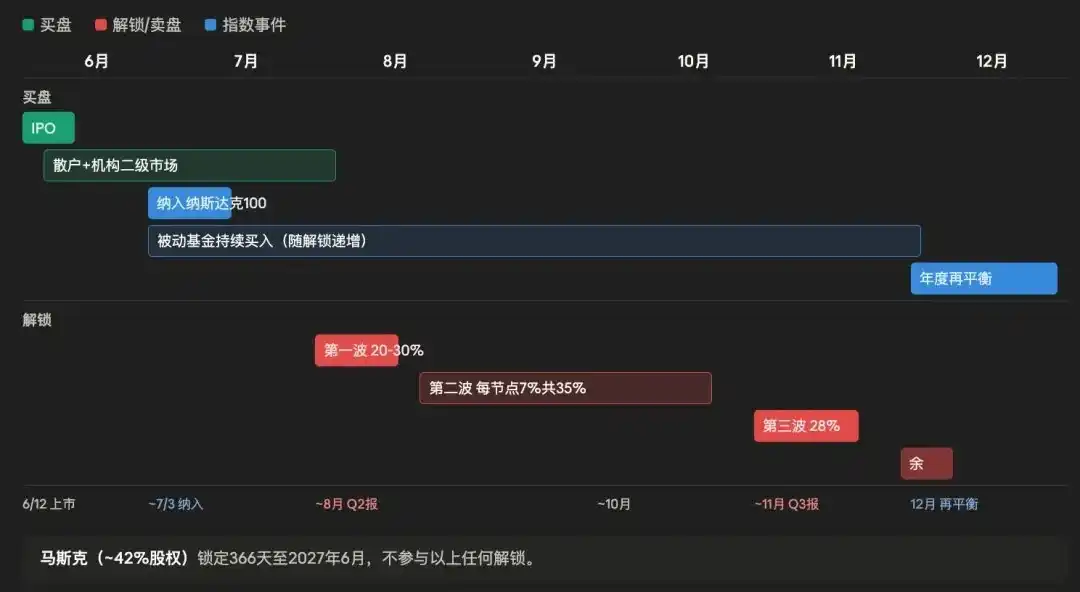
  • First wave, two days after the Q2 earnings release: Locked-up shareholders can sell up to 20% of their locked shares. If the stock price stays 30% above the IPO price and meets the threshold for 5 out of 10 trading days at this point, an additional 10% will be unlocked. This means the earliest group of insiders may start selling as soon as early August.
  • Second wave, on days 70, 90, 105, 120, and 135 after the IPO: 7% will be unlocked at each milestone, totaling 35% across the five milestones.
  • Third wave, after the Q3 earnings release, another 28% is unlocked, with the remainder released upon the expiration of the 180-day lock-up.

Elon Musk's shares are locked for 366 days, and he does not participate in any early releases. He controls over 85% of the voting rights, and this commitment is a crucial pillar of short-term market confidence in SpaceX.

From listing until the end of the year, the market will experience a six-month transformation in supply and demand dynamics. In the first half, the free float is locked up, and buying demand is highly predictable. In the second half, shares are gradually released, and each earnings milestone becomes a test of selling pressure.

The timing design is particularly noteworthy: By the time of the Nasdaq 100 annual rebalancing in mid-December, most insider shares will have been unlocked through the earlier phases. With the free float significantly increased, NASDAQ will correspondingly raise SpaceX's index weight, prompting passive funds to purchase additional shares again. This essentially provides institutional, mandatory buying support to cushion the market several months after insiders have sold substantial amounts.
Связанные с этим вопросы

QAccording to the article, what is the special arrangement made by NASDAQ to include SpaceX in the NASDAQ-100 index, and what is its potential impact?

ANASDAQ specially modified its rules for SpaceX, allowing it to be eligible for inclusion in the NASDAQ-100 just 15 trading days after its IPO. This move removed the previous 10% minimum free float requirement and introduced a new weighting rule: even though SpaceX's actual free float is only about 5%, the index will calculate its weight based on a cap of up to three times that, or 15%. This means that upon inclusion, passive funds tracking the index will be forced to buy a significant amount of SpaceX stock relative to its small float, potentially pushing up the price sharply in a short period.

QDescribe the three waves of buying pressure for SpaceX stock mentioned in the article and the sequence in which they occur.

AThe three waves of buying pressure are: 1) The IPO subscription on June 12th, where institutions and retail investors purchase the newly issued shares at a fixed price of $135. 2) Secondary market trading after the stock begins trading on NASDAQ, where the price is set by market supply and demand. 3) The mandatory buying by passive index funds after SpaceX is included in the NASDAQ-100 index. These three waves of buying pressure are described as occurring almost seamlessly within the first month after the listing.

QHow does SpaceX's lock-up release mechanism for insiders differ from a traditional 180-day lock-up, and what is its schedule?

ASpaceX does not use a traditional 180-day uniform lock-up expiration. Instead, it has a staged release mechanism for the approximately 54% of shares held by VCs, early employees, and other insiders. The schedule is: The first wave allows locked-up shareholders to sell up to 20% of their holdings two days after the Q2 earnings report, with an extra 10% unlocked if the stock price meets certain conditions. The second wave involves unlocks of 7% each on days 70, 90, 105, 120, and 135 post-IPO, totaling 35%. The third wave unlocks 28% after the Q3 earnings report, with the remainder released at the 180-day mark. Elon Musk's 42% stake is locked for 366 days and is not part of this staged release.

QWhat role does the NASDAQ-100 annual rebalancing in mid-December play according to the article's analysis of the supply and demand dynamics for SpaceX stock?

AThe article suggests that by the time of the NASDAQ-100's annual rebalancing in mid-December, most of the insider shares will have been unlocked through the earlier staged releases. With the free float significantly increased by then, NASDAQ will correspondingly raise SpaceX's weighting in the index. This forces the passive funds tracking the index to buy additional shares again. This institutional, forced buying is seen as providing a market floor several months after the period of heavy potential selling by insiders.

QWhat is the estimated total valuation of SpaceX at its IPO, and what is the size and percentage of the initial free float being offered?

ASpaceX is going public with an estimated total valuation of $1.8 trillion. The actual number of shares entering circulation at the IPO is about 556 million, corresponding to a free-float market capitalization of approximately $75 billion, which represents about 4.2% of the total valuation.

Похожее

a16z Crypto Partner: Cash Flow is the Moat

Cash Flow as the Moat: A Playbook for Crypto Founders Historically, the most enduring businesses have been built by positioning themselves within the "flow of funds"—facilitating the creation and transfer of value in a network and extracting a portion of it. Cryptocurrency is the first modern technology natively built for this purpose. For startups, failing to architect products and businesses to leverage these principles means missing a major opportunity. Blockchains are inherently network businesses. Each transaction settles on a shared ledger, and every new participant strengthens the underlying network for all. Well-designed network tokens amplify this by aligning users, developers, and validators around growing the network, with value flowing back to contributors in a transparent feedback loop. This model is not new; companies from railroads and Standard Oil to Google, Meta, and AWS have thrived by inserting themselves into critical flows of value (goods, attention, compute). Financial markets make it even clearer: firms like Visa and major market makers generate immense revenue not by predicting markets but by being in the path of transactions. The combination of fund flow and network effects creates one of the most durable business structures. The high margins in traditional finance (payments, custody, lending, FX) represent prime targets. Crypto founders have the opportunity to build the next version—programmable, instant, global, and natively in the flow of funds. The frontier extends beyond finance to areas like computing/GPUs, AI training data, energy, robotics, and space—markets without entrenched intermediaries, ripe for building new, efficient value rails on programmable infrastructure. Founders should ask: Are you in the flow of funds today? Does your revenue scale 10x with the value of activity on your platform? Where in your target market are profit margins highest relative to value created? The opportunity is clear: embed your startup into the new flows of value and let the network effects accumulate.

marsbit3 мин. назад

a16z Crypto Partner: Cash Flow is the Moat

marsbit3 мин. назад

a16z Crypto Partner: Cash Flow is the Moat

Title: a16z Crypto Partner: Cash Flow Is the Moat Summary: Historically, many of the best businesses were built by positioning themselves within the "flow of funds"—facilitating the creation and transfer of value within a network and taking a cut. The more value flows through, the larger the business grows. Cryptocurrency is the first modern technology natively built for this purpose. If a startup hasn't architected its product and business to benefit from these principles, it's missing a major opportunity. Thanks to stablecoins, capital and value now move at internet speed—globally settled, 24/7, with end-to-end programmability. Blockchains are inherently network businesses. Each transaction settles on a shared ledger, and every new participant strengthens the same underlying network. Network tokens amplify this effect. A well-designed token aligns all participants—users, developers, suppliers, validators, the protocol—around a single goal: growing the network. Participants are paid proportionally to their contributions, creating a transparent feedback loop between value flowing in the system and value accumulating to those building it. This model isn't new; crypto simply makes it more accessible and scalable for startups. The pattern is consistent: find where value flows and position yourself in the middle. Examples range from railroads (earning from freight) and Standard Oil to Google, Meta, and AWS (earning from attention, commerce, and compute flows, respectively). Financial markets make this even clearer. Visa's net income stems from its position in the $15.7 trillion payment flow. Major market makers profit from being in the flow of every order. This combination of fund flow and network effects creates one of the most durable business structures. Jeff Bezos's adage "your margin is my opportunity" applies perfectly here, especially to traditional finance—a massive pool of profit extraction. Crypto founders have the chance to build the next version: programmable, instant, global, and natively in the flow of funds. The frontier extends beyond finance to areas like compute/GPUs, memory chips, AI training data, energy, robotics, space, and rare earth metals—all domains where global value can flow at unprecedented scale on new, programmable infrastructure. Founders should ask: Are you currently in the flow of funds? Does your revenue scale 10x if the value of activity on your product grows 10x? Where in your target market is profit extraction highest relative to value created? The opportunity is there. Seize it, integrate into the new flow, and let the network effects accumulate.

链捕手8 мин. назад

a16z Crypto Partner: Cash Flow is the Moat

链捕手8 мин. назад

RWA First Stock's Major Acquisition: Why Buy a 'Traditional' Mortgage Company?

On June 10th, Figure Technology Solutions (Nasdaq: FIGR), a blockchain-native capital markets firm, announced a $717 million acquisition of Kiavi, a leading non-bank lender for residential real estate investors. The deal involves Figure acquiring Kiavi's technology and operations for approximately $538 million, while forming a joint venture with alternative asset manager Sixth Street to purchase Kiavi's existing loan portfolio. Sixth Street also provided a $3 billion forward purchase commitment. This acquisition marks a strategic shift for Figure, known as the "RWA (Real World Asset) first stock," allowing it to expand significantly into the larger market of first-lien mortgages. Kiavi specializes in non-qualified mortgage (Non-QM) loans, such as short-term fix-and-flip (RTL) and rental property (DSCR) loans—a segment traditionally underserved by major banks. The move is expected to increase Figure's first-lien loan origination to over $7 billion annually, aiming for these to constitute about 40% of its business by 2027. Both companies leverage AI for underwriting: Kiavi uses proprietary models to value renovated properties and automate document processing, dominating the fix-and-flip lending space. Figure plans to integrate these assets onto its blockchain platform, Provenance, using its new 'Adaptor' product to standardize and tokenize the loans for institutional investors on its Democratized Prime marketplace. While the integration poses challenges—including merging different asset types, interest rate sensitivity of Kiavi's loans, and post-IPO execution risks—Figure projects the deal to be accretive to earnings with a cash payback period under four years. The transaction is seen as a major step in scaling blockchain-based capital markets, moving RWA tokenization from concept validation toward large-scale operation.

Foresight News36 мин. назад

RWA First Stock's Major Acquisition: Why Buy a 'Traditional' Mortgage Company?

Foresight News36 мин. назад

Торговля

Спот
Фьючерсы

Популярные статьи

Как купить S

Добро пожаловать на HTX.com! Мы сделали приобретение Sonic (S) простым и удобным. Следуйте нашему пошаговому руководству и отправляйтесь в свое крипто-путешествие.Шаг 1: Создайте аккаунт на HTXИспользуйте свой адрес электронной почты или номер телефона, чтобы зарегистрироваться и бесплатно создать аккаунт на HTX. Пройдите удобную регистрацию и откройте для себя весь функционал.Создать аккаунтШаг 2: Перейдите в Купить криптовалюту и выберите свой способ оплатыКредитная/Дебетовая Карта: Используйте свою карту Visa или Mastercard для мгновенной покупки Sonic (S).Баланс: Используйте средства с баланса вашего аккаунта HTX для простой торговли.Третьи Лица: Мы добавили популярные способы оплаты, такие как Google Pay и Apple Pay, для повышения удобства.P2P: Торгуйте напрямую с другими пользователями на HTX.Внебиржевая Торговля (OTC): Мы предлагаем индивидуальные услуги и конкурентоспособные обменные курсы для трейдеров.Шаг 3: Хранение Sonic (S)После приобретения вами Sonic (S) храните их в своем аккаунте на HTX. В качестве альтернативы вы можете отправить их куда-либо с помощью перевода в блокчейне или использовать для торговли с другими криптовалютами.Шаг 4: Торговля Sonic (S)С легкостью торгуйте Sonic (S) на спотовом рынке HTX. Просто зайдите в свой аккаунт, выберите торговую пару, совершайте сделки и следите за ними в режиме реального времени. Мы предлагаем удобный интерфейс как для начинающих, так и для опытных трейдеров.

1.4k просмотров всегоОпубликовано 2025.01.15Обновлено 2026.06.02

Как купить S

Sonic: Обновления под руководством Андре Кронье – новая звезда Layer-1 на фоне спада рынка

Он решает проблемы масштабируемости, совместимости между блокчейнами и стимулов для разработчиков с помощью технологических инноваций.

2.3k просмотров всегоОпубликовано 2025.04.09Обновлено 2025.04.09

Sonic: Обновления под руководством Андре Кронье – новая звезда Layer-1 на фоне спада рынка

HTX Learn: Пройдите обучение по "Sonic" и разделите 1000 USDT

HTX Learn — ваш проводник в мир перспективных проектов, и мы запускаем специальное мероприятие "Учитесь и Зарабатывайте", посвящённое этим проектам. Наше новое направление .

1.8k просмотров всегоОпубликовано 2025.04.10Обновлено 2025.04.10

HTX Learn: Пройдите обучение по "Sonic" и разделите 1000 USDT

Обсуждения

Добро пожаловать в Сообщество HTX. Здесь вы сможете быть в курсе последних новостей о развитии платформы и получить доступ к профессиональной аналитической информации о рынке. Мнения пользователей о цене на S (S) представлены ниже.

活动图片