JPMorgan Warns Strategy’s Bitcoin Sale Spooked Markets

bitcoinistОпубликовано 2026-06-08Обновлено 2026-06-08

Введение

JPMorgan analysts warn that a small, voluntary sale of 32 bitcoins by Strategy (formerly MicroStrategy) last week unsettled crypto markets, raising concerns about the company's ability to cover its $1.7 billion annual dividend obligations without selling more of its massive bitcoin holdings. The bank notes Strategy's dollar reserves only cover about 6.3 months of dividends, suggesting a need to rebuild cash to restore investor confidence. While Strategy is expected to keep buying bitcoin, JPMorgan has turned more cautious on the broader crypto outlook, citing weaker capital flows, bitcoin's price falling below estimated production cost, and reduced likelihood of key US crypto legislation passing this year. The analysts state that a stronger second half for crypto is conditional on Strategy clarifying its dividend funding strategy and the passage of the Clarity Act, for which they now see less than a 50% chance.

JPMorgan analysts say Strategy’s last week sale of 32 bitcoin unsettled crypto markets and may force Michael Saylor’s company to rebuild its dollar reserves to restore confidence among investors. The warning comes as the bank turns more cautious on crypto, citing weaker capital flows, bitcoin’s break below estimated production cost, and reduced confidence in US crypto legislation passing this year.

In a report titled Alternative Investments Outlook and Strategy, JPMorgan analysts led by managing director Nikolaos Panigirtzoglou said Strategy’s small bitcoin sale had an outsized signaling effect. The sale was described as “symbolic and voluntary,” intended to demonstrate flexibility and commitment to preferred stockholders. But according to the analysts, it still “spooked” markets because it raised a central question for holders of both bitcoin and Strategy securities: whether the company could meet dividend obligations without selling more of its BTC stack.

Strategy Needs Cash To Calm Bitcoin Fears

Strategy, formerly MicroStrategy, has become the dominant corporate bitcoin treasury vehicle under Saylor, making its balance-sheet decisions a market-wide signal. JPMorgan said the company’s current dollar reserves cover only around 6.3 months of dividend payments, a level the analysts believe may be too thin for investors who are already watching the firm’s leverage, preferred stock structure and bitcoin exposure closely.

“In our opinion a rebuilding of the company’s dollar reserves might be needed to restore confidence and reduce investor concerns that the company would sell more bitcoins to cover dividend payments,” the analysts said.

The concern is not that Strategy has abandoned its bitcoin acquisition strategy. JPMorgan still expects the company to keep buying BTC. But the firm’s funding mix, dividend burden and limited cash buffer have become more relevant after the 32 BTC sale showed that bitcoin disposals, however small, are now part of the market’s risk calculus.

Strategy created a $1.44 billion US dollar reserve in December to safeguard dividend payments on its preferred stock and service interest on outstanding debt. JPMorgan said the company now needs to clarify how it plans to meet roughly $1.7 billion in annual dividend payments, particularly if bitcoin remains under pressure.

Saylor, meanwhile, signaled the opposite direction on Sunday, posting on X: “A good time to add more dots.” Strategy currently holds 843,706 bitcoin at an average cost of $75,699. At current prices near $62,000, that position implies a paper loss of roughly $11.5 billion.

JPMorgan said that if Strategy maintains its year-to-date pace of acquisitions, the company could buy around $32 billion of bitcoin in 2026, up from the bank’s prior estimate of $30 billion last month. That would compare with roughly $22 billion of bitcoin purchases in both 2025 and 2024.

The bank’s broader crypto outlook has also shifted. In February, JPMorgan was “overweight” and “positive” on digital assets for 2026, expecting institutional flows to drive the market higher. Now, the analysts have turned cautious, pointing to weaker inflows and a more uncertain regulatory backdrop.

A stronger second half for crypto, they said, depends on two conditions: Strategy explaining how it will cover dividends, and Congress passing the US crypto market structure bill, known as the Clarity Act. JPMorgan now sees less than a 50% chance of that legislation passing this year, citing a narrowing window ahead of the US midterm elections, continued debate around stablecoin yield, and remaining political hurdles.

The analysts also noted that bitcoin has spent much of the year below their estimated production cost. Their central estimate fell from $90,000 at the start of the year to $77,000 as hashrate and mining difficulty declined, before rebounding to around $87,000. Historically, they said, production cost has acted as a “soft floor” for bitcoin, making the current price near $62,000 another reason for caution.

Capital flows tell a similar story. JPMorgan estimates total digital asset inflows at around $22 billion year-to-date, implying an annualized pace of roughly $52 billion, about half the level recorded in 2025. The estimate includes crypto fund flows, CME futures positioning, crypto venture capital fundraising and corporate treasury purchases, including Strategy’s bitcoin acquisitions.

Despite the cautious stance, JPMorgan left room for a reversal in sentiment. The analysts said the current weakness could prove a “bullish contrarian signal going forward.” Still, they concluded that a constructive second half “would be conditional on Strategy clarifying its strategy [for] meeting dividend payments of $1.7 billion a year and on the approval of the US market structure legislation for which we now see less than 50% chance.”

At press time, BTC traded at $63,071.
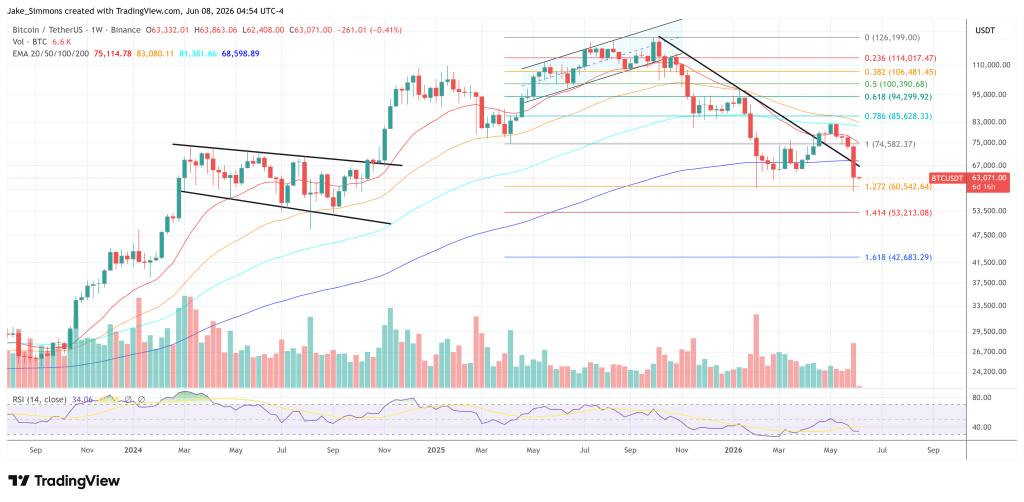
Bitcoin hovers below the 200-week EMA, 1-week chart | Source: BTCUSDT on TradingView.com

Связанные с этим вопросы

QWhy did JPMorgan analysts say Strategy's small bitcoin sale had an outsized effect on the market?

AJPMorgan analysts said Strategy's small bitcoin sale had an outsized signaling effect because it raised a central question for investors: whether the company could meet its dividend obligations without selling more of its bitcoin holdings.

QAccording to JPMorgan, what might Strategy need to do to restore investor confidence?

AAccording to JPMorgan, Strategy might need to rebuild its dollar reserves to restore investor confidence and reduce concerns that the company would sell more bitcoins to cover its dividend payments.

QWhat are the two main conditions JPMorgan says are needed for a stronger second half for crypto?

AJPMorgan says a stronger second half for crypto depends on two conditions: Strategy explaining how it will cover its dividends, and the U.S. Congress passing the crypto market structure bill known as the Clarity Act.

QWhat is JPMorgan's current estimated probability that the U.S. crypto market structure bill will pass this year?

AJPMorgan now sees less than a 50% chance of the U.S. crypto market structure bill passing this year.

QWhat is the implied paper loss on Strategy's bitcoin holdings at the time of the report?

AAt current prices near $62,000, Strategy's position of 843,706 bitcoin with an average cost of $75,699 implies a paper loss of roughly $11.5 billion.

Похожее

When AI Begins to Audit the World: From Claude Discovering the ZEC Vulnerability, Watching the Encryption Industry Enter the 'Recursive Security Era'

**When AI Audits the World: From Claude's Discovery of a ZEC Vulnerability, Viewing the Crypto Industry Entering a "Recursive Security Era"** This article examines a pivotal shift in the blockchain security landscape, triggered by the convergence of two events: Anthropic's research on AI's "Recursive Self-Improvement" and Claude Opus 4.8's discovery of a critical vulnerability in Zcash's code. Traditionally, crypto security has relied on human experts and automated tools for periodic audits. However, the article argues AI is transitioning from a mere tool to an active participant in understanding and analyzing complex systems. Claude's ability to identify a subtle flaw in Zcash's zero-knowledge proof system demonstrates AI's potential to dramatically lower the cost and time required for risk discovery. This goes beyond finding a single bug; it signals a change in the very mechanism of how vulnerabilities are found. The core thesis introduces the concept of "Recursive Security," drawing a parallel to Anthropic's "Recursive Self-Improvement." Just as AI can accelerate its own development through feedback loops, security systems are evolving towards a continuous cycle of analysis, risk identification, remediation, and re-analysis. Security is becoming a persistent, evolving capability integrated into a system's lifecycle, rather than a one-time pre-launch audit. This shift is particularly urgent for the crypto industry, where system complexity from Layer-2 networks, modular architectures, and ZK-proofs is growing faster than human analysis capacity. AI excels at the pattern recognition and contextual understanding needed to navigate this complexity. Importantly, the article cautions that AI augments both defenders and potential attackers, accelerating the entire threat landscape. The future competitive advantage may not lie in having zero vulnerabilities, but in having the fastest risk discovery, validation, and response capabilities. The Claude-Zcash incident is thus an early signal of an era where AI-driven, recursive security systems become essential for managing risk in an increasingly complex digital world.

marsbit1 ч. назад

When AI Begins to Audit the World: From Claude Discovering the ZEC Vulnerability, Watching the Encryption Industry Enter the 'Recursive Security Era'

marsbit1 ч. назад

From MSTR to STRC+: Where Is the Limit of the Strategy Universe?

From MSTR to STRC+: The Evolution and Limits of the Strategy Universe This article examines the transformation of Strategy (formerly MicroStrategy) from a simple "Bitcoin treasury" company into a complex financial engineering firm building a BTC-backed credit system. **Core Thesis:** Strategy's true significance lies not just in its massive BTC holdings (~844k BTC), but in its attempt to transform this static reserve into a multi-layered credit curve within traditional capital markets and, subsequently, into on-chain yield infrastructure. **The MSTR Flywheel:** The initial model was a reflexive loop: BTC price rises → MSTR stock rises → company raises capital (debt/equity) at a premium → buys more BTC → increases per-share BTC exposure → MSTR premium grows. This "amplified Bitcoin" equity (MSTR) thrives on bullish momentum but is vulnerable to tightening premiums and rising funding costs. **Building the Credit Curve:** Strategy's innovation is slicing its single BTC balance sheet into different risk/return profiles via specialized securities: * **MSTR:** High-volatility equity layer absorbing full BTC upside/downside. * **STRC:** Key product. A perpetual preferred stock designed as "short duration high yield credit," offering ~11.5% floating monthly dividends. It attracts fixed-income investors seeking yield without direct BTC exposure, funding Strategy's operations. * **STRD/STRK/STRF:** Other preferred/share classes with varying durations, conversion rights, and fixed dividends. **Risks of the STRC Model:** STRC's high yield is not risk-free. Its stability depends on: 1) Sufficient BTC asset coverage, 2) Strategy's continued ability to pay dividends, and 3) Market faith in the MSTR/STRC funding flywheel. Stress points include deep BTC price declines eroding the asset buffer, rising dividend costs if STRC trades below par, and a broken flywheel if MSTR's premium (mNAV) falls persistently. **On-Chain Expansion: STRC+:** Projects like **Saturn** and **Apyx** aim to package STRC's (and other DAT preferred stock) cash flows into on-chain stablecoin yield (e.g., sUSDat, apyUSD). They offer DeFi a new yield source distinct from trading fees or incentives—cash dividends from traditional securities. However, this introduces compounded risks: off-chain custody, issuer credit risk, BTC volatility, and protocol execution risk. **Conclusion: The Ultimate Boundary** Strategy's endgame is not infinite BTC accumulation. It is the market's long-term acceptance of a new credit system where BTC serves as collateral for tradable securities whose cash flows can power on-chain financial applications. Its "universe" expands if this BTC-native credit curve gains legitimacy, but contracts if these instruments are repriced purely as high-risk, yield-bearing credit assets without stablecoin mythology.

marsbit1 ч. назад

From MSTR to STRC+: Where Is the Limit of the Strategy Universe?

marsbit1 ч. назад

Торговля

Спот
Фьючерсы

Популярные статьи

Как купить S

Добро пожаловать на HTX.com! Мы сделали приобретение Sonic (S) простым и удобным. Следуйте нашему пошаговому руководству и отправляйтесь в свое крипто-путешествие.Шаг 1: Создайте аккаунт на HTXИспользуйте свой адрес электронной почты или номер телефона, чтобы зарегистрироваться и бесплатно создать аккаунт на HTX. Пройдите удобную регистрацию и откройте для себя весь функционал.Создать аккаунтШаг 2: Перейдите в Купить криптовалюту и выберите свой способ оплатыКредитная/Дебетовая Карта: Используйте свою карту Visa или Mastercard для мгновенной покупки Sonic (S).Баланс: Используйте средства с баланса вашего аккаунта HTX для простой торговли.Третьи Лица: Мы добавили популярные способы оплаты, такие как Google Pay и Apple Pay, для повышения удобства.P2P: Торгуйте напрямую с другими пользователями на HTX.Внебиржевая Торговля (OTC): Мы предлагаем индивидуальные услуги и конкурентоспособные обменные курсы для трейдеров.Шаг 3: Хранение Sonic (S)После приобретения вами Sonic (S) храните их в своем аккаунте на HTX. В качестве альтернативы вы можете отправить их куда-либо с помощью перевода в блокчейне или использовать для торговли с другими криптовалютами.Шаг 4: Торговля Sonic (S)С легкостью торгуйте Sonic (S) на спотовом рынке HTX. Просто зайдите в свой аккаунт, выберите торговую пару, совершайте сделки и следите за ними в режиме реального времени. Мы предлагаем удобный интерфейс как для начинающих, так и для опытных трейдеров.

1.4k просмотров всегоОпубликовано 2025.01.15Обновлено 2026.06.02

Как купить S

Sonic: Обновления под руководством Андре Кронье – новая звезда Layer-1 на фоне спада рынка

Он решает проблемы масштабируемости, совместимости между блокчейнами и стимулов для разработчиков с помощью технологических инноваций.

2.3k просмотров всегоОпубликовано 2025.04.09Обновлено 2025.04.09

Sonic: Обновления под руководством Андре Кронье – новая звезда Layer-1 на фоне спада рынка

HTX Learn: Пройдите обучение по "Sonic" и разделите 1000 USDT

HTX Learn — ваш проводник в мир перспективных проектов, и мы запускаем специальное мероприятие "Учитесь и Зарабатывайте", посвящённое этим проектам. Наше новое направление .

1.8k просмотров всегоОпубликовано 2025.04.10Обновлено 2025.04.10

HTX Learn: Пройдите обучение по "Sonic" и разделите 1000 USDT

Обсуждения

Добро пожаловать в Сообщество HTX. Здесь вы сможете быть в курсе последних новостей о развитии платформы и получить доступ к профессиональной аналитической информации о рынке. Мнения пользователей о цене на S (S) представлены ниже.

活动图片