Author: Oluwapelumi Adejumo
Compiled by: Saoirse, Foresight News
Key Highlights
- Following SpaceX's public listing, Elon Musk has become the first person in modern history with a personal net worth exceeding $1 trillion.
- His total wealth of $1.11 trillion surpasses the combined market capitalization of all cryptocurrencies excluding Bitcoin, highlighting extreme wealth concentration and the continued valuation erosion of altcoins.
- This wealth milestone remains highly dependent on stock price fluctuations; meanwhile, multiple companies under Musk hold Bitcoin, and he remains an active, public participant in the digital asset space.
Elon Musk has now become the first individual in modern history to surpass the $1 trillion mark in personal net worth. SpaceX's record-breaking public listing last week propelled him past this historic wealth threshold.
According to the Bloomberg Billionaires Index, the tech entrepreneur's total wealth currently stands at $1.11 trillion.
To put the unprecedented scale of this capital into perspective: Musk's personal net worth is higher than the total market capitalization of the global cryptocurrency market excluding Bitcoin. If the world's largest digital asset, Bitcoin, is included in the calculation, his wealth is exactly equal to half of the entire crypto industry's total market cap.
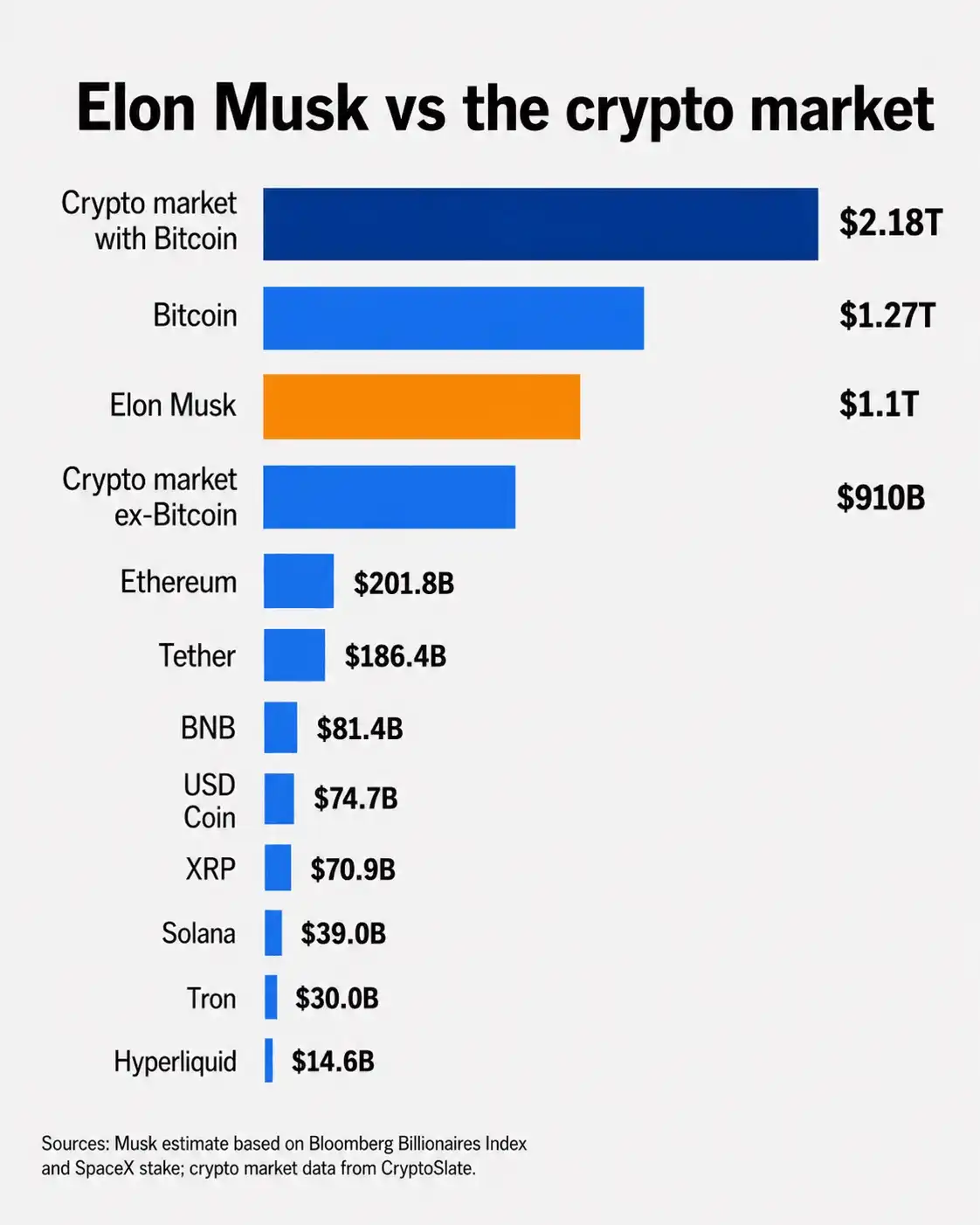
This wealth milestone quickly sparked global discussions about wealth concentration, as the scale of Musk's fortune even exceeds the Gross Domestic Product of several developed countries.
SpaceX's IPO Breaks Multiple Records
The direct trigger for Musk's wealth surge was SpaceX's highly anticipated listing on the Nasdaq.
The company, which focuses on rocket development, communication services, and artificial intelligence, reached a staggering valuation of $2.2 trillion post-listing.
Underwriters initially set the offering price at $135 per share, raising $75 billion before trading even began.
However, unprecedented investor enthusiasm for the commercial space sector and Musk-affiliated companies drove the stock to open at $150, surge to an intraday high of $176.50, and ultimately close at $161 last Friday.
Market observers noted that the stock listing brought unprecedented market liquidity.
Bloomberg ETF analyst Eric Balchunas pointed out that the stock's trading volume on its first day reached $85 billion. This figure set a new global record for single-day IPO trading volume and ranked among the top ten single-day trading volumes for any individual stock in history, surpassing the highest single-day trading volume of Apple Inc. in any of the past 40 years.
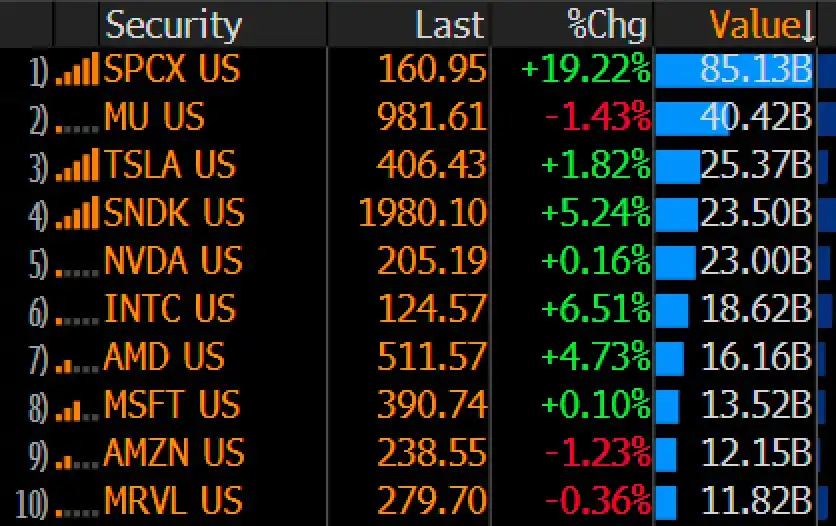
SpaceX Initial Public Offering Trading Volume (Source: Eric Balchunas)
Musk holds a 42% stake in the Hawthorne, California-based company, granting him near unilateral voting control over its operations and strategic decisions.
Musk's Ties to Cryptocurrency
Comparing Musk's wealth scale with the digital asset market clearly shows the significant shift in global capital allocation over the past year.
Data from the TradingView TOTAL2 index shows that the total market capitalization of all altcoins (excluding stablecoins) is approximately $880 billion, a figure easily surpassed by Musk's $1.11 trillion in paper wealth.
Even using the broader statistical approach of data platform CoinGecko—which puts the total global crypto market cap at about $2.27 trillion, with Bitcoin's market cap at $1.28 trillion—the combined value of all remaining altcoins after excluding Bitcoin still falls short of the personal net worth of the SpaceX CEO.
This market cap gap intuitively reflects the significant valuation contraction of the mainstream altcoin market compared to previous cycles. TradingView data shows that in October 2025, the total market cap of crypto assets excluding Bitcoin exceeded $1.7 trillion.
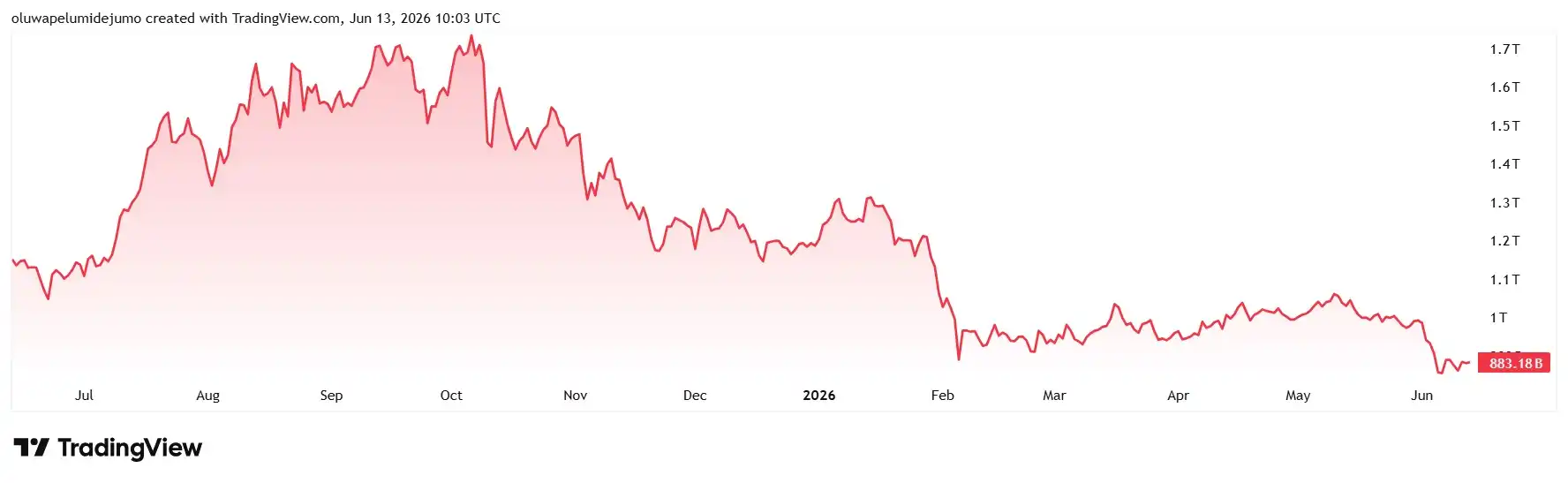
Total Cryptocurrency Market Cap Excluding Bitcoin (Source: TradingView)
This value has nearly halved since then, due to sustained liquidity contraction in the digital asset market and an overall withdrawal of institutional capital from the crypto sector, which has flowed instead into large-cap tech stocks and AI-related equities.
Despite his personal wealth now dwarfing the entire altcoin market, Musk remains deeply intertwined with the digital asset ecosystem, both through personal holdings and corporate balance sheets.
Musk has publicly confirmed that he owns Bitcoin, Ethereum, and Dogecoin. Apart from mentioning a gift of 0.25 Bitcoin in 2018, he has never disclosed his complete personal portfolio, but several of his companies hold institutional-scale positions in the crypto market.
Post-listing regulatory filings reveal that SpaceX's corporate treasury holds 18,712 Bitcoin, corresponding to a value exceeding $1.3 billion. His electric vehicle company Tesla follows a similar strategy, maintaining a long-term holding of 11,509 Bitcoin as part of its corporate liquidity reserve.
If the holdings of both companies were combined, their total Bitcoin holdings would rank fifth globally among publicly traded companies.
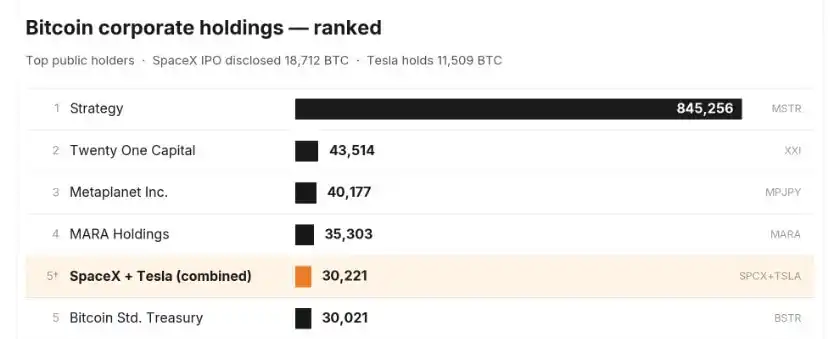
SpaceX and Tesla's Bitcoin Holdings (Source: Bitcoin Treasuries)
Furthermore, Musk's $44 billion acquisition of the social platform X (formerly Twitter) and the integration of financial data tools within the platform have embedded financial market information directly into the mainstream information flow. The platform's built-in cash tag feature displays real-time prices for traditional stocks and various digital assets.
X's official statement clarifies that the platform serves only as a market data tool and does not act directly as a securities broker or cryptocurrency exchange. However, this feature further intertwines Musk's media and commercial ecosystem with the day-to-day functioning of financial markets.
Ultimately, Musk's staggering wealth scale reveals the severe concentration of private wealth in founder-controlled tech giants; it is also important to note that this trillion-dollar fortune is inherently tied to stock market prices and is not a pool of freely spendable cash assets.