U.S. Stock Market Trend: Nasdaq Plunges 3.5% Intraday Before a Remarkable Recovery, All Eyes on CPI Tomorrow

marsbitОпубликовано 2026-06-10Обновлено 2026-06-10

Введение

"US Stock Market Trends: Nasdaq Plunges 3.5% Before Dramatic Recovery, Eyes on Tomorrow's CPI" On Tuesday, US markets experienced a wild swing. The Nasdaq initially surged nearly 0.7% before plummeting to a 3.5% intraday loss following a post by Donald Trump on Truth Social. He stated that Iran had shot down a US Apache helicopter in the Strait of Hormuz and that the US "must...respond." The index, however, staged a remarkable recovery in the final two hours, closing down only 0.97%, as subsequent remarks from Trump and Vice President Vance suggested a potential Iran deal within days. The S&P 500 fell 0.26%, while the Dow Jones gained 0.17%, supported by its non-tech components. This incident marked the first loss of a US military asset since tensions with Iran escalated in late February. Despite the event, crude oil prices fell sharply (WTI -3.93%) due to expectations of a near-term deal, OPEC+ plans to increase output, and fears that strong jobs data could lead to Fed rate hikes. Market attention is now laser-focused on the May CPI data release Wednesday morning. This report is seen as critical evidence for whether hot job growth is fueling inflation and will heavily influence expectations for the Federal Reserve's upcoming meeting. A hotter-than-expected reading could trigger further sell-offs, particularly in tech, while a cooler print could spark a significant rebound. The article notes a clear sector rotation, with money flowing out of tech (Nasdaq down over 5% in a...

Author: Tide Research

On Tuesday, Wall Street witnessed a thriller of "kill first, rescue later."

The morning session progressed calmly, with the Nasdaq once gaining nearly 0.7%, and chip stocks continuing their rebound from Monday. In the afternoon, Trump posted on Truth Social that Iran had shot down a U.S. Apache helicopter over the Strait of Hormuz. Both pilots were safely rescued, but the U.S. "must respond to this attack."

The Nasdaq instantly plunged, falling as much as -3.5% at its intraday low.

Over the following two hours, the market gradually climbed back as Trump provided follow-up statements like "negotiations are still ongoing" and "a deal could be reached within two or three days," eventually paring losses. The Nasdaq closed down 0.97% at 25,678.82 points, and the Nasdaq 100 fell 1.12%. The S&P 500 dropped 0.26% to 7,386.65 points. The Dow Jones, supported by its non-tech components, bucked the trend to close up 0.17% (+86 points) at 50,872.11 points.

From -3.5% to -0.97%, the Nasdaq recovered over 70% of its intraday decline in the two hours before the close. This strength of recovery sends two signals: first, bears are hesitant to aggressively increase positions on the eve of CPI; second, the market still holds a firm belief that the "Iran issue will eventually be resolved," it's just a matter of time.

Helicopter Incident: The First Time U.S. Military Assets Were Hit

This is the first time since the U.S.-Iran conflict erupted at the end of February that the U.S. side has lost an Apache helicopter. Although there were no casualties, "hitting U.S. military assets" itself crosses a psychological line. Trump used the phrase "must respond," some of his toughest rhetoric on the Iran issue.

CNN reported that a U.S. military unmanned vessel rescued the two pilots. Iranian Foreign Minister Araghchi later responded on X: "Foreign military forces approaching our territory always face the risk of their own human error, accidents, or being caught in crossfire." The subtext is clear: no admission of actively shooting it down, but no denial either.

Vice President Vance stated in a CBS interview that a deal is "very close," but "there's still some work to do." After attending the NBA Finals (Spurs vs. Knicks), Trump told reporters that a final deal might be reached "within two or three days," and the Strait of Hormuz would reopen "immediately" after the agreement is signed. He also emphasized that the U.S. blockade of Iranian ports would not be lifted before a deal is reached.

The reason the market could digest this bombshell intraday is that from March to June, investors have been repeatedly taught a lesson over 100 days regarding the Middle East situation: every escalation is followed by a de-escalation; behind every missile launch, there's a tweet saying "negotiations are still ongoing." This is a form of "war fatigue"—not fatigue with the war itself, but fatigue with the market being repeatedly held hostage by it.

Sector Divergence: Tech Takes Another Hit, Dow Holds Steady

Among the S&P's 11 sectors, only Technology (-2%) and Energy closed in the red. The other 9 sectors all closed higher. The Dow's non-tech components held the line.

This has been a persistent pattern over the past week: the Dow is stable, the Nasdaq is crumbling. From June 4th (Thursday) to June 9th (Tuesday), the Nasdaq has accumulated a loss of over 5%, while the Dow has fallen less than 1.5%. The trend of funds flowing continuously from AI chips to defensive sectors like healthcare, finance, and consumer staples shows no signs of slowing down.

Nvidia slipped 0.22%, Micron fell 1.41%. Following last Friday's trillion-dollar chip massacre, chip stocks have neither seen a panic-driven secondary sell-off nor a convincing V-shaped rebound; they are simply consolidating at low levels. Institutions are waiting for one thing: tomorrow's CPI.

Crude Oil: Helicopter Shot Down, Yet Oil Prices Fell

The most counter-intuitive market move on Tuesday happened in the oil market.

Logically, the downing of a U.S. military helicopter should have caused oil prices to surge. However, WTI crude plummeted 3.93% to $87.73/barrel, and Brent fell 1.3% to $93.02/barrel. The reason was three simultaneous bearish factors: Trump and Vance's "deal is at hand" remarks suppressed the war premium; OPEC+ approved a further production increase of 188,000 barrels per day for July; and after last week's strong non-farm payrolls report, the market began to worry that Fed rate hikes would curb demand.

WTI falling below $90 is a psychological threshold. The last time it was at this level was after the initial ceasefire in mid-April. If CPI data shows inflation cooling due to the drop in oil prices, it would provide the Fed with the perfect excuse to pause rate hikes.

Gold continued to be under pressure, hovering around $4,300, a two-month low. A strong dollar and rate hike expectations both suppressed safe-haven buying for the precious metal. Silver rose slightly by 0.81% to $68.90, finding some support from industrial demand.

Bitcoin fell to around $62,500, down 27% year-to-date for 2026, having halved from its all-time high. Spot BTC ETFs have seen net outflows for four consecutive weeks, with a cumulative withdrawal of $5.4 billion over the past four weeks. Strategy (formerly MicroStrategy) plunged 24.29% last week, its worst weekly performance since the FTX crash in November 2022, showing that even the staunchest bulls in the crypto space are bleeding.

Looking Ahead: CPI Day, June's Most Important 8:30 AM

Tomorrow (Wednesday) at 8:30 AM ET, the May CPI data will be released.

The weight of this data point goes beyond being just a monthly economic indicator. It is the key evidence the market will use to answer all the following questions:

Has last week's overheated jobs number of 172K translated into price pressures? How deeply has the Middle East war-driven oil price increase penetrated into core inflation? At the Fed's June 16-17 meeting, will they maintain a wait-and-see stance or clearly turn hawkish?

The market is currently pricing in a 70% probability of a rate hike in December. If CPI exceeds expectations to the upside, this probability could surge towards 90%, putting the Nasdaq under renewed selling pressure. If CPI surprisingly cools, especially core CPI, it would become the strongest catalyst for chip stocks to bottom out, potentially triggering a fierce technical rebound from short covering.

Oracle's earnings are also due after Wednesday's close. As a key player in AI cloud infrastructure, it holds over $500 billion in remaining performance obligations (RPO), and the market needs to see these contracts translating into real revenue. Thursday brings a triple whammy: PPI, the ECB interest rate decision, and the OPEC monthly report.

Larger IPO events are also approaching. SpaceX is expected to price on June 11th and list on the Nasdaq on June 12th (ticker SPCX), with a valuation range of $1.75 trillion to $2 trillion. The FIFA World Cup kicks off in the U.S. on June 11th.

But all of this comes after tomorrow's 8:30 AM.

Over the past six trading sessions, the Nasdaq has fallen 5.2% from its all-time high of 27,094 points to 25,679 points. The VIX has surged from 16 to 19. The chip sector has evaporated over $1 trillion in value. The Middle East ceasefire exists in name only. Bitcoin has halved. This is a market under comprehensive pressure.

Against this backdrop, a CPI reading below 4% would be a shot in the arm; a reading above 4.5% might mean last week's sell-off was just an appetizer.

At least for today, one thing is clear: oil prices falling below $90 indicate the market is pricing in peace. But whether peace actually arrives depends on whether the Iranian deal, claimed to be "reached within two or three days," is yet another empty promise or the real thing this time.

It's been a hundred days. The market is no longer willing to guess. It just wants to see results.


Связанные с этим вопросы

QWhat caused the sharp intraday drop and subsequent partial recovery of the Nasdaq Composite on Tuesday?

AThe sharp intraday drop was triggered by former President Trump's post on Truth Social stating that Iran shot down a U.S. Apache helicopter in the Strait of Hormuz and that the U.S. 'must respond.' The subsequent partial recovery occurred over the next two hours as Trump and Vice President Vance made follow-up statements suggesting a deal with Iran was very close and could be reached in a couple of days, easing market fears.

QWhat is the market's primary focus after the trading session described, and why is it so critical?

AThe market's primary immediate focus is the release of the May CPI data. It is critical because it will serve as key evidence for whether strong recent job growth has fueled inflation, how deeply Middle East conflict-driven oil prices have impacted core inflation, and whether the Fed will maintain its wait-and-see stance or turn more hawkish at its upcoming meeting.

QWhy did oil prices fall despite the reported downing of a U.S. military helicopter in a key region?

AOil prices fell due to three concurrent bearish factors: 1) Statements from Trump and Vance suggesting an Iran deal was imminent, which reduced the geopolitical risk premium. 2) OPEC+'s approval to increase production by 188,000 barrels per day in July. 3) Market concerns that strong recent non-farm payroll data could lead to Fed rate hikes, which would dampen demand.

QHow have different market sectors, specifically the Dow Jones and Nasdaq, performed over the past week according to the article?

AOver the past week, there has been a clear divergence: the Nasdaq Composite has fallen more than 5% while the Dow Jones Industrial Average has declined less than 1.5%. Funds have been consistently flowing out of tech/AI chip stocks and into defensive sectors like healthcare, finance, and consumer staples, supporting the Dow.

QWhat major event is scheduled for June 12th according to the article, and why is it significant?

ASpaceX (ticker SPCX) is scheduled to go public on the Nasdaq on June 12th. It is significant because its estimated valuation range is between $1.75 trillion and $2 trillion, making it one of the largest IPOs ever.

Похожее

Claude to Mandate "Face-Scan ID Verification", No ID No Service Starting July?

Anthropic, the creator of Claude AI, has sent privacy policy update emails to users, signaling a significant shift. The key change, effective July 8, is the potential requirement for consumer-level users (Free, Pro, Max plans) to verify their age or identity. This verification would be conducted through the third-party service Persona, involving uploading a government-issued photo ID and taking a live selfie for comparison. Anthropic states this data is for security purposes only, will not be used for model training, and is processed by Persona, not stored on its own servers. The update also clarifies data handling for Claude's new capabilities: when performing multi-step tasks or connecting to third-party apps, user data may flow between Anthropic and those external services. Additionally, more information may be collected from users who participate in Anthropic research. This move is seen as a major step towards establishing accountability as AI agents become more powerful and autonomous, capable of executing complex, real-world tasks. It follows previous enforcement actions, like the banning of the "Fable 5" account, and indicates a broader industry trend toward stricter user identification and safety measures. The verification is expected to apply in specific scenarios, particularly as users engage Claude in more complex agentic workflows.

链捕手6 мин. назад

Claude to Mandate "Face-Scan ID Verification", No ID No Service Starting July?

链捕手6 мин. назад

Blockchain Has Finally Started to Sail into the Mainstream After 18 Years

Blockchain Finds Its True Path After 18 Years: Becoming the Financial Backbone for AI Agents and Autonomy This analysis explores a pivotal shift in the blockchain and crypto investment landscape, driven by the dominance of AI. Major venture capital firms, including Variant, Paradigm, Haun Ventures, and YZi Labs, are moving beyond pure "crypto" investment theses. They are expanding their focus to AI, robotics, and frontier tech, signaling that blockchain is no longer seen as a standalone sector but as an underlying infrastructure layer. The core argument is that blockchain's killer application may not be user-facing apps, but rather providing the economic rails for the coming wave of AI agents, autonomous robots, and automated systems. Key capabilities like self-custody wallets, programmable stablecoins for micropayments, on-chain identity, and verifiable smart contracts are positioned as essential for a future where machines conduct economic activity. The recent $1.4 billion investment by Tether (via its venture arm) in German robotics company NEURA Robotics exemplifies this, aiming to embed Tether's wallet tools directly into robots for autonomous transactions. While many "AI + Crypto" projects remain superficial, the article concludes that true value lies where crypto is a necessary component—enabling machine-to-machine payments, agent autonomy, verifiable data provenance, and open financial settlement for the AI era. For crypto venture capital, this convergence with AI represents both an adaptation to shifting capital flows and a potential path to unlocking the large-scale, non-speculative utility the industry has long sought.

marsbit14 мин. назад

Blockchain Has Finally Started to Sail into the Mainstream After 18 Years

marsbit14 мин. назад

Blockchain has finally begun sailing toward the main channel after 18 years

After 18 years of development, blockchain technology is beginning to move from a specialized niche into mainstream adoption, according to a recent industry analysis. The shift is reflected in the changing strategies of major crypto venture capital firms, which are expanding their focus beyond pure "digital ownership" towards broader themes like "autonomy." The report highlights that leading VC firms like Variant, Paradigm, Haun Ventures, and YZi Labs are broadening their investment mandates to include not only crypto but also artificial intelligence (AI), robotics, biotech, and other frontier technologies. This reflects a recognition that the isolated "crypto investment" narrative is losing appeal to limited partners (LPs) as capital and attention increasingly flow toward AI and other high-growth tech sectors. A key emerging thesis is that blockchain's most significant future application may not be as a consumer-facing product, but as the underlying economic and settlement infrastructure for the AI era. As AI agents and autonomous systems become more prevalent, they will require programmable, global, and low-cost payment networks (like stablecoins), verifiable digital identities, and secure wallets to manage transactions and assets on behalf of users. The investment by stablecoin issuer Tether into robotics company NEURA, with plans to integrate its wallet technology, is cited as a prime example of this convergence. However, the article cautions that simply labeling projects as "AI + Crypto" is insufficient. True value lies in integrations where blockchain technology is essential—such as enabling machine-to-machine micropayments, verifiable data provenance for AI, or transparent governance for autonomous organizations—rather than being a superficial marketing add-on. In conclusion, while AI currently dominates the tech narrative and capital flows, it may ultimately create the real-world, high-frequency demand that the crypto industry has long sought. For crypto VCs and projects, the path forward is to position blockchain not as a competing sector, but as a critical foundational layer powering autonomy and economic activity in an AI-driven future.

链捕手21 мин. назад

Blockchain has finally begun sailing toward the main channel after 18 years

链捕手21 мин. назад

Y Combinator Co-founder: How to Make a Billion Dollars?

The Y Combinator co-founder argues that becoming a billionaire by founding a successful startup is not only possible but demonstrably achievable without unfair or unethical practices. He disputes a politician's claim to the contrary, using the example of a founder whose company grew at 93% monthly solely through creating a product users loved and recommended. The core mechanism is exponential growth. A conservative 15% monthly growth rate compounds to a 4384x increase over five years, which can easily lead to billion-dollar valuations and founder wealth. The process depends on two key variables: the growth rate and the duration it can be sustained. A high growth rate stems from a great product that users naturally promote, while a long duration requires a large enough market. For aspiring founders, especially young ones, the simplest path is to build something they and their friends genuinely need. Young people's current needs often predict future mass-market trends. He advises against actively "searching" for ideas, as this tends to filter out unconventional but promising ones. Instead, inspiration should come from working on interesting projects with friends, as many iconic companies (e.g., Apple, Facebook) started this way. Ultimately, building a massively valuable startup is not about exploitation but empathy: deeply understanding a user group and building a product that significantly improves their lives. This, powered by exponential growth in a large market, is the legitimate path to immense wealth creation.

Foresight News23 мин. назад

Y Combinator Co-founder: How to Make a Billion Dollars?

Foresight News23 мин. назад

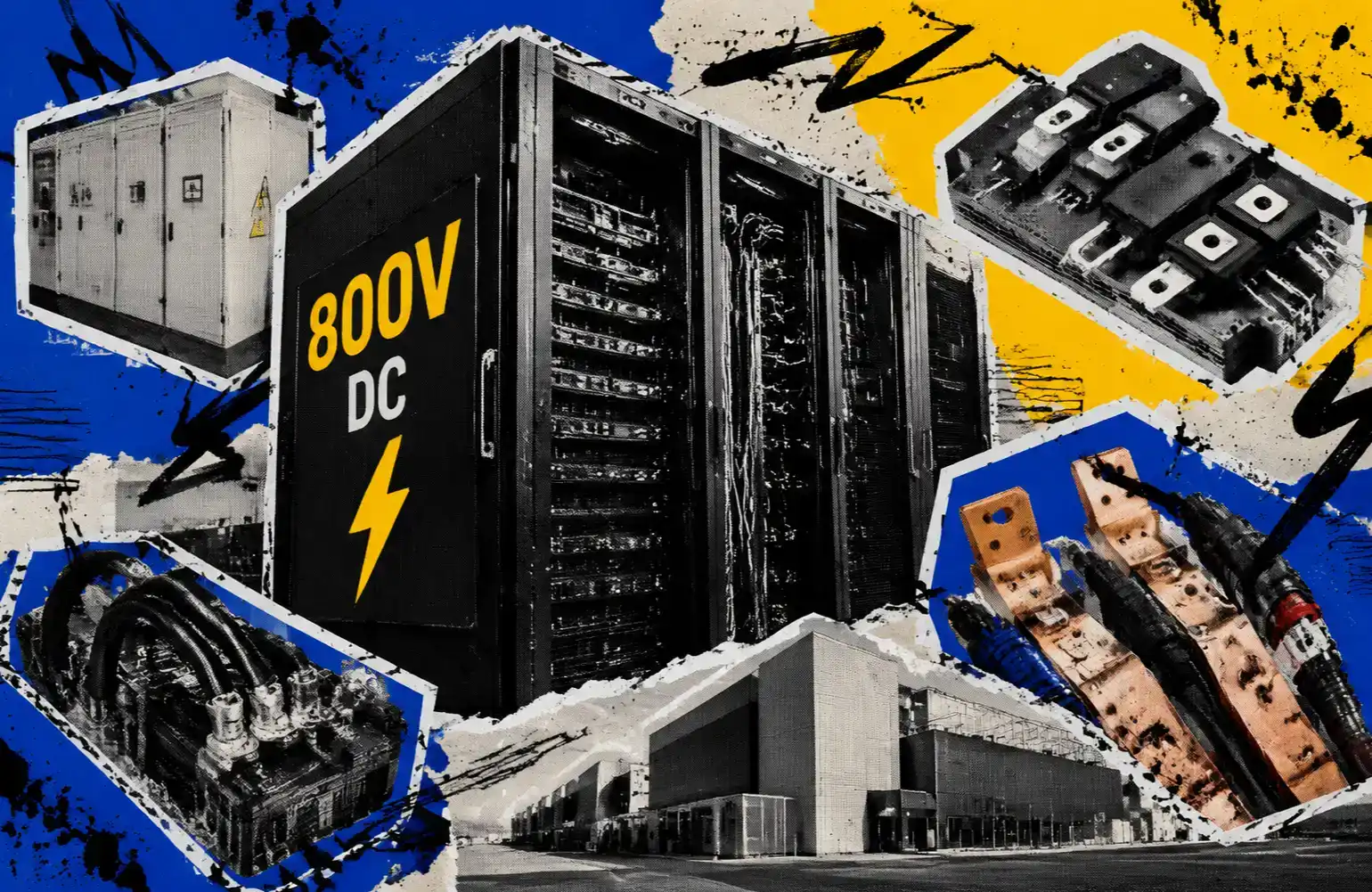
The 800V Voltage Standard Championed by Nvidia: Which Infrastructure Providers Stand to Benefit?

NVIDIA is actively promoting the 800VDC architecture as a key direction for its next-generation AI factories and high-power racks, particularly for the upcoming Rubin and Kyber platforms. The primary driver is the rapidly increasing power density of AI racks, with designs like GB200/GB300 NVL72 reaching 120-140kW and future systems potentially hitting 180-220kW. At such high power levels, traditional low-voltage power delivery becomes inefficient due to massive current, leading to significant copper use, cable bulk, heat, and power loss. The 800VDC standard aims to increase efficiency by transmitting power at higher voltage and lower current to the rack before stepping it down locally for GPUs. NVIDIA claims this can improve efficiency by up to 5%, reduce total cost of ownership (TCO) by up to 30%, and cut copper usage by approximately 45%. This shift redefines infrastructure roles, pushing power engineering to the forefront alongside GPU performance. Key beneficiaries and ecosystem partners highlighted include: 1. **Power Infrastructure Providers:** Companies like Vertiv, Schneider Electric, Delta Electronics (台达电), and Korean firms LS Electric and HD Hyundai Electric are involved in designing next-gen AI factory power distribution, rack power supplies, and backup systems. 2. **Power Semiconductors:** Suppliers of SiC/GaN devices, such as Infineon and STMicroelectronics, are better suited for high-voltage, high-efficiency conversion in this new architecture. 3. **Connectivity & Structure:** The focus shifts to high-reliability components like busbars, high-voltage connectors, and advanced PCBs that meet stricter insulation and safety requirements. 4. **Liquid Cooling & Rack ODM:** As power and heat density rise, liquid cooling becomes critical. Full-rack system integrators (e.g., Dell, Wiwynn, Wistron) must now demonstrate robust pre-delivery testing capabilities, including burn-in testing under full load, requiring significant power and cooling infrastructure in their factories. The transition is not immediate for all data centers but is targeted at high-density AI factories. NVIDIA’s 800VDC ecosystem is in a preparatory phase, with full-scale production expected to align with the 2027 launch of Kyber rack-scale systems. The investment thesis revolves around which companies can demonstrate proven product integration, customer validation, and reliable delivery of complete, high-power AI rack systems, making power, cooling, and testing capabilities new critical variables in the AI infrastructure value chain alongside GPUs.

marsbit43 мин. назад

The 800V Voltage Standard Championed by Nvidia: Which Infrastructure Providers Stand to Benefit?

marsbit43 мин. назад

Торговля

Спот
Фьючерсы
活动图片