Author | Asher(@Asher_ 0210)

Prediction markets are currently one of the most discussed sectors in Web3.
Trading around macro events, the crypto industry, and even entertainment topics continues to heat up, with discussion fervor and participation numbers constantly rising. However, as the market develops rapidly, some discordant voices have gradually emerged—some events, upon settlement, deviate from users' expectations based on common sense or "real-world understanding," sparking controversies over rule design, fairness, and even platform credibility.
Recently, two highly controversial events occurred in quick succession in prediction markets. Below, Odaily Planet Daily will sort through and discuss them.
Polymarket: U.S. Rescue of Downed Pilot in Iran Judged as U.S. Invasion of Iran
On April 3, a U.S. F-15E Strike Eagle fighter jet was shot down by Iranian air defense systems in southwestern Iran. The two crew members (one pilot, one Weapon Systems Officer/WSO) ejected; one was quickly rescued, while the other was missing for several days, hiding in the Iranian mountains.
- The U.S. military subsequently launched a Search and Rescue (SAR) operation involving armed aircraft, helicopters, etc., ultimately successfully rescuing the second severely injured crew member (Trump personally announced "WE GOT HIM").
- The rescue operation involved U.S. forces entering Iranian territory (mountain search and rescue, possible ground or low-altitude operations), which attracted attention given the current sensitive geopolitical conflict background.
Since U.S. forces entering Iranian territory could, in a way, be considered a U.S. invasion of Iran, this directly affected the prediction event on the Polymarket platform regarding when U.S. forces would enter Iran (US forces enter Iran by?).
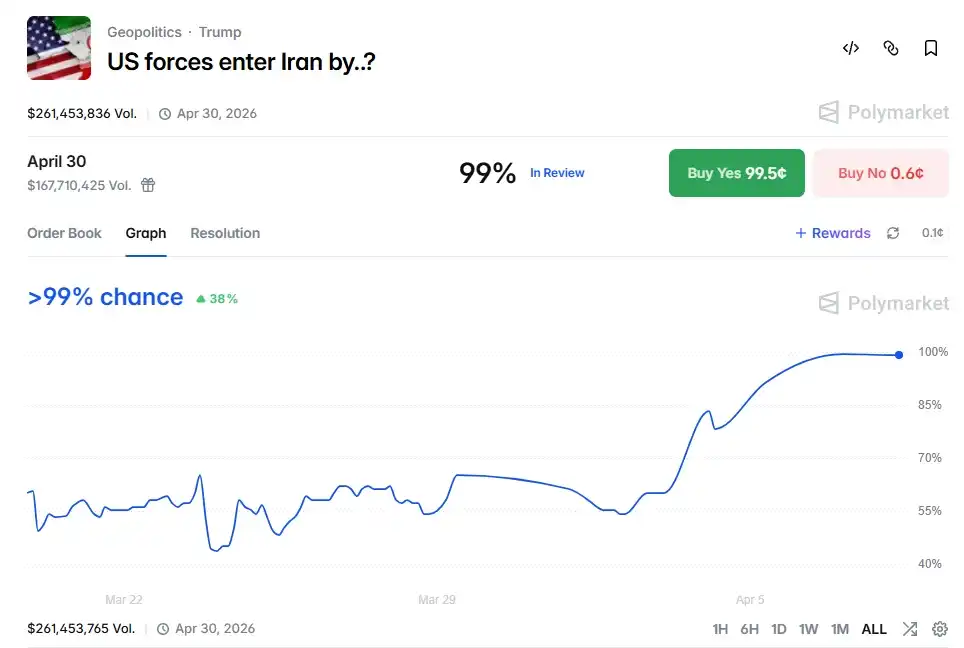
According to the settlement rules, active U.S. military personnel (including special operations forces) entering Iranian land territory before the specified date counts as an invasion. Downed pilots do not count as invasion, but the special forces sent by the U.S. military did indeed enter Iranian territory to rescue the pilot. Therefore, the special forces entering Iran to rescue the pilot met the criteria for judging "Yes" for a U.S. invasion of Iran.
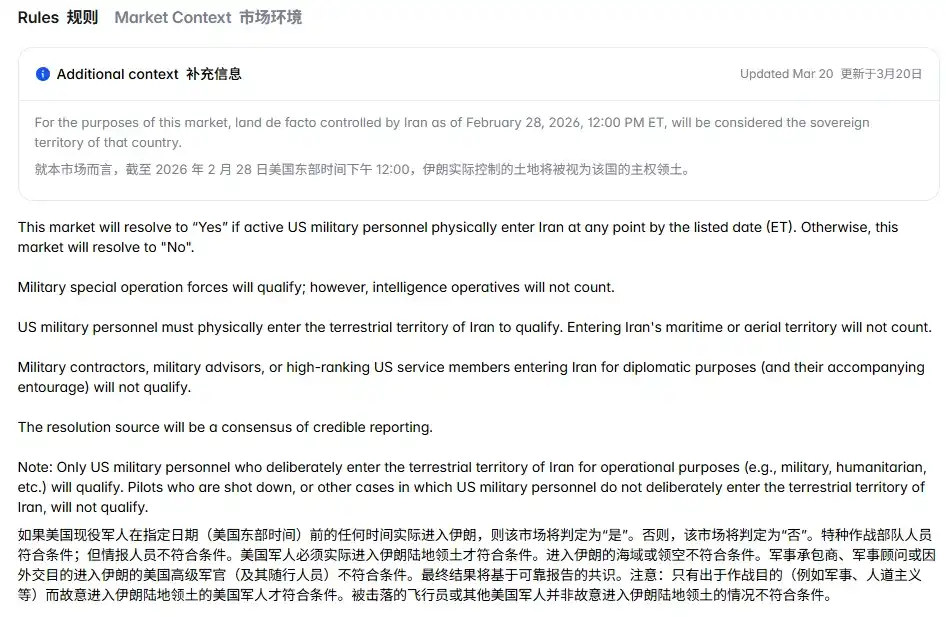
Polymarket's judgment that the "pilot rescue" event constituted a U.S. invasion of Iran has sparked strong controversy in the community.
Those supporting "counts as entry" (Yes side) argue that this operation meets the definition of "entry" in the rules. The U.S. special forces deliberately entered Iranian territory to execute a mission, and the rules explicitly state that "special operation forces will qualify," also covering "for operational purposes (including humanitarian)." Objectively, this is the first confirmed ground infiltration by U.S. forces in the current conflict context; U.S. personnel did set foot on Iranian soil, so it should be considered "entry."
Those opposing "counts as entry" (No side) believe this definition is an overextension. The action was essentially a short-term, limited-scale humanitarian rescue, not a combat invasion (invasion), nor did it have an intent to occupy, which does not align with the public's common-sense understanding of "U.S. forces entering Iran." Furthermore, the rules explicitly exclude "pilots who are shot down... will not qualify," and this operation was precisely about rescuing a downed pilot, possessing a nature of "forced entry" and should logically fall under a similar exception. Referring to past cases (e.g., similar regional actions were not considered invasions), rescue operations should not be equated with military entry; if judged as Yes, it might encourage marginal interpretations of the rules, weakening the market's seriousness and consistency. The Chinese community also generally believes that "entering Iran" should refer more to large-scale ground or amphibious operations, not short-term "rescue and leave" actions.
Predict.fun: Polymarket Issuing Stablecoin Judged as Token Launch
On the evening of April 6, Polymarket officially announced on X a comprehensive exchange upgrade:
- Rebuilding the trading engine, upgrading smart contracts;
- Launching a new native collateral token, Polymarket USD (1:1 pegged to USDC, to replace USDC.e and reduce bridging risks).
The second point, mentioning the launch of the native collateral token Polymarket USD, directly affected the probability of two related prediction events on the Predict.fun platform: one about token launch; the other about post-launch market cap:
1. When will Polymarket launch a token? (Will Polymarket launch a token by ___ ?)
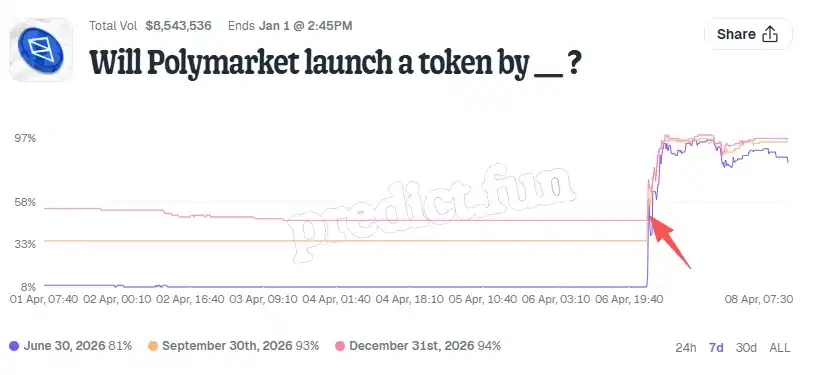
2. Polymarket's FDV one day after launch (Polymarket FDV above ___ one day after launch?);
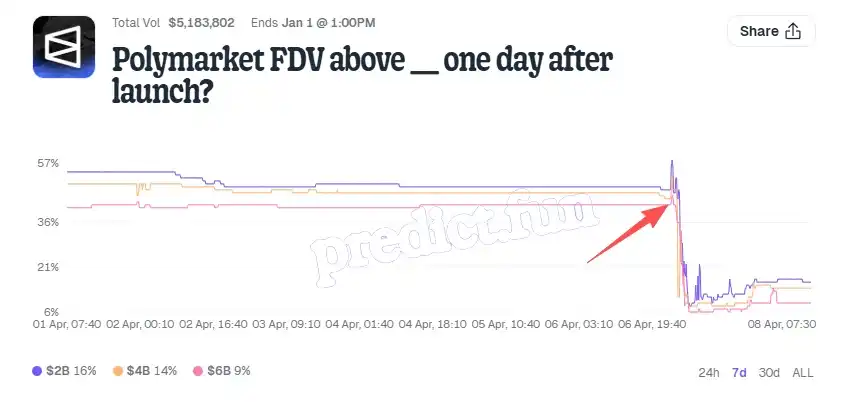
According to the settlement rules document, it clearly states that "any fungible token issued by Polymarket counts as a 'token launch' in this event", and stablecoins are of course no exception. Therefore, the Polymarket stablecoin meets the criteria for a Yes judgment.
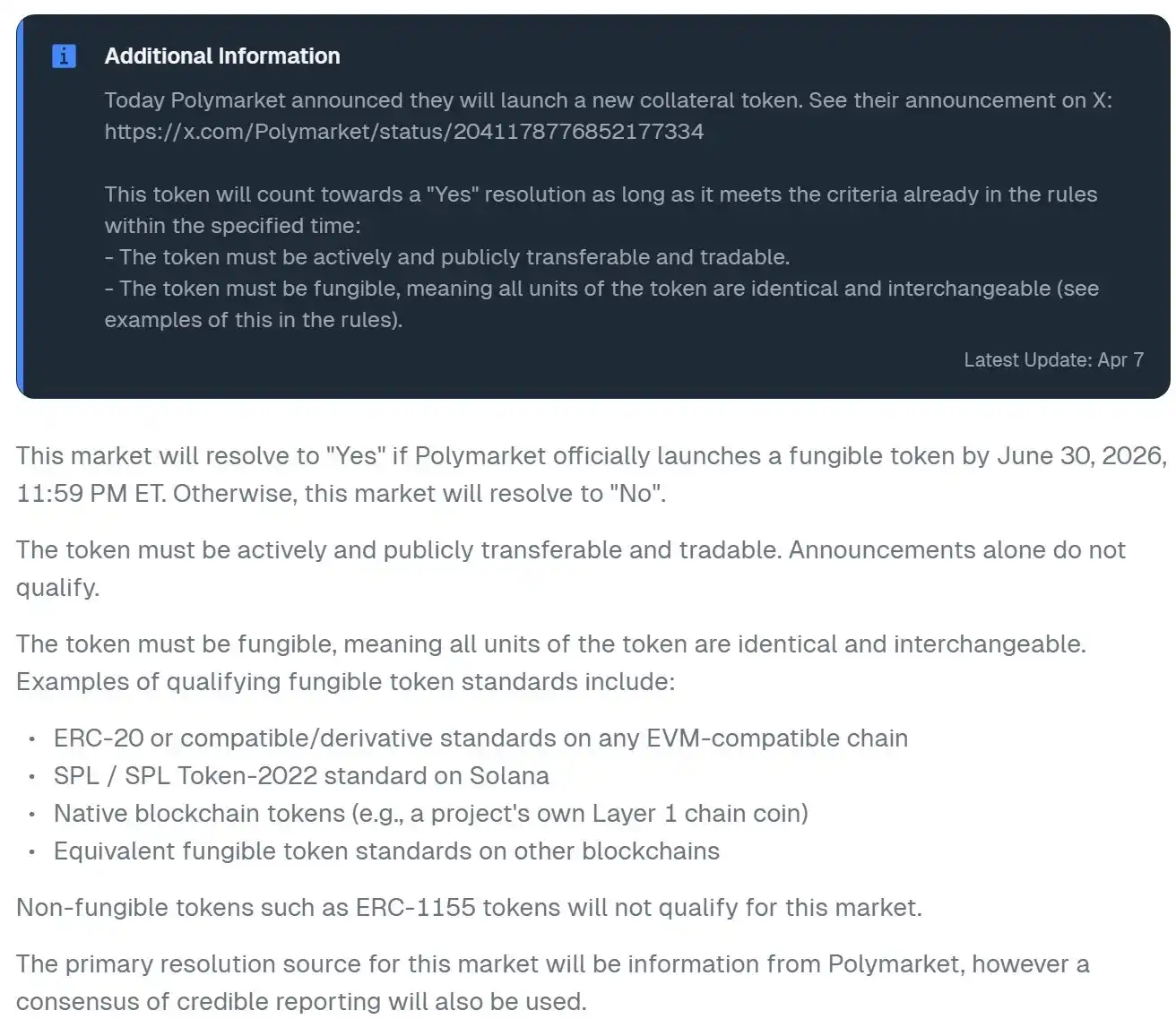
Relevant explanation of settlement rules
The community debated this issue.
Supporters argue that, literally from the rules, "issuing a token" is not limited to must be a "governance token," but is a general term for all tokens. Under this premise, Polymarket USD, as a fungible token (like ERC20/SPL) issued by Polymarket, essentially fits the definition of "token launch." Additionally, the official follow-up clarification was more a reiteration of the existing rules rather than a temporary change, so it has some legitimacy in terms of compliance.
However, skeptics do not accept this interpretation. On one hand, they believe including stablecoins in the "token launch" category is an overinterpretation of the rules, a typical play on words; on the other hand, even if stablecoins are acknowledged as "token launch," the core of this prediction market is "Polymarket FDV," not "Polymarket USD FDV." Stablecoins serve more as collateral or settlement tools; their market cap structure is fundamentally different from that of the project's main token (e.g., a POLY governance token), so they should not be directly equated or substitute for the project's overall valuation logic.
Which Side Are You On?
Overall, looking at these events, the controversies in prediction markets essentially revolve around a core question: are you betting on "reality" or are you betting on "rules"? Often, these two do not completely overlap.
For us participating in prediction markets, understanding the rules themselves might be more important than judging the direction of events. How the information source is defined, whether there are exception clauses, whether there is room for interpretation—these details can decisively determine win or loss at critical moments.
Precisely because of this, some high-probability events that look like "sure-win bets" are not without risk; they might instead be potential "lose-everything bets." Many reversals happen exactly in these overlooked details. Rather than betting blindly, taking an extra look at the rules is more useful than complaining after losing money.