Polymarket's "2028 Presidential Election" Traffic King Is... LeBron James???

Odaily星球日报Опубликовано 2026-04-23Обновлено 2026-04-23

Введение

An article titled "Polymarket's '2028 Presidential Election' Volume Leader is... LeBron James???" discusses a peculiar trend on the prediction market platform Polymarket. Despite having less than a 1% real-time probability of winning, celebrities like NBA star LeBron James (with $48.41 million in trading volume), Kim Kardashian ($33.84 million), and even ineligible candidates such as Elon Musk ($23.14 million) dominate trading activity for the 2028 U.S. presidential election. In contrast, high-probability candidates like Vice President JD Vance and California Governor Gavin Newsom have significantly lower volumes. The high volumes for unlikely candidates are not driven by irrational betting. Instead, they are largely attributed to users seeking risk-free returns from Polymarket’s 4% annualized holding rewards for certain markets, which exceeds the yield on 5-year U.S. Treasuries. Large holders often simultaneously buy both "YES" and "NO" shares on these candidates to capitalize on this incentive. Additionally, some users purchase "NO" shares for liquidity or pricing advantages and later convert them into "YES" shares for their preferred candidates. Thus, the seemingly absurd trading behavior is rational and strategically motivated.

Original | Odaily Planet Daily (@OdailyChina)

Author | Azuma (@azuma_eth)
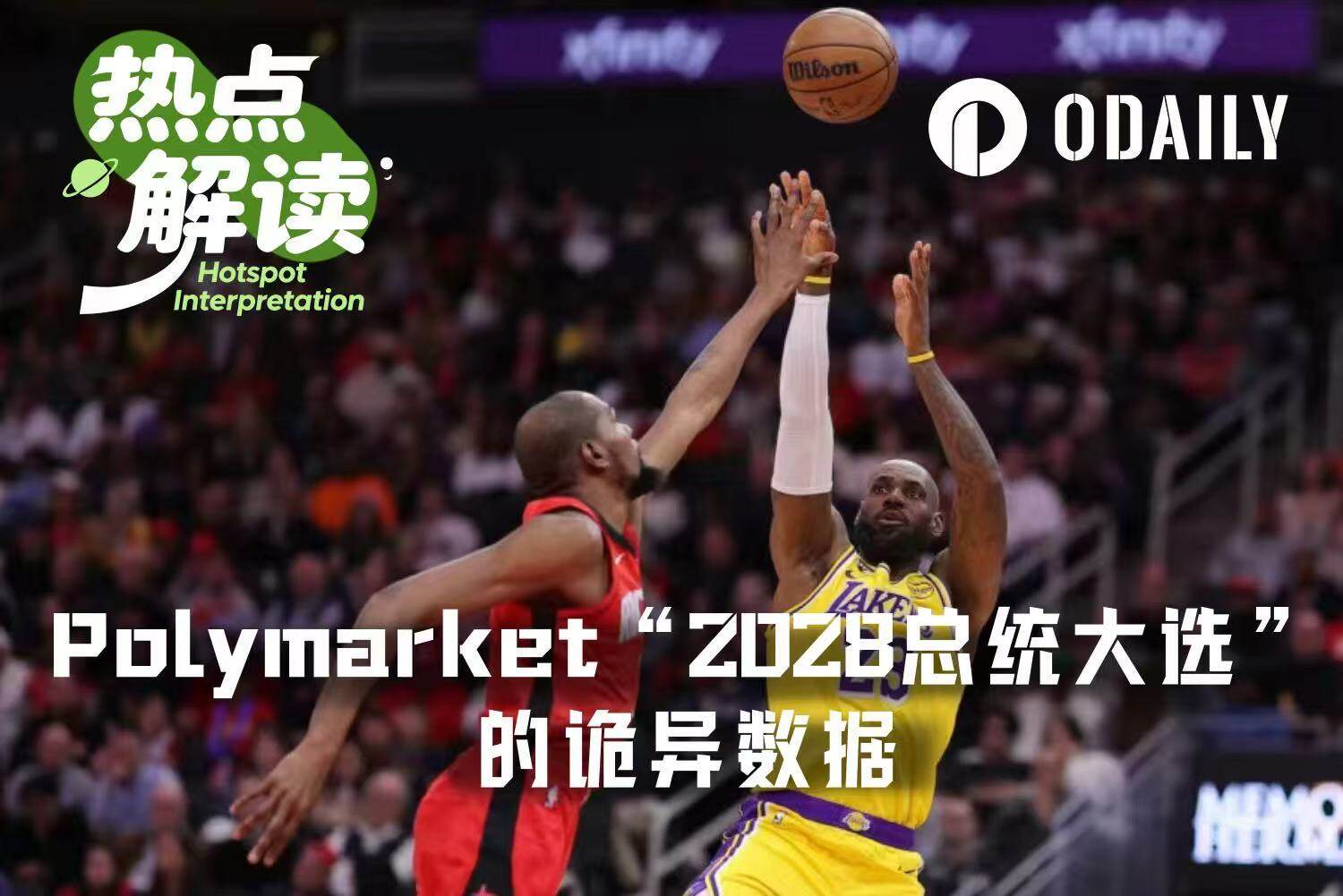
This morning, Barron's reporter Nick Devor posted a very "bizarre" phenomenon on X — on the "2028 Presidential Election" prediction event on Polymarket, about 70% of the trading volume is concentrated on some almost impossible (real-time probability less than 1%) candidates.

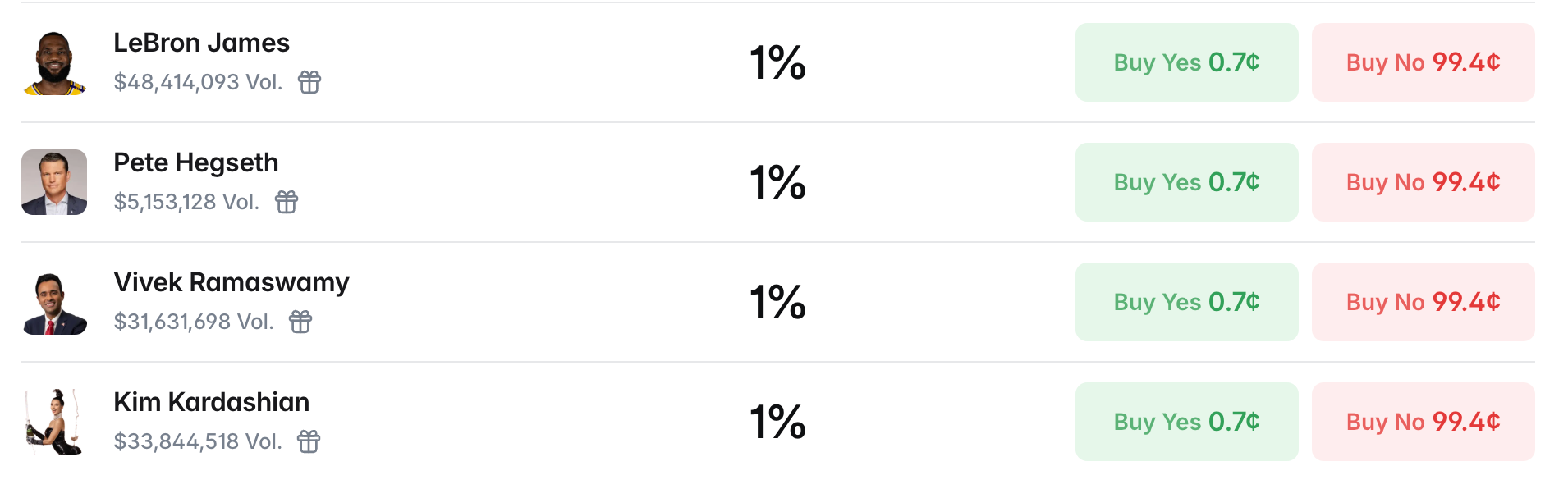
For example, the highest trading volume is actually NBA star LeBron James (trading volume $48.41 million), followed closely by entertainment celebrity Kim Kardashian (trading volume $33.84 million), and even some candidates who are not even U.S. citizens (not meeting the candidacy rules), such as the world's richest man Elon Musk (trading volume $23.14 million), New York City Mayor Zohran Mamdani (trading volume $18.39 million)......
As for those truly high-probability candidates, such as the real-time probability leader Vice President JD Vance (trading volume $10.58 million), California Governor Gavin Newsom (trading volume $15.71 million), Secretary of State Marco Rubio (trading volume $9.32 million), their trading volumes are far lower than the aforementioned "celebrity candidates".
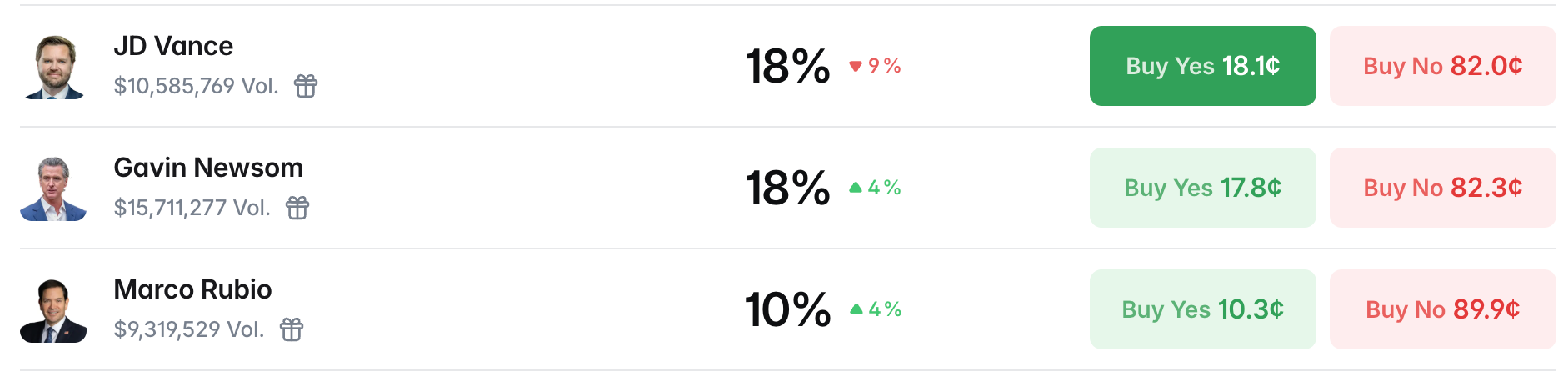
Official data from Polymarket shows that the total trading volume for the "2028 Presidential Election" has reached $549 million, making it the platform's hottest betting event. However, a closer look at the trading volume data for the 36 candidates reveals the counterintuitive situation described above. Why is this? Are people crazy, betting on candidates who are almost or completely impossible?

The answer, of course, is no. Earlier this year, Odaily wrote an article titled "Who is Placing Counterintuitive Bets in Prediction Markets?", which used examples like "The Second Coming of Jesus" and "Flat Earth Theory" to explain that the groups trading or providing liquidity in these absurd event markets can be categorized into three main types: "lottery players, bots, and airdrop hunters".
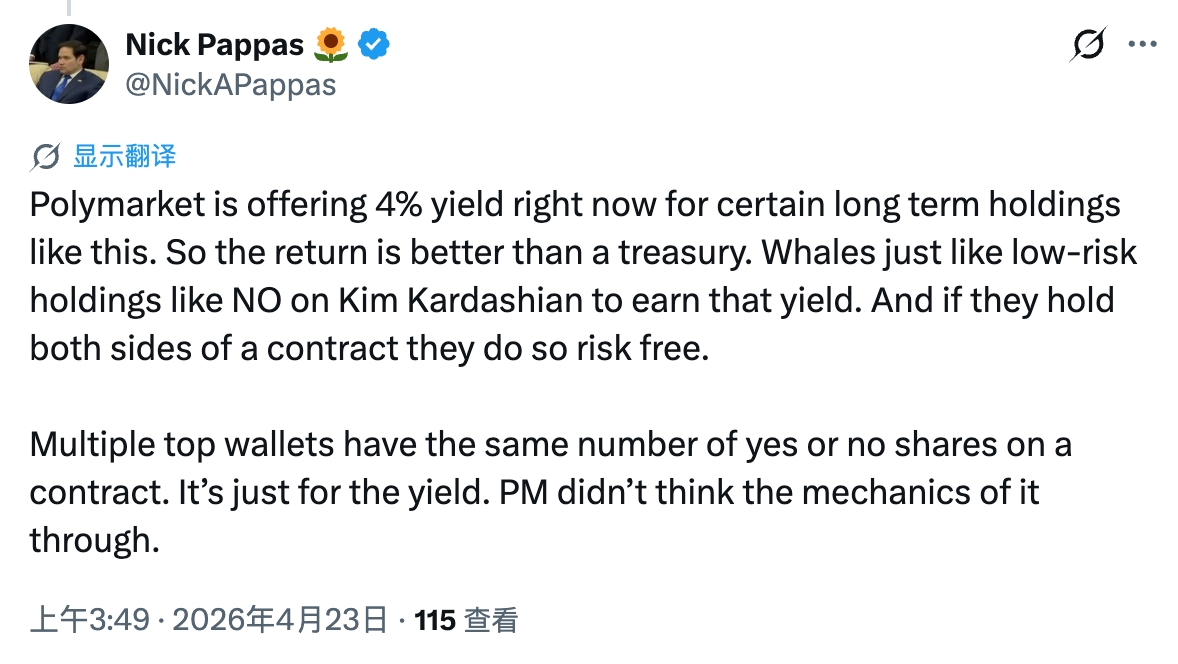
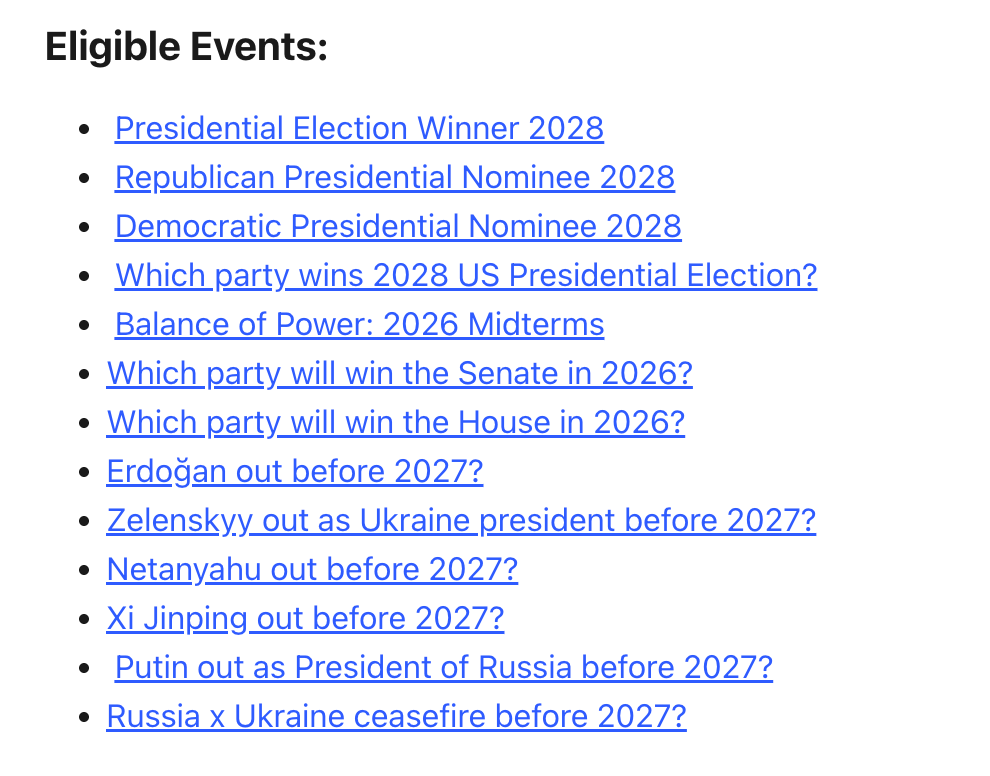
Nick Devor's own explanation also aligns with the third logic we listed. He found that multiple top addresses hold equal quantities of YES and NO shares for the same candidate, essentially aiming to earn risk-free returns subsidized by Polymarket — to maintain long-term pricing accuracy, Polymarket provides a 4% annualized holding reward based on the total position value for holdings in certain markets, and the "2028 Presidential Election" is one of these subsidized events.
Nick Devor stated that a 4% annualized return is higher than the current U.S. Treasury yield (3.98% for 5-year notes), making whales prefer this low-risk holding strategy. For example, they might buy NO shares for James or Kardashian (it's all the same, just buy whoever is popular) to capture this return; by simultaneously holding both YES and NO shares, they can achieve risk-free returns.

As for why some users unilaterally hold small amounts of YES shares for such low-probability candidates, another X user A5 (@probablythenuts) explained that in this type of multi-option market, Polymarket offers a feature that allows users to convert a set of NO shares into a corresponding set of YES shares.

Many users utilize this feature for better liquidity depth or pricing — meaning they don't directly buy YES shares for the candidate they think will win, but first buy NO shares for the candidates they believe will lose, and then convert these NO shares into a corresponding set of YES shares. Additionally, they can buy NO shares for multiple candidates and, after conversion, hold a corresponding set of YES shares for other candidates, including any new candidates added to the event in the future.

Therefore, the users trading James and Kardashian on Polymarket's "2028 Presidential Election" event are neither crazy nor foolish. They are either seeking stable annualized returns or a better execution path. While the operations may seem absurd, they are still driven by rationality.

Связанные с этим вопросы

QWhy is LeBron James the highest volume candidate in Polymarket's 2028 US Presidential Election market, despite having less than a 1% chance of winning?

AThe high trading volume on seemingly improbable candidates like LeBron James is primarily driven by users seeking to earn a risk-free 4% annualized yield on their positions, which is subsidized by Polymarket and is higher than the current 5-year US Treasury yield. Additionally, some users trade these candidates to utilize a platform feature that allows for the conversion of NO shares into YES shares for better execution.

QWhat are the three main groups of participants that trade in outlandish prediction market events, as mentioned in the article?

AThe three main groups are lottery-type bettors, automated trading bots, and airdrop farmers (users seeking to earn platform rewards).

QWhat specific financial incentive does Polymarket offer to encourage liquidity in its '2028 Presidential Election' market?

APolymarket offers a 4% annualized yield on the total position value for holding shares in certain markets, including the '2028 Presidential Election' market, to maintain long-term pricing accuracy.

QHow can a user achieve a risk-free return on Polymarket according to the explanation provided?

AA user can achieve a risk-free return by simultaneously holding both YES and NO shares for the same candidate, thereby qualifying for the platform's 4% annualized yield subsidy on the total position value without any market exposure.

QWhat is the functional reason, unrelated to yield farming, that a user might trade the NO shares of a low-probality candidate like Kim Kardashian?

AA user might trade the NO shares of a low-probability candidate to later use Polymarket's conversion feature, which allows them to swap a set of NO shares for a corresponding set of YES shares, often to get better liquidity or pricing than buying the YES shares directly.

Похожее

Fu Peng's First Public Speech in 2026: What Exactly Are Crypto Assets? Why Did I Join the Crypto Asset Industry?

Fu Peng, a renowned macroeconomist and now Chief Economist at New火 Group, delivered his first public speech of 2026 at the Hong Kong Web3 Festival. He explained his perspective on crypto assets and why he joined the industry, framing it within the context of macroeconomic trends and financial evolution. Fu emphasized that crypto assets are transitioning from an early, belief-driven phase to a mature, institutionally integrated asset class. He drew parallels to the 1970s-80s, when technological advances (like computing) revolutionized traditional finance, leading to the rise of FICC (Fixed Income, Currencies, and Commodities). Similarly, current advancements in AI, data, and blockchain are reshaping finance, with crypto assets becoming part of a new "FICC + C" (C for Crypto) framework. He noted that institutional capital, including traditional hedge funds, avoided early crypto due to its speculative nature but are now engaging as regulatory clarity emerges (e.g., stablecoin laws, CFTC classifying crypto as a commodity). Fu predicted that 2025-2026 marks a turning point where crypto becomes a standardized, financially viable asset for diversified portfolios, akin to commodities or derivatives in traditional finance. Fu defined Bitcoin not as "digital gold" in a simplistic sense but as a value-preserving, financially tradable asset. He highlighted that crypto's future lies in regulated, institutional adoption, moving away from retail-dominated trading. His entry into crypto signals this maturation, where traditional finance integrates crypto into mainstream asset management.

marsbit46 мин. назад

Fu Peng's First Public Speech in 2026: What Exactly Are Crypto Assets? Why Did I Join the Crypto Asset Industry?

marsbit46 мин. назад

Justin Sun Sues Trump Family: What $75 Million Bought Was Only a Blacklist

Justin Sun, founder of Tron, has filed a lawsuit in federal court against World Liberty Financial (WLF), alleging he was made the "primary target of a fraudulent scheme" after investing $75 million. Sun claims the investment secured him an advisor title and WLFI tokens, which were later frozen by WLF, causing "hundreds of millions in losses." The dispute began in late 2024 when Sun's investment helped revive WLF's struggling token sale, which ultimately raised $550 million. Shortly after, the SEC dropped its lawsuit against Sun following Donald Trump's inauguration. However, relations soured when Sun refused WLF's demands for additional funding. In August 2025, WLF added a "blacklist" function to its smart contract, allowing it to unilaterally freeze tokens. Sun's holdings, worth approximately $107 million, were frozen, and he was threatened with token destruction. The lawsuit highlights WLF's structure, which directs 75% of token sale profits to the Trump family, who had earned $1 billion by December 2025. WLF's CEO is Zach Witkoff, son of U.S. Middle East envoy Steve Witkoff. The project faces scrutiny for opaque operations, including a controversial loan arrangement on the Dolomite platform, co-founded by a WLF advisor. Despite Sun's history with the SEC, the case underscores centralization risks within DeFi, as WLF controls governance and holds powers to freeze assets arbitrarily. Sun's tokens remain frozen as legal proceedings begin.

marsbit53 мин. назад

Justin Sun Sues Trump Family: What $75 Million Bought Was Only a Blacklist

marsbit53 мин. назад

$500 to Buy OpenAI Stock: Silicon Valley's Most Respectable Liquidity Invitation

Silicon Valley's largest venture capital platform, AngelList, has launched a new fund called USVC, allowing U.S. retail investors to buy into high-profile AI companies like OpenAI, Anthropic, and xAI with a minimum investment of $500—no accredited investor status required. Promoted by AngelList co-founder Naval Ravikant, the fund is framed as an opportunity for ordinary people to access high-growth private tech investments traditionally reserved for VCs. However, critics argue it functions more like an exit vehicle for early insiders. USVC acquires shares not through primary rounds but largely via secondary transactions—purchasing stakes from early investors, VC funds, and employees looking to cash out at peak valuations. With companies like xAI heavily weighted in the portfolio, the fund effectively channels retail money into providing liquidity for insiders who entered at much lower valuations. The fund’s structure raises concerns: shares are illiquid, with no secondary market, and buybacks are limited and discretionary. The actual annual fee reaches 3.61%, far above the advertised 1% management fee. This model parallels the "low float, high fully diluted valuation" strategy seen in crypto, where early investors profit by selling to latecomers at inflated prices. The timing—alongside similar moves by platforms like Robinhood—suggests that Silicon Valley’s sudden interest in retail inclusion may be less about democratizing access and more about securing exits for insiders.

marsbit1 ч. назад

$500 to Buy OpenAI Stock: Silicon Valley's Most Respectable Liquidity Invitation

marsbit1 ч. назад

Торговля

Спот
Фьючерсы

Популярные статьи

Как купить S

Добро пожаловать на HTX.com! Мы сделали приобретение Sonic (S) простым и удобным. Следуйте нашему пошаговому руководству и отправляйтесь в свое крипто-путешествие.Шаг 1: Создайте аккаунт на HTXИспользуйте свой адрес электронной почты или номер телефона, чтобы зарегистрироваться и бесплатно создать аккаунт на HTX. Пройдите удобную регистрацию и откройте для себя весь функционал.Создать аккаунтШаг 2: Перейдите в Купить криптовалюту и выберите свой способ оплатыКредитная/Дебетовая Карта: Используйте свою карту Visa или Mastercard для мгновенной покупки Sonic (S).Баланс: Используйте средства с баланса вашего аккаунта HTX для простой торговли.Третьи Лица: Мы добавили популярные способы оплаты, такие как Google Pay и Apple Pay, для повышения удобства.P2P: Торгуйте напрямую с другими пользователями на HTX.Внебиржевая Торговля (OTC): Мы предлагаем индивидуальные услуги и конкурентоспособные обменные курсы для трейдеров.Шаг 3: Хранение Sonic (S)После приобретения вами Sonic (S) храните их в своем аккаунте на HTX. В качестве альтернативы вы можете отправить их куда-либо с помощью перевода в блокчейне или использовать для торговли с другими криптовалютами.Шаг 4: Торговля Sonic (S)С легкостью торгуйте Sonic (S) на спотовом рынке HTX. Просто зайдите в свой аккаунт, выберите торговую пару, совершайте сделки и следите за ними в режиме реального времени. Мы предлагаем удобный интерфейс как для начинающих, так и для опытных трейдеров.

1.2k просмотров всегоОпубликовано 2025.01.15Обновлено 2025.03.21

Как купить S

Sonic: Обновления под руководством Андре Кронье – новая звезда Layer-1 на фоне спада рынка

Он решает проблемы масштабируемости, совместимости между блокчейнами и стимулов для разработчиков с помощью технологических инноваций.

2.2k просмотров всегоОпубликовано 2025.04.09Обновлено 2025.04.09

Sonic: Обновления под руководством Андре Кронье – новая звезда Layer-1 на фоне спада рынка

HTX Learn: Пройдите обучение по "Sonic" и разделите 1000 USDT

HTX Learn — ваш проводник в мир перспективных проектов, и мы запускаем специальное мероприятие "Учитесь и Зарабатывайте", посвящённое этим проектам. Наше новое направление .

1.8k просмотров всегоОпубликовано 2025.04.10Обновлено 2025.04.10

HTX Learn: Пройдите обучение по "Sonic" и разделите 1000 USDT

Обсуждения

Добро пожаловать в Сообщество HTX. Здесь вы сможете быть в курсе последних новостей о развитии платформы и получить доступ к профессиональной аналитической информации о рынке. Мнения пользователей о цене на S (S) представлены ниже.

活动图片