
Valuation Surpasses 200 Billion, Kimi Reportedly Raises 13.6 Billion More, Speeds Up Hong Kong IPO

marsbitОпубликовано 2026-06-08Обновлено 2026-06-08

Введение

Beijing-based AI unicoth MoonDark (Kimi) is reportedly in talks for a new funding round aiming to raise up to $20 billion (approximately RMB 136 billion), targeting a post-money valuation of $300 billion (approximately RMB 2.035 trillion). If successful, this would mark its third round in six months and a six-fold increase from its $43 billion valuation in December last year. Last month, the company completed a $20 billion funding round led by Meituan Longzhu, reaching a valuation exceeding $200 billion. According to reports, MoonDark has raised over RMB 376 billion across six rounds, making it the most funded large language model startup in China. Founded in 2023 by CEO Yang Zhilin, the company's core product is the Kimi AI Assistant. In April, it launched and open-sourced its flagship model, Kimi K2.6, which has demonstrated performance comparable to top models like GPT-5.4 in certain benchmarks. Recently, it began beta testing for Kimi Work, a local AI agent for knowledge workers. Commercially, the company's Annual Recurring Revenue (ARR) reportedly surpassed $2 billion in April. Regarding its IPO plans, Bloomberg reported in March that MoonDark is preparing for a listing in Hong Kong, though the process remains in early stages. The funding and IPO pace for leading Chinese AI firms has accelerated notably in 2026, mirroring global trends where companies like OpenAI and Anthropic are also setting new fundraising and valuation records. Securing substantial capital is bec...

Zhixi News, June 8 — According to reports, the Beijing-based AI large model unicorn Moon's Dark Side (Kimi) is currently negotiating a new round of financing, aiming for a maximum scale of 20 billion USD (approximately 136 billion RMB) and a target valuation of 300 billion USD (approximately 2,035 billion RMB).

If this round is completed as targeted, Moon's Dark Side's valuation would increase by about 6 times compared to its 4.3 billion USD (approximately 298 billion RMB) valuation in December last year. This would also be the third round of financing initiated by Moon's Dark Side in nearly six months.

Just last month, Moon's Dark Side completed a financing round of approximately 20 billion USD (approximately 136 billion RMB), with a post-money valuation exceeding 200 billion USD (approximately 1,356 billion RMB). This round was led by Meituan Dragon Ball, with participation from Tsinghua Capital, China Mobile, CPE (CITIC Private Equity), among others.

According to previous reports by Huafeng Capital, Moon's Dark Side has completed 6 rounds of financing, with a total funding amount exceeding 37.6 billion RMB, making it the domestic large model startup with the highest cumulative financing.
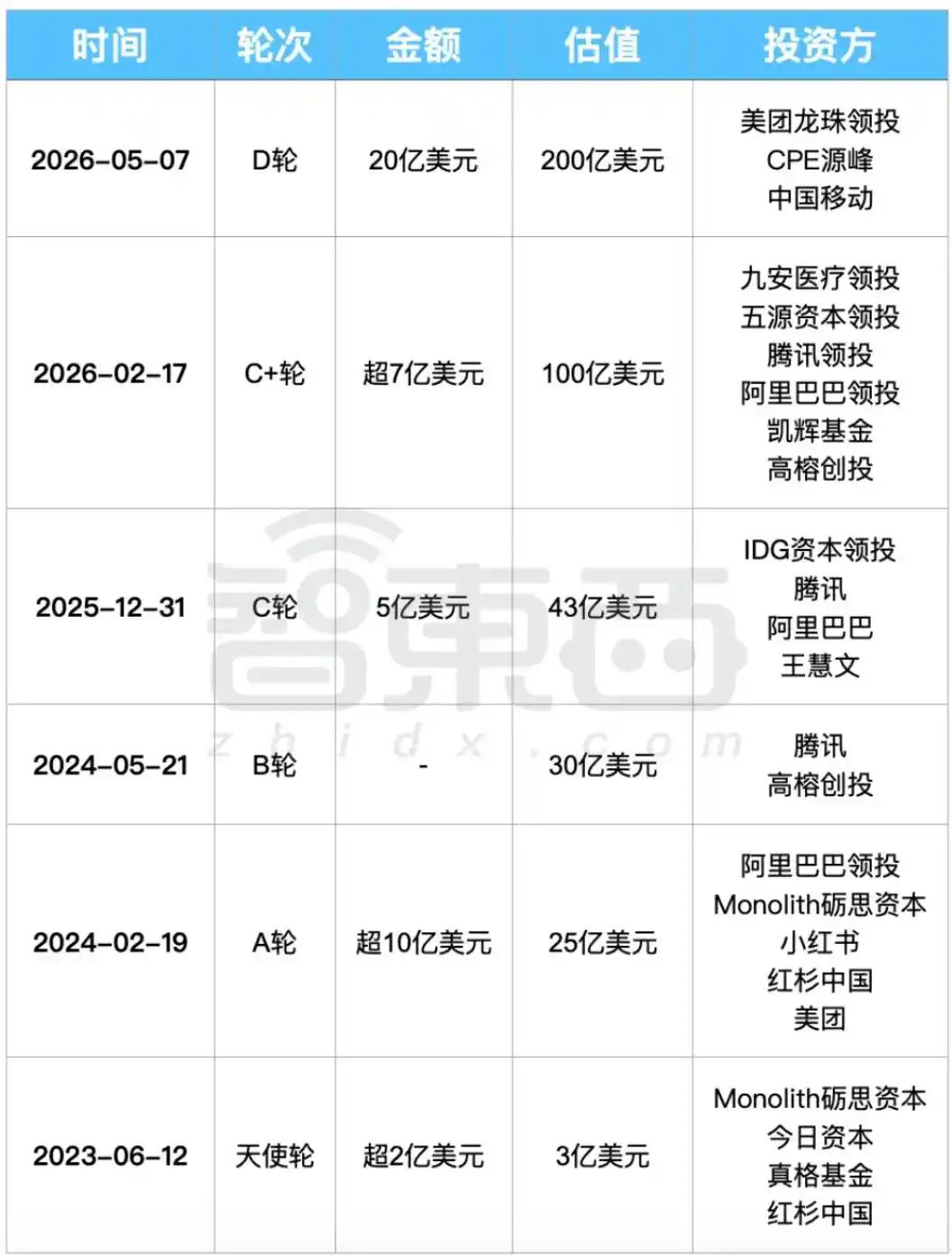
▲ Moon's Dark Side's past financing situation (Chart by Zhixi News, data source: Qichacha)

Moon's Dark Side was founded in 2023 in Beijing. Its founder and CEO, Yang Zhilin, earned his bachelor's degree from the Department of Computer Science at Tsinghua University and his Ph.D. from Carnegie Mellon University (CMU). He previously worked at Google Brain and Meta AI.

The core product of Moon's Dark Side is the Kimi Intelligent Assistant. On April 20, Moon's Dark Side released and open-sourced its flagship model Kimi K2.6. In multiple global authoritative benchmark tests, K2.6's performance in certain dimensions matched or even surpassed top closed-source models such as GPT-5.4, Claude Opus 4.6, and Gemini 3.1 Pro.

As of today, on the OpenRouter Benchmarks list, Kimi K2.6 ranks 9th on the Artificial Analysis Intelligence Index list with a score of 53.9, placing it after MiniMax-M3 and before Xiaomi MiMo-V2.5-Pro.
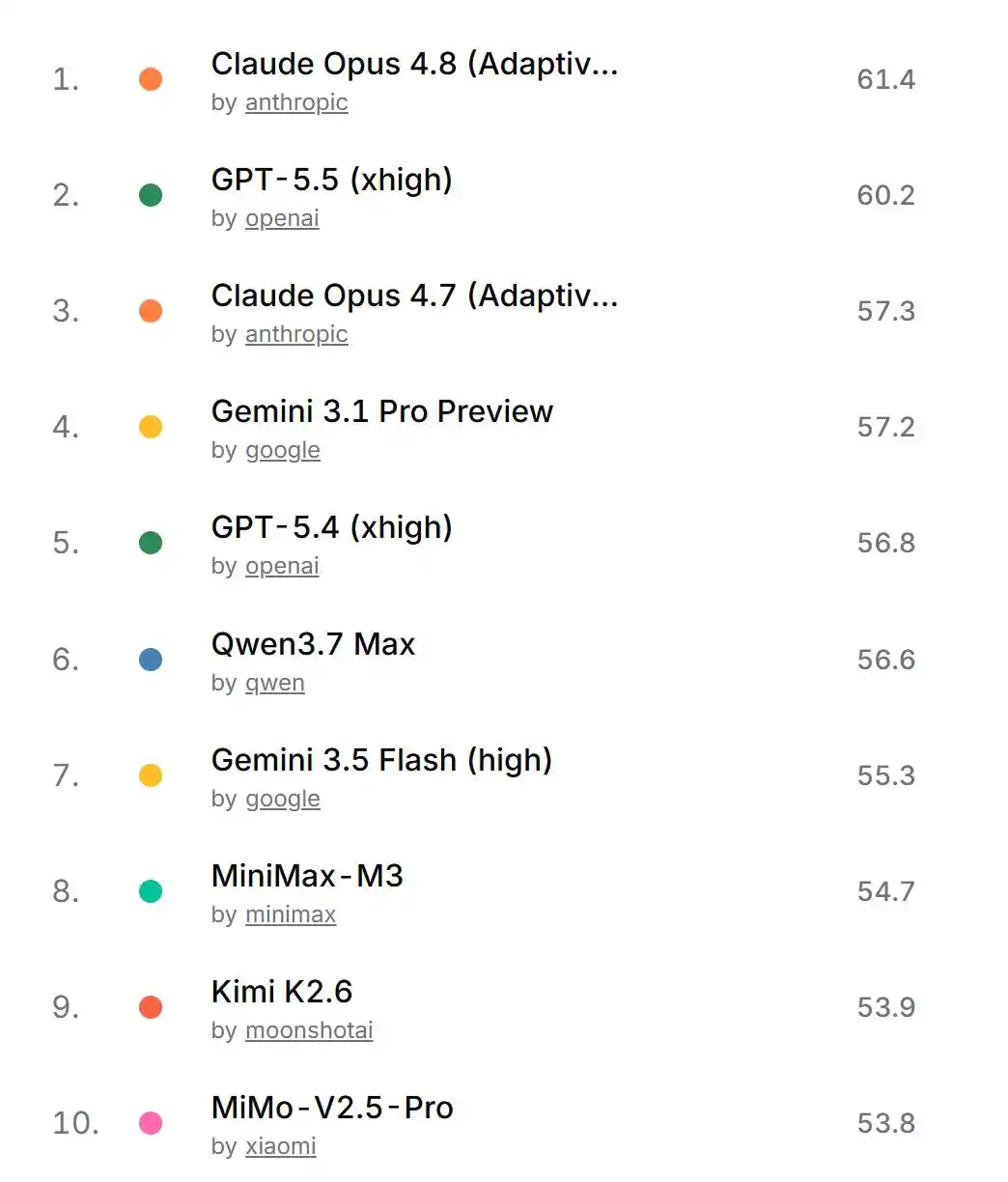
▲ Kimi K2.6 ranks 9th on the Artificial Analysis Intelligence Index list (Source: OpenRouter)

On the product side, on June 3, Moon's Dark Side began the beta testing of Kimi Work Beta, positioned as a local universal Agent for knowledge workers. Users can describe task goals in natural language, and Kimi Work can decompose tasks, call tools, use browsers, create and organize files locally on the computer, and deliver work products such as documents, spreadsheets, and PPTs.

Regarding commercialization, Moon's Dark Side has begun to generate a certain scale of revenue. According to previous disclosures by Huafeng Capital, Moon's Dark Side's Annual Recurring Revenue (ARR) in April had already exceeded 200 million USD (approximately 1.36 billion RMB), with accelerated growth in paid subscriptions and API revenue.

In terms of IPO progress, on March 26, Bloomberg reported that Moon's Dark Side is recently preparing for a Hong Kong IPO. Sources familiar with the matter stated that Moon's Dark Side is in the early stages, with the aim of stimulating investor interest in AI. Another source revealed that related preparations are still ongoing, and an IPO launch may not ultimately proceed.

Overall, since entering 2026, the capitalization process of leading domestic large model companies has significantly accelerated. On one hand, companies like Moon's Dark Side and Stepwise Stars have densely completed large-scale financing rounds, and DeepSeek was also reported last week to be about to complete its first external financing since its founding. On the other hand, companies like Zhipu and MiniMax have already taken the lead in opening the door to the Hong Kong stock market and are continuing to advance related work for A-share listings.

Looking globally, leading overseas AI companies like OpenAI and Anthropic are also preparing for IPOs, continuously setting new records for financing and valuation. In March this year, OpenAI completed a financing round of 122 billion USD (approximately 8,272 billion RMB), achieving a post-money valuation of 852 billion USD (approximately 57.8 trillion RMB). On June 1, Anthropic announced the completion of a 65 billion USD (approximately 4,407 billion RMB) Series H financing round, with a post-money valuation reaching 965 billion USD (approximately 65.3 trillion RMB), and secretly filed its IPO prospectus the following day.

Against this backdrop, the financing and IPO pace of domestic large model companies has noticeably quickened. Capital, computing power, and commercialization capabilities are becoming key variables alongside model competition. For large model companies still in a high-investment cycle, large-scale financing and IPOs are not only ways to replenish ammunition but will also become important chips in the next phase of competing for top positions.

This article is from the WeChat public account "Zhixi News" (ID: zhidxcom), author: Yang Jingli

Связанные с этим вопросы

QWhat is the rumored size of Moonshot AI's (Kimi) new funding round and its target valuation?

AMoonshot AI is reportedly in talks for a new funding round aiming to raise up to $20 billion, with a target valuation of $300 billion.

QHow many funding rounds has Moonshot AI completed, and what is its total cumulative funding amount?

AAccording to the article, Moonshot AI has completed 6 funding rounds, with a total cumulative funding exceeding 37.6 billion RMB.

QWhat is the name of Moonshot AI's core product and its recently launched flagship model?

AMoonshot AI's core product is the Kimi Intelligent Assistant. It recently released and open-sourced its flagship model, Kimi K2.6.

QWhat significant beta testing did Moonshot AI begin in early June 2026?

AOn June 3rd, Moonshot AI began the beta test of 'Kimi Work,' a local universal Agent designed for knowledge workers to perform complex tasks on their computers.

QWhat is the reported Annual Recurring Revenue (ARR) for Moonshot AI as of April, and what is its potential IPO plan?

AAs of April, Moonshot AI's Annual Recurring Revenue (ARR) reportedly exceeded $200 million. The company is reportedly preparing for a potential IPO in Hong Kong.

Похожее

The Right Way to Use Skills: 5 Reflections After Anthropic Publicly Shared Its Internal Methodology

A deep dive into Anthropic's internal methodology for building effective AI "Skills" reveals five key insights for maximizing their value. First, Skills should focus on capturing "Gotchas" and tacit organizational knowledge—like common pitfalls and undocumented rules—rather than restating general information the AI already knows. Second, think of Skills as a form of "Context Engineering"; they are best structured as folders, not monolithic documents. A core `SKILL.md` file should act as a navigational index, progressively pulling in detailed references, examples, and assets only as needed to avoid overwhelming the model's context window. Third, whenever possible, automate repetitive tasks with scripts. This preserves the model's reasoning capacity for judgment and analysis, while scripts reliably handle the execution, saving tokens and improving accuracy. Instructions within a Skill provide the "why" and the expert judgment, while scripts provide the concrete "how." Fourth, a Skill's description is critical and often misunderstood. It should not be a list of features but a routing rule that clearly signals *when* the Skill should be triggered based on user intent and common phrasing. Finally, as Skills scale from personal tools to team-wide assets, management is crucial. Anthropic advocates for a lightweight, organic approach: let new Skills spread organically within small groups first. Those that prove genuinely useful through adoption naturally graduate to a formal marketplace, ensuring the curated library contains only high-value, battle-tested tools.

marsbit16 мин. назад

The Right Way to Use Skills: 5 Reflections After Anthropic Publicly Shared Its Internal Methodology

marsbit16 мин. назад

Vying for the AI Payment Track: Traditional Card Networks Face Off Against Coinbase

As AI agents increasingly conduct commercial transactions, a battle for control over the underlying payment infrastructure is unfolding. The competition centers on two divergent and incompatible technical approaches for autonomous AI payments. One camp, led by traditional card networks Visa and Mastercard, relies on tokenized card credentials within the established banking rails. Visa's "Intelligent Commerce" and Mastercard's "Agent Pay" services extend their existing tokenization technology to authorized AI agents for consumer retail transactions, leveraging decades of fraud protection and dispute resolution systems. Their partners include major AI firms like Anthropic, OpenAI, and Microsoft. The opposing camp, spearheaded by Coinbase, advocates for an open internet protocol using stablecoins. Coinbase's x402 protocol utilizes the HTTP 402 status code to enable direct, machine-to-machine micropayments with USDC on-chain. This model eliminates card fees and is designed for high-frequency, low-value transactions between AI agents, such as paying for API calls or data streams, where traditional card costs are prohibitive. Currently, application scenarios are clearly divided. Mainstream consumer-facing AI shopping services (e.g., ChatGPT's "one-click checkout," Amazon's AI-assisted shopping) predominantly use card channels due to their mature consumer protections and merchant networks. Conversely, the stablecoin channel dominates machine-to-machine payments, as seen in Amazon Bedrock's core payment service using Base blockchain. Significantly, traditional card networks are not solely defending their turf; they are also investing in the stablecoin arena. Visa has rapidly expanded its stablecoin settlement volume and partnered with Coinbase on interoperability, while Mastercard moved to acquire stablecoin platform BVNK. This dual-strategy indicates their intent to become the fee-collecting gateway for all payment flows, regardless of the underlying rail. The short-term outlook is for coexistence: cards for personal retail, stablecoins for machine transactions. The long-term outcome hinges on whether AI-driven commerce will resemble traditional retail or evolve into a vast network of machine micropayments. Visa and Mastercard's hedging strategy suggests they are prepared for either future, while companies betting on a single channel face greater risk.

Foresight News17 мин. назад

Vying for the AI Payment Track: Traditional Card Networks Face Off Against Coinbase

Foresight News17 мин. назад

For the First Time, Pure Human Video Pretrained VLA for Dexterous Manipulation: Deployable with Minimal Fine-Tuning Data

For the first time, a purely human-video-pretrained Vision-Language-Action (VLA) model for dexterous manipulation requires only a small amount of data for fine-tuning to achieve successful real-world deployment. Achieving human-level dexterous manipulation remains a core challenge in robotics. While multi-fingered hands offer hardware potential, Visual-Language-Action (VLA) models lag behind due to the high cost of collecting diverse, high-quality robot data. A novel framework, VITRA, developed by Microsoft Research Asia and Tsinghua University, addresses this by automatically transforming massive, unlabeled real-world human activity videos into a structured V-L-A training dataset. Key innovations include precise 3D hand motion annotation from monocular video, atomic action segmentation based on hand-speed minima, and automated instruction generation using VLMs combined with 3D trajectory visualization. This process created a massive dataset of 1 million clips. Pretrained exclusively on this human video data, the VLA model (combining a VLM backbone with a Diffusion Transformer action expert) demonstrates strong zero-shot hand motion prediction in unseen environments. Crucially, it requires minimal fine-tuning (~1.2k demonstrations) on real robot data to achieve high-success-rate dexterous manipulation tasks like grasping, placing, pouring, and sweeping on hardware like the Realman robot with the XHAND1 dexterous hand. The model shows exceptional generalization to novel objects and environments. The research also observes promising scaling behavior, where performance improves with more pretraining data, paving the way for more generalized embodied intelligence.

marsbit28 мин. назад

For the First Time, Pure Human Video Pretrained VLA for Dexterous Manipulation: Deployable with Minimal Fine-Tuning Data

marsbit28 мин. назад

Торговля

Спот
Фьючерсы

Популярные статьи

Как купить UP

Добро пожаловать на HTX.com! Мы сделали приобретение Superform (UP) простым и удобным. Следуйте нашему пошаговому руководству и отправляйтесь в свое крипто-путешествие.Шаг 1: Создайте аккаунт на HTXИспользуйте свой адрес электронной почты или номер телефона, чтобы зарегистрироваться и бесплатно создать аккаунт на HTX. Пройдите удобную регистрацию и откройте для себя весь функционал.Создать аккаунтШаг 2: Перейдите в Купить криптовалюту и выберите свой способ оплатыКредитная/Дебетовая Карта: Используйте свою карту Visa или Mastercard для мгновенной покупки Superform (UP).Баланс: Используйте средства с баланса вашего аккаунта HTX для простой торговли.Третьи Лица: Мы добавили популярные способы оплаты, такие как Google Pay и Apple Pay, для повышения удобства.P2P: Торгуйте напрямую с другими пользователями на HTX.Внебиржевая Торговля (OTC): Мы предлагаем индивидуальные услуги и конкурентоспособные обменные курсы для трейдеров.Шаг 3: Хранение Superform (UP)После приобретения вами Superform (UP) храните их в своем аккаунте на HTX. В качестве альтернативы вы можете отправить их куда-либо с помощью перевода в блокчейне или использовать для торговли с другими криптовалютами.Шаг 4: Торговля Superform (UP)С легкостью торгуйте Superform (UP) на спотовом рынке HTX. Просто зайдите в свой аккаунт, выберите торговую пару, совершайте сделки и следите за ними в режиме реального времени. Мы предлагаем удобный интерфейс как для начинающих, так и для опытных трейдеров.

598 просмотров всегоОпубликовано 2026.02.10Обновлено 2026.06.02

Как купить UP

Обсуждения

Добро пожаловать в Сообщество HTX. Здесь вы сможете быть в курсе последних новостей о развитии платформы и получить доступ к профессиональной аналитической информации о рынке. Мнения пользователей о цене на UP (UP) представлены ниже.

活动图片