Anthropic and OpenAI Have Single-Handedly Severed the Logic of Pre-IPO Stock Tokenization

marsbitОпубликовано 2026-05-12Обновлено 2026-05-12

Введение

The pre-IPO stock token market is experiencing significant turmoil following strong statements from AI giants Anthropic and OpenAI. Both companies have updated their official policies, declaring that any transfer of their company shares—including sales, transfers, or assignments of share interests—without prior board approval is "invalid" and will not be recognized in their corporate records. This means buyers in such unauthorized transactions would not be recognized as shareholders and would have no shareholder rights. A major point of contention is the use of Special Purpose Vehicles (SPVs), which are legal entities commonly used by pre-IPO token platforms to pool investor funds and indirectly acquire shares from employees or early investors. The companies explicitly state they do not permit SPVs to acquire their shares, and any such transfer violates their restrictions. They warn that third parties selling shares through SPVs, direct sales, forward contracts, or stock tokens are likely engaged in fraud or are offering worthless investments due to these transfer limits. This stance directly threatens the core model of many pre-IPO token platforms, which rely on SPV structures. The announcement revealed additional risks within this model, such as complex "SPV-within-SPV" layering that obscures legal transparency, increases management fees, and creates a chain reaction risk of invalidation. Following the news, tokens like ANTHROPIC and OPENAI on platforms like PreStocks fel...

Original | Odaily Planet Daily (@OdailyChina)

Author | Azuma (@azuma_eth)

The pre-IPO stock token market has just experienced a severe shockwave. The epicenter of this earthquake comes from two statements issued by AI giants Anthropic and OpenAI.

Anthropic and OpenAI Successively State They "Do Not Recognize" Unauthorized Transfers

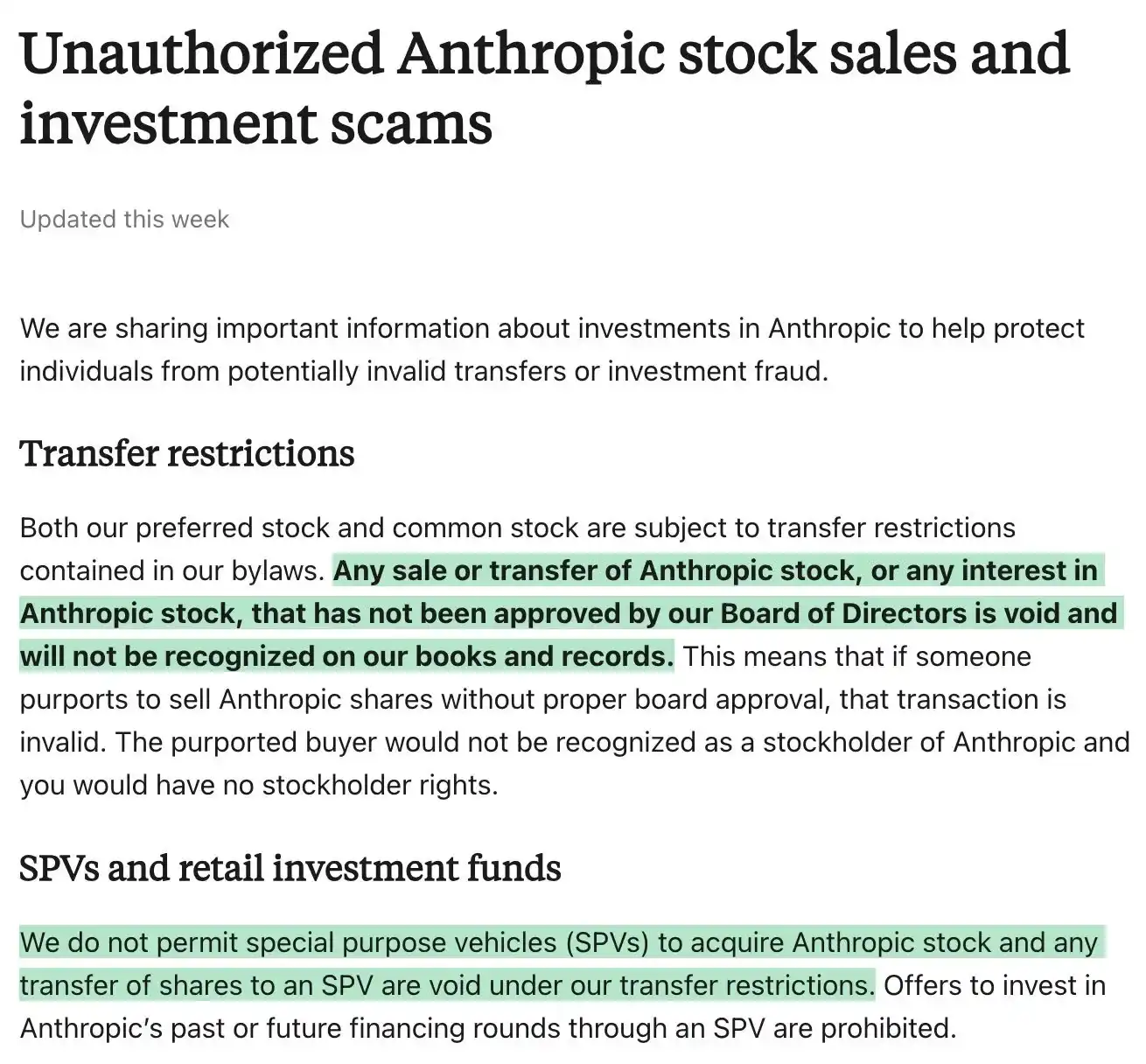
Today, Anthropic updated an official statement it released in February titled "On Unauthorized Anthropic Stock Sales and Investment Scams."

In the article, Anthropic explicitly stated: "Any sale or transfer of Anthropic stock, or disposition of an interest in Anthropic stock, that has not been approved by our board of directors, is invalid (note the use of 'invalid') and will not be recognized on the company's books and records. This means that if anyone sells Anthropic stock without board approval, the transaction will be deemed invalid. The purported buyer will not be recognized as an Anthropic shareholder and will not enjoy any shareholder rights."
Shortly after Anthropic updated its statement, OpenAI also followed up with an announcement stating: "All equity interests are subject to transfer restrictions. No shares may be transferred directly or indirectly without the written consent of the company. Any sale without consent is not only unauthorized but also invalid."
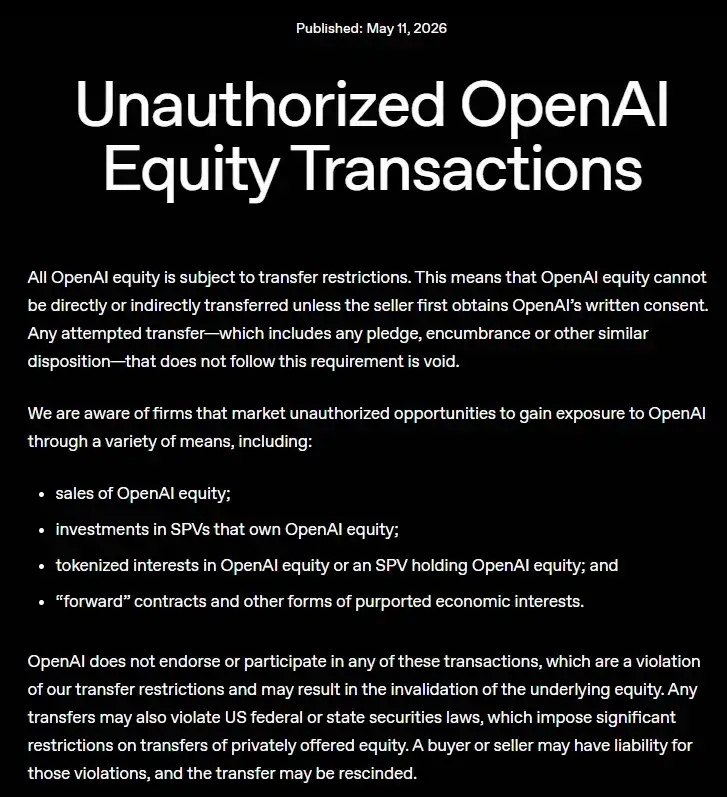
In their announcements, both Anthropic and OpenAI explained that the companies' preferred and common stock are subject to transfer restrictions stipulated in their charters, meaning all stock transfers require board approval.

Anthropic also emphasized, "The company also does not permit the acquisition of Anthropic shares by 'Special Purpose Vehicles' (SPVs). Any transfer of shares to an SPV violates the company's transfer restrictions... Some investment funds may claim to offer indirect access to Anthropic shares, but these funds are likely attempting to circumvent transfer restrictions. Therefore, any third party claiming to sell Anthropic shares to the public — whether through direct sales, forward contracts, stock tokens, or other mechanisms — may be involved in fraud or offering worthless investments due to Anthropic's transfer restrictions."
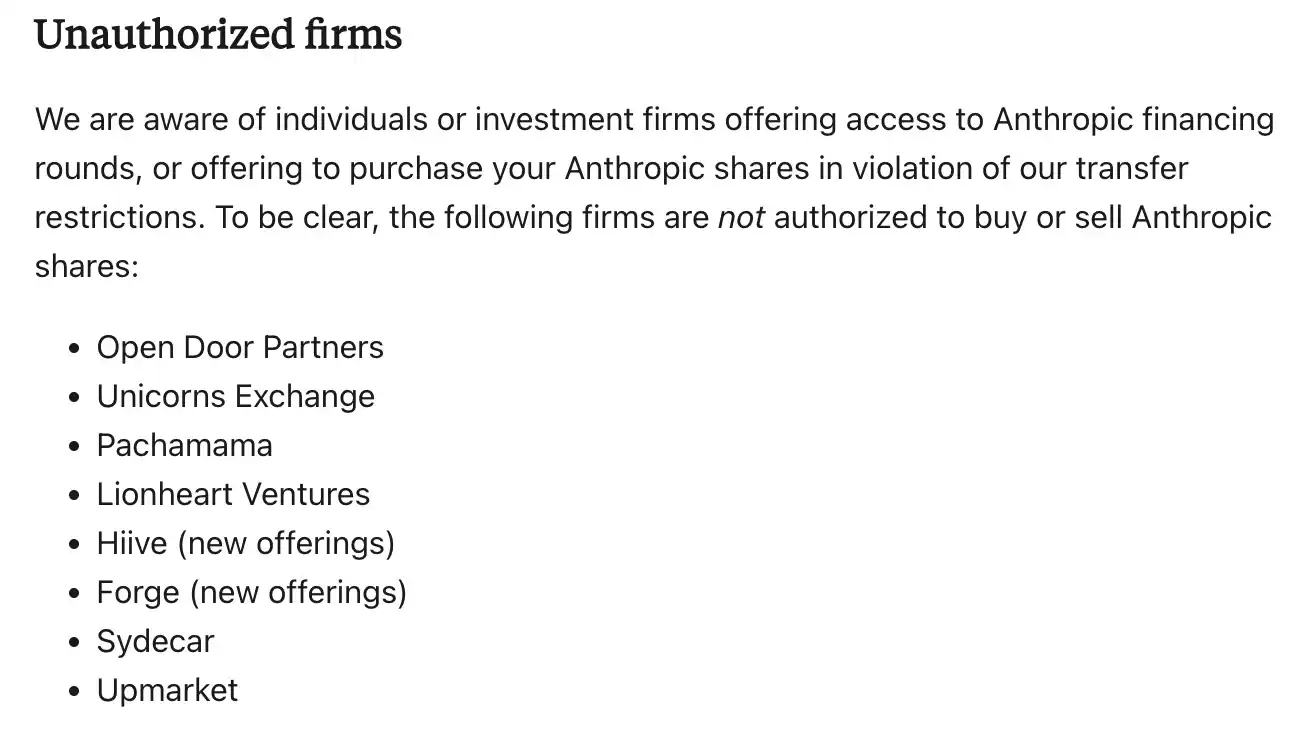
  • Odaily Note: The image shows unauthorized equity transfer platforms named by Anthropic.

What is an SPV?

To understand why this update has had such a massive impact on the pre-IPO stock token market, one must first understand what an SPV is.

In traditional pre-IPO stock trading, directly transferring original shares is extremely difficult, restricted not only by company charters but also involving complex legal procedures. In this context, SPVs emerged.

An SPV is a legal entity established specifically for a particular transaction or investment purpose. It can be understood as a 'shell company dedicated to holding a specific asset.' Multiple investors can indirectly hold shares in a company or a certain asset by contributing capital to the same SPV, achieving goals such as centralized ownership, lowered entry barriers, and optimized legal and tax structures. SPVs are particularly common in popular pre-IPO stock trading. Since many high-profile companies are often unwilling to directly introduce numerous small shareholders, institutions typically first set up an SPV, which then uniformly invests in the target company.

For example, so-called "early participation in Anthropic or OpenAI share subscriptions" in the market essentially involves investors first contributing capital to an SPV, which then purchases the unlisted equity of Anthropic or OpenAI.

Currently, most pre-IPO stock token platforms (such as Prestock) adopt the SPV structure.

  • The platform or its partners will register an SPV in a certain jurisdiction. The sole purpose of this SPV is to buy original Anthropic shares in the secondary market (usually from employees or early investors).
  • The platform will then issue derivative tokens on-chain (e.g., ANTHROPIC or OPENAI), which are legally defined in agreements as "claims to the economic benefits of that SPV."
  • Theoretically, these tokens are 1:1 pegged to the original shares. For every token issued, the underlying SPV should hold a corresponding share of stock.

The problem now is that Anthropic and OpenAI have now explicitly stated they 'do not recognize unauthorized stock transfers.' This means if an SPV transfers stock without board approval (which is highly unlikely to be granted), the stock held by that SPV may be considered invalid in the eyes of Anthropic and OpenAI. If the stock held by the SPV is invalid, then the "economic benefits" referenced by the on-chain tokens become worthless.

The Risk of SPV "Nesting"

A significant reason for Anthropic and OpenAI's strong opposition to SPVs is the growing risk of over-financialization as their pre-IPO stock tokens continue to be hotly traded (Anthropic's pre-IPO valuation once soared to $1.4 trillion, far exceeding its last funding round valuation).

Among these risks, the "nesting" of SPVs is most concerning — many investors buying pre-IPO stock tokens believe they are purchasing company shares, but are actually only buying claims to the economic benefits of an SPV. More exaggeratedly, many SPVs do not directly hold Anthropic's original shares but are instead nested two or three SPV layers down.

This "nesting" structure is, in fact, very dangerous.

  • Legal Transparency Issues: With each additional layer, the authenticity of the underlying assets becomes more blurred. Investors find it difficult to confirm whether the bottom-most SPV has actually obtained the company's board transfer approval.
  • Management Fee Exploitation: Each layer of SPV charges management fees, performance fees, and dividends. After layer-by-layer skimming, investors' actual returns are severely diluted.
  • Zeroing Risk: If the equity transfer at any layer is deemed "invalid" by Anthropic, the entire value chain could instantly collapse.

Whether for reputational reasons or investor protection, Anthropic and OpenAI clearly do not want to see this situation.

Pre-IPO Stock Tokens Plummet, Contracts Remain Relatively Stable

Once the announcements from Anthropic and OpenAI spread, the market immediately reacted.

ANTHROPIC on PreStocks plunged sharply, falling below $1,000 at its lowest, temporarily reported at $1,082 as of 12:00, down 20.62% for the day; OPENAI was temporarily reported at $1,440, down 26.82% for the day.
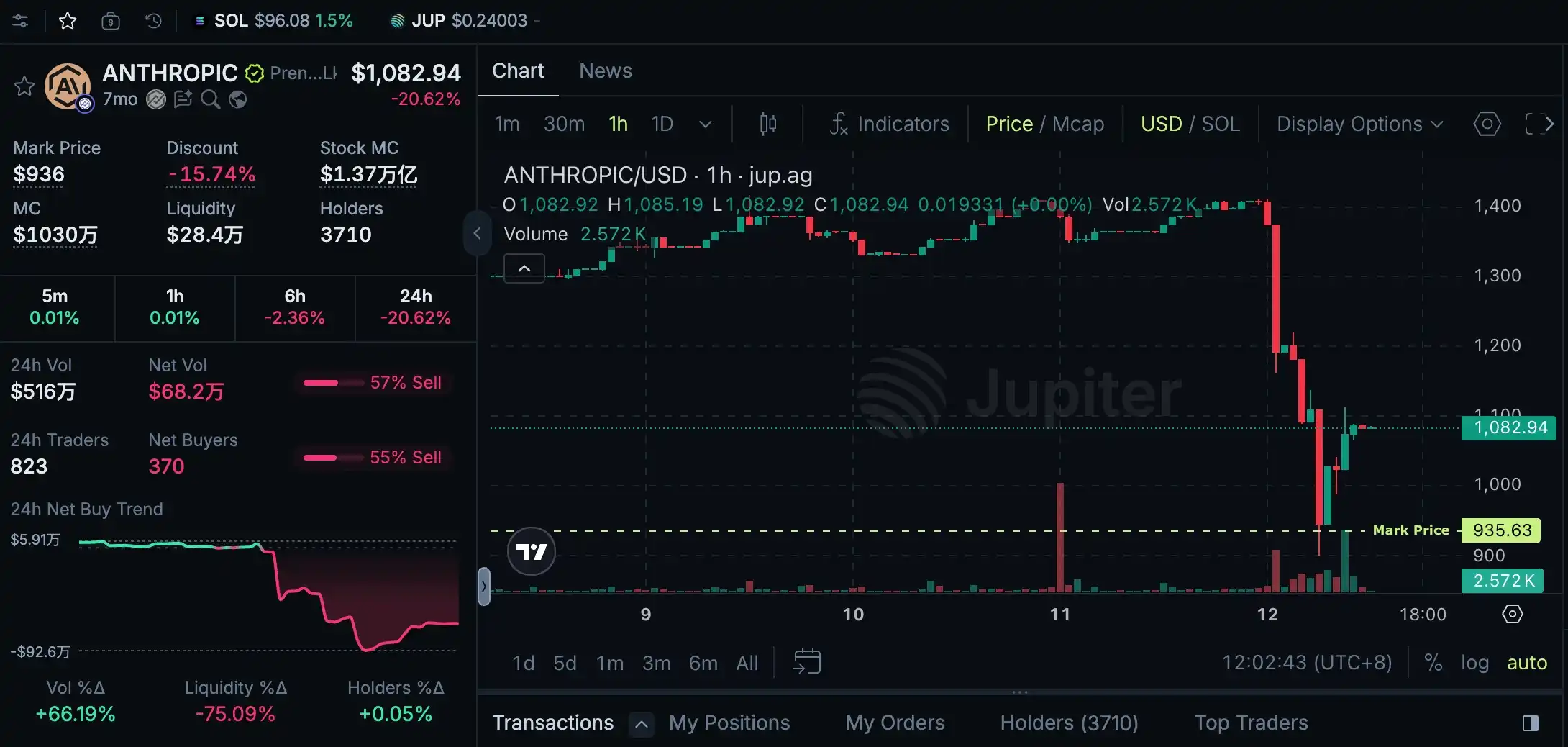
Investor panic is easily understood. Since Anthropic and OpenAI explicitly stated they do not recognize unauthorized shareholdings, the "rights" behind these tokens face the probability of becoming "worthless paper." Holders may confront significant claim validation risks and legal litigation costs.

Interestingly, while pre-IPO stock tokens came under pressure, another type of pre-IPO stock trading product performed relatively stably — pre-IPO contracts that rely entirely on market-driven bilateral betting. The reason for this is that such products do not hold any real stock; Anthropic and OpenAI's restrictions have no effect on them. They are essentially "bilateral betting pools" on future IPO prices, relying on price competition between buyers and sellers.

Predictions for Future Direction

In response to Anthropic and OpenAI's "non-recognition" statements, two distinctly different voices have emerged in the industry.

Some believe the logic of pre-IPO tokenized stock trading is dead. If headliners like Anthropic and OpenAI are leading the charge to ban SPVs, other giants may follow suit. With equity backing being questioned, the value of so-called pre-IPO stock tokens is in doubt.

However, others, including Rivet founder Nick Abouzeid, believe this is not a cause for alarm. Trading pre-IPO stock tokens through unofficial channels was always a gamble; buyers should have had the awareness from day one that the "company might not recognize" the shares. What you lack is direct investment opportunity; obtaining that opportunity through other channels always carries certain risks.

In summary, at a time when premiums for pre-IPO stock tokens have continued to expand and market sentiment has grown increasingly feverish, Anthropic and OpenAI's statements undoubtedly pour cold water on the entire sector.

Over the past few months, more and more investors have begun viewing pre-IPO stock tokens as a 'low-barrier channel to participate in the growth of top AI companies.' Valuations for some AI-concept pre-IPO stock tokens have significantly detached from reality, with even crazy speculation far exceeding the valuations of the last funding rounds. Against this backdrop, the public "debunking" by Anthropic and OpenAI, in a way, is also about redrawing the boundaries for this wildly growing new market.

For speculators, this is a lesson in risk; but for the long-term development of the industry, the market may also need such a moment of "de-bubbling."


Связанные с этим вопросы

QAccording to the article, what did Anthropic and OpenAI announce regarding unauthorized stock transfers?

ABoth Anthropic and OpenAI announced that any sale or transfer of their company stock without board approval is unauthorized and invalid. They will not recognize such transactions on their books, meaning buyers of such shares will not be considered shareholders and will have no shareholder rights.

QWhat is an SPV, and how was it typically used in the pre-IPO stock token market as described?

AAn SPV (Special Purpose Vehicle) is a legal entity created for a specific transaction or investment. In the pre-IPO token market, platforms would use an SPV to purchase company stock (e.g., from employees). They would then issue tokens on a blockchain, which represented a claim on the economic benefits of that SPV, theoretically 1:1 with the underlying shares.

QWhy does the article consider the multi-layered 'nesting' of SPVs particularly risky?

AMulti-layered 'nesting' of SPVs is risky because it obscures the transparency of the underlying asset, makes it hard to verify if the transfer was authorized, involves multiple layers of fees that dilute investor returns, and creates a chain where if any one transfer is deemed invalid by the company, the entire value chain can collapse.

QHow did the market react to the announcements from Anthropic and OpenAI, particularly concerning different types of pre-IPO products?

AThe market reacted negatively to pre-IPO stock tokens based on SPV structures. For example, ANTHROPIC and OPENAI tokens on PreStocks saw significant price drops (over 20%). However, pre-IPO contracts, which are purely speculative bilateral bets on future IPO prices and do not hold actual stock, remained relatively stable as they were unaffected by the companies' transfer restrictions.

QWhat are the two contrasting viewpoints presented in the article regarding the future of the pre-IPO stock token market after these announcements?

AOne viewpoint is that the logic behind pre-IPO token trading is dead, as other major companies might follow Anthropic and OpenAI's lead, undermining the value of tokens without recognized underlying equity. The other viewpoint, from figures like Nick Abouzeid, is that this was always a known risk when buying through unofficial channels, and investors should have been aware that the company might not recognize such holdings from the start.

Похожее

The Essence of AI Layoffs: Why More AI Adoption Leads to More Corporate Anxiety?

The author, awaiting potential inclusion on an 8000-person layoff list, analyzes the true nature of recent "AI-driven" layoffs. They argue that while AI use, particularly tools like Claude for code generation, has skyrocketed and boosted developer output (e.g., 2-5x more code commits), this has not translated into proportional business growth or revenue. The core issue is a misalignment between increased "Input" (code) and tangible "Outcomes" (user value, revenue). AI acts as a costly B2B SaaS, inflating operational expenses without guaranteed returns. Two key problems emerge: 1) The friction that once filtered out bad ideas is gone, as AI allows cheap pursuit of even weak concepts. 2) Organizational "alignment tax"—the difficulty of coordinating across teams—becomes crippling when development velocity outpaces consensus-building. Thus, layoffs serve two immediate purposes: 1) To offset ballooning AI costs (Token consumption) and maintain cash flow, as rising input costs without outcome growth destroys unit economics. 2) To reduce organizational bloat and alignment friction by simply removing teams, thereby speeding up execution in the short term. Therefore, these layoffs are fundamentally caused by AI, even if AI doesn't directly replace roles. They represent a painful correction until companies learn to convert AI-driven productivity into real business outcomes and streamline organizational coordination to match the new pace of work. The cycle will continue until this learning curve is mastered.

marsbit28 мин. назад

The Essence of AI Layoffs: Why More AI Adoption Leads to More Corporate Anxiety?

marsbit28 мин. назад

Can the Solana Foundation and Google's Collaboration on Pay.sh Bridge the Payment Link Between Web2 and Web3 in the Agent Economy?

Solana Foundation, in collaboration with Google Cloud, has launched Pay.sh, a payment gateway designed to bridge the gap between AI agents and enterprise-grade service infrastructure. The initiative aims to solve a key bottleneck in the "agent economy": existing payment systems are ill-suited for autonomous AI agents. Traditional methods like credit cards require human verification, while newer on-chain protocols like x402 and MPP create a separate, Web3-native system that raises barriers for service providers. Pay.sh functions as a universal payment layer. It allows users to fund a Solana wallet via credit card or stablecoin, which then acts as an identity and payment proxy for AI agents. When an agent needs to access a paid API service (e.g., Google Cloud, Alibaba Cloud), Pay.sh handles the transaction seamlessly. It leverages the HTTP 402 status code ("Payment Required") to initiate payments, intelligently choosing between one-time transfers (x402-style) or session-based authorizations (MPC-style) based on the service's billing model. This spares agents from manual account registration and API key management. A key feature for service providers is low integration effort. They can adopt Pay.sh by providing a declarative configuration file, enabling features like tiered pricing, free tiers, and automatic revenue splitting to multiple addresses (e.g., for royalties, cloud costs). Providers can also list their APIs in a central Pay Skill Registry for agent discovery. The collaboration with Google Cloud provides crucial infrastructure for API proxying, traffic routing, and compliance logging, aiming to keep agent activities within regulated boundaries. By connecting Web2 services with Web3 payment rails, Pay.sh positions the Solana wallet as a foundational identity and payment tool for AI agents, potentially driving more transaction volume to the Solana ecosystem. However, the report notes challenges. The service registry currently lacks robust vetting, risking exposure to unauthorized or malicious third-party APIs. Pay.sh also inherits security and compatibility risks from its underlying payment protocols (x402, MPC). Furthermore, adoption may be hindered by varying regional data privacy and payment compliance regulations among API providers. Despite these hurdles, Pay.sh represents a significant step towards integrating Web2 and Web3 for autonomous agent commerce.

marsbit35 мин. назад

Can the Solana Foundation and Google's Collaboration on Pay.sh Bridge the Payment Link Between Web2 and Web3 in the Agent Economy?

marsbit35 мин. назад

Bitcoin's Bull-Bear Cycle Indicator Turns Positive for the First Time in 7 Months: End of Bear Market or False Breakout?

Bitcoin's "Bull-Bear Market Cycle Indicator" from CryptoQuant has turned positive for the first time since October 2025. This gauge, based on the P&L Index relative to its 365-day moving average, suggests a potential shift from a bear market phase. Concurrently, the Bull Score Index rose to a neutral reading of 50 in late April. The indicator's move into positive territory follows a roughly 35% price rebound from a low near $60,000 in February to above $81,000. The recovery over approximately three months was faster than the 12-month period observed during the 2022 bear market. However, analysts caution against premature optimism, citing a historical precedent from March 2022. Back then, the Bull Score Index briefly hit 50, but it proved to be a false signal as Bitcoin's price subsequently plunged further. Structural differences exist in the current cycle, including consistent inflows into spot Bitcoin ETFs and an increase in large holder addresses. Yet, some models, referencing the four-year halving cycle, suggest a potential deeper bottom near $50,000 might still be possible around late 2026. In summary, while on-chain data shows marked improvement and the worst panic may be over, market participants remain cautious. A convincing trend reversal confirmation likely requires Bitcoin to sustainably break above key resistance, such as the 200-day moving average near $82,000.

marsbit42 мин. назад

Bitcoin's Bull-Bear Cycle Indicator Turns Positive for the First Time in 7 Months: End of Bear Market or False Breakout?

marsbit42 мин. назад

How to Automate Any Workflow with Claude Skills (Complete Tutorial)

This is a comprehensive guide to mastering Claude Skills, a feature for creating permanent, reusable instruction sets that automate specific workflows. Unlike simple saved prompts, Skills function like trained employees, delivering consistent, high-quality outputs by defining the entire task process, standards, error handling, and output format. The guide is structured in four phases: **Phase 1: Installation (5 minutes).** Skills are folders containing a `SKILL.md` file. The user is instructed to find a relevant Skill online, install it, test it on a real task, and compare its performance to one-off prompts. **Phase 2: Building Your First Custom Skill.** Start by rigorously defining the Skill's purpose, trigger phrases, and providing a concrete example of perfect output. The `SKILL.md` file has two parts: a YAML frontmatter with a specific name/description/triggers, and a detailed, step-by-step workflow written in natural language with examples and quality standards. **Phase 3: Testing & Optimization for Production.** Test the Skill in three scenarios: 1) a standard, common task; 2) edge cases with missing or conflicting data; and 3) a pressure test with maximum complexity. Any failure indicates a needed instruction. Implement a weekly optimization cycle to continuously refine the Skill based on real usage. **Phase 4: Building a Complete Skill Library.** The goal is to create a team of Skills for all repetitive tasks. Examples are given for industries like real estate, marketing, finance, consulting, and e-commerce. The user should list their tasks, prioritize them, and build one new Skill per week, maintaining a master document to track their library. The conclusion emphasizes the compounding time savings: ten Skills saving 30 minutes each per week reclaims over 260 hours (6.5 work weeks) per year, fundamentally transforming one's work system.

marsbit1 ч. назад

How to Automate Any Workflow with Claude Skills (Complete Tutorial)

marsbit1 ч. назад

Торговля

Спот
Фьючерсы
活动图片