Claude Requires ID Verification and Facial Recognition? The Facial Recognition Requirement is an Old Story from Two Months Ago, and "Sharing Data with Police" is a Misinterpretation

marsbitОпубликовано 2026-06-15Обновлено 2026-06-15

Введение

Anthropic's updated privacy policy, effective July 8th, has sparked misinterpretations in Chinese social media, primarily concerning new identity verification and data sharing with law enforcement. A detailed comparison reveals these claims are largely unfounded. First, identity verification (including submitting government ID and a live selfie via third-party provider Persona) is not a new July policy. This mechanism was actually implemented in mid-April 2026 for certain high-use or flagged accounts, particularly Claude Max subscribers. The July update merely formally documents this existing practice in the policy text under a new "Verification Data" section. Second, the widespread claim that the new policy lowers the threshold for sharing user data with law enforcement is incorrect. Comparing the new text with the old version (dated September 28, 2025) shows no substantive tightening. While the new policy more clearly structures the conditions for disclosure—including having a "good-faith belief" it's necessary for legal compliance, preventing harm, fraud detection, or enforcing terms—the old policy already allowed Anthropic to disclose data based on its judgment for similar reasons (e.g., protecting safety, preventing fraud, or complying with law). The term "good-faith belief" acts as a limiting standard, not a lowered barrier. A 2025 court case where Anthropic resisted disclosing user data in a copyright lawsuit further demonstrates the complexity of such standards. Th...

Author: Claude, Deep Tide TechFlow

Deep Tide Guide: Anthropic's updated privacy policy will take effect on July 8th. The predominant interpretation on Chinese social media has been a "major shift towards real-name verification with facial recognition + opening data to law enforcement agencies." However, after a line-by-line comparison with the original text, most of the sensational conclusions do not hold up: identity verification is an old mechanism launched back in April, and the so-called "lowered threshold for disclosure to law enforcement" cannot be found in either the old or new versions of the terms. The real substantive addition is that the data flow for Agent tasks has been written into the policy for the first time.

Anthropic released a privacy policy update notice on June 8th. The new version will take effect for Claude free, Pro, and Max individual users starting July 8th. After the notice was released, Chinese tech and community circles spread the news rapidly, with the mainstream narrative focusing on two points:

  1. Claude will introduce real-name and facial verification.
  2. The new regulations lower the threshold for disclosing user data to law enforcement agencies, marking "the end of the era of anonymity for large models."

After comparing the full text of the new policy, the old version (dated September 28, 2025), and Anthropic's official update summary line by line, we found that most conclusions from this narrative do not match the original text of the policy.

Misconception 1: Real-name verification and facial recognition is an old mechanism from April, not a new policy in July

Treating identity verification as a "sudden new policy" on July 8th is the most common error in the current chain of dissemination.

The fact is, Anthropic already activated an identity verification mechanism on the Claude platform on April 14, 2026. The next day, the official website's help center formally launched the "Identity verification" policy page.

According to reports from V2EX, East Money Network, and 36Kr at the time, users who triggered verification had to submit government-issued physical documents (passport, driver's license, or ID card) through the third-party compliance service provider Persona and complete a real-time selfie liveness detection via camera. Records from East Money Network's affiliated Wealth Account at the time indicated that those triggered were mostly accounts subscribing to the highest-paying Max tier, high-frequency users, or accounts flagged as potentially abnormal by the risk control system, with developers experiencing account suspensions due to AI misjudgments.

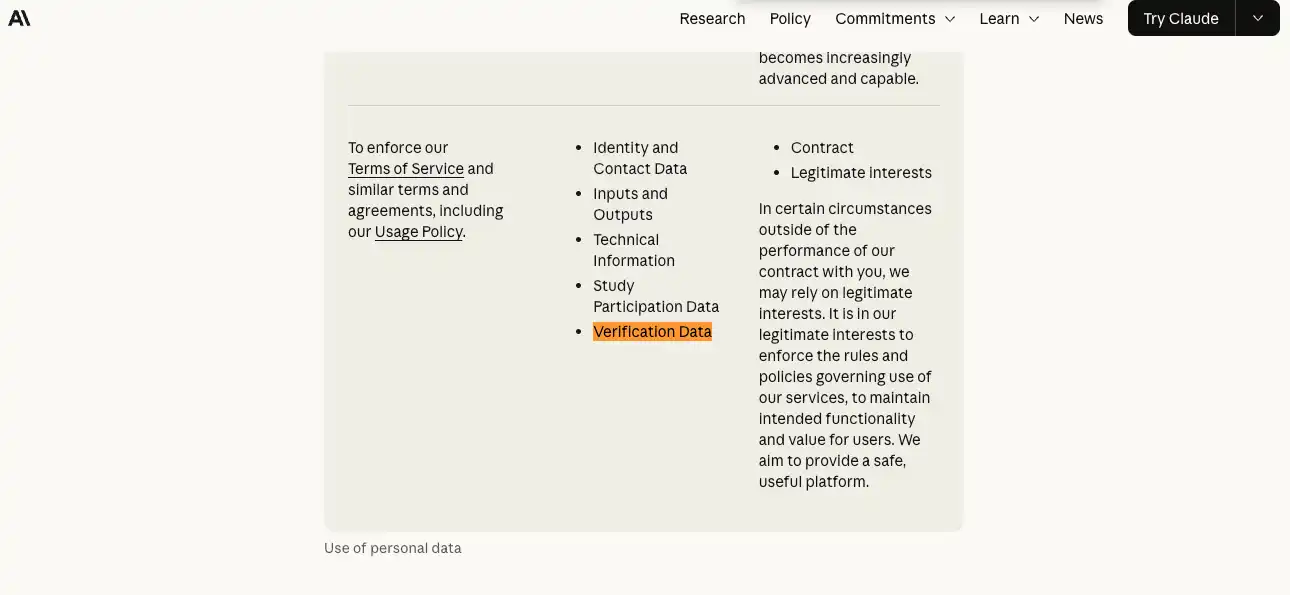
In other words, the matter of "whether to submit an ID" happened two months ago and already sparked a wave of backlash from developers. The July 8th privacy policy update did not add this action; it merely formally documented the data collection practices corresponding to the already-operating verification mechanism within the privacy policy text—the newly added "Verification Data" section clearly lists the content that will be collected:

Images of government documents along with the document number and date of birth on them, portraits in photo or video form, facial geometry templates (considered biometric data in some jurisdictions), and the verification result itself.

Mistaking "formal documentation in the policy text" for "sudden mechanism launch" gets the entire timeline wrong.
Misconception 2: "Opening Data to Law Enforcement Agencies" Doesn't Hold Up; Word-for-Word Comparison of Old and New Clauses Shows No Substantial Tightening

The most impactful and most in-need-of-correction point in the dissemination chain is the claim that "the new regulations lower the threshold for disclosing user data to law enforcement agencies." Some Chinese reinterpretations stated that the old version only disclosed data when "legally required," while the new version relaxes this to allow disclosure whenever Anthropic has a "good-faith belief."

We could not find the source for this comparison framework in the original text, even using Claude.

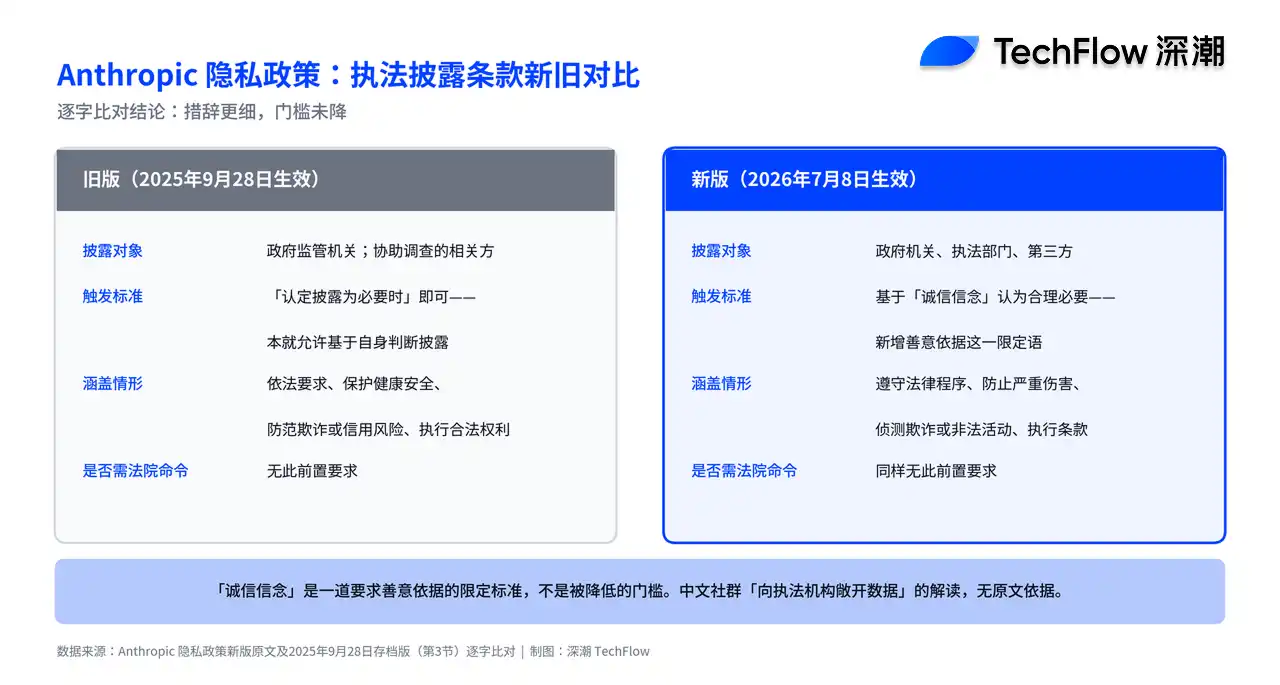
The phrasing in Section 3 of the new version is: Anthropic may share data with government authorities, law enforcement agencies, or third parties, based on available information and a "good-faith belief" that disclosure is reasonably necessary, for four types of situations:

To comply with laws, regulations, or legal process (including responding to enforceable government requests); to prevent serious harm to person or property; to detect, prevent, or address fraud or illegal activity; to enforce terms or protect the rights, safety, or property of Anthropic, its users, or others.

The key lies in how the old version (September 28 version) was written. Old Section 3 also permitted disclosing data when Anthropic "determines disclosure is necessary to protect your or others' health and safety, prevent fraud or credit risk, enforce legal rights, etc.," and also included "disclosure to government regulatory authorities as required by law... or assisting in investigations." In other words, the old version was never "disclose only when legally required"—it already gave Anthropic room to disclose based on its own judgment.

The conclusion from the word-for-word comparison is:

The new version rewrites this clause in a more structured way, explicitly mentioning "law enforcement agencies," adding the qualifier "good-faith belief," and listing the four types of situations clearly. In legal substance, "good-faith belief" is a limiting standard requiring a basis of good faith, not a lowered threshold. More detailed wording does not equate to a lower threshold. Anthropic's official update summary characterizes this part only as "more clearly stating when we may share data with third parties."
Another factual point in the opposite direction can help calibrate the deviation of this misinterpretation.

In August 2025, the US District Court for the Northern District of California ruled in the copyright lawsuit Universal Music Group et al. v. Anthropic that Anthropic did not need to provide user personal information to the publishers. According to Intellectual Property Finance citing Bloomberg, the judge believed that linking conversation content to specific users "lacked sufficient basis and would harm the weight of third-party privacy." In that case, Anthropic was on the side refusing to hand over user data. This demonstrates that the operation of standards like "good-faith belief" in reality is far more complex than the description "opening data to law enforcement agencies."

As for the specific claim that "biometric data is not stored on Anthropic servers and is handled by Persona," which appears in the Chinese reinterpretations of some media outlets, there is no corresponding statement in the original text of the new policy. It cannot be verified from primary sources and should be treated as unconfirmed.

What the Policy Actually Changed: Data Flow for Agent Tasks Written into Text for the First Time

Stripping away the exaggerated parts, the real substantive addition of the new policy is explicitly stipulating the data flow when Claude performs multi-step tasks and connects to third-party applications. This is precisely the part the old version barely covered.

New content added to Sections 1 and 3 of the new version states: When users connect third-party services or instruct Claude to perform tasks on their behalf (reading files, sending messages, retrieving information), Claude will send the user's input, output, and instructions directly to the third-party service, which will handle this data according to its own privacy policy; Claude will also retrieve content from third-party services, and this content then becomes part of the user input. Some integrations maintain access until the user actively disconnects.

This is the compliance foundation added for the Agent-oriented product form. When the old privacy policy was written, Claude was primarily a Q&A dialogue tool; the new version must answer a new question—how data flows between you, Anthropic, and third parties when the AI performs operations across multiple external applications on your behalf. The new version also points out that as Agent tasks become more complex, verification scenarios may continue to expand in the future. For users who heavily rely on connectors and the Claude Code workflow, this clause is more worthy of attention than "whether to submit an ID": your data footprint will expand along with Claude's agent capabilities.

Besides Agent data flow and verification data, the new version also adds a "Research Participation Data" section (data collected when users participate in Anthropic's surveys, interviews) and details the legal basis for marketing recommendations and data processing. Anthropic reiterates three unchanged commitments in the update summary: not selling user data, Claude remaining ad-free, and users being able to control whether their conversations are used for model training.

Placing this update in context: it is more like a compliance-driven "catch-up" to align the policy text with existing product features, rather than an active tightening of user privacy.

The high level of interest in Chinese communities partly stems from mixing April's old news, standard industry terms, and the real additions when reading. For ordinary users, the real risk of account suspension comes from violating usage policies and being flagged as abnormal by risk control—this has existed since April and was not aggravated by this update. As for the worry that "chat logs will be arbitrarily handed over to the police," judging from the original text and the California case ruling, this has been significantly exaggerated.

Note: This article was written by Claude itself, making it more convincing compared to media reports and reinterpretations.

Reference links:

Anthropic New Privacy Policy:

https://www.anthropic.com/legal/privacy

Связанные с этим вопросы

QWhat are the two main misinterpretations about Anthropic's updated privacy policy circulating in Chinese social media?

AThe two main misinterpretations are: 1) That the identity verification (including providing ID and facial recognition) is a new measure launching on July 8th, and 2) That the new policy lowers the threshold for sharing user data with law enforcement agencies.

QWhen did Anthropic actually implement its identity verification mechanism for Claude?

AAnthropic actually implemented the identity verification mechanism on April 14, 2026. The policy update on July 8th merely formally documented this existing practice in the privacy policy text.

QAccording to the article's comparison, did the new policy actually lower the threshold for data disclosure to law enforcement compared to the old version?

ANo, the article's comparison found no substantive lowering of the threshold. The old policy already allowed for data disclosure based on Anthropic's judgment in certain situations. The new policy restructured the clause, added the 'good-faith belief' qualifier, and listed specific scenarios more clearly, but this represents a clarification, not a relaxation of standards.

QWhat is described as the real substantive change in the updated privacy policy?

AThe real substantive change is the explicit documentation of data flows when Claude acts as an Agent - performing multi-step tasks and connecting to third-party applications. The new policy specifies how user inputs, outputs, and instructions are shared with and retrieved from these third-party services.

QWhat is the article's overall conclusion about the nature of this privacy policy update?

AThe article concludes that the update is primarily a compliance exercise to align the policy text with existing product features (like identity verification and Agent functionality) that were already in place, rather than an active, new tightening of user privacy rules.

Похожее

The Value Distribution of Stablecoins

**Summary: The Value Distribution of Stablecoins** The article argues that stablecoins are evolving from mere trading tools into broader channels for dollar access. It divides the stablecoin ecosystem into four layers to analyze how value is distributed: 1. **Issuance Layer:** Mints stablecoins, holds reserve assets, and captures the spread between reserve yield and user costs (e.g., Tether, Circle). This layer currently earns the largest profit margin. 2. **Infrastructure Layer:** Connects stablecoins to the traditional financial system, handling fiat on/off-ramps, banking integration, compliance (KYC/AML), and asset management (e.g., Bridge, BVNK). This is the "unglamorous" but critical work, building the essential bridges between crypto and real-world finance. 3. **Acquiring/Distribution Layer:** Integrates stablecoins into merchant systems, manages payment flows, and provides enterprise financial software (e.g., Stripe, Coinbase). They act as the access point for businesses. 4. **Application Layer:** The end-users and businesses that ultimately use stablecoins for payments, settlements, or as a store of value. They benefit from convenience but have little pricing power. The core thesis is that while the issuance layer currently dominates profits, the often-overlooked **infrastructure layer holds significant long-term potential**. The real challenge and barrier to mass adoption is not the on-chain transfer of stablecoins (which is simple), but the complex "last mile" integration into existing business workflows, banking systems, and regulatory frameworks across different countries. Companies in this layer are currently in a "land grab" phase, investing heavily to build networks, secure bank partnerships, and establish compliance pathways. While their position is currently pressured by the profitable issuers above and distribution platforms below, the article suggests that if stablecoins become a default financial rail for businesses, the infrastructure providers who have done the hard work of integration will ultimately gain strong pricing power and become entrenched, essential players.

marsbit7 мин. назад

The Value Distribution of Stablecoins

marsbit7 мин. назад

The Value Distribution of Stablecoins

The Value Distribution of Stablecoins The article argues that stablecoins are evolving from a mere trading tool into a broad "dollar channel." It analyzes the industry's value chain through four layers: 1. **Issuance Layer (e.g., Tether, Circle):** The top layer that mints stablecoins, holds reserve assets, and captures the thickest interest rate spread. 2. **Infrastructure Layer (e.g., Bridge, BVNK):** Connects stablecoins to the traditional financial system, handling critical but complex "dirty work" like fiat on/off-ramps, banking integration, compliance (KYC/AML), and cross-border settlement. 3. **Acquiring/Distribution Layer (e.g., Stripe, Coinbase):** Embeds stablecoins into merchant systems, manages payment flows, and integrates with enterprise software. 4. **Application Layer:** End-users and businesses that ultimately use stablecoins for payments, settlement, or storing value. The author posits that while the issuance layer currently captures the most profit, the most overlooked and potentially critical layer is infrastructure. The core challenge for stablecoin adoption isn't the on-chain transfer (which is simple), but bridging the gap between blockchain and the real-world financial system. This involves solving practical problems for businesses: fiat conversion, reconciliation, tax handling, and user onboarding. Infrastructure companies are currently in a difficult "land-grab" phase—building networks, securing banking relationships, and achieving compliance country-by-country. They face pressure from both the profitable issuance layer above and distribution platforms below. However, the author suggests this layer is building a crucial moat. Once stablecoins become a default business rail, the infrastructure players who have done the hard work of integration may gain significant, durable value and pricing power.

链捕手10 мин. назад

The Value Distribution of Stablecoins

链捕手10 мин. назад

Why Is Nvidia Borrowing $20 Billion When It's Not Short of Cash?

Nvidia's recent announcement to issue at least $20 billion in senior notes, despite holding a strong cash position with over $48.6 billion in free cash flow last quarter, is not a sign of financial need. Instead, it represents a strategic move to leverage its high credit rating (recently upgraded to AA by S&P) to secure low-cost, long-term debt. This capital will support long-term AI infrastructure investments, data centers, R&D, supply chain prepayments, and strategic investments, while allowing the company to continue aggressive shareholder returns through stock buybacks and dividends. The decision reflects a mature capital management strategy: using debt to finance long-term growth assets is more efficient and less dilutive to shareholders than equity financing. It signals that Nvidia, like other tech giants (Alphabet, Meta, Amazon), is entering a new phase of heavy AI capital expenditure, shifting from a pure growth story to a story about capital allocation, credit strength, and long-term ecosystem positioning. The key question for investors is whether Nvidia can maintain its high cash flow generation and ensure that returns from these AI investments justify the cost of capital over the long term. The bond issuance amplifies its expansion capabilities but also ties its valuation more closely to the broader AI investment cycle's sustainability and profitability.

marsbit46 мин. назад

Why Is Nvidia Borrowing $20 Billion When It's Not Short of Cash?

marsbit46 мин. назад

How to Do Research Well: Deliberately Practice the Real Skills That Matter

No one truly teaches you how to do research. You're often given a desk, a pre-selected problem, and vague instructions to "create something new." Consequently, many people reverse-engineer the job based on visible outputs—papers, posts, announcements—learning only how to *appear* like a researcher rather than how to *become* one. True research capability is built from stacking small, trainable skills, nearly all of which can be developed through deliberate practice. **Pick Your Own Problem:** Most researchers absorb problems from advisors or trends, lacking the underlying reasoning. Choosing a problem you genuinely care about, as John Schulman advises, leads to original work. Develop "taste" like a muscle: predict experiment outcomes, guess paper results from methods, and track which findings remain important over time. **Upgrade Your Inputs:** Relying on shared reading lists (arXiv hot lists, filtered group chats) leads to unoriginal conclusions. Undervalued old literature often holds crucial insights (e.g., MoE, LSTM, backpropagation). Richard Sutton's "The Bitter Lesson" or Claude Shannon's 1952 talk on creative thinking are more predictive than lengthy modern surveys. Breadth matters as much as depth: draw from neuroscience, mechanism design, hardware knowledge, and honest statistics. Read papers directly, especially appendices and limitations sections. **Write Everything Down:** As Paul Graham noted, writing exposes flaws in seemingly mature ideas. Writing is the cheapest defense against self-deception. Following Feynman's principle, Darwin programmatically wrote down facts contradicting his theory to combat memory bias. Maintain a detailed log of hypotheses, setups, predictions, results, and updated understandings. Reviewing past logs fosters essential humility.

marsbit2 ч. назад

How to Do Research Well: Deliberately Practice the Real Skills That Matter

marsbit2 ч. назад

Торговля

Спот
Фьючерсы

Популярные статьи

Как купить S

Добро пожаловать на HTX.com! Мы сделали приобретение Sonic (S) простым и удобным. Следуйте нашему пошаговому руководству и отправляйтесь в свое крипто-путешествие.Шаг 1: Создайте аккаунт на HTXИспользуйте свой адрес электронной почты или номер телефона, чтобы зарегистрироваться и бесплатно создать аккаунт на HTX. Пройдите удобную регистрацию и откройте для себя весь функционал.Создать аккаунтШаг 2: Перейдите в Купить криптовалюту и выберите свой способ оплатыКредитная/Дебетовая Карта: Используйте свою карту Visa или Mastercard для мгновенной покупки Sonic (S).Баланс: Используйте средства с баланса вашего аккаунта HTX для простой торговли.Третьи Лица: Мы добавили популярные способы оплаты, такие как Google Pay и Apple Pay, для повышения удобства.P2P: Торгуйте напрямую с другими пользователями на HTX.Внебиржевая Торговля (OTC): Мы предлагаем индивидуальные услуги и конкурентоспособные обменные курсы для трейдеров.Шаг 3: Хранение Sonic (S)После приобретения вами Sonic (S) храните их в своем аккаунте на HTX. В качестве альтернативы вы можете отправить их куда-либо с помощью перевода в блокчейне или использовать для торговли с другими криптовалютами.Шаг 4: Торговля Sonic (S)С легкостью торгуйте Sonic (S) на спотовом рынке HTX. Просто зайдите в свой аккаунт, выберите торговую пару, совершайте сделки и следите за ними в режиме реального времени. Мы предлагаем удобный интерфейс как для начинающих, так и для опытных трейдеров.

1.5k просмотров всегоОпубликовано 2025.01.15Обновлено 2026.06.02

Как купить S

Sonic: Обновления под руководством Андре Кронье – новая звезда Layer-1 на фоне спада рынка

Он решает проблемы масштабируемости, совместимости между блокчейнами и стимулов для разработчиков с помощью технологических инноваций.

2.3k просмотров всегоОпубликовано 2025.04.09Обновлено 2025.04.09

Sonic: Обновления под руководством Андре Кронье – новая звезда Layer-1 на фоне спада рынка

HTX Learn: Пройдите обучение по "Sonic" и разделите 1000 USDT

HTX Learn — ваш проводник в мир перспективных проектов, и мы запускаем специальное мероприятие "Учитесь и Зарабатывайте", посвящённое этим проектам. Наше новое направление .

1.8k просмотров всегоОпубликовано 2025.04.10Обновлено 2025.04.10

HTX Learn: Пройдите обучение по "Sonic" и разделите 1000 USDT

Обсуждения

Добро пожаловать в Сообщество HTX. Здесь вы сможете быть в курсе последних новостей о развитии платформы и получить доступ к профессиональной аналитической информации о рынке. Мнения пользователей о цене на S (S) представлены ниже.

活动图片