Behind ZEC's Over 30% Plunge: An 'Unlimited Minting' Vulnerability with No Way to Prove if It Was Ever Exploited

marsbitОпубликовано 2026-06-05Обновлено 2026-06-05

Введение

A critical vulnerability was discovered in Zcash's Orchard privacy pool, allowing for the theoretical creation of undetectable counterfeit ZEC. Researcher Taylor Hornby found the flaw on May 29th, 2024, within the Orchard circuit's cryptographic constraints, which could let an attacker bypass asset conservation rules. Although a rapid emergency fix was deployed within days via a coordinated soft and hard fork, a core uncertainty remains: due to Orchard's privacy features, it is impossible to cryptographically prove whether this "unlimited mint" flaw was exploited in the nearly four years since the pool's 2022 launch. This uncertainty, rather than the patched flaw itself, triggered a market panic, causing ZEC's price to drop over 30%. While the Zcash Foundation stated no evidence of exploitation was found, independent entity Shielded Labs emphasized the impossibility of definitively proving no counterfeit ZEC was ever created. The incident highlights the unique trust challenge in privacy systems. To address this, developers are proposing a new network upgrade with enhanced auditing to allow verifiable proof of supply integrity. Notably, the researcher utilized the newly released AI model Claude Opus 4.8 as a tool during the security review, signaling the growing role of advanced AI in uncovering complex cryptographic vulnerabilities.

On June 5th, Zcash founder Zooko Wilcox published a rare, detailed security retrospective.

The article disclosed that security researcher Taylor Hornby discovered a severe forging vulnerability in Orchard, Zcash's latest generation privacy pool, on May 29th. An attacker could construct a transaction that should not have passed validation, generating unlimited and undetectable counterfeit ZEC within Orchard.

This was not merely a theoretical risk. Taylor had already written a complete exploit program in a local test environment, successfully generating counterfeit ZEC. If the same program were deployed on the mainnet, an attacker could theoretically generate an unlimited quantity of counterfeit assets in their own mainnet wallet.

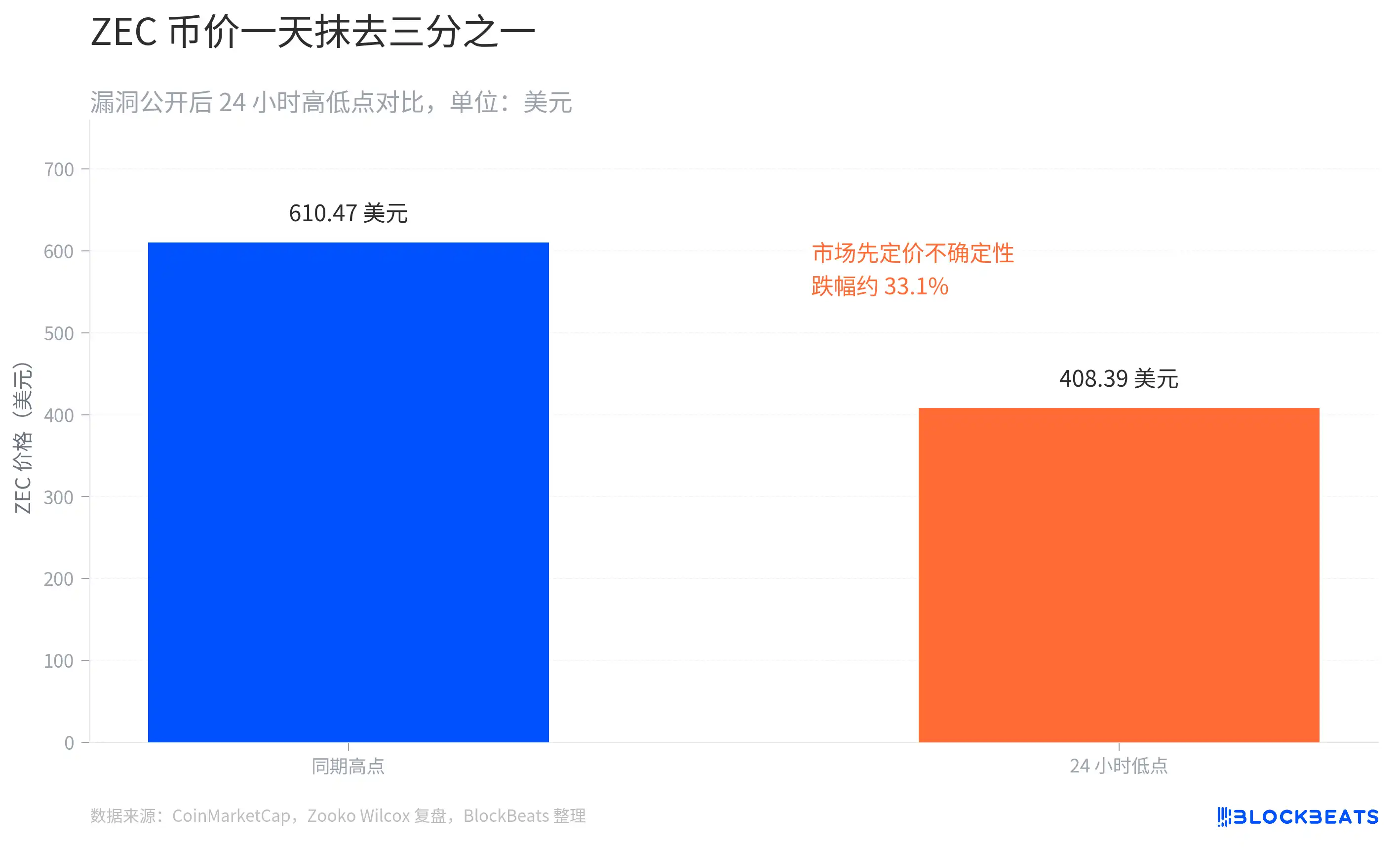
After the news became public, ZEC plunged by over 30%. Data from CoinMarketCap shows ZEC hit a 24-hour low of $408.39, down about one-third from its recent high of $610.47. Unfortunately, this was one of the few assets in the crypto space with excellent wealth effects recently, boasting a promising narrative favored by numerous industry leaders, now shattered by this vulnerability.
If one only looks at the outcome, this seems like another familiar crypto security incident: a vulnerability is discovered, developers rush to patch it, and the market panics.

However, the truly thorny aspect of the Orchard incident is that, while the vulnerability has been patched, the Zcash community cannot directly answer another, more sensitive question:

Has anyone exploited this vulnerability in the past four years?

Four-Day Emergency Patch, Orchard Briefly Suspended

Orchard is Zcash's next-generation privacy payment protocol launched in 2022 and one of the primary privacy pools currently used by Zcash. Users can hide balances, transaction amounts, and fund flows, while proving to the network via zero-knowledge proofs that transactions comply with the rules.

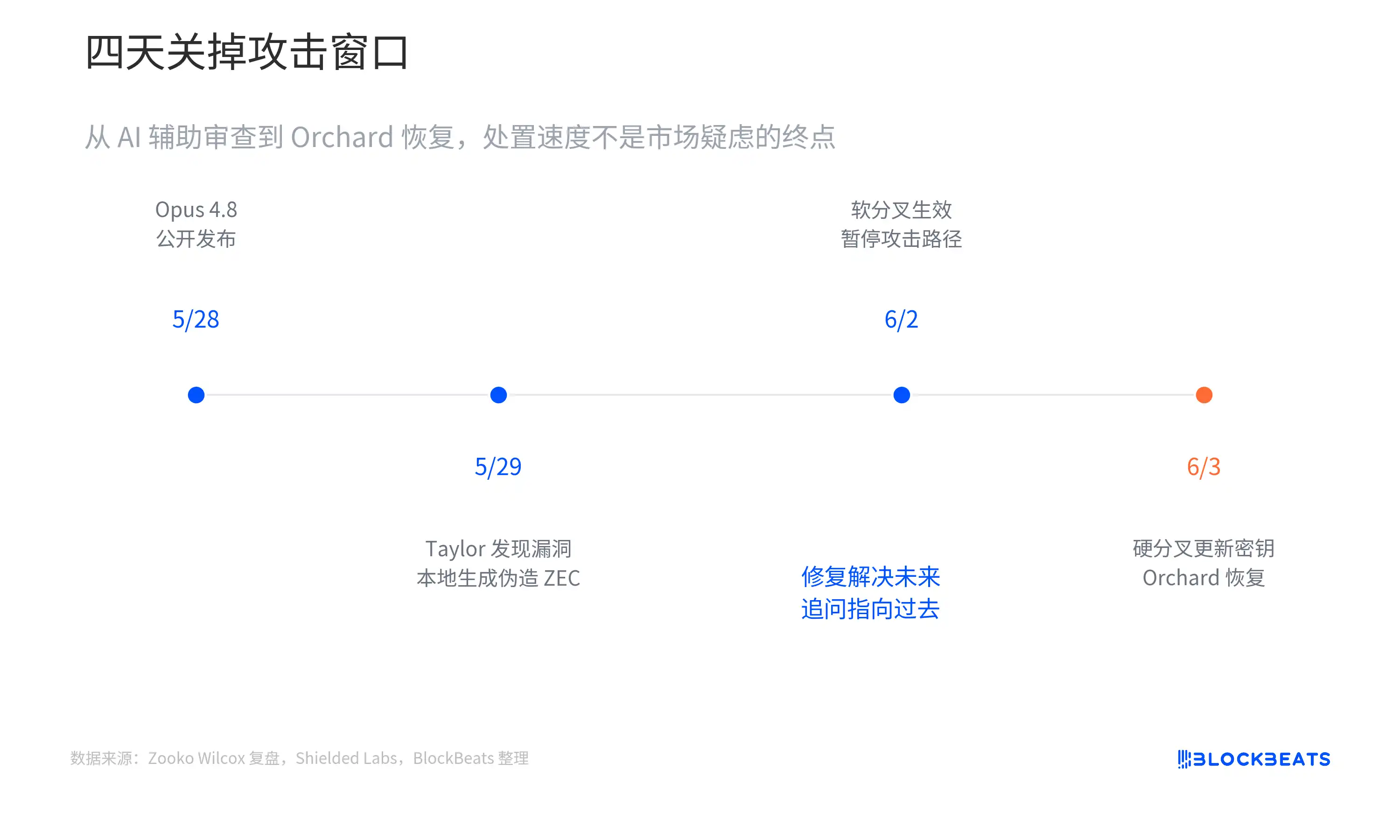
According to the timeline disclosed by Zooko, Shielded Labs, and the Zcash community, Taylor discovered anomalies during a targeted security audit of the Orchard circuit on May 29th and immediately privately disclosed the vulnerability to the Zcash Open Development Lab (ZODL). Shielded Labs is an independent, donation-funded Zcash ecosystem support organization based in Switzerland, long involved in Zcash's protocol development, security, and network sustainability efforts, and is not affiliated with the Zcash Foundation or ZODL.

ZODL engineers confirmed the issue was genuine within hours of receiving the report and began seeking a fix. To avoid exposing the vulnerability's details by directly releasing a code patch, the team first chose to temporarily shut down Orchard: prohibiting the creation of new Orchard outputs and the spending of funds already within Orchard.

After coordinating upgrades among developers, miners, node operators, exchanges, and infrastructure providers, an emergency soft fork took effect on June 2nd. Subsequently, Zcash performed a hard fork upgrade to update the verification key for the Orchard circuit and restored Orchard functionality on June 3rd. Transparent addresses and the Sapling privacy pool continued to operate during this period.

The entire process, from disclosure to remediation, took only a few days. In terms of emergency response speed, this was a remarkably successful handling.

But the market did not calm down because the vulnerability was fixed, as the fix addresses the future, not the past.
The Market Fears Not a Future Attack, But That an Attack May Have Already Happened

Ordinary security incidents usually have a relatively clear scale of loss. For a hacked smart contract, on-chain tracking can reveal how much the attacker moved; a cross-chain bridge vulnerability allows for tracking fund flows and affected addresses.

The Orchard incident is different.

According to Shielded Labs' explanation, this vulnerability could be used to generate unlimited and undetectable counterfeit ZEC within Orchard. Due to Orchard's inherent privacy properties, it is impossible for outsiders to cryptographically prove definitively whether this attack vector was exploited before the fix.

This means the market is not facing a determined loss figure but a kind of unquantifiable uncertainty:

If someone indeed found and exploited the vulnerability in the past, does counterfeit ZEC already exist within Orchard? If it exists, what is the scale? Do these assets remain in the privacy pool? Have they gradually leaked out through normal transactions?

More importantly, this risk window did not just open on May 29th. Shielded Labs stated that the vulnerability had existed since Orchard's launch in May 2022, until the emergency fix was completed in June 2026. In other words, the problem lay dormant for nearly four years.

What the market truly fears is not what happened between May 29th and June 2nd, but whether undetectable anomalies occurred during those past four years.

This is also the core reason behind ZEC's plunge of over 30%.

The market is selling off not just a vulnerability, but a repricing of the credibility of the supply.

How a Missing Mathematical Constraint Evolved into an 'Unlimited Minting' Risk

Seeing the words 'unlimited minting vulnerability,' our first thought might be that hackers gained admin privileges or some kind of protocol backdoor.

The reality is more fundamental.

Orchard's security relies on a zero-knowledge proof circuit (Orchard circuit). Users can hide specific transaction details but must prove to the network that their transaction satisfies protocol rules. One of the most important rules is asset conservation: a transaction cannot create new value out of thin air.

Simply put, users don't have to reveal how much ZEC they have or how much they send to whom, but the network must be able to confirm that:

The assets spent indeed come from legitimate inputs.
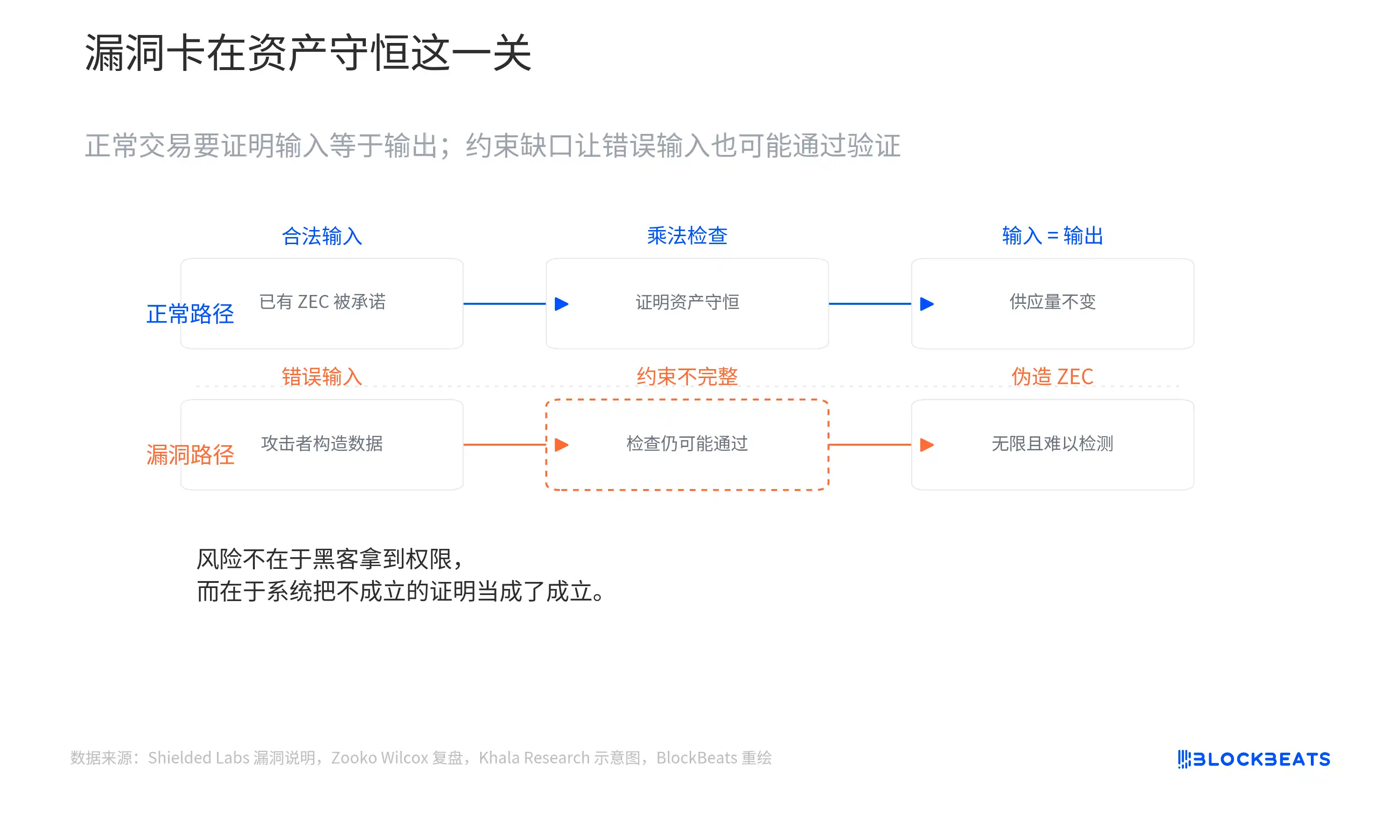
The problem Taylor discovered lies in an elliptic curve multiplication check within the Orchard circuit.

Shielded Labs describes it as an 'under-constrained element,' meaning a circuit element with incomplete constraints. Because the relevant mathematical relationship was not fully constrained, an attacker could input arbitrary erroneous data into the elliptic curve multiplication process, yet the verification process might still return a pass.

In other words, the attacker doesn't need to crack cryptographic algorithms or control network nodes.

They only need to construct a set of data that should not hold, tricking the system into erroneously believing the transaction still satisfies asset conservation.

Once this false proof is accepted by the network, the non-existent ZEC can be treated as legitimate assets, remaining within Orchard.

This is why Shielded Labs used extremely severe wording:

unlimited, undetectable counterfeit ZEC

The truly dangerous part is not just 'unlimited,' but 'undetectable.'

An Important Distinction Lies Between Two Statements

In its post-upgrade announcement, the Zcash Foundation stated that there is currently no evidence the vulnerability was exploited, no detection of unauthorized value creation, and user funds and privacy remain unaffected. The announcement also emphasized that Zcash's existing Turnstile Accounting mechanism can track value flows between different pools and protect the 21 million ZEC total supply cap.

Meanwhile, Shielded Labs clearly stated that it is impossible to cryptographically prove that counterfeit ZEC never appeared in Orchard's history.

These two statements may seem contradictory but actually address two different levels of the problem.

Zcash's original Turnstile Accounting can be understood as a 'gate' between different asset pools. The system can count how much legitimate asset entered Orchard and limit the scale of assets that can flow out of Orchard.

Suppose Orchard originally contained only 1 million legitimate ZEC; even if an attacker counterfeited more assets inside, the system would not allow assets exceeding the legitimate scale to flow out entirely. This helps prevent the total Zcash network supply cap from being easily breached.

But this mechanism cannot directly prove that counterfeit coins never appeared inside Orchard.

If counterfeit assets remain within Orchard, or gradually replace real assets within the legal outflow quota, the original statistical mechanism may not provide a definitive historical conclusion.

Regarding this arguably one of the oldest crypto privacy projects, all we know is that there is currently no evidence of abnormal minting, but the community still cannot directly prove that counterfeit assets never existed within Orchard.

This is precisely the type of risk the market finds hardest to handle.

The problem is not how many counterfeit coins have been discovered, but that no one can definitively confirm they never existed.

How Can Zcash Prove There Are No Counterfeit Coins in Orchard?

Patching the vulnerability is only the first step.

Shielded Labs has stated it is working with other Zcash developers on a new network upgrade proposal. The plan includes deploying a new privacy pool and enforcing Turnstile Accounting for all assets migrating out of Orchard.

This is akin to setting up a new migration gate for Orchard.

Assets in the old Orchard wishing to enter the new privacy pool would need to complete migration according to verifiable rules. The system could re-count the scale of legitimate assets flowing out and determine if there are any extra ZEC that cannot be migrated normally.
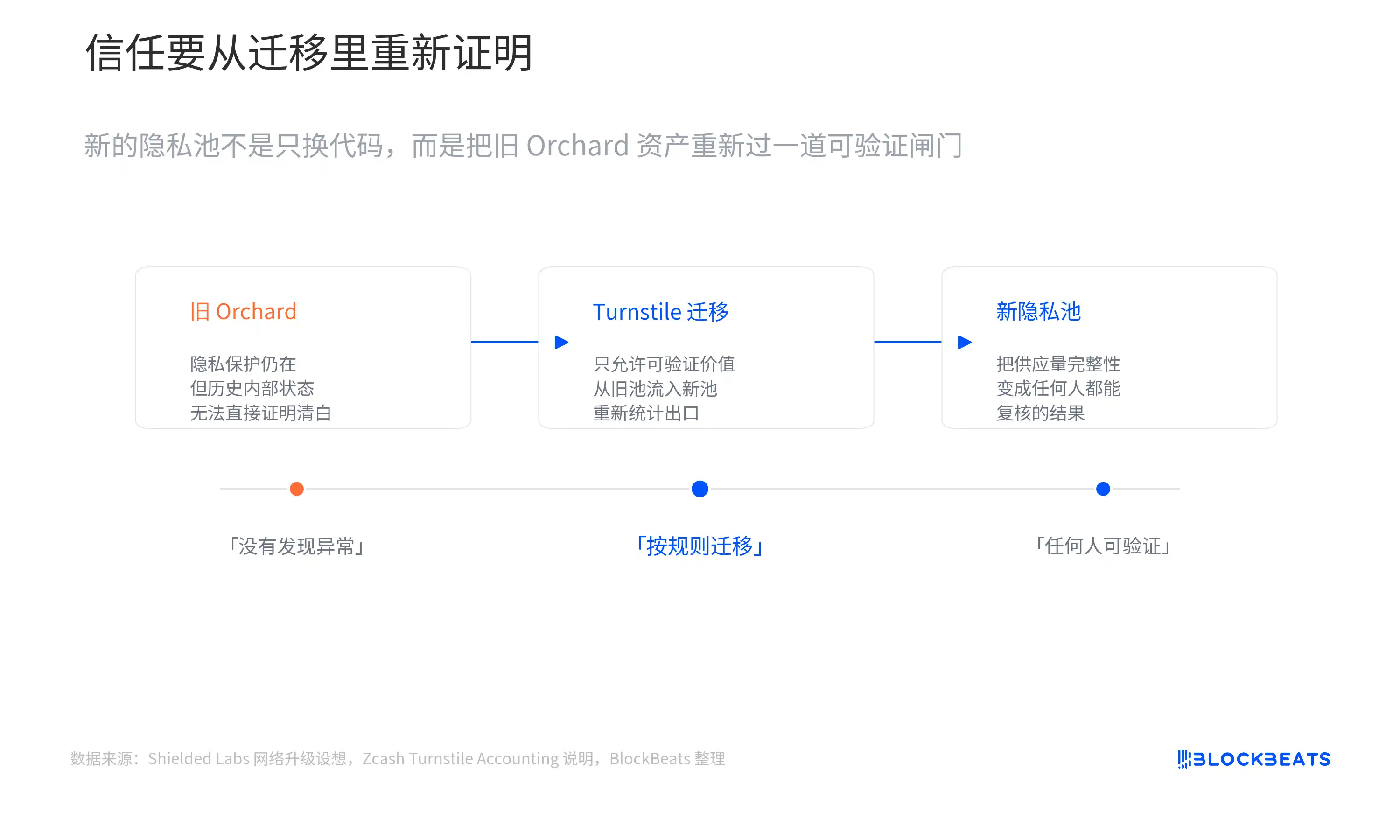
If the upgrade proceeds smoothly, anyone could verify Zcash's supply integrity and further prove no counterfeit assets exist in Orchard.

The significance of this plan is not just fixing code, but rebuilding market trust in Orchard.

Because in a privacy system, trust should not come from 'we think an attack didn't happen,' but from 'anyone can verify an attack didn't happen.'

Shielded Labs itself acknowledges the probability of prior malicious exploitation is low. The vulnerability was hidden for years and extremely difficult to discover; Taylor was actively searching for such issues in a dedicated security research project; after disclosure, the ecosystem quickly shut the attack window within days.

But Shielded Labs also emphasizes that users should not rely solely on the development team's subjective judgment.

The market needs proof.

Why Was a Four-Year-Old Vulnerability Discovered Now?

The Orchard incident has another detail easily overlooked by the market.

On May 28th, Anthropic released Claude Opus 4.8.

One day later, Taylor discovered the Orchard vulnerability.

According to the retrospective by Zooko and Shielded Labs, shortly after Opus 4.8's release, Taylor used it for a highly targeted audit of the Orchard circuit and discovered the issue on May 29th. Subsequently, with the assistance of Opus 4.8, he wrote a complete exploit program, generating unlimited, undetectable counterfeit ZEC in a local environment.

This detail is noteworthy not because AI can independently conduct cryptographic audits.

Public information does not support such an exaggerated conclusion.

Taylor himself is an experienced security researcher. Shielded Labs also mentioned he used a combination of traditional security research methods, a customized AI tool framework, and specifically designed prompts. Opus 4.8 was a crucial tool in the audit process, but not the only factor.

What is truly notable is that Taylor used not Anthropic's restricted-access, cybersecurity-focused model Claude Mythos Preview, but the newly publicly released general-purpose model Opus 4.8.

Anthropic positions Mythos Preview as an advanced model with significant vulnerability discovery and exploitation capabilities. Due to potential misuse risks, Anthropic did not release this model directly to the public but provides access to vetted partners via Project Glasswing.

In contrast, Opus 4.8 is a general-purpose model accessible to ordinary developers. Anthropic emphasized in its release notes its improvements in code analysis, complex task execution, and identifying code defects.

This makes the Orchard incident send an even more significant signal:

The capability to discover high-value vulnerabilities is diffusing from a few specialized security models to general-purpose models.

A general-purpose model released publicly for just one day, guided by a professional researcher, was able to participate in auditing a complex zero-knowledge proof circuit and help discover a critical vulnerability hidden for nearly four years.

This does not mean cryptography experts are no longer important.

On the contrary, Taylor's experience, choice of audit target, and ability to validate the model's output remain the core of the entire process.

But the combination of experts and AI is significantly lowering the cost of discovering complex vulnerabilities.

The Vulnerability is Closed, But the Market Still Awaits Answers

For Zcash, the most urgent attack window is closed.

Orchard functionality is restored, the verification circuit is updated, and there is currently no evidence the vulnerability was maliciously exploited.

But ZEC's plunge of over 30% indicates the market cares about more than just whether the code is fixed.

The market is still waiting for a more definitive answer:

In the past nearly four years, did counterfeit ZEC ever appear inside Orchard?

If the new privacy pool and Turnstile Accounting upgrade can be successfully implemented, the community will finally have a chance to prove supply integrity and rebuild market trust.

But until that proof is completed, the Orchard incident retains an unavoidable suspense:

Did those theoretically unlimited counterfeit ZEC never exist, or were they once hidden where no one could directly see?


Связанные с этим вопросы

QWhat is the primary reason the ZEC price dropped over 30% despite the Orchard vulnerability being quickly patched?

AThe primary reason for the price drop was not the vulnerability itself or the risk of future attacks, but the market's inability to determine whether the vulnerability had already been exploited in the past. The vulnerability existed for nearly four years, and due to Orchard's privacy features, there is no way to cryptographically prove whether undetectable counterfeit ZEC was created during that time. This created profound uncertainty about the true supply integrity of ZEC.

QWhat specific aspect of the Orchard circuit was flawed, and what did it allow an attacker to do?

AThe flaw was an "under-constrained element" in an elliptic curve multiplication check within the Orchard zero-knowledge proof circuit. This incomplete mathematical constraint allowed an attacker to input incorrect data. The verification process could incorrectly pass, making the system believe a transaction obeyed the conservation of assets (no new value creation) when it did not. This enabled the creation of unlimited, undetectable counterfeit ZEC within the Orchard pool.

QWhat is the key difference between the statements from Zcash Foundation and Shielded Labs regarding the historical exploitation of the vulnerability?

AThe Zcash Foundation stated there is no evidence the vulnerability was exploited and that the overall 21 million ZEC supply cap remains protected by the Turnstile Accounting mechanism. Shielded Labs, however, clarified that while the supply cap is protected, it is cryptographically impossible to prove that no counterfeit ZEC was *ever* created inside Orchard in the past. Their statements address different levels: one is about the lack of observed evidence and the outer supply limit, while the other is about the fundamental impossibility of proving a negative within the private pool.

QWhat role did Anthropic's Claude Opus 4.8 play in the discovery of the Orchard vulnerability?

AAnthropic's Claude Opus 4.8, a publicly released general-purpose AI model, was used as a key tool by security researcher Taylor Hornby. The day after its release, Hornby used it to assist in a targeted security review of the Orchard circuit, which led to the discovery of the vulnerability. He then used Opus 4.8 to help write the complete exploit program. This highlights how vulnerability discovery capabilities are diffusing from specialized, restricted security models to publicly available general AI models when guided by expert researchers.

QWhat is the proposed next step by Shielded Labs to rebuild trust in Zcash's supply integrity after the patch?

AShielded Labs is working on a proposal for a new network upgrade. This involves deploying a new privacy pool and enforcing Turnstile Accounting on all assets migrating out of the old Orchard pool. This creates a new 'gate' for migration. By verifying the rules during this process, the network can effectively audit the assets leaving Orchard. If successful, this would allow anyone to verify that no extra, illegitimate ZEC existed in Orchard, moving trust from subjective assurance to objective, verifiable proof.

Похожее

How Much Debt Does Strategy Really Have? Is There a Risk of Implosion?

MicroStrategy's Debt Risk: A Turning Point in the "Never Sell" Strategy As of June 3, 2026, MicroStrategy holds 843,706 bitcoins (valued at ~$53.1B) but faces significant financial obligations. Its capital structure includes $6.75B in convertible notes and $15.48B in perpetual preferred stock (led by the $8.5B STRC series), creating an annual payout burden of ~$1.71B. With software revenue at only ~$500M, interest and dividend obligations far exceed operating income. A critical shift occurred in late May 2026 when the company sold 32 bitcoins for ~$2.5M to cover dividends, breaking CEO Michael Saylor's long-standing "never sell" pledge. This symbolic move triggered a sharp decline in both Bitcoin's price and MSTR stock, reflecting market fears about cash flow sustainability. The core of the strain is the STRC perpetual preferred stock, designed as a "permanent loan" with no maturity date but requiring high monthly dividends (currently 11.5%). Its business model relies on a three-part cycle: issuing new STRC shares, using proceeds to buy more Bitcoin and fund a USD reserve, and using that reserve to pay dividends. This cycle depends on continuous investor demand for STRC and Bitcoin's price appreciation. Analysis shows Bitcoin needs to appreciate at least 2.3% annually to cover the $1.71B in yearly obligations at current holdings. With Bitcoin price down ~22% from March 2026 highs, this pressure has intensified. The company's $900M USD reserve can only cover about 7 months of payments if STRC issuance stalls. Key risks are not immediate bankruptcy or forced Bitcoin liquidation (as BTC is not collateral), but rather: 1) The erosion of MSTR's premium to its Bitcoin holdings (mNAV), which would cripple its ability to raise cheap capital; 2) A vicious cycle where stagnant Bitcoin prices reduce STRC demand, draining the USD reserve and forcing BTC sales, further depressing prices. The period from February 2027 to September 2028 is a crucial test, with over $5.9B in convertible notes facing put options or maturity. In essence, MicroStrategy has evolved from a simple Bitcoin holder into a complex financial entity acting like a "private Bitcoin bank," leveraging its BTC holdings to create layered financial products. Its survival depends on maintaining Bitcoin's price trend, its stock premium, and market appetite for its preferred shares. The recent token sale marks not a betrayal of its Bitcoin thesis, but an admission that the leveraged strategy must eventually be paid for.

marsbit9 мин. назад

How Much Debt Does Strategy Really Have? Is There a Risk of Implosion?

marsbit9 мин. назад

Anthropic Cries Wolf: Is the AGI Threat Real, or Just an IPO Story?

Anthropic has published an article titled "When AI builds itself," discussing the emerging concept of "recursive self-improvement," where AI begins to actively participate in designing, training, testing, and optimizing its own subsequent versions. The company presents internal data showing that by May 2026, over 80% of code merged into its codebase was written by Claude, its AI model. Claude's capabilities have expanded to handling complex, open-ended engineering tasks, achieving a 76% success rate in such areas, and even contributing to research processes, such as optimizing code performance and conducting AI safety experiments. Anthropic outlines an evolution from human-driven development to AI-assisted workflows, culminating in the current stage where AI agents can autonomously write, run, and delegate code. The company cautions that the path toward a "closed loop," where AI continuously improves itself, is becoming visible. It calls for coordinated global mechanisms to potentially slow or pause frontier AI development to allow safety research and societal structures to catch up. However, the timing of this warning coincides with Anthropic's preparations for an IPO, framing the narrative not just as a safety concern but also as a demonstration of Claude's advanced capabilities and its integral role in accelerating Anthropic's own R&D—creating a potential "flywheel" effect for competitive advantage. This contrasts with OpenAI's recent, more policy-oriented discussion of the same risks, highlighting the competitive dynamics in the AI industry as companies position themselves in both the technological and regulatory landscape.

marsbit1 ч. назад

Anthropic Cries Wolf: Is the AGI Threat Real, or Just an IPO Story?

marsbit1 ч. назад

BIT Research: ETF Purchases Have Slowed, Strategy (MicroStrategy) Has Slowed, What Else Can Drive Bitcoin's Rise?

Market Refocus on Inflation and Rate Expectations Weighs on Bitcoin Currently, the market is in a phase of macro-repricing dominated by inflation and interest rate expectations. Bitcoin, which previously benefited from easy liquidity and low inflation, is seeing its core bullish drivers weaken. These drivers were market expectations for interest rate cuts and strong inflows from Bitcoin ETFs and institutions like MicroStrategy (referred to as "Strategy" in the text). The logic has shifted. Recent high inflation data (e.g., CPI hitting 3.8% in a May 2026 report) has caused the market to sharply reduce its rate cut expectations for 2025 and even price in potential hikes. This is a key constraint for Bitcoin, as it lacks cash flows and is highly sensitive to rate expectations. Concurrently, institutional capital flows have slowed significantly. Following the hot CPI data, Bitcoin ETFs saw accelerated outflows, with around $4.3 billion leaving over a period. MicroStrategy's ability to keep adding substantial Bitcoin to its balance sheet is also diminishing. Together, ETF and MicroStrategy holdings total roughly $110 billion, but their momentum as growth engines is cooling. In summary, Bitcoin's current pressure stems not from its own fundamentals but from a changing macro environment. As long as inflation stays elevated, Bitcoin is likely to remain in a consolidating phase. However, historically, inflation eventually peaks. Once it recedes and rate cut expectations rebuild, institutional capital could return, potentially fueling a new and more robust recovery phase for Bitcoin.

marsbit1 ч. назад

BIT Research: ETF Purchases Have Slowed, Strategy (MicroStrategy) Has Slowed, What Else Can Drive Bitcoin's Rise?

marsbit1 ч. назад

Торговля

Спот
Фьючерсы

Популярные статьи

Как купить S

Добро пожаловать на HTX.com! Мы сделали приобретение Sonic (S) простым и удобным. Следуйте нашему пошаговому руководству и отправляйтесь в свое крипто-путешествие.Шаг 1: Создайте аккаунт на HTXИспользуйте свой адрес электронной почты или номер телефона, чтобы зарегистрироваться и бесплатно создать аккаунт на HTX. Пройдите удобную регистрацию и откройте для себя весь функционал.Создать аккаунтШаг 2: Перейдите в Купить криптовалюту и выберите свой способ оплатыКредитная/Дебетовая Карта: Используйте свою карту Visa или Mastercard для мгновенной покупки Sonic (S).Баланс: Используйте средства с баланса вашего аккаунта HTX для простой торговли.Третьи Лица: Мы добавили популярные способы оплаты, такие как Google Pay и Apple Pay, для повышения удобства.P2P: Торгуйте напрямую с другими пользователями на HTX.Внебиржевая Торговля (OTC): Мы предлагаем индивидуальные услуги и конкурентоспособные обменные курсы для трейдеров.Шаг 3: Хранение Sonic (S)После приобретения вами Sonic (S) храните их в своем аккаунте на HTX. В качестве альтернативы вы можете отправить их куда-либо с помощью перевода в блокчейне или использовать для торговли с другими криптовалютами.Шаг 4: Торговля Sonic (S)С легкостью торгуйте Sonic (S) на спотовом рынке HTX. Просто зайдите в свой аккаунт, выберите торговую пару, совершайте сделки и следите за ними в режиме реального времени. Мы предлагаем удобный интерфейс как для начинающих, так и для опытных трейдеров.

1.4k просмотров всегоОпубликовано 2025.01.15Обновлено 2026.06.02

Как купить S

Sonic: Обновления под руководством Андре Кронье – новая звезда Layer-1 на фоне спада рынка

Он решает проблемы масштабируемости, совместимости между блокчейнами и стимулов для разработчиков с помощью технологических инноваций.

2.3k просмотров всегоОпубликовано 2025.04.09Обновлено 2025.04.09

Sonic: Обновления под руководством Андре Кронье – новая звезда Layer-1 на фоне спада рынка

HTX Learn: Пройдите обучение по "Sonic" и разделите 1000 USDT

HTX Learn — ваш проводник в мир перспективных проектов, и мы запускаем специальное мероприятие "Учитесь и Зарабатывайте", посвящённое этим проектам. Наше новое направление .

1.8k просмотров всегоОпубликовано 2025.04.10Обновлено 2025.04.10

HTX Learn: Пройдите обучение по "Sonic" и разделите 1000 USDT

Обсуждения

Добро пожаловать в Сообщество HTX. Здесь вы сможете быть в курсе последних новостей о развитии платформы и получить доступ к профессиональной аналитической информации о рынке. Мнения пользователей о цене на S (S) представлены ниже.

活动图片