Two Giants' Credit Expansion: Loan Balances of $9.9 Billion vs. $14.6 Billion, Brazil Emerges as the Main Battlefield

链捕手Опубликовано 2026-06-22Обновлено 2026-06-22

Введение

Title: Two Giants "Credit" Surge: Loan Balances of 99 Billion vs. 146 Billion USD, Brazil Emerges as Main Battlefield Summary: The article compares the rapid expansion of credit businesses by two major e-commerce and fintech players, Sea (via Monee) and Mercado Libre (via Mercado Pago), in overseas markets like Southeast Asia and Latin America, contrasting with a slowing domestic Chinese credit market. Using Q1 2026 financial data, it highlights their significant growth. Sea's Monee reached a loan balance of $99 billion, up 71% year-over-year (YoY), contributing 17.5% to Sea's total revenue. Mercado Pago's loan balance hit $146 billion, up 87% YoY, contributing 45% to its parent company's revenue. Both maintained stable risk metrics (e.g., Monee's 90+ day NPL at 1.1%) despite rapid scaling. Brazil is identified as a key and accelerating growth market for both. Sea's Brazilian operations saw loan volumes exceed $10 billion, growing 250% YoY, with SPayLater GMV penetration still low (~10%) indicating high potential. Sea also secured a key Brazilian financial credit license (SCFI). Mercado Libre's Brazil segment contributed over half (54%) of total group revenue, with its credit business there generating $11.24 billion in revenue, up 89% YoY and accounting for 12.7% of global revenue. Mercado Pago's credit portfolio, especially credit cards (46% of loans, +105% YoY), is a strategic focus, described as crucial as building logistics was a decade ago. Its net interest margin afte...

Author: Xiaohui, A Fintech Goose

While we see slow growth in the domestic credit market, with major lending platforms and consumer finance companies tightening strategies and adopting cautious volume control, the overseas credit track stands in stark contrast, experiencing a period of rapid expansion.

Southeast Asia and Latin America markets are particularly active, which are also the primary choices for Chinese fintech companies expanding overseas.

Over the past two years, "A Fintech Goose" has been consistently following two highly representative companies in Southeast Asia and Latin America:

1 Shopee's parent company Sea's Monee;

2 Mercado Libre's Mercado Pago fintech division.

Judging from the Q1 financial report data this year, the credit businesses of both companies continue to grow steadily, bringing more momentum to their respective group revenues.
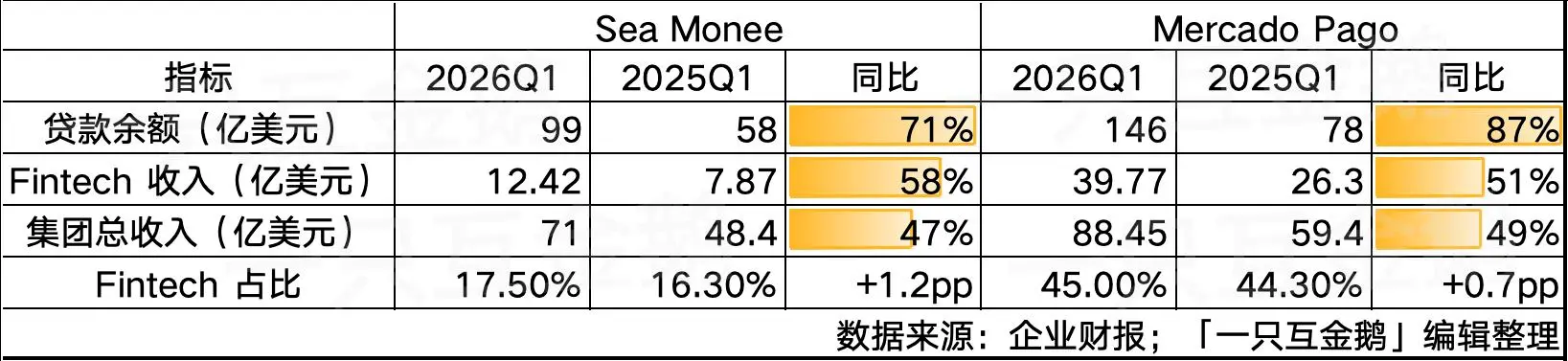
As of the end of Q1 2026:

  • Monee's loan balance reached $9.9 billion (approximately RMB 67 billion), up 71% year-on-year;

  • Mercado Pago's loan balance reached $14.6 billion (approximately RMB 98.7 billion), up 87% year-on-year.

For Q1 2026:

  • Monee's revenue reached $1.242 billion (approximately RMB 8.4 billion), accounting for 17.5% of Sea's total group revenue, up from 16.3% in Q1 2025;

  • Mercado Pago's revenue reached $3.977 billion (approximately RMB 26.9 billion), accounting for 45% of Mercado Libre's total group revenue, up from 44.3% in Q1 2025.

The development logic of "E-commerce + Fintech" for these two companies is not unfamiliar to us. Chinese giants like Ant, JD, and ByteDance all grew by following this path.

However, their differentiated approaches implemented in Southeast Asia and Latin America are also highly valuable as references for domestic fintech and internet giants expanding overseas.

Below, "A Fintech Goose" reviews the key data and development highlights for both giants in Q1 2026.

01 Sea's Monee: Obtained Financial Credit License in Brazil in Q1
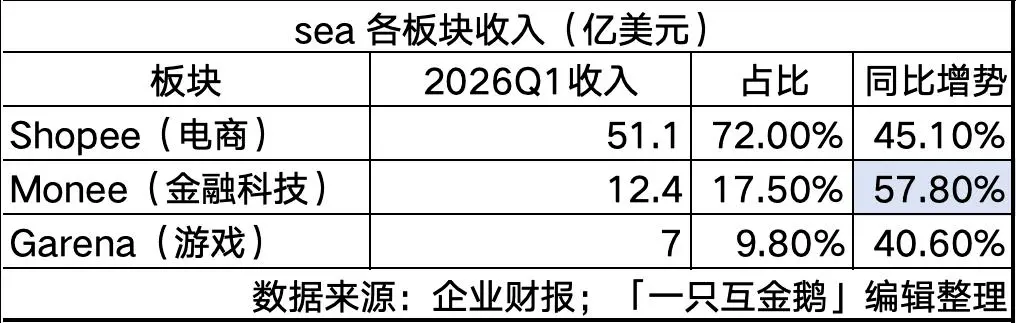
From the data, the fintech segment, i.e., Monee, significantly outperformed in revenue growth (+57.8% YoY) compared to the e-commerce segment Shopee (+45.1%) and the gaming segment Garena (+40.6%).

It's evident that the revenue contribution of the fintech segment Monee within the entire Sea group continues to increase.

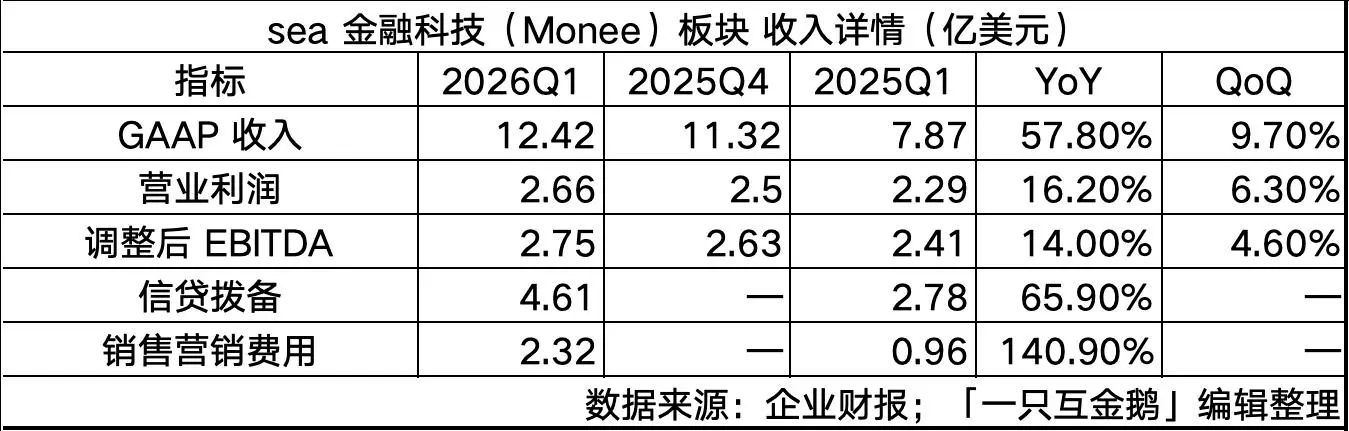
Specific data for the fintech segment:

(1) Loan Balance
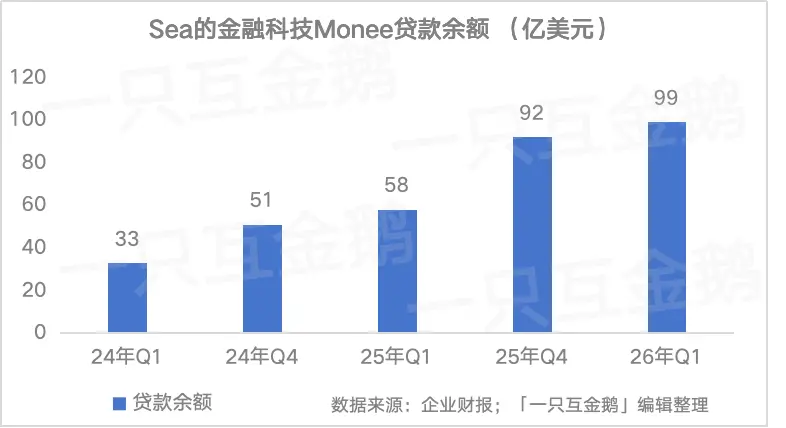
In just two years, the loan balance has grown from $3.3 billion to $9.9 billion, tripling in size.

Each quarter, the loan balance maintains high double-digit growth.

During the investor call, management mentioned that Q1 is typically a consumption off-season, but this year Q1, Sea Monee's loan balance still achieved a sequential growth of +7.5%.

(2) Risk Performance:
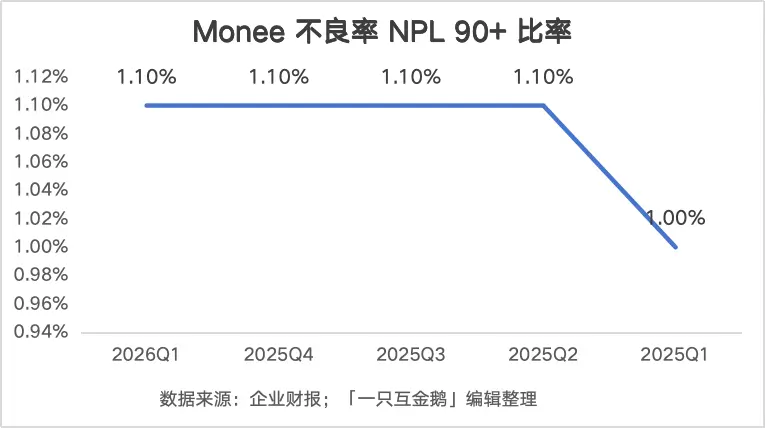
While the loan portfolio grew 71% within a year, the 90+ day NPL ratio only slightly increased from 1.0% to 1.1%, remaining stable at 1.1% for four consecutive quarters.

The stable NPL ratio indicates, to some extent, that their risk model has withstood the test of rapid credit expansion.

Important note on NPL ratio calculation: The denominator for the NPL 90+ ratio includes total loan principal from both "on-book + off-book" loans.

The financial report explains:

Off-book mainly refers to channeling arrangements, where cooperative financial institutions lend on the Sea platform.

(3) Three Growth Paths for Credit Business

Sea clearly outlined three growth paths for Monee's credit business in the conference call:

Path 1: Deepen relationships with existing users

Gradually increase credit limits as understanding of user repayment behavior deepens. This is reflected in the average loan balance per user increasing from $200 to $250 (+25%).

Path 2: Acquire high-quality new users

Launch targeted campaigns for customer segments with better risk scores and stronger spending power, attracting them with competitive pricing, higher credit limits, and longer repayment terms. Management explicitly stated "early signs show success."

Path 3: Expand credit scenarios outside the Shopee ecosystem (Off-Shopee)

This is the most promising growth direction.

In Thailand and Indonesia, Off-Shopee SPayLater loans exceeded 20% of the SPayLater portfolio by the end of Q1.

Notably, strong growth is seen in high-value categories in Indonesia (like electronics and two-wheelers), where installment credit plays a significant role in purchases.

(4) Brazil Market Shines Brightly

In Q1 2026, Brazil became Sea's fastest-growing market.

Both the e-commerce Shopee segment and the fintech Monee segment had highlights:

Shopee Brazil:

  • Q1 was the fastest-growing market while remaining profitable;

  • GMV growth exceeded market average, driven by active buyers, purchase frequency, and average order value;

  • Delivery times improved by over 1 day year-on-year;

  • 3 new fulfillment centers were built, bringing the total to 5;

  • ShopeeMall GMV more than doubled year-on-year, accounting for about 15% of Brazil's total GMV;

  • ShopeeVIP membership program launched in Brazil in April (already over 10 million members in Asia).

Brazil Fintech (Monee Brazil):

  • The combined SPayLater + cash loan credit product launched last year aligns well with Brazilian consumers' credit habits. This drove strong growth in user numbers and repurchase rates.

  • In Q1 2026, Brazil's loan portfolio exceeded $1 billion, up 250% year-on-year, becoming the fourth market with a loan portfolio over $1 billion.
    Note: The other three billion-dollar markets are Indonesia, Thailand, and Malaysia.

  • SPayLater GMV penetration in Brazil is only about 10%, far below mature markets, indicating huge growth potential;

  • Average loan balance per user in Brazil doubled year-on-year, showing extremely strong user stickiness.

  • Crucially – they secured a key license!

In Q1 2026, Sea was approved for Brazil's SCFI license (Sociedade de Crédito, Financiamento e Investimento), also known as the Brazilian financial credit license.

Obtaining this license broadens the range of financial services that can be offered in Brazil. It lays a compliant foundation for independently conducting more diversified credit business in Brazil in the future. This is a key milestone.

02 Mercado Libre: Brazil Credit Business Q1 Revenue $1.124 Billion (approx. ¥8 billion RMB)

Now let's look at Mercado Libre.

Like Sea, Brazil is a significant part of Mercado Libre's operations across all countries.
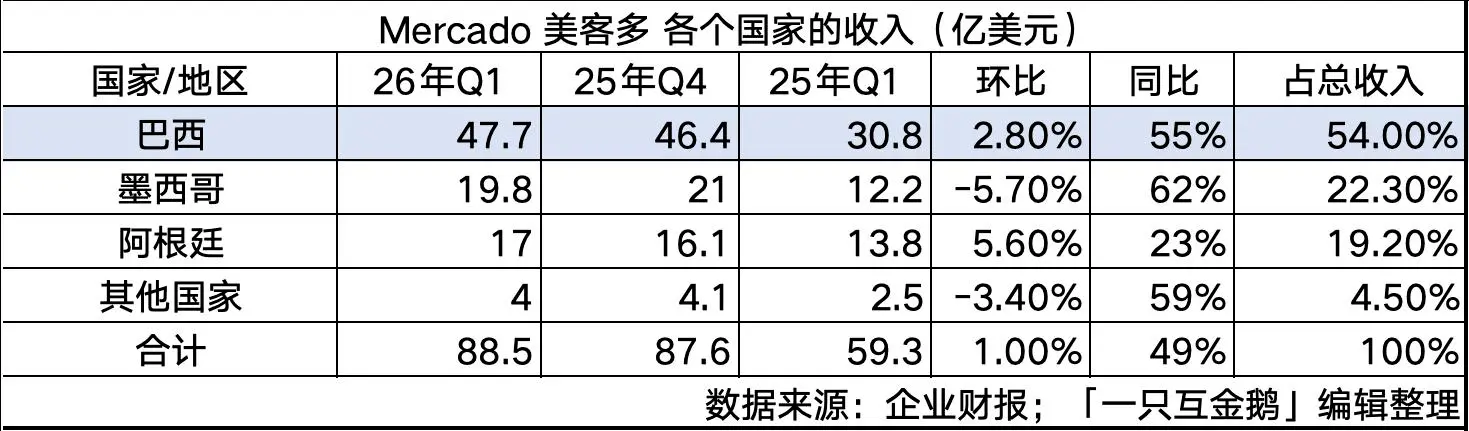
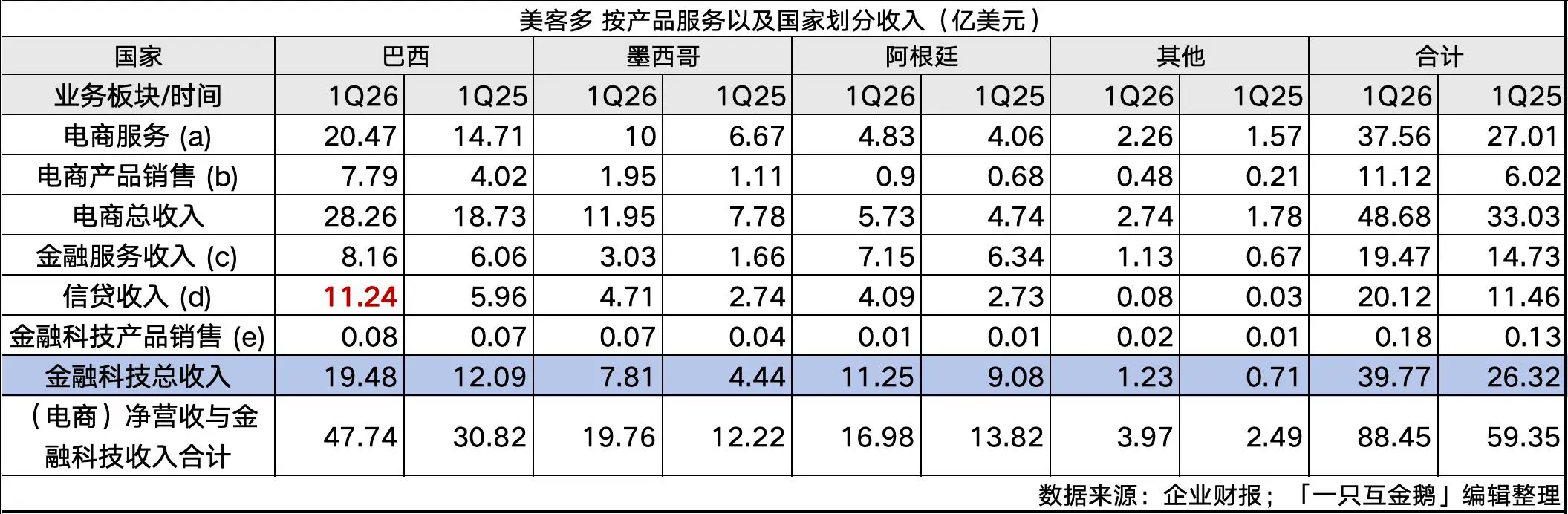
Looking at the Q1 2026 financial report, if revenue is broken down by country:

  • Brazil contributed over half of the total revenue, accounting for 54%;

  • Mexico was the fastest-growing market, with revenue up 62% year-on-year;

  • Argentina saw relatively moderate growth, with revenue up 23%, but considering Argentina's inflation and currency depreciation, the real local currency growth was high;

  • Other countries, including Chile, Colombia, Peru, etc., have a relatively small scale, collectively accounting for only 4.5%.

Looking at business segments in Q1 2026, the e-commerce segment declined slightly quarter-on-quarter (seasonal off-peak), but the Fintech segment bucked the trend with sequential growth of +4.1%.
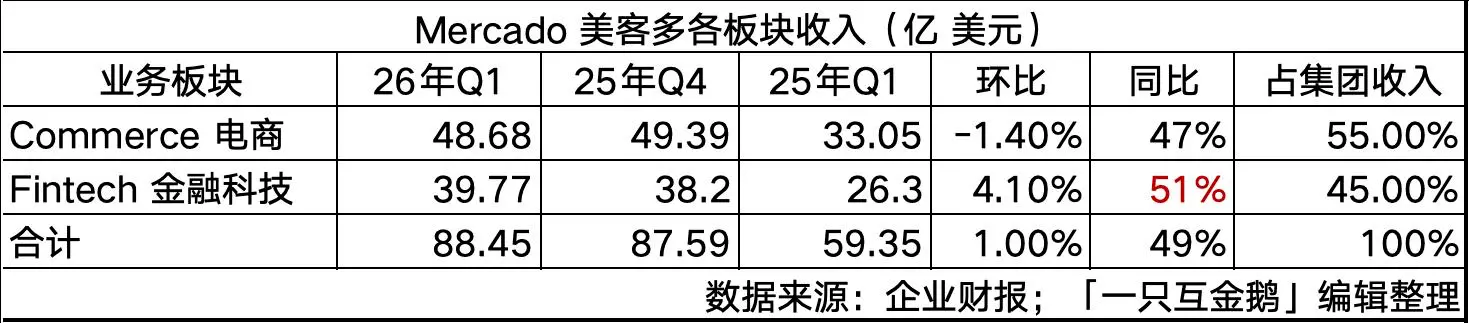
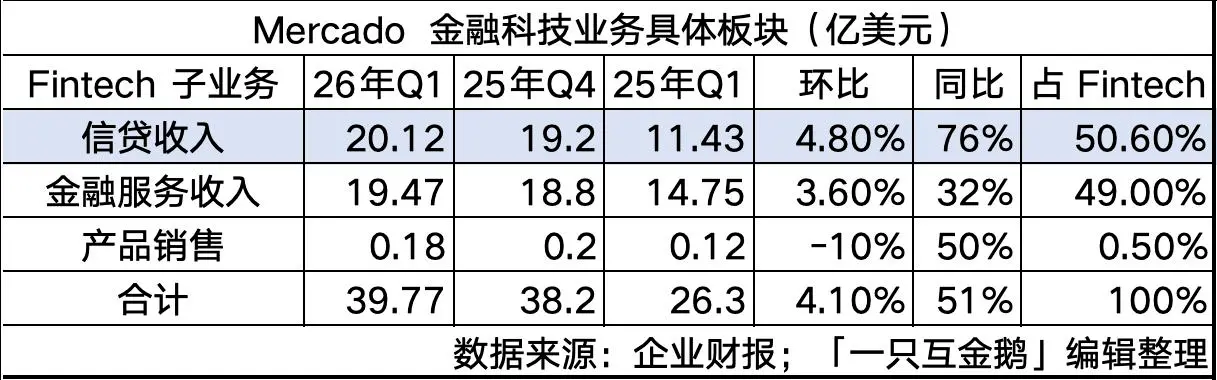
Interestingly, within the fintech segment, credit revenue surpassed financial services revenue for the first time, becoming the largest engine for Fintech.

In other words: the credit business supports the overall performance.

In previous articles, "A Fintech Goose" has detailed Mercado Libre's credit business.

Specifically, it includes:

1 Consumer loans; 2 Credit card business; 3 Merchant loans; 4 Auto loans.
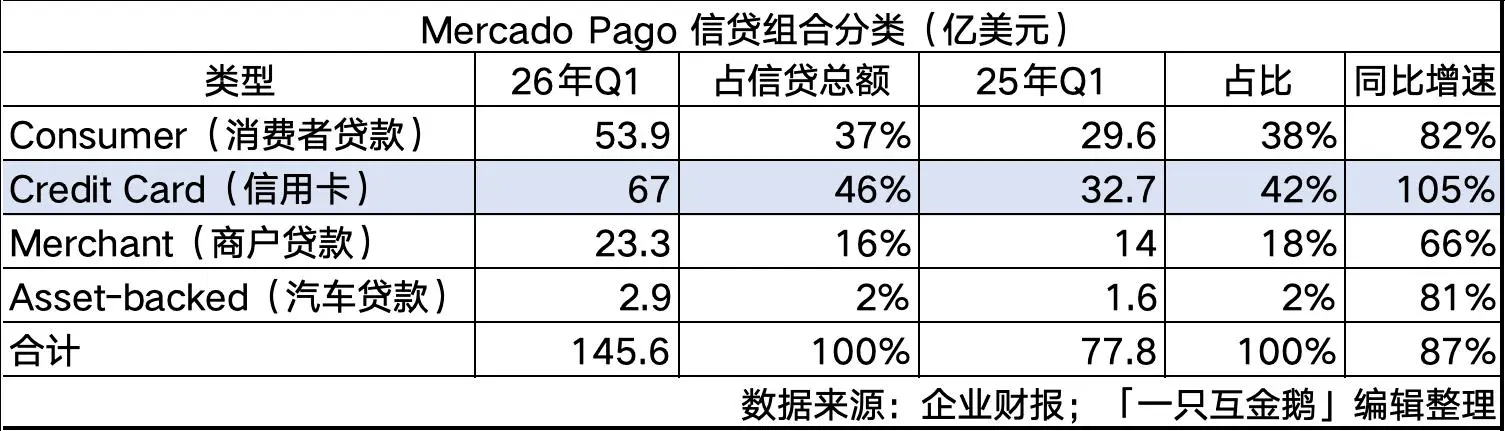
Looking at Q1 2026 data:

The credit card business showed significant loan portfolio growth (+105%), with its size accounting for 46%, taking the largest share.

No matter which country, credit cards are a business with an extremely long investment-return cycle.

In Latin America, Mercado Libre's credit card issuance incurs very high initial costs: zero annual fee + up to 40 days interest-free + up to 18 interest-free installments, plus substantial subsidies for customer acquisition. The required costs are extremely high.

Coupled with Brazilian users' habit of using interest-free installments, it takes a relatively long time from users "grabbing benefits" to "generating interest income."

(1) Strategic Significance of Credit Cards

During the investor call, management repeatedly mentioned the strategic significance of the credit card business.

They even used this phrase to describe it:"Investing in credit cards is as important for Mercado Pago as building our own logistics network was for the e-commerce platform ten years ago."

Key points summarizing Mercado Libre's credit card business:

  • Card issuance: Q1 saw 2.7 million new cards issued, credit card TPV grew 90% year-on-year, MAU grew 68% year-on-year.

  • Cross-selling flywheel: Many credit card users were previously only platform buyers and have now become active Fintech users.

  • Ecosystem effect: Credit cards improve platform conversion rates, GMV per user, and cross-ecosystem transaction volume.

  • 5-year investment in Brazil: Credit cards in Brazil have been invested in for 5 years. Older vintages are maturing as expected, gradually offsetting the dilution effect of new vintages.

  • Acceleration in Mexico: Credit card issuance in Mexico is accelerating, with an attractive payback period.

  • New start in Argentina: Credit cards were just launched in Argentina last August-September, with early performance similar to the initial stage in Brazil.

(2) Credit Risk Performance
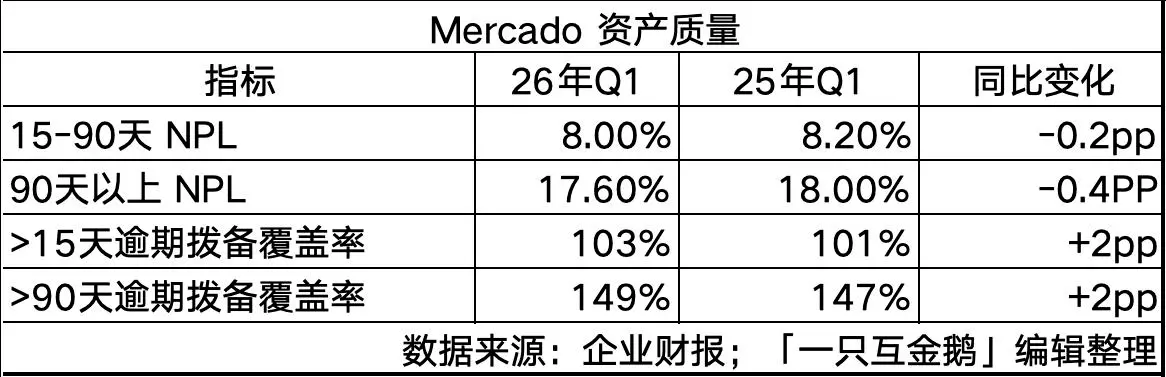
While the credit portfolio grew 87%, the NPL ratio declined year-on-year, and provisions for severely overdue loans exceeded by about 1.5x, strengthening the risk buffer.

Special note: An NPL ratio over 17% seems alarming, but lending rates in the local market are also higher than in China.

Based on Mercado Libre's NIMAL and public information from the Brazilian market, it's estimated:

Personal Loans: Annual interest rate 146%;

Payroll Loans: Annual interest rate 28% (secured, lowest rate);

Credit Card revolving interest annual rate 451% (Central Bank of Brazil, March 2026).

(3) Net Interest Margin Remains Impressive
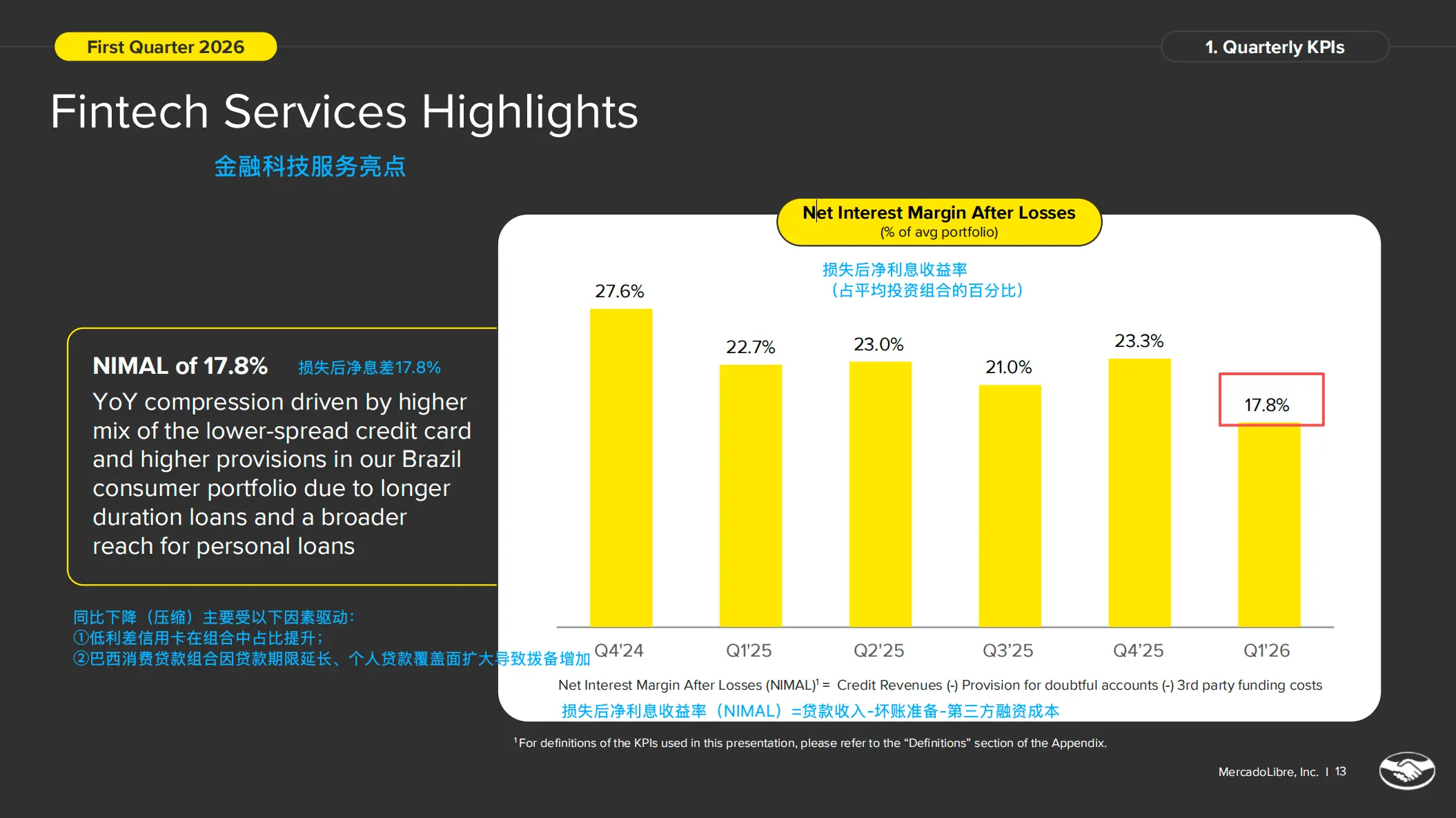
Screenshot from Mercado Libre Investor Report (Click image to enlarge)

Mercado Libre's net interest margin remains impressive.

It declined from 22.7% in Q1 2025 to 17.8% in Q1 2026, a drop of 4.9 percentage points, but this is still an extremely high level.

For comparison, in China, China Merchants Bank's Q1 2026 NIM was only 1.83%; WeBank, China's "profit king" among private banks, had an NIM of only 4.19% in 2025 (pre-provision basis).

Moreover, Mercado Libre's metric calculation is more stringent.

  • Mercado Libre NIMAL = Credit revenue - Bad debt provisions - Funding cost, i.e., Net Interest Margin after deducting bad debts.

  • Domestic bank NIM = (Interest income - Interest expense) / Interest-earning assets, i.e., before bad debt deduction.

Mercado Libre's investor call mentioned: The 4.9ppts year-on-year decline in NIMAL was primarily due to:

  • Increased proportion of credit cards (2/3 of the compression from this factor): Initial NIMAL for credit cards is lower because full expected loss provisions need to be booked at issuance;

  • Longer terms and broader coverage of consumer loans in Brazil (1/3 of the compression): Terms extended from 5 months to 8 months, reaching more credit score segments.

  • Notably, each sub-portfolio remains profitable. Consumer loan portfolio still maintains double-digit margins, merchant loans have the highest spread. Credit cards follow a "first loss, then profit" model, and older vintages in Brazil have already started generating profits.

(4) Brazil Market, the Biggest Surprise

Management expressed pleasant surprise and the importance of the Brazil market in the shareholder letter:

"Twenty-six years after launch, Mercado Libre is growing at startup rates across all of our major markets. Nowhere is this more evident than in Brazil, our largest and most established market, where growth is not just fast – it is accelerating."

Mercado Libre's e-commerce revenue in Q1 2026 was $2.826 billion, up 51% year-on-year.

Specifically in Q1, e-commerce GMV grew 38% year-on-year, items sold grew 56%, and active buyers grew 32%.

This growth primarily stemmed from the decision in 2025 to lower the free shipping threshold, which management called "one of the most important decisions in 2025" – lowering the free shipping threshold to R$19 (approximately RMB 25.49) greatly reduced the psychological barrier for first-time purchases.

Looking at the fintech segment –

  • Fintech in Brazil contributed $1.948 billion in revenue in Q1 2026, accounting for 22.0% of the group's total revenue;

  • Within that, credit-related revenue was $1.124 billion, accounting for 12.7% of the group's total revenue. This revenue was $596 million in Q1 last year, representing 89% year-on-year growth.

Currently, Brazil's credit business is undoubtedly a key growth engine for Mercado Libre.

The credit revenue from a single market already accounts for nearly one-eighth of Mercado Libre's global total revenue.
In short, while both Sea and Mercado Libre are betting big on Brazil, with growth rates often doubling, it is indeed an extremely tempting market.

However, this rapid growth seems to be reserved for the giants. Other fintech players—without e-commerce transaction scene data, without a payment loop to cultivate users—find it extremely difficult to operate credit businesses in Brazil. The local tax system is also particularly complex, making it hard for general players to establish themselves, and it's not recommended.


Связанные с этим вопросы

QAccording to the article, how does the credit business performance of Sea's Monee and Mercado's Mercado Pago compare in Q1 2026?

AIn Q1 2026, both Monee and Mercado Pago showed strong growth in their credit businesses. Monee's loan book reached $9.9 billion, a year-on-year increase of 71%, while Mercado Pago's loan book reached $14.6 billion, a year-on-year increase of 87%. Mercado Pago's loan book was larger and grew at a faster rate.

QWhat were the three key growth paths identified for Sea Monee's credit business?

AThe three key growth paths for Sea Monee's credit business are: 1) Deepening relationships with existing users by increasing credit limits as repayment behavior is understood better. 2) Acquiring high-quality new users through targeted campaigns with competitive pricing, higher limits, and longer repayment terms. 3) Expanding credit scenarios outside the Shopee ecosystem (Off-Shopee), such as in Indonesia for high-value categories like electronics and two-wheelers.

QWhy is the Brazilian market considered a 'main battleground' for both Sea and Mercado Libre?

ABrazil is considered a main battleground because it is the fastest-growing and most significant market for both companies. For Sea, Brazil was its fastest-growing market in Q1 2026, with Monee's loan book there exceeding $1 billion and growing 250% year-on-year. For Mercado Libre, Brazil contributed over 54% of its total revenue, with its credit business in Brazil generating $1.124 billion in revenue, accounting for 12.7% of the group's total revenue and growing 89% year-on-year. Both see immense potential due to low credit penetration compared to mature markets.

QWhat strategic importance does the credit card business hold for Mercado Pago, as stated in the article?

AMercado Pago's management compared the strategic importance of investing in credit cards to the significance of building its own logistics network for its e-commerce platform a decade ago. The credit card business is crucial for driving cross-selling, increasing platform conversion rates, boosting per-user GMV, and expanding cross-ecosystem transaction volume. Although it has a long investment payback period, older batches in Brazil have already started to become profitable.

QDespite high delinquency rates, how does Mercado Pago maintain profitability in its credit business, especially in Brazil?

AMercado Pago maintains profitability despite high delinquency rates because the interest rates on its credit products in markets like Brazil are significantly higher than in regions like China. For example, personal loan annual rates can be around 146%, and credit card revolving interest rates can be as high as 451%. This high revenue potential, combined with prudent risk management like maintaining a 1.5x provision coverage for severely delinquent loans, allows the business to remain profitable even with a high NPL ratio.

Похожее

Печально известный MEV-бот JaredFromSubway обезврежен на $7,5 миллиона

По сообщениям, один из самых известных MEV-ботов Ethereum, известный под псевдонимом JaredFromSubway, был опустошен примерно на 7,5 миллионов долларов. По данным компании Blockaid, злоумышленники использовали подконтрольные им контракты, чтобы обмануть автоматическую систему бота и заставить его предоставить разрешения на использование токенов (approvals). Затем эти разрешения были использованы для вывода средств WETH, USDC и USDT с контракта бота. Этот инцидент примечателен своей иронией: боты MEV созданы для извлечения выгоды из мельчайших временных и маршрутных преимуществ на рынке, но в данном случае их собственная автоматизация стала уязвимостью. Атака не была взломом базового протокола Ethereum или массовым сбоем в популярном DeFi-приложении. Она была целенаправленной и использовала логику самого бота для автоматического одобрения вредоносных торговых маршрутов, которые он посчитал прибыльными. Происшествие высвечивает более широкий риск для автоматизированных торговых систем: стремление к скорости может обернуться уязвимостью. Оно служит напоминанием, что разрешения на использование токенов в DeFi — это мощные права доступа, требующие строгих мер безопасности, проверок и симуляций. Хотя сумма ущерба значительна, она не носит системного характера для сети. Основные последствия, вероятно, будут репутационными для инфраструктуры MEV и заставят операторов ботов тщательнее пересматривать свою логику предоставления разрешений.

bitcoinist1 ч. назад

Печально известный MEV-бот JaredFromSubway обезврежен на $7,5 миллиона

bitcoinist1 ч. назад

Интерпретация отчета Morgan Stanley: Подробный анализ настроений инвесторов перед квартальным отчетом Micron и текущей ситуации в секторе аппаратного обеспечения

Обзор отчетов J.P. Morgan: подробный анализ настроений инвесторов перед квартальным отчетом Micron и ситуации в секторе hardware. Эксперт J.P. Morgan Джошуа Майерс в отчете от 21 июня обобщил результаты опроса инвесторов перед квартальным отчетом Micron, фидбэк от компаний hardware, обновления по прогнозам капитальных затрат на ИИ и динамику ключевых компаний. **Ключевые выводы:** 1. **Настроения перед отчетом Micron остаются оптимистичными**, но растут вопросы относительно устойчивости высокой валовой маржи (превышает 80%) и методов оценки. Рынок ожидает объявления новых долгосрочных соглашений (SCA). 2. **В цепочке поставок hardware спрос, связанный с ИИ, остается сильным, но наблюдается дифференциация между акциями.** Celestica (CLS) улучшила прогноз по марже, Western Digital и Seagate выигрывают от улучшения цен. Fabrinet (FN) усиливает предсказуемость роста бизнеса оптических модулей для ИИ. 3. **Прогнозы по капитальным затратам на ИИ снова повышены.** Прогноз роста рынка оборудования для производства пластин (WFE) на 2027 год повышен до 29%. **Другие наблюдения:** * Улучшение прогноза по марже Celestica сигнализирует о росте уверенности в передаче затрат и концентриции спроса на ИИ-сетевые проекты среди ведущих поставщиков. * Квартальный отчет Micron является ключевым катализатором, а переменной выступает степень детализации по SCA. * Часть текущего сильного спроса на серверы и сетевое оборудование может быть связана с упреждающими закупками из-за опасений роста пошлин. **Сигналы для отслеживания:** Детализация SCA и прогноз по марже в отчете Micron; возможность повышения годового guidance компанией Arista Networks; выполнение Fabrinet плана по наращиванию выручки от модулей для Amazon до $250 млн в квартал в течение года.

marsbit1 ч. назад

Интерпретация отчета Morgan Stanley: Подробный анализ настроений инвесторов перед квартальным отчетом Micron и текущей ситуации в секторе аппаратного обеспечения

marsbit1 ч. назад

Интерпретация аналитического отчета: Дебют нового председателя ФРС - сменился лидер, но не сменился ли сценарий?

**Обзор доклада: первое выступление нового председателя ФРС, новый руководитель, но прежний сценарий?** Морган Стэнли анализирует первое заседание FOMC под председательством Кевина Уорша. Главные выводы: 1. **Отсутствие дорожной карты по ставкам — само по себе сигнал.** Уорш сознательно избегает «прямого руководства» (forward guidance), что соответствует его подходу. Прогнозы FOMC предполагают лишь одно повышение ставки в этом году. Однако, если инфляция, как ожидает экономист Морган Стэнли Сет Карпентер, окажется ниже прогнозов (3.3% на 2026 г.), логика этого единственного повышения ставится под сомнение, тем более что на 2027 год уже прогнозируются снижения ставок. 2. **Сокращение баланса ФРС может быть более агрессивным, но менее болезненным.** Позиция Уорша по сокращению баланса (quantitative tightening, QT) известна. Карпентер указывает, что даже сокращение вдвое баланса Казначейства на счетах ФРС уменьшит общий баланс примерно на $500 млрд с минимальным влиянием на рынки. Комбинация мер (снижение процентов по резервам, изменение требований к ликвидности) может позволить сократить баланс больше, чем ожидает рынок. Ключевой риск для рынков — возможные прямые продажи ипотечных ценных бумаг (MBS). 3. **Пересмотр рамок политики, но цель по инфляции 2% остается.** Уорш создал рабочую группу для пересмотра политических рамок, но целевой показатель инфляции в 2% подтвержден. Карпентер отмечает, что упрощение коммуникации FOMC — это скорее возврат к прошлым практикам, а не кардинальный сдвиг. Истинная ценность «прямого руководства», по его мнению, была лишь при нулевых ставках. **Итог:** Основные дебаты на рынке теперь вращаются не вокруг того, что сказал Уорш, а вокруг того, чего он *не* сказал: будет ли это единственное повышение ставки в 2026 году и как именно будет проходить сокращение баланса. Ответы зависят от данных по инфляции (PCE), конкретных планов по QT и выводов рабочей группы по пересмотру политики.

marsbit2 ч. назад

Интерпретация аналитического отчета: Дебют нового председателя ФРС - сменился лидер, но не сменился ли сценарий?

marsbit2 ч. назад

Решающая неделя на рынке: коррекция BTC и борьба за поддержку HYPE | Приглашенный анализ

Ключевая неделя для рынка: BTC тестирует уровень поддержки, борьба вокруг уровня HYPE. На этой неделе рынок вступает в решающую фазу. Ожидания относительно политики ФРС продолжают влиять на оценку рискованных активов, в то время как на крипторынке после недавней консолидации расхождения между быками и медведями проявляются на ключевых ценовых уровнях. **Биткойн (BTC):** * **Анализ:** На 4-часовом графике цена формирует краткосрочный восходящий канал. Текущее движение рассматривается как повторное тестирование (откат) нижней границы этого канала после ее пробоя. * **Прогноз на неделю:** Ключевой момент — результат этого тестирования. * Если цена удержит поддержку канала, возможен рост к зоне сопротивления $69,500–$70,500. * Если поддержка не удержится, вероятно повторное тестирование ключевого уровня поддержки $59,000–$60,000. * **Стратегия:** В моделях позиционирования подтверждается медвежья структура. Среднесрочная стратегия предполагает удержание открытых на прошлой неделе коротких позиций (~20% капитала) в ожидании возможностей для их увеличения. Краткосрочная тактика (до 30% капитала) предлагает три сценария (A/B/C) для торговли в диапазоне между ключевыми уровнями поддержки и сопротивления. **HYPE:** * **Анализ:** На 4-часовом графике видна коррекция в три волны от недавнего максимума. Цена вернулась к ключевой зоне поддержки $64–$66. * **Прогноз на неделю:** Основное внимание — на результат битвы между быками и медведями в зоне $64–$66. * Удержание поддержки может продолжить восходящий тренд. * Пробитие поддержки может привести к более глубокой коррекции к $52–$54. * **Стратегия:** Краткосрочная стратегия сосредоточена на поиске возможностей для покупки на откатах к поддержке ($64–$66 или $52–$54) при появлении сигналов разворота. Позиции должны быть небольшими (менее 30% капитала) со строгим соблюдением стоп-лоссов. **ВАЖНО:** Все представленные мнения, модели и стратегии являются личным техническим анализом и записью для торгового дневника. Они не представляют собой инвестиционные рекомендации. Рынки изменчивы, управление рисками и дисциплина стоп-лоссов являются абсолютным приоритетом.

marsbit2 ч. назад

Решающая неделя на рынке: коррекция BTC и борьба за поддержку HYPE | Приглашенный анализ

marsbit2 ч. назад

Обзор аналитического отчета: Citigroup участвует в саммите AWS, оптимистично оценивает ускорение облачного бизнеса, но управление данными остается ключевым фактором

**Краткое изложение доклада Citigroup по итогам саммита AWS в Нью-Йорке** Аналитики Citigroup, посетившие саммит AWS 17-18 июня, выпустили отчет, в котором прогнозируют ускорение роста доходов облачного подразделения Amazon с 30% в FY26 до 37% в FY27, считая эти оценки, возможно, консервативными. **Ключевые выводы:** 1. **Фокус AWS сместился на масштабируемое развертывание.** В отличие от прошлогоднего акцента на экспериментах, новые продукты AWS (такие как Context, Quick, Continuum, Kiro) напрямую направлены на решение реальных проблем предприятий при внедрении AI. Например, AWS Context создает единый граф знаний из разрозненных корпоративных данных, выступая в роли уровня поиска для AI-агентов. 2. **Провайдеры инфраструктуры данных выигрывают от роста AI.** Компании вроде Snowflake, Elastic и Oracle демонстрируют активный рост, помогая клиентам управлять данными для AI-нагрузок. 3. **Управление данными (Data Governance) стало критическим фактором.** По мере роста числа AI-агентов в компании с сотен до тысяч, способность каждого агента находить нужные данные в рамках правильных разрешений становится ключом к интеграции AI в основные бизнес-процессы. AWS Context рассматривается как важный шаг AWS в сторону предоставления инфраструктурного уровня для управления данными. **Инвестиционные тезисы:** * **Основная ставка:** на ускорение роста AWS и на доходы провайдеров инфраструктуры данных. * **Не ожидается:** резкого снижения затрат на AI в краткосрочной перспективе, хотя компании теперь уделяют больше внимания оптимизации расходов. * **Ключевые сигналы для отслеживания:** Фактический рост выручки AWS, динамика объема задач в AWS Bedrock AgentCore и влияние изменений в ценах поставщиков данных (например, Elastic) на спрос.

marsbit2 ч. назад

Обзор аналитического отчета: Citigroup участвует в саммите AWS, оптимистично оценивает ускорение облачного бизнеса, но управление данными остается ключевым фактором

marsbit2 ч. назад

Торговля

Спот
Фьючерсы
活动图片