Three Months of Raising $6 Billion in Funding: What Are the Leading Crypto VCs Betting On?

marsbitОпубликовано 2026-05-08Обновлено 2026-05-08

Введение

While the crypto bear market persists, top-tier venture capital firms are making significant moves by raising massive new funds, signaling a strategic bet on the industry's future. Haun Ventures and a16z recently announced funds totaling $1 billion and $2.2 billion, respectively. This follows other major raises from firms like Dragonfly, Paradigm, ParaFi, and Blockchain Capital. In under three months, these six VCs have amassed over $6 billion in fresh capital, a clear example of counter-cyclical investing during a quiet market phase. The fundraising landscape highlights a sharp divergence between large and small VCs. Many mid-sized and smaller funds are struggling with poor returns, limited exit options, and difficulty raising new capital, leading some to scale back or exit. In contrast, leading firms are strengthening their dominance due to structural advantages: superior access to high-quality deals, the ability to invest across all stages, greater capacity for long-term bets and risk, and stronger negotiation power. These new funds are largely converging on key investment themes. The strongest consensus centers on next-generation on-chain financial infrastructure, including stablecoins, real-world asset (RWA) tokenization, prediction markets, and on-chain payments. VCs are focusing on projects with validated demand that can attract traditional finance flows. Another major focus is artificial intelligence (AI), particularly AI agents, as crypto seeks to position its open...

Author: Azuma, Odaily Planet Daily

The bear market in cryptocurrencies continues, yet some highly significant moves have emerged in the primary market.

On May 4th, Haun Ventures, the venture capital firm founded by former U.S. federal prosecutor Katie Haun, announced the completion of a funding round totaling $1 billion. The early-stage and later-stage funds will each be allocated $500 million, primarily to be invested over the next 2 to 3 years in startups within the cryptocurrency and blockchain sectors, while also expanding into intersecting areas such as AI agents, fintech, and alternative assets.

Just one day later, a16z followed up by announcing the close of its fifth cryptocurrency fund, Crypto Fund 5, securing $2.2 billion in committed capital. The fund will continue to deepen its focus on the cryptocurrency market, concentrating on the often-overlooked yet most value-creating parts during cyclical shifts, transforming next-generation infrastructure into products people use daily.

Looking back further in the timeline reveals that this is not a coincidence but more like a "collective consensus" among leading VCs.

In February of this year, Dragonfly's Fund IV completed a $650 million raise. At the end of February, multiple media outlets reported that Paradigm was seeking to raise up to $1.5 billion for its next fund. In March, ParaFi announced the completion of a $125 million raise. In late April, sources revealed that Blockchain Capital was raising $700 million for two funds... Within less than three months, just these six VCs alone have quietly amassed over $6 billion in funding.
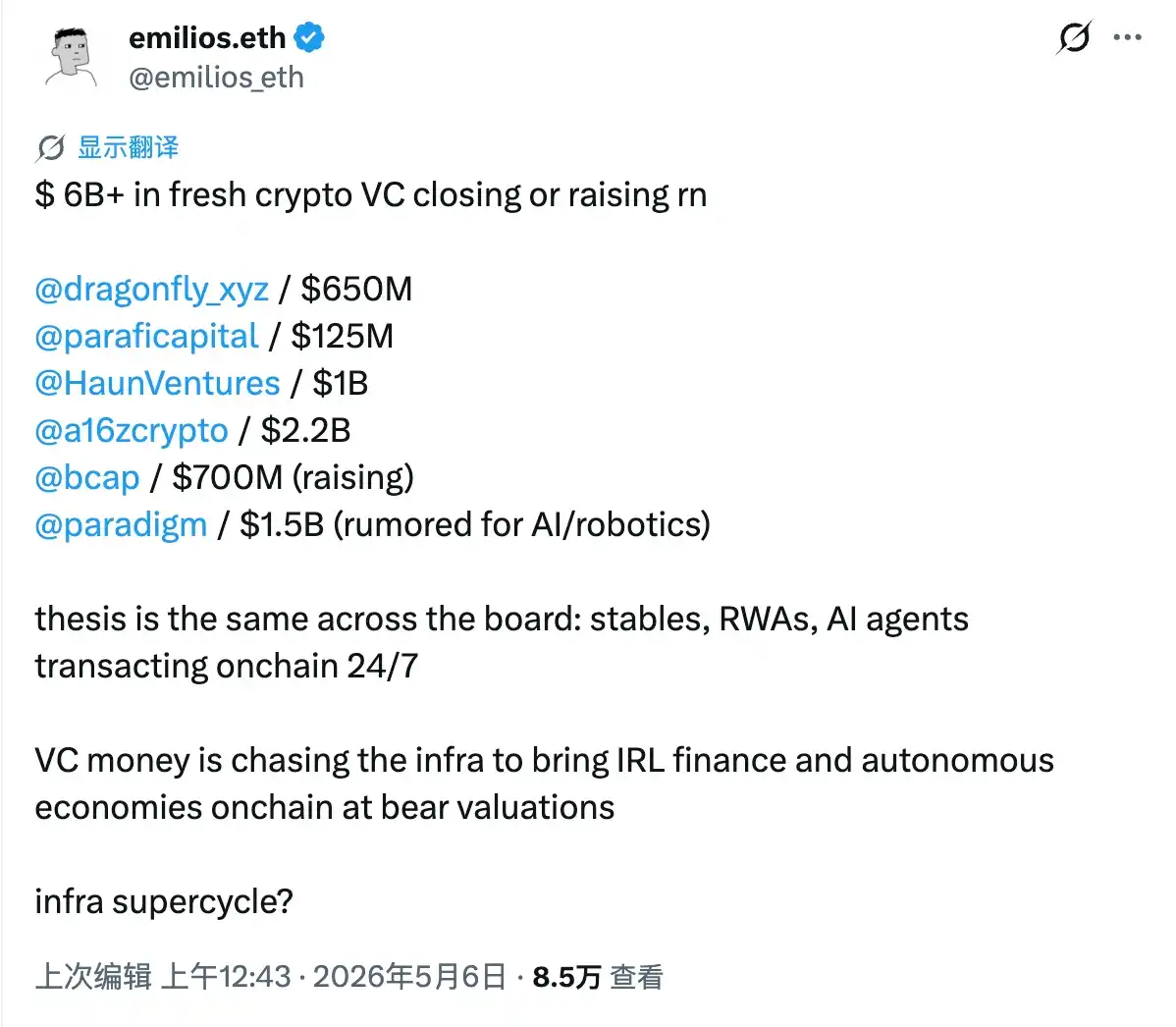
More crucially, this wave of fundraising did not occur at the market's peak but during the bearish phase characterized by depleted altcoin liquidity, declining primary market valuations, and persistently low industry sentiment. As a16z partner Chris Dixon stated, "We are in a relatively quiet stage." This is not a bullish follow-up but a typical counter-cyclical deployment.

The Primary Market is Diverging

Focusing solely on the $6 billion fundraising amount can easily create the illusion of "a primary market recovery," but the reality is far more complex. Surveying the current survival status of top-tier VCs versus mid-sized and smaller VCs reveals a clear trend of divergence in the primary market.

For most mid-sized and smaller VCs, this cycle is proving much tougher than anticipated. Due to the continued slump in altcoins (largely missing the entire bull run) coupled with tightening liquidity in the secondary market, exit channels for funds are severely obstructed. Paper profits often shrink or even turn negative over prolonged vesting periods. The disappointing investment returns have directly led to a decline in LP confidence, making fundraising for new funds increasingly difficult.

Consequently, we are witnessing the passive contraction of most mid-sized and smaller VCs during the bear market: some have chosen to downsize their funds and reduce deployment frequency; others have transitioned to pure secondary market funds; and some have exited the market entirely. Many mid-sized VCs that were highly visible during the last bull run have now vanished from the scene.

In stark contrast are the leading VCs still raising funds aggressively. Although their investment pace has also slowed with the market downturn, leveraging structural advantages, their dominance in the primary market is actually strengthening.

Regarding these structural advantages, firstly, top VCs typically possess stronger resource monopoly capabilities, enabling them to capture rare high-quality projects more effectively (prime examples include Kalshi backed by a16z and Paradigm, Polymarket backed by Dragonfly and ParaFi, Blockchain Capital which invested in Coinbase and Circle). Secondly, top VCs can cover the entire investment cycle, from early pre-seed and seed rounds to later Series A and B, offering more opportunities for late entry or amplified gains. Thirdly, top VCs have greater room for error, with larger AUM allowing them to withstand relatively higher failure rates and bet on longer-term narratives. Fourth, the brand power of top VCs translates to stronger bargaining power, often securing more favorable terms than mid-sized VCs even within the same funding round.

This structural disparity in advantages and disadvantages ultimately leads to market divergence, where the Matthew effect becomes increasingly pronounced. In a bull market, mid-sized VCs might still pull off a comeback with a few lottery-ticket wins, but during a bear cycle, this trend only intensifies.

What Are These $6 Billion Targeting?

Based on disclosures from these six VCs, the newly raised $6 billion is earmarked for the following sectors and directions.

  • Dragonfly: Bullish on crypto financialization trends, specifically mentioning stablecoins, prediction markets, agent payments, on-chain privacy, real-world asset tokenization.
  • Paradigm: Expanding beyond crypto into AI, robotics, and other frontier tech areas.
  • ParaFi: Stablecoins, asset tokenization, institutional-grade on-chain financial products.
  • Blockchain Capital: Focused on early-stage and growth-stage crypto startups.
  • Haun Ventures: Bullish on next-gen financial infrastructure, including stablecoins, asset tokenization, prediction markets, and also optimistic about the agent economy.
  • a16z: Mentions financial infrastructure like stablecoins, DeFi, prediction markets, asset tokenization. Also believes that in the era of the AI explosion, crypto networks' inherent properties can still address software transparency and verifiability issues.

Placing the public statements of these six VCs side by side, while differences in emphasis remain, overall they have converged significantly.

The core consensus undoubtedly centers on the new generation of on-chain financial infrastructure represented by stablecoins, asset tokenization (RWA), prediction markets, and on-chain payments. Whether it's Haun Ventures, a16z, Dragonfly, or ParaFi, these keywords are repeatedly mentioned in their new fund directions. To some extent, this signals a shift in the investment logic of the crypto industry. Compared to the more sentiment-driven bets of the last cycle, this time, leading VCs are placing greater emphasis on infrastructure-type projects that have preliminarily validated real demand and have the potential to capture traditional financial flows in the long term.

Additionally, leading VCs are significantly ramping up their AI-related investments. Paradigm has explicitly stated it will allocate part of its funds to AI and robotics, while Haun Ventures and Dragonfly have also mentioned agent-related directions. The reasons behind this trend are not complicated: on one hand, AI is currently the most certain major theme in the global tech industry, a space top VCs cannot afford to miss; on the other hand, the crypto industry is also trying to prove that it is not merely an old narrative marginalized by the AI hype but can become part of the underlying infrastructure for the AI era — especially as the agent economy gradually emerges, the inherent openness, composability, and permissionless nature of crypto networks are beginning to demonstrate renewed value.

Bear Market Fundraising is Essentially a Bet on the Next Cycle

For VCs, the bear market is often the stage that truly determines the future landscape.

While funds are easiest to raise during a bull market, project valuations and entry barriers are often also at their highest. It is only when market sentiment is low, liquidity dries up, and industry narratives falter that the opportunity for VCs to capture excess returns through judgment is truly amplified.

Looking back at past cycles, bear markets do not kill truly high-quality projects; instead, they accelerate market shakeouts, allowing the "gold to shine faster." This is why, even with current market sentiment remaining low, leading VCs are still raising funds counter-cyclically.

Because what they are truly betting on is never the "present," but rather who will become the next Circle, the next Hyperliquid, the next Polymarket once the next cycle begins.


Связанные с этим вопросы

QWhat is the most significant consensus among the six top-tier crypto VCs regarding their new investment focus, as mentioned in the article?

AThe core consensus among these VCs is a focus on the next generation of on-chain financial infrastructure, including stablecoins, asset tokenization (RWA), prediction markets, and on-chain payments. They are prioritizing projects with validated real-world demand and the potential to capture long-term traditional financial flows.

QWhy are major crypto VCs raising large funds during a bear market, according to the article?

AThey are practicing counter-cyclical investment. The primary reason is that bear markets offer the best opportunity to capture outsized returns. Valuations and entry barriers are lower, and the market washout allows truly high-quality projects to emerge more clearly. They are essentially betting on who will become the leading projects in the next market cycle.

QHow is the venture capital landscape in the crypto market currently diverging, as described in the article?

AThe market is experiencing significant divergence. While top-tier VCs are actively raising large funds, most small to mid-sized VCs are facing severe challenges. The latter are struggling with poor returns, dwindling LP confidence, and difficulties in raising new funds, leading many to downsize, pivot to secondary markets, or exit entirely. This is widening the gap and strengthening the dominance of major players.

QWhat structural advantages do leading crypto VCs possess that allow them to thrive even in a bear market?

ALeading VCs possess four key structural advantages: 1) Stronger resource monopolization to capture scarce, high-quality deals. 2) The ability to cover the full investment lifecycle from pre-seed to late-stage. 3) Larger fund sizes providing more room for error and enabling longer-term bets. 4) Stronger brand power and bargaining power to secure better deal terms.

QBesides financial infrastructure, what other major trend are top crypto VCs increasingly investing in, and why?

AThey are significantly increasing their investments in AI-related fields. This is because AI is the most certain trend in global tech, making it an unavoidable area for top VCs. Furthermore, the crypto industry aims to position itself as part of AI's foundational infrastructure. The inherent properties of crypto networks—openness, composability, and permissionless access—are seen as valuable for emerging areas like the Agent economy.

Похожее

The Next Generation of Payments Lies Not in the Payment Layer

The Next-Generation of Payment is Not in the Payment Layer This is the second piece in a series analyzing Stripe's AI strategy. The series stems from Stripe's vision of becoming the economic infrastructure for the AI Agent era, announced at Stripe Sessions 2026. A key debate centers on whether Know Your Agent (KYA) is merely an upgrade to existing payment systems. The author argues the opposite: payment will become a subsystem of KYA, not the other way around. Historically, major payment innovations (online banking, mobile wallets, QR codes) emerged from new transaction scenarios that broke the underlying assumptions of old systems, not from optimization within the payment layer itself. Agent economy is that new scenario, and KYA is the foundational infrastructure growing to support it. KYA's proposed five layers—Agent Identity, Authorization Scope, Intent Signing, Liability Chain Auditing, and Credit Rating—extend far beyond payments. Only authorization and auditing directly touch the payment链路. Identity, intent, and credit layers serve broader needs like cross-platform calls, AI alignment, and permission management. Stripe's strategic moves validate this view. Its focus on "economic infrastructure for AI," investments in protocols like Agentic Commerce Protocol (an identity/session protocol), Shared Payment Tokens, stablecoin infrastructure, embedded wallets, and its own Tempo blockchain for settlement, all point to building the KYA layer, not just optimizing payments. Data shows the core challenge in AI commerce has shifted upstream: determining "who this is, what they intend to do, and if they deserve resources" happens long before checkout. This is why Stripe is moving its Radar fraud prevention from the transaction moment to the entire user lifecycle—a KYA-layer concern. Legally, ultimate responsibility will still fall on a human, as laws like AB 316 dictate. However, in a distributed,网状 liability chain involving users, Agent platforms, model providers, and payment protocols, KYA's role is to use cryptography to make every entity's actions and roles verifiable and traceable. This enables accountability where it was previously impossible to pinpoint evidence, fundamentally changing责任追溯, not just payment efficiency. The next-generation payment形态 will not be designed within the payment layer. It will emerge from the Agent economy scenario after the KYA infrastructure is established.

marsbit1 ч. назад

The Next Generation of Payments Lies Not in the Payment Layer

marsbit1 ч. назад

The Next Generation of Payments Is Not in the Payment Layer

The next generation of payments won't be designed within the payment layer itself. This article argues that historical payment innovations (e.g., online banking, mobile wallets) emerged from new transactional scenarios, not from optimizing existing payment systems. The new scenario is the Agent economy. Know Your Agent (KYA) is not merely a payment-layer upgrade for efficiency. It is the foundational infrastructure layer for the Agent economy. KYA’s five layers—Agent identity, authorization scope, intent signature, accountability chain audit, and credit rating—primarily serve broader needs like cross-platform identification, AI alignment, and permission management. Payment is just one application built on top of this KYA foundation. Stripe’s strategy exemplifies this shift. Its focus on "economic infrastructure for AI," investments in protocols like the Agentic Commerce Protocol (identity/session layer), stablecoin infrastructure, embedded wallets, and moving risk management (Radar) to the user lifecycle all indicate it is building the KYA layer, not just optimizing payments. While ultimate legal liability remains with a human (as laws like AB 316 stipulate), KYA enables traceability in a distributed,网状 responsibility chain involving multiple entities (user, Agent platform, model provider, etc.). It makes accountability verifiable where previously it was opaque. The conclusion: A new class of economic actors (Agents) forces a new infrastructure layer (KYA) to emerge. This layer redefines identity, authorization, and accountability. On top of it, the next generation of payment will reorganize and emerge from the demands of the scenario, not from within the traditional payment system.

链捕手1 ч. назад

The Next Generation of Payments Is Not in the Payment Layer

链捕手1 ч. назад

The "Big Short" Prototype Makes a Major Bet: Shorting Nvidia, Going Long on Software Stocks 'Scared Away' by AI

'The Big Short' Legend Michael Burry Doubles Down on AI Bet: Shorts Nvidia, Buys Beaten-Down Software Stocks As the Nasdaq hits record highs and Nvidia's market cap nears $5.3 trillion, Michael Burry—famed for his 2008 subprime mortgage bet—is making a major contrarian move. He is significantly expanding his bearish wagers against the AI frenzy while buying traditional software stocks he believes have been unfairly punished. Burry's latest portfolio adjustments, revealed in his Substack column, include maintaining and increasing put options on Nvidia and Palantir. He has also initiated new short positions on Palantir and expanded bearish bets on the semiconductor ETF (SOXX), the Nasdaq 100 ETF (QQQ), and Oracle. Simultaneously, he is buying shares of software companies like Adobe, Autodesk, Salesforce, and Veeva Systems. He argues these stocks have been sold off due to "AI disruption" fears and technical selling pressure from private credit funds, not deteriorating fundamentals. Their valuations have fallen to multi-year lows. This creates a complete hedge: short the perceived "AI winners" and long the oversold "AI losers." Burry believes the current AI infrastructure spending boom mirrors the late-1990s internet bubble, with inflated demand projections and questionable accounting practices by large cloud customers extending GPU depreciation schedules. While his Palantir short is currently profitable, his Nvidia put options are deeply underwater as the stock trades near all-time highs. Burry remains steadfast, comparing Nvidia to Cisco during the dot-com era. He anticipates a broad repricing of the AI bubble, where overvalued beneficiaries fall and unfairly battered companies rebound.

marsbit1 ч. назад

The "Big Short" Prototype Makes a Major Bet: Shorting Nvidia, Going Long on Software Stocks 'Scared Away' by AI

marsbit1 ч. назад

Торговля

Спот
Фьючерсы
活动图片