The Cost of an 11.5% Annualized Return: Will MicroStrategy's STRC Face a Moment of Reckoning?

marsbitОпубликовано 2026-04-23Обновлено 2026-04-23

Введение

This article analyzes the potential risks associated with MicroStrategy's (MSTR) use of structured financial products like STRC to leverage its BTC exposure. While these tools have enabled impressive returns (e.g., 11.5% annualized) and fueled significant capital inflows ($13.5B outstanding), they also create substantial annual dividend obligations (~$400M). The author argues that this structure, while effective in a bull market, could become a liability if BTC price stagnates or declines. The core risk is a potential negative feedback loop: the growing dividend burden from continued STRC issuance may eventually outweigh the benefits of increased BTC holdings. To meet these obligations, MicroStrategy might need to use new issuance proceeds for dividends instead of buying more BTC, which could disappoint equity investors. If the market capitalization (mNAV) falls below the value of its BTC holdings, the company could be forced to sell BTC instead of issuing new shares, potentially triggering a panic. The author estimates a potential inflection point in 6 months, where annual dividend costs reach $3-4B. At that stage, CEO Michael Saylor might face a difficult choice: sell BTC to meet obligations or sacrifice the credibility of the preferred shares by halting dividends. The article concludes that this financial engineering, while powerful, could ultimately "backfire" on MicroStrategy if market conditions turn.

Editor's Note: As Michael Saylor continues to amplify his company's exposure to Bitcoin through tools like STRC, a seemingly efficient financial structure is simultaneously accumulating dividend pressure and potential risks. In the short term, it drives capital inflows and price increases; but once the market turns, this mechanism reliant on continuous financing could quickly backfire on the company itself. This article explores this structure, attempting to outline its operational boundaries and potential chain reactions under extreme scenarios.

Below is the original text:

Through STRC, Saylor has created a "Frankenstein's monster."

Victor Frankenstein created this monster out of arrogance—he was confident he could play God and challenge death. But after the monster successively destroyed his family and friends, it ultimately dragged him into ruin as well.

Through STRC, Saylor has designed an "idealized" BTC-linked instrument, allowing retail investors to capture Bitcoin's excess returns in a manner similar to a "risk-free rate." It is this financial engineering capability that enables him to claim unprecedented Sharpe ratios and an 11.5% return with just 1 basis point of volatility—but ultimately, this mechanism could also crush MSTR.

Note: The following analysis is based on one premise—BTC trades sideways or declines. If BTC can achieve the 20–25%+ compound growth rate assumed in Strategy's internal model, then many of these assumptions would no longer hold (though not all would be invalidated).

In just the past two weeks, STRC has attracted nearly $3.5 billion in inflows, with total issuance reaching $8.5 billion. Combined with other preferred instruments from Strategy, the outstanding amount is currently about $13.5 billion (excluding convertible bonds here). These financing proceeds have supported the corresponding scale of BTC purchases and were likely a major driver behind last week's price surge to $78,000; but at the same time, they also bring an annual dividend obligation of approximately $400 million.

Previously, Saylor maintained a dividend reserve of about $2.25 billion. Before the April issuance round, this reserve could cover about 25 months of dividends. But the new issuances in just the last two weeks have already compressed the coverage period to 18 months. To restore it to 25 months, he would need to raise about $500 million through ATM (at-the-market) offerings.

Currently, MSTR's mNAV has fallen back to 1.25–1.30 times the annual high range, which has also prompted the crypto community (CT) to call for large-scale BTC purchases again this week. However, the issue is that I believe about 50–70% of this week's new issuances will be used to replenish the dividend reserve, rather than directly for buying BTC.

More importantly, it is worth considering STRC's performance in "extreme scenarios." MSTR's current market cap is approximately $55–60 billion. The practical question is: How much more STRC can Saylor issue before the dividend burden puts substantial pressure on mNAV?

A simple estimation method: the annual issuance scale could be controlled at 1–2% of MSTR's average daily volume (ADV). Based on the current daily trading volume of about $2–3 billion and 252 trading days per year, this roughly corresponds to an issuance space of $5–15 billion—equivalent to 3–10 times the current annual dividend/coupon payments.

However, I tend to believe this range represents the "upper limit," not the常态 level. In fact, for shareholders holding only common stock, the structural cost of this trade is already becoming apparent: STRC's success is actually suppressing MSTR's mNAV—and in the震荡区间 since 2023, this metric was closer to 1.5 times (though one could argue the current environment is more like mid-early 2022).
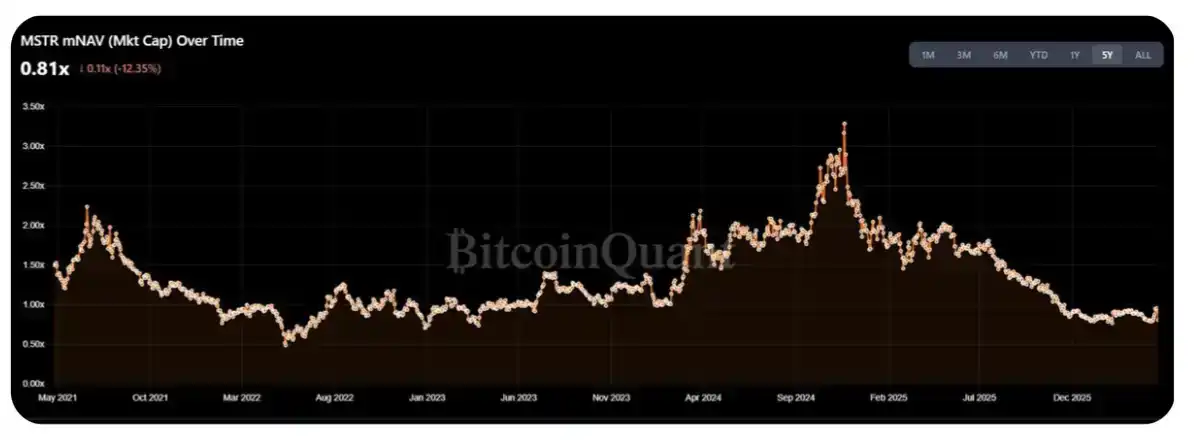
On the surface, for common stockholders, continuing to support these "yields" that do not translate into their own upside gains seems irrational—under continuous issuance, the BTC holdings per share have not substantially increased (though this is largely due to Strategy's already massive size).
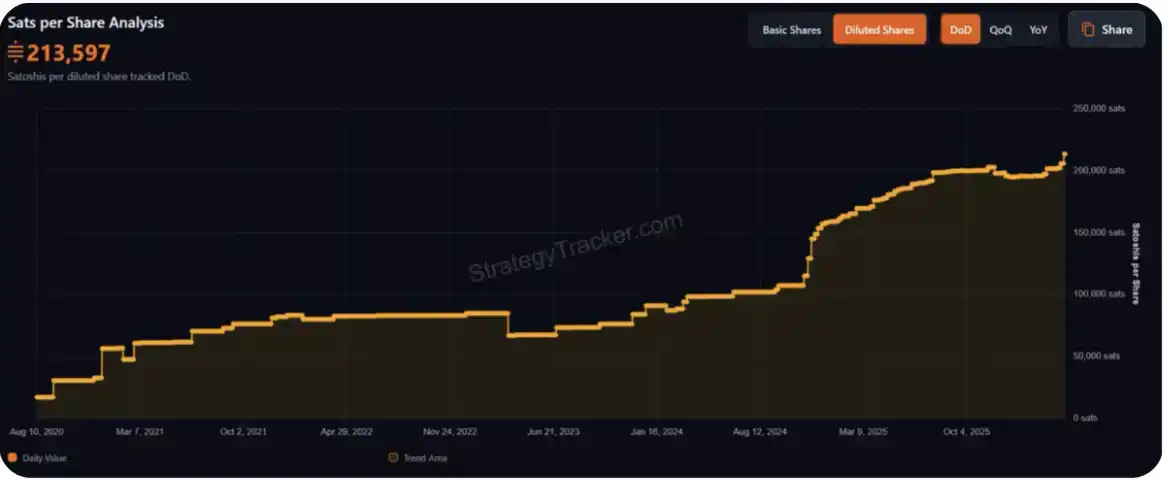
That said, DAT shareholders are a rather "special" group, and I can imagine they can withstand such pressure, at least for the next year, without necessarily adopting this view.

Additionally, the above analysis implies a key premise: MSTR can maintain an mNAV above 1 times for the foreseeable future. If it falls below 1 times, then compared to directly issuing stock, selling BTC would result in less dilution for shareholders. This would open the floodgates of supply, pushing the market into a phase of "DAT reflexivity dominating in a downturn"—a point I discussed last year (see original post).

To briefly summarize this logical chain:

STRC continues to expand;

As the scale grows, Saylor needs to pay越来越多的 dividends;

MSTR buyers gradually realize that the stock they are buying is actually financing dividends, not用于增持 BTC;

Buyers find this is not the交易结构 they initially expected and start exiting;

Once new buying dries up, mNAV falls below 1 times;

mNAV < 1 times → Saylor is forced to sell BTC instead of issuing more stock;

The market enters a panic state.

In my view, the correct way to judge STRC's maximum supply scale is to find a "tipping point": where the dividend burden from new issuances begins to exceed the marginal benefit of per-share BTC growth. A rough estimate suggests this tipping point corresponds to an annual dividend支出 of $3–4 billion, equivalent to issuing about $10–20 billion more STRC. At the current pace, it could be reached within 6 months.

Of course, Saylor still has room to maneuver. The dividend reserve does help stabilize prices and market confidence, but if the震荡 or downtrend continues, holders are essentially playing a game of "musical chairs." When the dividend reserve is down to 6 to 9 months, the rational choice might become: exiting early in the 90–95 price range, rather than bearing the downside risk of Saylor suspending dividends (another option he has).

Although STRC dividends are "cumulative," in extreme cases, I believe Saylor is more likely to choose "com sacrificing preferred stock credit" rather than being forced to大规模 sell BTC. Essentially, he faces this arithmetic problem: "If I fulfill preferred stock obligations and give up future issuance space, how much more BTC can I buy" - "the amount of BTC I have to sell to maintain preferred stock" = result

If the result is positive, choose to sell BTC; otherwise, "sacrifice" preferred stockholders

The main argument against this judgment is: once it really reaches the stage where this calculation is needed, the market has likely already turned, and MSTR's mNAV has most likely fallen below 1 times.

Thank you for reading, even if the beginning was somewhat "sensational." Also welcome any different views or criticisms. (Acknowledgments to @TraderBot888, the first person to discuss this idea with me back in the day.)


Связанные с этим вопросы

QWhat is the core risk that the article highlights regarding MicroStrategy's STRC (Structured Tokenized Return Certificate)?

AThe core risk is that the STRC, while providing a high annualized return of 11.5% and attracting massive capital inflows, creates a massive and growing dividend obligation for MicroStrategy. If the Bitcoin market turns bearish or remains stagnant, this reliance on continuous financing to pay these dividends could quickly deplete the company's dividend reserve, potentially forcing it to sell its Bitcoin holdings or default on its obligations, leading to a downward spiral for the company.

QAccording to the article, what is the estimated annual dividend obligation created by STRC and other preferred instruments?

AThe article states that the outstanding scale of STRC and other preferred instruments is approximately $13.5 billion, which creates an annual dividend obligation of about $400 million.

QWhat is the 'inflection point' or 'tipping point' mentioned in the analysis for the STRC structure?

AThe 'inflection point' is the point at which the dividend burden from new STRC issuances begins to exceed the marginal benefit of the increase in Bitcoin holdings per share. A rough estimate places this point at an annual dividend expenditure of $3-4 billion, which would be equivalent to issuing an additional $100-200 billion in STRC.

QWhat critical scenario would force MicroStrategy to sell its Bitcoin holdings instead of issuing more stock?

AThe critical scenario is if MicroStrategy's market capitalization falls below its metric Net Asset Value (mNAV), specifically if mNAV drops below 1x. In this case, selling Bitcoin would be less dilutive to shareholders than issuing more stock, potentially opening the floodgates to a panic-driven market.

QWhat is one potential extreme action Michael Saylor might take if the dividend burden becomes unsustainable, according to the author's analysis?

AThe author suggests that in an extreme scenario, Michael Saylor might choose to 'sacrifice the credit of the preferred shares' entirely—meaning he would likely suspend dividend payments to STRC holders—rather than be forced into a large-scale sell-off of MicroStrategy's Bitcoin treasury.

Похожее

$292 Million KelpDAO Cross-Chain Bridge Hack: Who Should Foot the Bill?

On April 18, 2026, an attacker stole 116,500 rsETH (worth ~$292M) from KelpDAO’s cross-chain bridge in 46 minutes—the largest DeFi exploit of 2026. The stolen assets were deposited into Aave V3 as collateral, causing $177–200M in bad debt and triggering a cascade of losses across nine DeFi protocols. Aave’s TVL dropped by ~$6B overnight. This legal analysis argues that KelpDAO and LayerZero Labs share concurrent liability, with fault apportioned 60%/40%. KelpDAO negligently configured its bridge with a 1-of-1 decentralized verifier network (DVN)—a single point of failure—despite LayerZero’s explicit recommendation of a 2-of-3 setup. LayerZero, which operated the compromised DVN, failed to secure its RPC infrastructure against a known poisoning attack vector. Both protocols’ terms of service cap liability at $200 (KelpDAO) or $50 (LayerZero), but these limits are likely unenforceable due to unconscionability, gross negligence exceptions, and potential securities law invalidation (if rsETH is deemed a security under the Howey test). Aave’s governance also faces fiduciary duty claims for raising rsETH’s loan-to-value ratio to 93%—far above competitors’ 72–75%—without adequately assessing bridge risks, amplifying the systemic fallout. Practical recovery targets include LayerZero Labs (a registered Canadian entity), KelpDAO’s founders, auditors, and identifiable Aave governance delegates. The incident underscores escalating legal risks for DeFi protocols, infrastructure providers, and governance participants.

marsbit12 мин. назад

$292 Million KelpDAO Cross-Chain Bridge Hack: Who Should Foot the Bill?

marsbit12 мин. назад

Insider Trading in War: 5 People Involved, the Highest Earner Was Arrested

On April 24, the U.S. Department of Justice arrested U.S. Army Special Forces Staff Sergeant Gannon Ken Van Dyke for insider trading related to the capture of Venezuelan President Nicolás Maduro on January 3. Van Dyke allegedly profited over $400,000 by placing bets on a prediction market, Polymarket, using insider knowledge of the covert operation. According to the indictment, Van Dyke registered an account (0x31a5) on December 26 and made a series of bets predicting Maduro’s capture and U.S. military involvement in Venezuela. He withdrew most of his funds on the day of the operation and attempted to obscure his tracks by transferring assets through crypto and brokerage accounts. This case marks the first time the DOJ has prosecuted insider trading on Polymarket. PolyBeats had previously identified five suspicious accounts, including Van Dyke’s—the highest earner—in January. The other accounts, with profits ranging from $34,000 to $145,000, remain under unofficial scrutiny but have not been charged. Their lower profits, indirect access to information, and unclear legal boundaries may complicate prosecution. Polymarket has since strengthened its market integrity rules, explicitly prohibiting trading based on confidential or insider information. Van Dyke’s arrest, nearly four months after his trades, signals increased regulatory attention and the persistent traceability of blockchain-based transactions.

marsbit14 мин. назад

Insider Trading in War: 5 People Involved, the Highest Earner Was Arrested

marsbit14 мин. назад

Bitwise: Bullish on Bitcoin's Performance in the Second Half of the Year, AI and Regulation Will Spark a New Altcoin Season

Bitwise CIO Matt Hougan and Research Lead Ryan Rasmussen express strong bullish sentiment on Bitcoin's long-term prospects, suggesting that its $1 million price target may be too conservative. They argue Bitcoin serves a dual role: as digital gold and a potential global settlement asset, especially amid declining trust in traditional monetary systems. Despite a weak Q1 2026 where nearly all crypto assets and prices saw double-digit declines, the analysts remain optimistic due to strong forward-looking catalysts, including institutional adoption via Bitcoin ETFs from major firms like Morgan Stanley and Goldman Sachs. Geopolitical instability, such as Iran’s mention of using Bitcoin for international payments, increases the value of Bitcoin’s “out-of-the-money call option” as a non-political, global settlement currency. This enhances its appeal beyond a mere store of value. . Additionally, Hougan highlights that a clearer regulatory token framework under current SEC leadership, combined with AI efficiency gains and high-performance blockchains, could fuel a new “altseason” by late 2026. This may lead to a wave of legitimate, value-capturing token projects, unlike the earlier ICO boom. . Bitwise also announced an Avalanche ETF, citing its unique architecture and rapid growth in real-world asset (RWA) tokenization, which has surged 10x to nearly $30 billion in two years. The firm believes Layer 1 blockchains are still early in their growth cycle, with significant potential ahead.

marsbit1 ч. назад

Bitwise: Bullish on Bitcoin's Performance in the Second Half of the Year, AI and Regulation Will Spark a New Altcoin Season

marsbit1 ч. назад

Торговля

Спот
Фьючерсы
活动图片