Uniswap web usage soars as crypto traders transition to self-custody

AmbcryptoОпубликовано 2022-11-17Обновлено 2022-11-17

Введение

Uniswap just announced that the number of users on its web app recently soared to a new 2022 high. This outcome is unsurprising considering that recent events revealed that many centralized exchanges may not have adequate reserves.

Uniswap just announced that the number of users on its web app recently soared to a new 2022 high. This outcome is unsurprising considering that recent events revealed that many centralized exchanges may not have adequate reserves.

Crypto users have thus been moving their cryptocurrencies from exchanges. As a result, decentralized exchanges (DEXes) like Uniswap have seen an increase in activity.

Uniswap’s latest post acknowledges that demand for self-custody solutions and transparency has increased. As a result, decentralized exchanges have seen more user adoption.

New users of Uniswap’s Web App reached a 2022 high.

Self-custody and transparency are in demand and users are flocking to what they know and trust.

Let’s keep building. pic.twitter.com/IwPqTmx58J

— Uniswap Labs 🦄 (@Uniswap) November 14, 2022

The key reason why traders have shifted to DeFi is that FTX sowed the seeds of distrust against centralized exchanges. It has become clear to traders that holding cryptocurrencies on exchanges may not be ideal. If more traders transition to DEXes, we might witness an explosion of utility for DEXes during the next bull run.

Uniswap’s short-term outcome already confirms that the number of addresses using the DEX has increased. The number of addresses with non-zero balance transacting on UNI has been growing steadily this month. They were at the highest level in the last three months, at the time of writing.
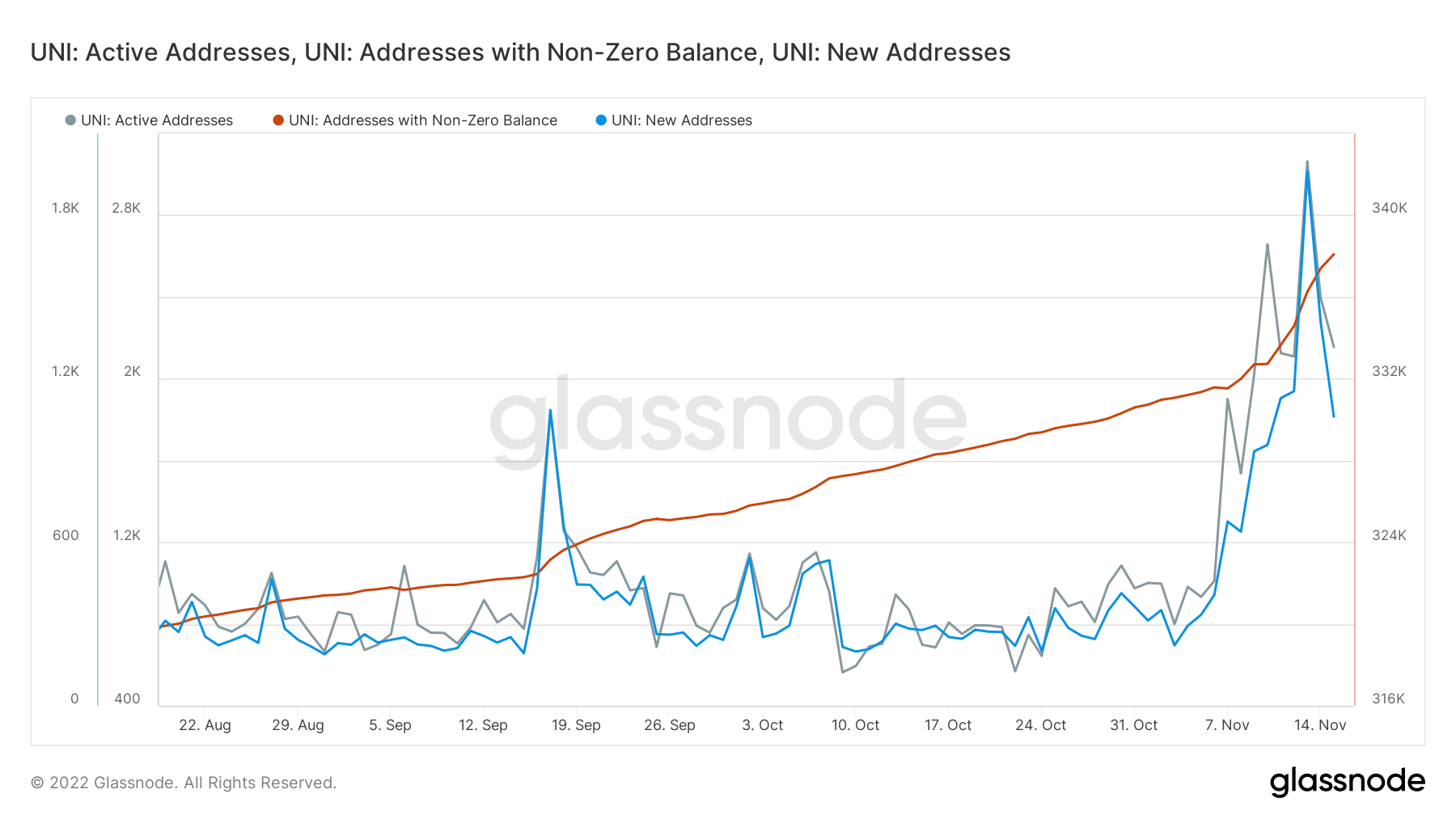
New addresses and active addresses registered healthy growth since mid-October. They recently peaked near mid-November, after which they pivoted. The upside is due to a resurgence of demand at recent lows. The fact that both active addresses and new addresses have pivoted is confirmation that short-term demand has tapered off.

Uniswap’s reported increase in usage may have been short-lived based on the above observations. The DEX’s volume and transactions metric confirm that there was, indeed, a sharp increase in transactions and volume this week. However, the same metrics have pivoted just as quickly.

It is worth noting that both the volume and transactions managed to achieve new 3-month highs during this week. This suggests that more activity has taken place this week and this might be due to the investors’ migration to DEFI.

Impact on UNI price action

We will likely see a repeat of the same in the long run if investors’ demand continues to favor DEXes.

Such an outcome will favor Uniswap’s network growth in the long-run while also favoring UNI demand. UNI’s price pulled off a 36% upside from last week’s lows to its Tuesday’s (15 November) highs.
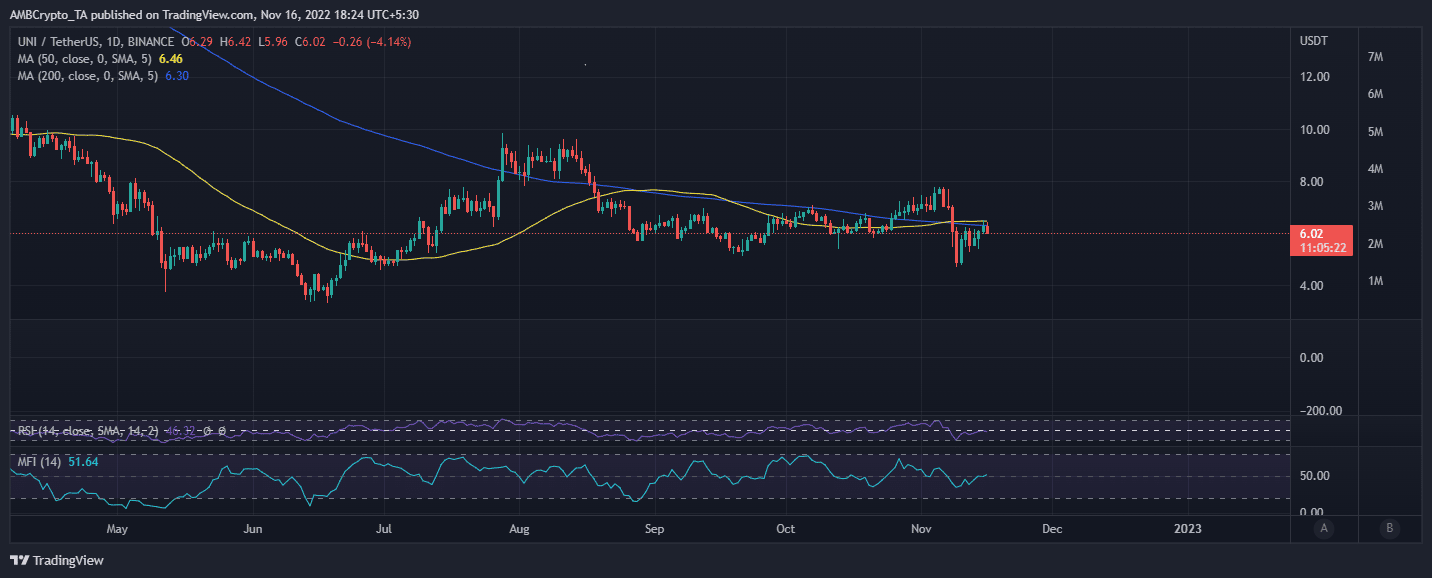
UNI’s 50-day moving average recently formed a golden cross with the 200-day MA. This is traditionally a bullish sign. We might see more upside if the price manages to cross above the two moving averages.


Похожее

MLCC Capacitor Price Increase: A Comprehensive Overview of Beneficiary Companies

Recent teardown reports of Nvidia's next-generation AI chips have reignited investor interest in the MLCC (Multi-Layer Ceramic Capacitor) sector. Analysis of the Rubin architecture VR200 server reveals a 30% increase in MLCC count and a 182% surge in component value per rack compared to the previous generation, with GPU board usage nearly doubling. High-power, high-voltage hardware designs are driving massive adoption of high-end, high-withstand-voltage, and large-capacity MLCCs, exacerbating supply shortages. The global MLCC supply-demand balance remains tight. Leading Japanese and Korean manufacturers have successively raised prices across series, compounded by overseas capacity constraints and long-term customer order locks at major factories. Delivery lead times for high-end products now exceed 20 weeks, with capacity struggling to keep pace with surging orders. Demand drivers include AI servers, automotive electronics, and recovering consumer electronics, leading to both volume and price increases for MLCCs. The industry chain beneficiaries are outlined as follows: **1. MLCC Product Manufacturers:** Direct beneficiaries of price hikes. Key Chinese companies include Fenghua Advanced Technology (leading domestic player), Sanhuan Group (vertical integration from materials to products), and others like Hongyuan Electronics (military focus) and Torch Electron (specialty ceramics). **2. MLCC Raw Materials & Components:** The foundation of the supply chain. * **Release Film:** A critical consumable in production. Companies include Jiemei Technology (domestic leader), Shuangxing New Materials, and Sidike. * **Metal Powders (Ni/Cu):** Core materials for internal electrodes. Key suppliers are Boqian New Materials, Yuean New Materials, and Gripm Advanced Materials. * **Dielectric Ceramic Powder:** The core material determining MLCC performance. Sinocera Advanced Materials is a global leader, while Sanhuan Group and Fenghua Advanced Technology also have significant in-house capabilities. The report highlights that rising AI server power is significantly increasing requirements for chip capacitors and inductors, forecasting explosive industry growth aligned with projected GPU/TPU shipments through 2027-2028.

marsbit1 ч. назад

MLCC Capacitor Price Increase: A Comprehensive Overview of Beneficiary Companies

marsbit1 ч. назад

Morning Post | Michael Saylor Says This Week's Buy Was Bonds, Not Bitcoin; StablR Suffers Attack Losing Approximately $2.8 Million; US Congress Reintroduces Bitcoin Reserve Bill

This cryptocurrency industry digest covers key developments from May 25. MicroStrategy's Michael Saylor clarified the company purchased bonds, not Bitcoin, this week. In regulatory news, the US Congress reintroduced a Bitcoin reserve bill, with Republican backing aiming to accumulate 5% of global supply. The legal and audit firms for the collapsed FTX agreed to a $66 million settlement over fraud allegations. Several CFTC officials skeptical of prediction market oversight were reportedly suspended and forced out. On the security front, the StablR stablecoin was attacked and de-pegged, resulting in an estimated $2.8 million loss for the attacker. The Ethereum Foundation faced criticism, though a researcher defended its core protocol-building mission over influencing ETH's price. Market data from GMGN showed the top 24-hour trending meme tokens on ETH were HEX, SHIB, LINK, PEPE, and mUSD. On Solana, leaders were TROLL, neet, WORLDCUP, HANTA, and Buttcoin. Base chain's top tokens included TOSHI, KEYCAT, BRETT, CLANKER, and LUNA. Featured articles included an a16z analysis arguing tokenization, or real-world assets (RWA), is fundamentally transforming asset nature and financial systems, with the market growing tenfold to ~$34 billion in two years. Another piece deconstructed Hyperliquid's success through a five-layer financial stack framework, emphasizing the critical importance of building from a robust settlement layer upward.

链捕手2 ч. назад

Morning Post | Michael Saylor Says This Week's Buy Was Bonds, Not Bitcoin; StablR Suffers Attack Losing Approximately $2.8 Million; US Congress Reintroduces Bitcoin Reserve Bill

链捕手2 ч. назад

Торговля

Спот
Фьючерсы
活动图片