$7.8mln ETH deployed into DeFi – Is Ethereum Foundation setting the tone?

ambcryptoОпубликовано 2026-03-19Обновлено 2026-03-19

Введение

The Ethereum Foundation has deployed 3,400 ETH (worth approximately $7.8 million) into DeFi protocol Morpho, signaling strong institutional confidence in Ethereum’s staking and lending ecosystem. This follows an earlier deposit of 2,400 ETH and $6 million in stablecoins in October 2025. The move is seen as a strategic effort to encourage broader DeFi adoption and strengthen Ethereum’s financial infrastructure. This activity coincides with growing institutional interest, including BlackRock’s Staked ETH ETF (ETHB) recording its largest inflow of 28,810 ETH ($67.18 million) and Grayscale’s Ethereum Mini Trust locking 76,800 ETH in under a week. Total Value Locked (TVL) in DeFi has surpassed $100 billion, with Ethereum dominating nearly 60% of the market. The upcoming CLARITY Act is expected to further accelerate institutional participation, positioning Ethereum’s DeFi as a key area for long-term investment and a hedge during market volatility. The Ethereum Foundation still holds over $400 million in ETH, underscoring its ongoing influence.

Staking yields are one of the main bridges connecting TradFi and DeFi.

Put simply, staking yields let traditional investors earn “predictable” returns while getting exposure to the decentralized ecosystem, similar to earning interest in banks. That’s why many in TradFi see the CLARITY Act as a real disruptor, as it could speed up DeFi adoption and reshape capital flows.

Ethereum [ETH], however, seems to be ahead of the curve.

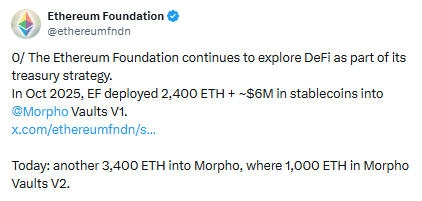
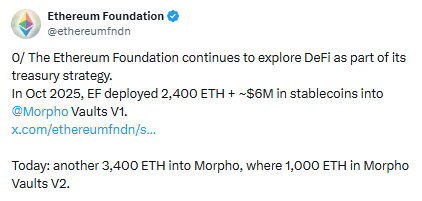
The Ethereum Foundation recently deployed 3,400 ETH into Morpho, including 1,000 ETH into Morpho Vaults V2. Back in October 2025, they had already added 2,400 ETH plus about $6 million in stablecoins into Morpho Vaults V1.

Source: X

From a strategic perspective, these moves carry real weight.

For instance, the Ethereum Foundation (a non-profit focused on network development) is showing that it’s actively putting capital to work in DeFi. By doing so, it signals confidence in Ethereum’s staking and lending ecosystem while also encouraging broader adoption across the network.

Notably, this strategy is playing out in real time.

On the 17th of March, the BlackRock Staked ETH ETF (ETHB) saw its largest inflow since inception, with a net flow of 28,810 ETH (about $67.18 million) and $0.3 billion in trading volume, highlighting growing institutional interest in Ethereum’s staking ecosystem.

And it doesn’t stop there.

Grayscale’s Ethereum Mini Trust has locked in 76,800 ETH in under a week alone. Technically, this shows that large ETH holders are allocating more and more capital into DeFi, with the Ethereum Foundation’s moves setting the pace.

Naturally, the question is: Does this give the network an edge as the CLARITY Act draws closer?

Ethereum treasuries deploy ETH, showing DeFi as a risk-off catalyst

Beyond network-level breakdowns, the DeFi sector is seeing unprecedented growth.

In fact, Total Value Locked (TVL) recently crossed $100 billion for the first time since February, demonstrating that staking continues to attract capital even in a broader risk-off environment.

Ethereum, which represents nearly 60% of the market, is clearly benefiting the most, making this trend a strong bullish signal for the network.

Against this backdrop, the CLARITY Act could become a meaningful catalyst for Ethereum, both technically and fundamentally. Backing this, the Ethereum Foundation is deploying millions into the financial infrastructure, showing that developers are laying the groundwork for broader DeFi adoption.

Source: Arkham

As the chart above shows, the Ethereum Foundation recently deposited $7.88 million of ETH to Steakhouse, a billion-dollar DeFi asset manager.

More importantly, the Foundation still holds over $400 million in ETH, highlighting its continued influence and strategic role in supporting the network’s growing market share.

According to AMBCrypto, this is just the start of a deeper trend.

As noted earlier, the CLARITY Act could act as a major catalyst, driving even greater institutional interest in Ethereum DeFi, with more ETH treasuries likely following BitMine’s playbook. Recent inflows into BlackRock’s ETHB only reinforce this momentum.

At the heart of it all, the Ethereum Foundation is clearly leading the way. Its recent “strategic” moves clearly signal the network’s direction, positioning Ethereum’s DeFi ecosystem as a key focus for long-term investors and a safety net during periods of intense volatility, supported by a 6% jump in ETH TVL so far this month.


Final Summary

  • Ethereum treasuries, including the Ethereum Foundation, are deploying hundreds of millions of ETH into DeFi protocols, signaling confidence and driving network growth.
  • Big inflows into BlackRock’s ETHB and Grayscale’s Ethereum Mini Trust show that traditional finance is increasingly participating in Ethereum staking, with the CLARITY Act likely acting as a catalyst.

Связанные с этим вопросы

QWhat is the significance of the Ethereum Foundation deploying 3,400 ETH into Morpho, according to the article?

AThe deployment signals the Foundation's confidence in Ethereum's staking and lending ecosystem, actively putting capital to work in DeFi to encourage broader adoption and set a strategic tone for the network.

QHow does the article connect the CLARITY Act to the growth of Ethereum's DeFi ecosystem?

AThe CLARITY Act is seen as a potential major catalyst that could accelerate DeFi adoption and drive greater institutional interest in Ethereum, reshaping capital flows and providing regulatory clarity.

QWhat recent institutional developments highlight growing interest in Ethereum's staking ecosystem?

ABlackRock's Staked ETH ETF (ETHB) had its largest inflow with a net flow of 28,810 ETH (about $67.18 million), and Grayscale's Ethereum Mini Trust locked in 76,800 ETH in under a week, showing increased institutional participation.

QWhat does the Total Value Locked (TVL) crossing $100 billion indicate for the DeFi sector and Ethereum specifically?

AIt demonstrates that staking continues to attract capital even in a risk-off environment, with Ethereum benefiting the most as it represents nearly 60% of the market, making it a strong bullish signal for the network.

QHow much ETH does the Ethereum Foundation still hold, and what does this signify for its role in the ecosystem?

AThe Ethereum Foundation still holds over $400 million in ETH, highlighting its continued influence and strategic role in supporting the network's growth and market share through DeFi deployments.

Похожее

Yang Ge Gary: Agent Economy and AI Sub-Microeconomics

"Agent Economy and AI Submicroeconomics" by Gary Yang discusses the evolution of AI Agent economies, written from Singapore in June 2026. The author observes a significant "civilizational generational gap" in AI development, particularly highlighted by events in Silicon Valley. The article identifies a current bottleneck in the transition from Human-to-Agent (H2A) economies to true Agent-to-Agent (A2A) ecosystems. While AI Payment protocols are rapidly emerging, many implementations remain non-AI-native, focusing on traditional human decision-making models rather than leveraging autonomous Agent decision-making. A core thesis is the inevitable formation of an **Agent Economy**, defined as a system where autonomous AI Agents create, exchange, and capitalize value independently. This requires new infrastructure: **AI Protocols**, which are the foundational rules and standards for Agent interaction. The piece explores the relationship and current gap between AI Protocols and Crypto Protocols, suggesting political and regulatory factors from traditional finance are temporarily constraining development. However, a future fusion into a mature Digital Protocol system is deemed inevitable based on first principles. The author introduces **AI Agent Submicroeconomics**, contrasting it with human economics. Key differences include higher transaction frequency, lower value per transaction, efficiency-driven (not emotion-driven) decisions, task-oriented (not consumption-oriented) behavior, and near-zero organizational and communication costs. A biological analogy is drawn, comparing an Agent to a cell, its LLM to a nucleus, and its protocol stack to a cell membrane. The rise of **AIFi** (AI Finance) is presented as a natural consequence, where value originates from AI-native activities and is subsequently tokenized and financialized. This contrasts with DeFi/TradFi, where finance is the source of value. The concept of a **Financial Chip (FinChip)**—an autonomous AI Agent integrated with a crypto smart contract—is highlighted as key infrastructure for this new economy. The conclusion emphasizes that **AI-Native** thinking represents a paradigm shift distinct from "Internet+" upgrades. It requires reasoning from first principles, focusing on energy-value shortest paths and maximum efficiency, which presents a steep learning curve and significant challenge for all participants in this rapidly evolving field.

marsbit34 мин. назад

Yang Ge Gary: Agent Economy and AI Sub-Microeconomics

marsbit34 мин. назад

ViaBTC CEO Haipo Yang: Looking Back at the Decade, Re-understanding the Value of Crypto

In "A Decade in Retrospect: Re-evaluating the Value of Crypto," ViaBTC & CoinEx CEO Haipo Yang reflects on the cryptocurrency industry's evolution since founding ViaBTC in 2016. Initially a niche interest, Crypto has fundamentally transformed key financial infrastructures like market making, trading, settlement, and issuance through open protocols, as seen with Uniswap and GMX, and enabled efficient cross-border transfers via stablecoins. While acknowledging speculation's role in fueling innovation and liquidity, Yang warns it often overshadows real demand. He distinguishes between blockchain (a trust-minimizing technology), Web3 (an application model requiring genuine utility), and Crypto assets. The latter's value derives from block space as a commodity (e.g., gas fees) and "sovereign liquidity premium" (e.g., Bitcoin's censorship resistance), with most tokens lacking such dual support. Looking ahead, Yang argues the next decade's focus should shift from "open participation" to "sustainable participation," emphasizing reliable infrastructure. He predicts consolidation towards networks with strong security and liquidity (like Bitcoin and Ethereum), and sees DeFi becoming a specialized tool rather than a mass replacement for traditional finance. Crypto will integrate into traditional finance (e.g., via Bitcoin ETFs) but may sacrifice some decentralization for mainstream adoption. Real future demand may come from AI agents and machine economies needing permissionless settlement. Ultimately, Yang believes Crypto's enduring value lies not in hype or replacing everything, but in verifiably reducing trust costs, increasing efficiency, and providing stable, transparent services across market cycles.

marsbit34 мин. назад

ViaBTC CEO Haipo Yang: Looking Back at the Decade, Re-understanding the Value of Crypto

marsbit34 мин. назад

Торговля

Спот
Фьючерсы
活动图片