[Key interpretation] BTC pretends to rise or be verified, and deviates from eth price first

HuobiОпубликовано 2022-09-13Обновлено 2022-09-14

Введение

Although the BTC price has a strong performance, it is suspected that it will induce more people to rise. Recently, we have paid attention to the negative impact of the expectation of the Federal Reserve's interest rate increase.

1. BTC releases the strongest trading volume

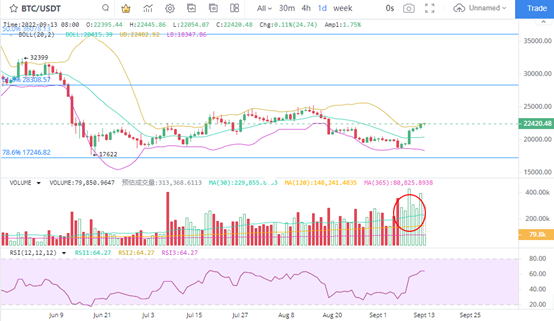
After the BTC price recovered and rebounded from the adjustment, the price easily reached above the middle rail of the brin line, rebounding from $18799 to around $22400, with a range increase of 19.2%. From the performance of trading volume, the effect of this 7 trading days is obviously better than the performance of the past 2 months, and it is also the largest average trading volume performance in the past year. Therefore, the week before the Federal Reserve raised interest rates on September 22, BTC is showing stronger rebound expectations. The recent BTC growth space depends more on the position that the trading volume can reach. The overall market will rebound in large quantities to reduce the selling pressure, and the impact of short-term selling pressure changes on the market is very important.
2. BTC medium and short-term investors' profit flight

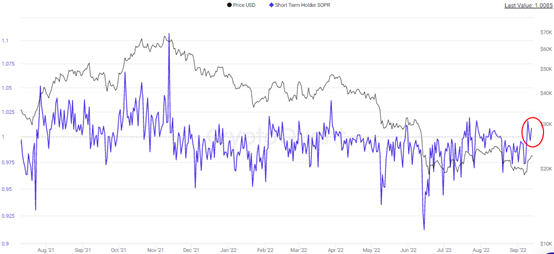
The profit flight of BTC's medium - and short-term investors shows that investors are facing the opportunity of reducing their positions. The SOPR index has been running above 0 since September 9, which indicates that investors have made profits as a whole. During BTC trading, the nature of trading is profit flight. In the next trading day, with the increase of BTC rebound space, expected profit trading will still dominate the overall market. Therefore, when judging the market trend, the higher the SOPR index can reach, the greater the short-term selling pressure it will prompt. Referring to the SOPR index that can be reached in the past year, when the index is in the range of 1.05 to 1.1, it can effectively test the effectiveness of selling points.
3. The unrecognized loss of BTC decreased significantly

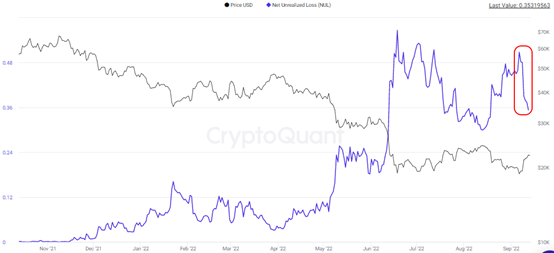
With the emergence of the rebound trend, the unconfirmed loss scale of BTC has dropped significantly, from the recent high of 0.507 on September 6 to around 0.353, and the loss scale has decreased by 15.4 percentage points. This shows that after the rebound trend of BTC in the past week, a considerable number of loss making orders have disappeared, which means that the selling pressure is also dropping rapidly.

In terms of absolute value, the proportion of unconfirmed losses on September 12 still reached 35.5%, which is still at a high level compared with the past two years. Therefore, BTC is still in the interpretation of digesting selling pressure, and we can pay further attention to the pressure level in the rebound.
4. Eth price rebounded slightly

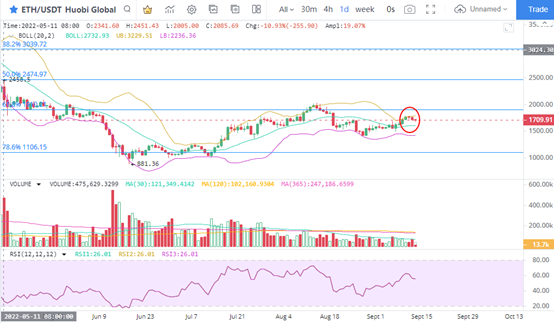
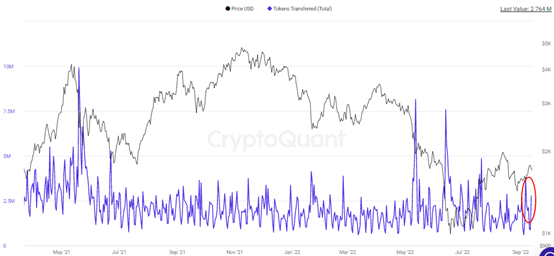
With the volatile trend of eth, the recent overall increase has not exceeded expectations. It can be seen that the ETH price trend shows a certain deviation from BTC, which indicates that the strength of the overall market may not last too long. In terms of trading volume, the daily K-line trading volume of eth is still shrinking, so the increase is not ideal. However, considering the large growth space of eth in the previous period, the advantage in terms of cumulative growth is still significant.
5. Eth transfer volume rebounded slightly

During the recent eth rebound, the number of transferred eth rebounded slightly, but it did not exceed the previous peak. From the rebound strength, it reached 3.773 million on September 6, lower than 4.857 million eth on July 21, and lower than 8.156 million and 7.569 million eth on May 12 and June 13. Therefore, the ETH price is still in a stable operation stage. The trading enthusiasm of investors has not changed, and the expectation of increase has not been strengthened.

Похожее

The End of the Crypto Premium? Market Logic Shift Seen Through Gemini's Post-IPO Struggles

The article "The End of the Crypto Premium? Market Logic Shifts as Gemini Struggles Post-IPO" examines the dramatic downturn of cryptocurrency exchange Gemini following its public listing in September 2025. Initially part of a wave of crypto IPOs, including Bullish, which saw soaring valuations and massive investor interest, Gemini's stock price has since collapsed by over 80%, falling from $28 to around $5. The company has cut 30% of its workforce, exited international markets, and faces significant financial strain, including $330 million in Bitcoin-denominated debt. The core argument is that Gemini's struggles reflect a broader market shift where the "excess premium" once associated with crypto assets is disappearing. Two key factors are identified: the erosion of regulatory arbitrage, as compliance costs rise for all players (up 22.5% for small firms in 2026), and the decline of liquidity scarcity premiums, as institutional investors now access crypto via low-friction ETFs and stocks rather than volatile altcoins. The approval of Bitcoin and other crypto ETPs, which now manage $1.8 trillion globally, has diverted institutional capital away from altcoins, causing their liquidity to dry up and volatility to increase. For Gemini, its strategy of being "the most compliant exchange" became a liability in a bear market, as fixed compliance costs remained high while trading revenue fell. The article concludes that the era of narrative-driven crypto valuations is ending, giving way to a market logic focused on fundamentals like actual usage, liquidity depth, and sustainable institutional adoption.

marsbit3 ч. назад

The End of the Crypto Premium? Market Logic Shift Seen Through Gemini's Post-IPO Struggles

marsbit3 ч. назад

Utexo Partners with x402 to Provide Near-Instant USDT Settlement for the Agent Economy

Utexo, a Bitcoin-native stablecoin payment execution and settlement layer, has partnered with x402 to integrate USDT compatibility into the x402 payment protocol. This collaboration enables near-instant settlement for agent-to-agent transactions, with speeds as fast as 50 milliseconds. x402 is an open protocol that uses the HTTP 402 "Payment Required" status code to embed payment functionality directly into HTTP requests. This allows applications, APIs, and autonomous systems to pay for services in real-time without requiring pre-funded accounts. The integration expands x402’s initial USDC support to include USDT, one of the most widely used stablecoins globally. Utexo’s infrastructure is designed for high-frequency, low-latency transactions, making it well-suited for machine-driven payments. According to Utexo CEO Viktor Ihnatiuk, supporting USDT within the x402 framework significantly broadens access and provides developers the performance needed for real-time agent-based systems. Kevin Leffew of x402 at Coinbase added that expanding stablecoin access improves performance and accelerates developer adoption. This partnership supports growing use cases where software systems autonomously conduct transactions—such as paying for API calls, accessing data on-demand, and coordinating services across platforms without human intervention. By combining x402’s protocol with Utexo’s settlement infrastructure, the collaboration enables a payment model where transactions are as fast and efficient as the requests that trigger them.

marsbit6 ч. назад

Utexo Partners with x402 to Provide Near-Instant USDT Settlement for the Agent Economy

marsbit6 ч. назад

Торговля

Спот
Фьючерсы
活动图片