JPMorgan seeking hire to push banking products onto metaverse, crypto companies

THE BLOCKОпубликовано 2022-09-11Обновлено 2022-09-11

Введение

JPMorgan is seeking a west coast business development specialist to push institutional payments products onto new crypto, web3 and metaverse clients.

Wall Street megabank JPMorgan is looking to expand its reach in the crypto market, seeking a new business development specialist in its payments group to target new clients across Web3, the metaverse, and crypto.

The bank — which has provided banking services for crypto exchange Coinbase — noted in a job advert on LinkedIn for a payments business development manager that the firm is keen to grow its business in merchant banking and treasury services "in the Web3, Crypto, Fintech, & Metaverse industry sub vertical."

The new hire would sit in the bank's technology, media, and telecom payments team on the West Coast.

As reported in 2020, JPMorgan took on Coinbase and Gemini as its first crypto exchange clients. More recently, the firm announced in February 2022 that it had opened up a branch in DCG-backed metaverse Decentraland.

Per the job description, the new hire would be responsible for lining up new corporate clients for a wide range of payment products, including transactional FX, liquidity and treasury services, and escrow.

"There is no industry playbook for these segments. This individual must be comfortable paving a path, creating frameworks, and working with extremely fast moving companies amongst ambiguity," the bank said. "These segments require increased technical knowledge around software that do not fit into the traditional training of front-office financial professionals."

Elsewhere, Wall Street heavyweight Citigroup was looking to hire a global head of digital asset risk management, signifying its own strategic push toward crypto services, as The Block reported in January. In August, Morgan Stanley Wealth Management was seeking a product development manager for the firm’s Investment Solutions Product Development team, which is responsible for supporting more than $900 billion in assets under management.

To be sure, such job ads don't necessarily mean banks are moving into new crypto opportunities at breakneck speed, as previously noted by Bitwise CEO Hunter Horsley.

“Hiring a mid-level person to work on something like this doesn’t guarantee a product comes to market,” said Horsley.

Похожее

On-chain Analyst: Why Are Most Zcash Transactions Still Traceable?

Title: Why Most Zcash Transactions Remain Traceable Zcash, a privacy-focused cryptocurrency launched in 2016, was designed to offer anonymity by hiding transaction details like sender, receiver, and amount using zero-knowledge proof technology (zk-SNARKs). However, in practice, a significant portion of ZEC transactions are still traceable on-chain. The key reason is Zcash's dual-address system. It features transparent addresses (t-addresses), which work like standard Bitcoin addresses with all data public, and shielded addresses (z-addresses) that encrypt transaction details. There are four transaction types with varying privacy levels: fully transparent (t→t), partially shielded (t→z and z→t), and fully private (z→z). Despite its privacy capabilities, most real-world Zcash activity involves transparent addresses, primarily because major exchanges and institutions use them for regulatory compliance. As a result, blockchain analytics platforms like Arkham can track and attribute a substantial volume of Zcash transactions. Arkham reports it has identified entities behind over $420 billion in ZEC transaction volume. Case studies highlight this traceability: the U.S. government holds seized Zcash from a dark web case, visible via its transparent wallet, and individual traders' profitable moves are trackable from purchase to exchange deposit. In conclusion, Zcash's privacy is not inherent but user-dependent. While purely shielded (z→z) transactions remain cryptographically private, the prevalence of transparent address usage makes much of the network's activity traceable. The actual privacy protection offered depends entirely on how users choose to transact.

marsbit4 мин. назад

On-chain Analyst: Why Are Most Zcash Transactions Still Traceable?

marsbit4 мин. назад

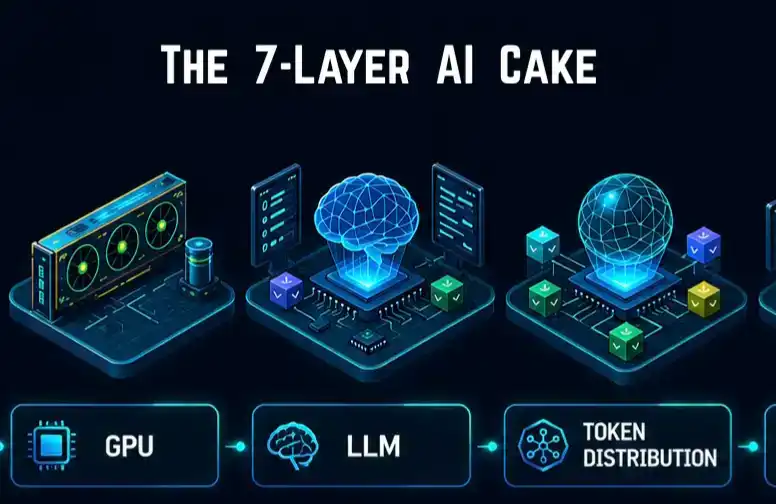
From Power Infrastructure to Token Economy: The 'Seven-Layer Cake' of the AI Industry Chain

From Power Grid to Token Economy: The AI Industry's "Seven-Layer Cake" The AI industry is shifting from a "model-centric" paradigm focused on massive training to a "token-centric" industrial era driven by inference demand. This new phase revolves around the production, distribution, scheduling, and consumption of tokens—the units of computation used by AI agents for every interaction and task. The article proposes a "seven-layer cake" framework for the AI economy: 1. **Power**: The foundational energy source, with competition shifting to securing stable, low-cost electricity. 2. **AIDC (AI Data Centers)**: Large-scale "Token factories." A trend toward smaller, modular, and regionally deployed AI Factories is emerging for efficiency and proximity to users. 3. **GPU**: The core production hardware for tokens. While NVIDIA dominates, competition exists from AMD, ASIC makers, and Chinese chipmakers, with a growing focus on inference efficiency. 4. **LLMs**: The "engines" that generate tokens. The competition is evolving beyond model size to prioritize factors like token cost, inference efficiency, and operational synergy with infrastructure. 5. **Token Distribution**: The "grid" that allocates and rents out compute resources, led by cloud giants and specialized AI-native platforms. 6. **Token Optimization & Intelligent Scheduling**: The critical "brain" layer that intelligently routes tasks (e.g., to local, cloud, or edge models) for optimal cost, latency, and privacy—maximizing the value of each token. 7. **AI Agents & Models**: The end consumers of tokens. The vision involves billions of AI agents working and interacting concurrently, consuming vast amounts of tokens. Currently, the industry faces fragmentation and inefficiencies between these layers. The true "mass adoption era" of AI will begin only when this seven-layer infrastructure is fully integrated and operates as a cohesive, intelligent network—transforming AI from a software tool into a global industrial system spanning energy, hardware, and compute logistics.

marsbit25 мин. назад

From Power Infrastructure to Token Economy: The 'Seven-Layer Cake' of the AI Industry Chain

marsbit25 мин. назад

Semiconductors up 78% annually, software down 12% annually: The 'Liquidity Siphon' is playing out within tech stocks

Semiconductor ETFs like SOXX have surged 78.5% year-to-date, while software ETFs like IGV have dropped 12.5%, creating a record performance gap exceeding 90 percentage points. This reflects a major "liquidity suction" within tech stocks, with capital flooding into semiconductors as software faces selling pressure. Driving the semiconductor boom are staggering capital expenditure plans from hyperscalers like Microsoft, Alphabet, Amazon, and Meta, whose combined 2026 capex is projected near $700 billion. This fuels demand for chips, with companies like SanDisk (up 426%), Intel (up 222%), and Micron (up 154%) leading the S&P 500. In contrast, major software firms like Microsoft, Adobe, and Salesforce are all down over 17% year-to-date. The software sector faces a dual challenge: capital is being redirected to semiconductors, and the rise of AI agents like Claude Code threatens traditional SaaS business models, triggering a narrative of AI displacement. Key unanswered questions remain: How long can hyperscalers sustain their massive capex, given potential free cash flow pressures? And will capital eventually rotate back into the deeply oversold software sector? While some analysts warn of a potential semiconductor bubble akin to the dot-com era, the sector's powerful momentum continues, making market timing exceptionally difficult.

marsbit25 мин. назад

Semiconductors up 78% annually, software down 12% annually: The 'Liquidity Siphon' is playing out within tech stocks

marsbit25 мин. назад

Торговля

Спот
Фьючерсы
活动图片