Fidelity Assesses the Limits of AI's Influence on the Crypto Market

cryptonews.ruОпубликовано 2026-08-20Обновлено 2026-08-20

Введение

Fidelity Analysts Assess the Limits of AI's Impact on the Crypto Market Fidelity Digital Assets senior analyst Max Waddington notes that AI agents could become a new source of activity in the digital asset sector, from payments to trading and lending. However, the benefits will likely be distributed unevenly. Fidelity's study of over 100,000 GitHub developers shows AI coding assistants increased commit counts by up to 180% and releases by 30%. These tools enable smaller teams to build blockchain applications faster, though critical financial software still requires manual code review. In the crypto industry itself, developer counts fell in 2026 amid lower prices, but commits per developer continued to rise. Waddington cautions that more applications don't guarantee success; user adoption, liquidity, compliance, and trust remain key. Autonomous AI agents, capable of payments, trading, liquidity provision, and lending, are emerging as another driver. Blockchains are suitable due to 24/7 operation and programmable settlements. According to Keyrock, AI agents had already conducted over 176 million transactions worth more than $73 million by May, predominantly using USDC. Infrastructure is developing, with Coinbase launching tools like the x402 protocol and 'Coinbase for Agents'. However, Fidelity expects agents to use multiple platforms (both public blockchains and traditional finance systems) based on cost and convenience. A surge in AI-driven transactions may not proportion...

AI agents could become a new source of activity for the digital asset sector—from payments to trading and lending. The benefits from this will be distributed unevenly among market participants, believes Max Waddington, Senior Analyst at Fidelity Digital Assets.

Developers Are Using AI More Frequently

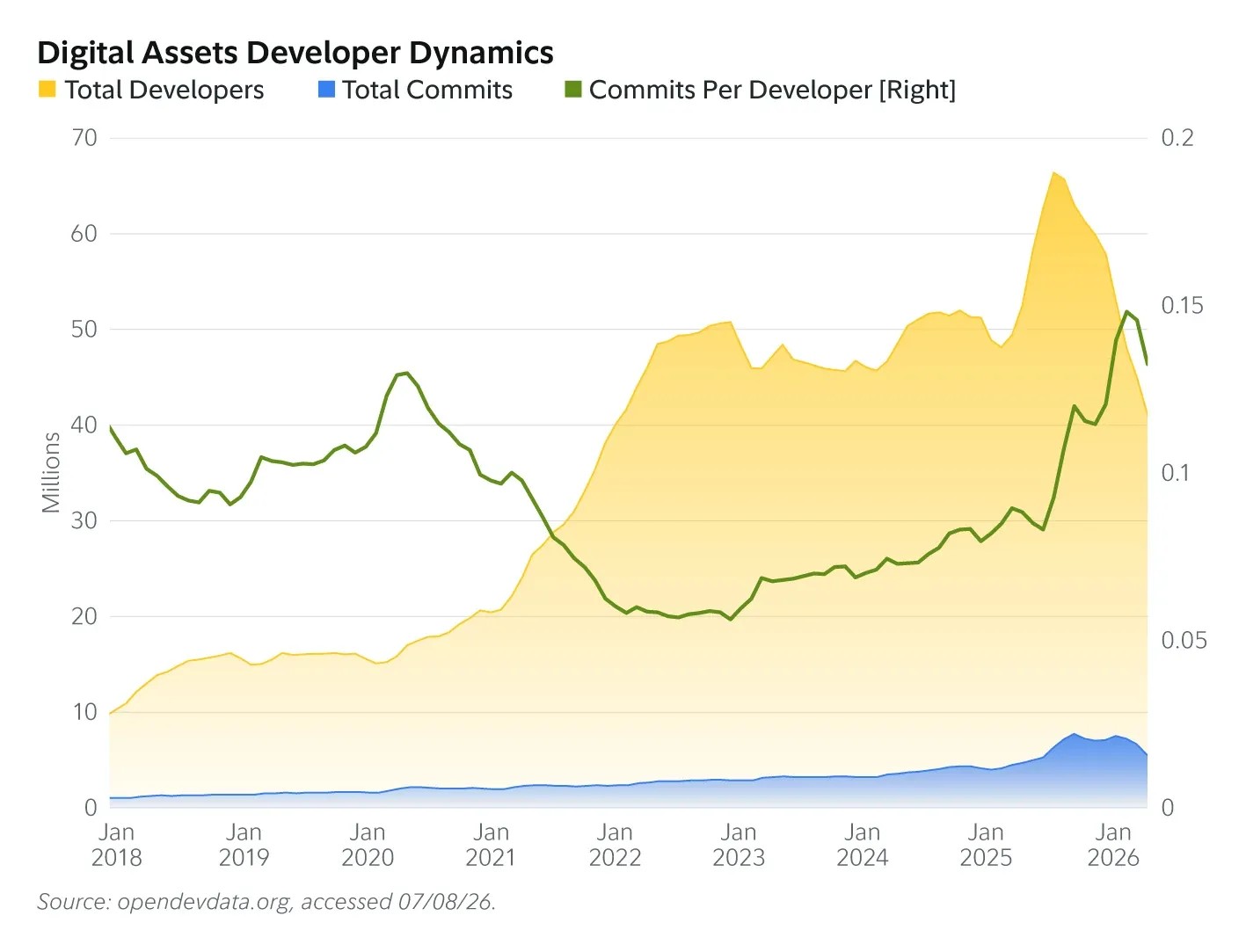
Fidelity studied data from over 100,000 GitHub developers. The use of digital programming assistants increased the number of commits by up to 180% and the number of releases by 30%.
Source: Fidelity.

Waddington noted that such tools will allow small teams to build and launch blockchain applications faster. However, in financial and other critical software, code still requires manual review.

A similar trend was observed within the crypto industry itself. In 2026, against the backdrop of declining digital asset prices, both the number of developers and the volume of commits decreased, with the latter indicator falling more slowly. As a result, the average number of changes per developer continued to grow.

At the same time, an increase in the number of applications alone does not guarantee their success. Projects still need users, liquidity, regulatory compliance, and trust. According to Waddington, as development becomes cheaper, these factors will come to the forefront.

AI Agents Will Go On-Chain

Autonomous AI agents could become an additional driver of activity in the sector. They are capable of independently making payments, trading assets, providing liquidity, as well as issuing and taking loans.

Blockchains are suitable for such operations due to 24/7 operation, programmable settlements, and the ability to conduct microtransactions without human involvement.

This market is already taking shape. According to Keyrock, by May, AI agents had conducted over 176 million transactions worth more than $73 million. About 98.6% of the operations involved the USDC stablecoin.

Infrastructure for such scenarios is also developing. One of the most active players here is the exchange Coinbase, which previously launched the x402 protocol for automatic internet payments and later introduced Coinbase for Agents—a set of tools for trading and settlements using AI.

Nevertheless, Fidelity does not expect all agent operations to migrate to public blockchains. Banks, fintech companies, and traditional players are developing their own solutions, possessing an established customer base, infrastructure, and access to credit products.

In the view of analysts, AI agents will most likely work with multiple platforms simultaneously, choosing between them based on cost and convenience.

What are AI agent payments (agentic payments)?

Transaction Growth Does Not Guarantee Revenue Growth

Even if AI attracts millions of new operations to blockchains, this will not necessarily lead to a proportional increase in revenue for the networks themselves.

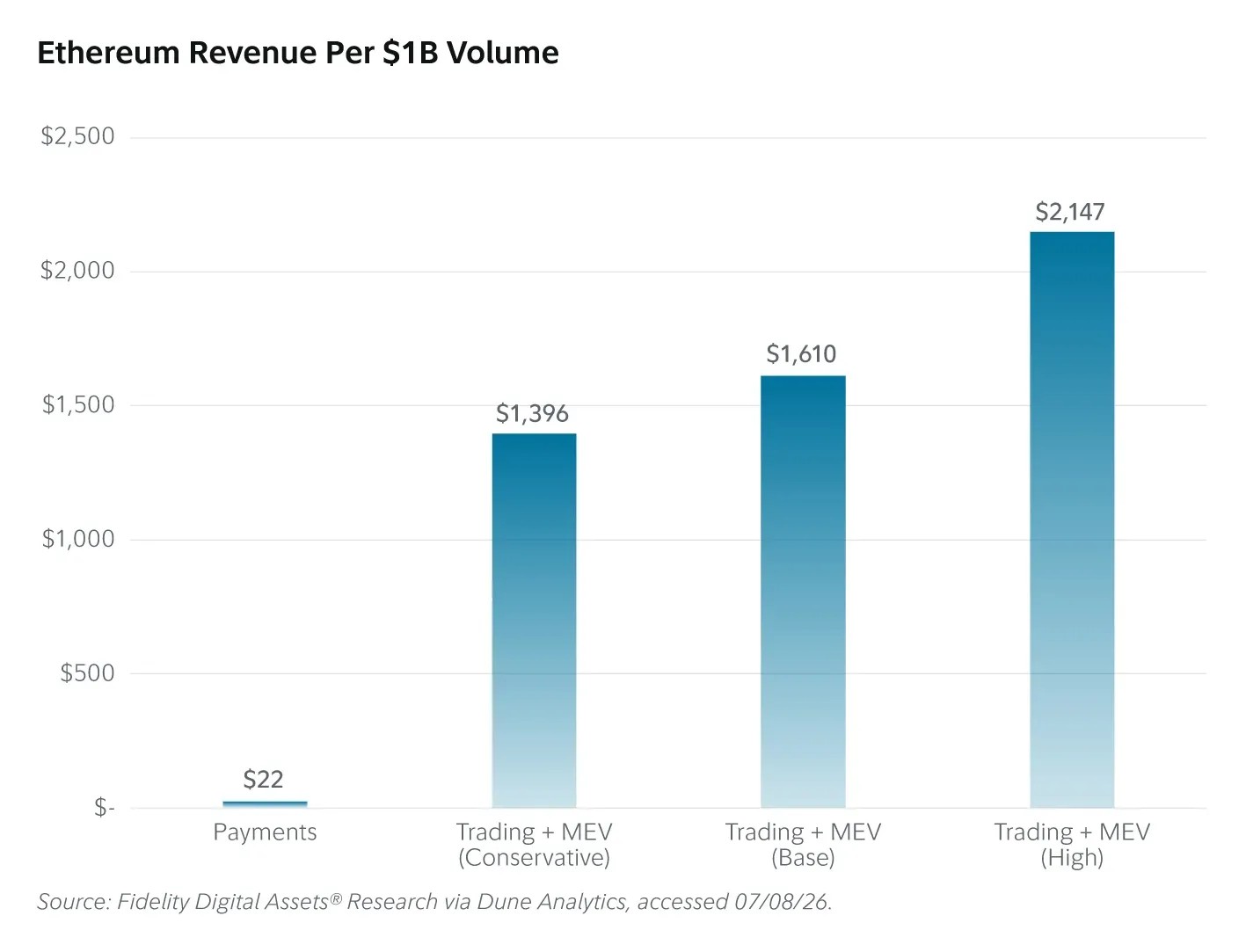
As an example, experts cited payments: their number can grow rapidly, but the fee per transaction remains low. Such transactions can also be batched, conducted off the main network, or moved to cheaper L2 solutions.

Operations with capital generate much more significant revenue. According to Fidelity's calculations, over the last 180 days, trading brought the base layer of Ethereum 49 times more revenue per dollar of volume than payments. Additional revenue is also created through MEV.
Source: Fidelity.

This is why analysts see greater potential in AI agents that will trade, lend, borrow, and provide liquidity. In the case of mass adoption of automatic payments, the main beneficiaries may be stablecoin issuers and infrastructure providers, rather than the native tokens of blockchains.

Recall that in March, specialists at Bernstein named digital assistants as the future of stablecoins. Later, Franklin Templeton noted that AI agents could become a driver of crypto payments.

end-content

Связанные с этим вопросы

QAccording to the Fidelity analysis mentioned in the article, what are the two main areas of crypto market activity that AI agents could significantly impact?

AAccording to the Fidelity analysis, AI agents could significantly impact two main areas: 1) Development of blockchain applications by increasing developer productivity, and 2) On-chain activity through autonomous operations like payments, trading, lending, and providing liquidity.

QWhat key finding about developer productivity using AI assistants did Fidelity's study of GitHub data reveal?

AThe study of over 100,000 GitHub developers revealed that the use of AI coding assistants increased the number of code commits by up to 180% and boosted the number of software releases by 30%.

QWhy does the article suggest that a surge in AI-driven transactions might not proportionally increase blockchain networks' revenue?

AThe article suggests this because many AI-driven activities, like payments, generate low fees per transaction. Furthermore, these transactions can be batched, processed off-chain, or moved to cheaper Layer-2 solutions, limiting revenue for the base layer. Revenue from capital-based activities like trading is much more significant.

QWhat is the primary type of cryptocurrency used by AI agents for their on-chain transactions, according to data from Keyrock cited in the article?

AAccording to data from Keyrock cited in the article, approximately 98.6% of transactions conducted by AI agents used the stablecoin USDC.

QWhat does the article identify as a major challenge for new blockchain projects, which will become even more critical as AI lowers development costs?

AThe article identifies that attracting users, ensuring liquidity, complying with regulatory requirements, and building trust are the major challenges for new projects. As AI makes development cheaper, these factors will become the primary focus for success, rather than just the ability to create an application.

Похожее

Bitdeer заключает сделку по AI-облачным вычислениям на $400 млн для объекта в Малайзии

Криптомайнинговая компания Bitdeer через свое подразделение Bitdeer AI заключила пятилетнее соглашение с неназванным клиентом «высокой кредитоспособности» о бронировании около 50% мощностей своего центра обработки данных A102 в Малайзии еще до его ввода в эксплуатацию. Сделка, общая стоимость которой оценивается примерно в 400 миллионов долларов, начнет приносить выручку в первом квартале 2027 года. Bitdeer AI планирует увеличить мощности для облачных вычислений в сфере ИИ до 350 мегаватт к началу 2028 года. Это часть стратегии компании по диверсификации бизнеса в сферу инфраструктуры ИИ и высокопроизводительных вычислений. Ранее в августе Bitdeer подписала 16-летний договор аренды мощностей в Норвегии на сумму 4,7 миллиарда долларов. Новость положительно повлияла на котировки акций Bitdeer, которые выросли на 7%.

cointelegraph16 мин. назад

Bitdeer заключает сделку по AI-облачным вычислениям на $400 млн для объекта в Малайзии

cointelegraph16 мин. назад

Биткоин (BTC) и альткоины переживают огромный рост! Но Glassnode по-прежнему не убеждена в этом: компания предупредила инвесторов и объяснила критические уровни!

Вчера крипторынок показал мощный рост: биткоин преодолел $72 000, а Ethereum, Solana и XRP выросли на двузначные проценты. По данным Bloomberg, это связано с ожиданиями роста ликвидности в США и благоприятной регуляторной риторикой. Однако аналитическая компания Glassnode сохраняет осторожность. По её оценке, восстановление биткоина — это краткосрочный подъём, а не разворот тренда. BTC остаётся ниже ключевых уровней стоимости ($68 500 и $75 800), что указывает на слабость рынка. Хотя некоторые индикаторы, такие как приток в ETF, стабилизировались, отрицательная премия Coinbase свидетельствует о недостаточном восстановлении спотового спроса в США. Glassnode считает, что для уверенного подтверждения восходящего тренда биткоину необходимо устойчиво преодолеть критические уровни издержек и продемонстрировать усиление спроса на спотовом рынке.

cryptonews.ru36 мин. назад

Биткоин (BTC) и альткоины переживают огромный рост! Но Glassnode по-прежнему не убеждена в этом: компания предупредила инвесторов и объяснила критические уровни!

cryptonews.ru36 мин. назад

Стимулирующий эффект выкупа казначейских облигаций США иссяк, долгосрочные облигации США расширили падение, фьючерсы на Nasdaq снижаются, спотовое золото упало на 1% в течение дня, цены на нефть растут

Эффект от программы обратного выкупа долгосрочных казначейских облигаций Минфина США, направленной на сдерживание роста доходности, оказался кратковременным. После первоначального улучшения настроений на рынке давление вернулось: фьючерсы на Nasdaq 100 упали, доходность 30-летних облигаций выросла до 5.25%, а спот-золото потеряло 1%. Рост цен на нефть (WTI +3%) вновь актуализировал инфляционные риски для инвесторов. Эксперты сравнивают действия Минфина с операцией "Твист" ФРС, но скептически оценивают долгосрочную эффективность таких мер на фоне фундаментальных проблем: высокого уровня госдолга, инфляционного давления и геополитической напряженности (ситуация вокруг Ирана). Ослабление доллара предоставило пространство для укрепления азиатских валют. На азиатских рынках наблюдался рост, подогретый масштабными программами возврата капитала акционерам южнокорейских компаний, таких как SK Hynix и Samsung Electronics.

marsbit45 мин. назад

Стимулирующий эффект выкупа казначейских облигаций США иссяк, долгосрочные облигации США расширили падение, фьючерсы на Nasdaq снижаются, спотовое золото упало на 1% в течение дня, цены на нефть растут

marsbit45 мин. назад

Суд запретил топ-менеджерам рухнувшей биржи FTX торговать

Суд запретил бывшим топ-менеджерам обанкротившейся криптобиржи FTX, Каролине Эллисон и Гари Вана, получать лицензии Комиссии по торговле товарными фьючерсами США (CFTC) на сроки десять и восемь лет соответственно, обязывая их при этом продолжать сотрудничество с ведомством. Эти меры стали итогом разбирательства CFTC и последовали за их судебными приговорами. Эллисон отбывала тюремный срок, а Ван получил условное наказание; смягчение приговора объясняется их помощью следствию по делу FTX. Основатель биржи Сэм Бэнкман-Фрид продолжает отбывать наказание до 2044 года, его прошение о помиловании было отклонено. Тем временем, с 31 июля FTX начала выплачивать около $900 млн пострадавшим клиентам, прошедшим процедуру идентификации, через указанные платформы.

cryptonews.ru49 мин. назад

Суд запретил топ-менеджерам рухнувшей биржи FTX торговать

cryptonews.ru49 мин. назад

Прогноз цены биткоина прорывается, поскольку казначейство удваивает программу обратного выкупа облигаций

Прогноз цены биткоина стал конструктивным после его решительного прорыва из многомесячной модели консолидации в виде симметричного треугольника. Цена поднялась до уровней, не наблюдавшимся с начала июня, достигнув почти $69 900. Этот резкий рост вызвал самую масштабную волну ликвидаций коротких позиций (шортов) в истории криптовалюты — на сумму около $2,74 млрд, что превысило показатели даже краха октября 2025 года. Аналитик Бенджамин Коуэн отмечает, что биткоин вновь вошёл в ключевую зону сопротивления медвежьего рынка. Главным испытанием станет способность актива закрепиться выше этого уровня и использовать его в качестве поддержки, а не просто достичь вершины и откатиться назад. Непосредственными триггерами для роста стали два фактора: объявление Министерства финансов США о расширении программы обратного выкупа долгосрочных облигаций до $4 млрд (воспринятое как инфляционный сигнал), а также призыв президента Трампа к Конгрессу принять Закон о прозрачности (Clarity Act) для регулирования крипторынка. Ключевые уровни на 20 августа 2026 года: ближайшее сопротивление — 200-дневная скользящая средняя ($71 479.33), поддержка — 100-дневная ($66 446.68) и 20-дневная ($64 919.13) скользящие средние. Дальнейшая динамика будет зависеть от того, сможет ли биткоин удержать позиции выше $69 000 после исчерпания эффекта от ликвидаций шортов и найдет ли он поддержку в свежем органическом спросе на фоне позитивных фундаментальных новостей.

cryptonews.ru49 мин. назад

Прогноз цены биткоина прорывается, поскольку казначейство удваивает программу обратного выкупа облигаций

cryptonews.ru49 мин. назад

Торговля

Спот
活动图片