The Logic Behind Circle's $50 Billion Valuation: The Market Only Sees USDC, But Overlooks the Payment Network

marsbitОпубликовано 2026-08-20Обновлено 2026-08-20

Введение

Circle's $50 billion valuation logic: The market sees only USDC but overlooks its payment network. While Circle is perceived as a simple stablecoin issuer, its potential as a full-stack monetary platform is undervalued. The article argues Circle's moat is deeper than recognized, with first-mover advantages in liquidity and network effects making its position hard to challenge. The stablecoin market is projected to grow at 40% CAGR, surpassing $1 trillion by 2030, with Circle well-positioned to capture significant share. Competitors like the Open Standard (OUSD) alliance face significant hurdles in governance and aligned incentives. Currently valued at $18 billion (6.7x P/S), Circle's revenue is heavily tied to interest income. However, its expanding payment network (showing explosive growth) and Arc chain could diversify revenue streams. By 2030, with $40B in interest income, $4B from payments, and $5B from Arc, total revenue could approach $50B. A re-rating to a 10x multiple on more diversified, less rate-sensitive revenue could justify a $500 billion market cap.

Author: Artemis Analytics

Compiled by: Deep Tide TechFlow

Deep Tide Introduction: The market views Circle as merely a stablecoin issuer, but the potential of its payment network and full-stack currency platform is far from being priced in. This article deconstructs Circle's moat and the scenario for a $50 billion market capitalization, serving as a key reference for investors focused on the stablecoin and payment sectors.
Last week, we invited ARK Invest's Lorenzo Valente on our podcast to discuss why Circle is undervalued by the market. This week's Thesis continues this line of thought.

Argument: The market believes Circle's moat is weak, stablecoins are homogeneous commodities, and consortia like Open Standard will capture the majority share. We believe Circle's moat is deeper and harder to breach than the market perceives, and its first-mover advantage is undervalued.

Core drivers:

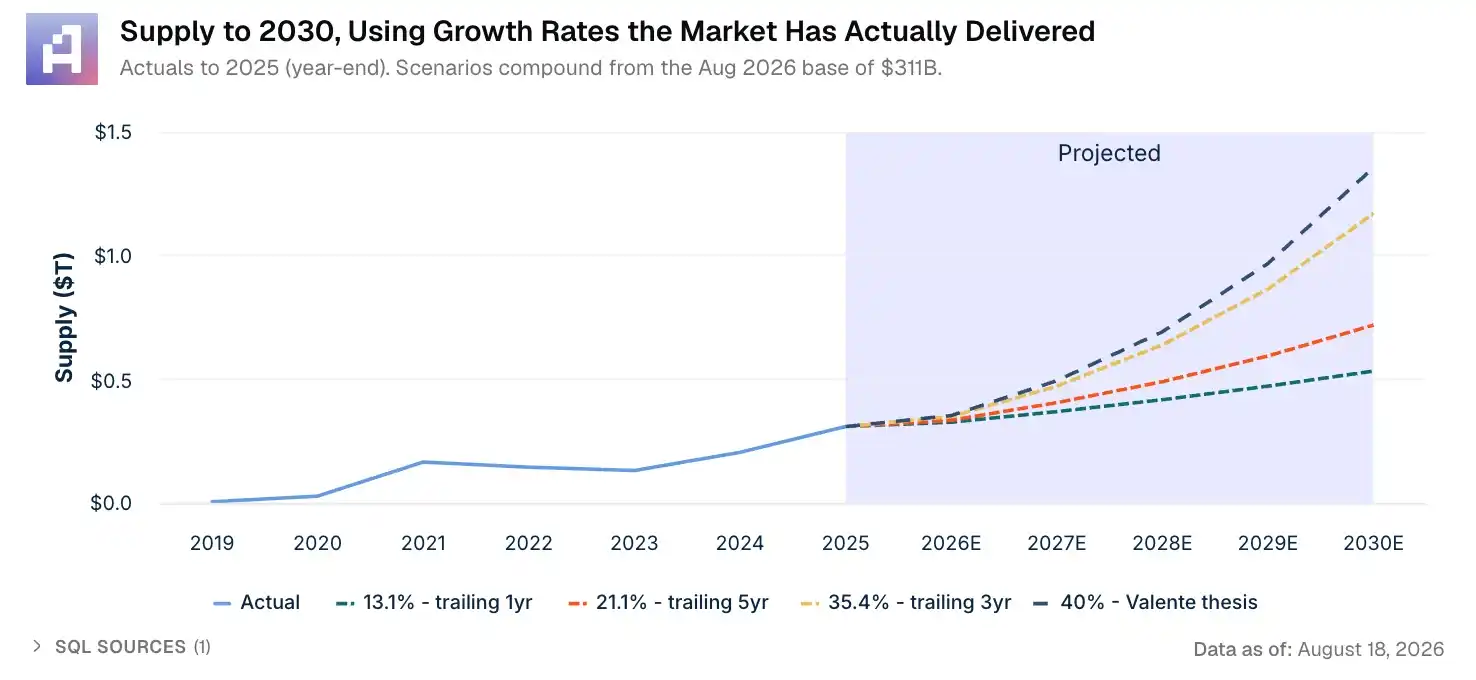
Stablecoins will grow at a 40% CAGR, exceeding $1 trillion by 2030.

The market shows a winner-take-all dynamic in terms of liquidity and network effects, making it difficult for alliances like OUSD to steal share.

The market prices Circle as a stablecoin issuer, not a full-stack currency platform.

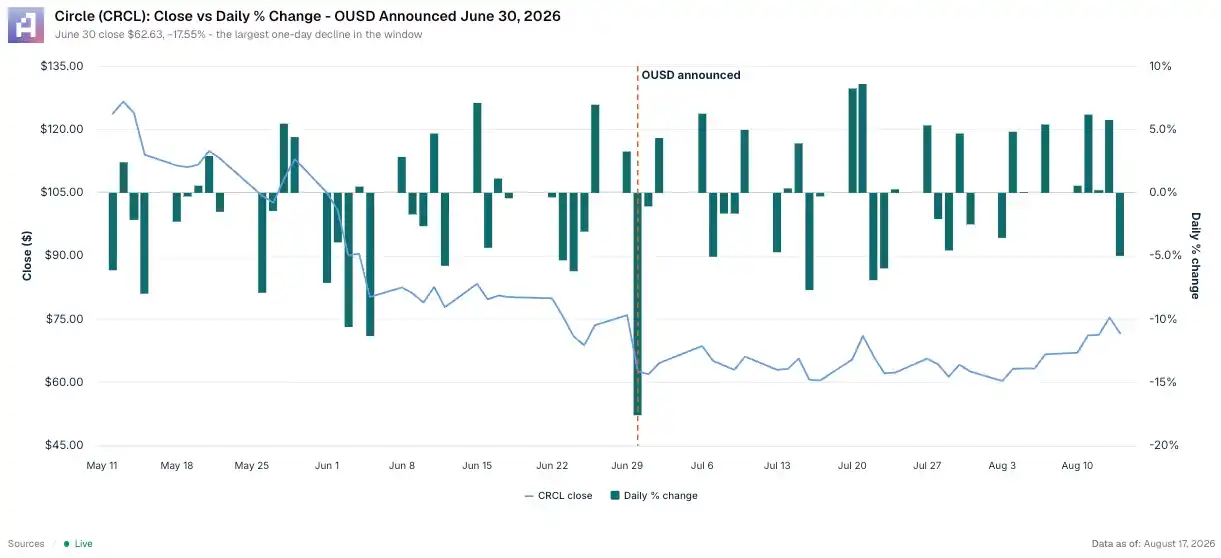
Circle's second-worst trading day in history occurred when Open Standard was announced. This is a consortium-backed stablecoin supported by over 140 companies, including Stripe, Visa, Mastercard, and Google, among others. The stock fell 17% after the news. The market's reaction is telling: Stripe will rally the troops, overthrow the Circle/Tether duopoly, and distribute stablecoin revenue proportionally to consortium members. This news drove CRCL's price near its all-time low.
Stablecoin Growth

We believe many investors don't think stablecoins will reach $1 trillion by 2030. They might point to stagnant growth. However, stablecoin supply has decoupled from crypto prices for the first time ever. Despite crypto prices falling 50-70% from recent highs, stablecoin supply has remained flat, indicating it has become its own category. If stablecoin supply continues to grow at the rate of the past 3 years, global supply will exceed $1 trillion by 2030.
Winner-Take-All Stablecoin Market, Liquidity and Network Effects are Crucial

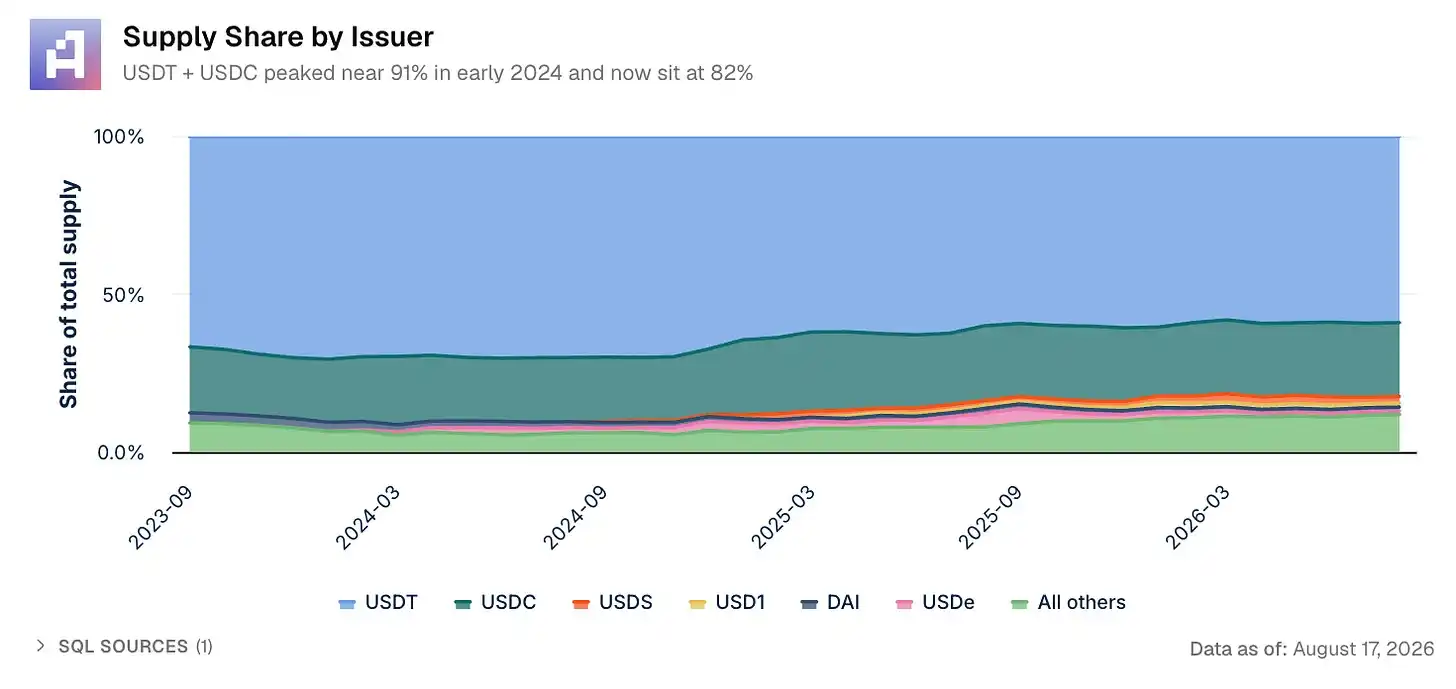
Over the past few years, dozens of issuers have tried to dismantle the Circle/Tether duopoly. Despite hundreds of stablecoins being issued now, these two giants still command over 80% of the supply share. The first-mover advantage gained by these players is extremely difficult to overcome. Building liquidity from scratch across chains, applications, and exchanges is hard, and Circle is far ahead of challengers.
Looking Specifically at OUSD

The market clearly views OUSD as a significant threat to Circle's business. However, history shows that consortia rarely succeed. A successful consortium requires:

Aligned incentives among members – OUSD achieves this to some extent through interest income distribution.

Clear governance – Open Standard appears weak here, with several announced "partners" revealing they were not consulted and have not yet made commitments.

Existential pressure – I don't think most institutions yet see stablecoins as a matter of survival, though Stripe may be the exception.

Therefore, based on current information, Open Standard meets roughly only one-third of the necessary conditions.

Circle is Priced as a Stablecoin Issuer, Not a Full-Stack Currency Platform

The market views Circle merely as the issuer of USDC. It underestimates Circle's revenue, which is almost entirely interest income subject to Federal Reserve policy.

In reality, Circle is building a full-stack currency product for the future of the internet. At its core, it's a technology company.

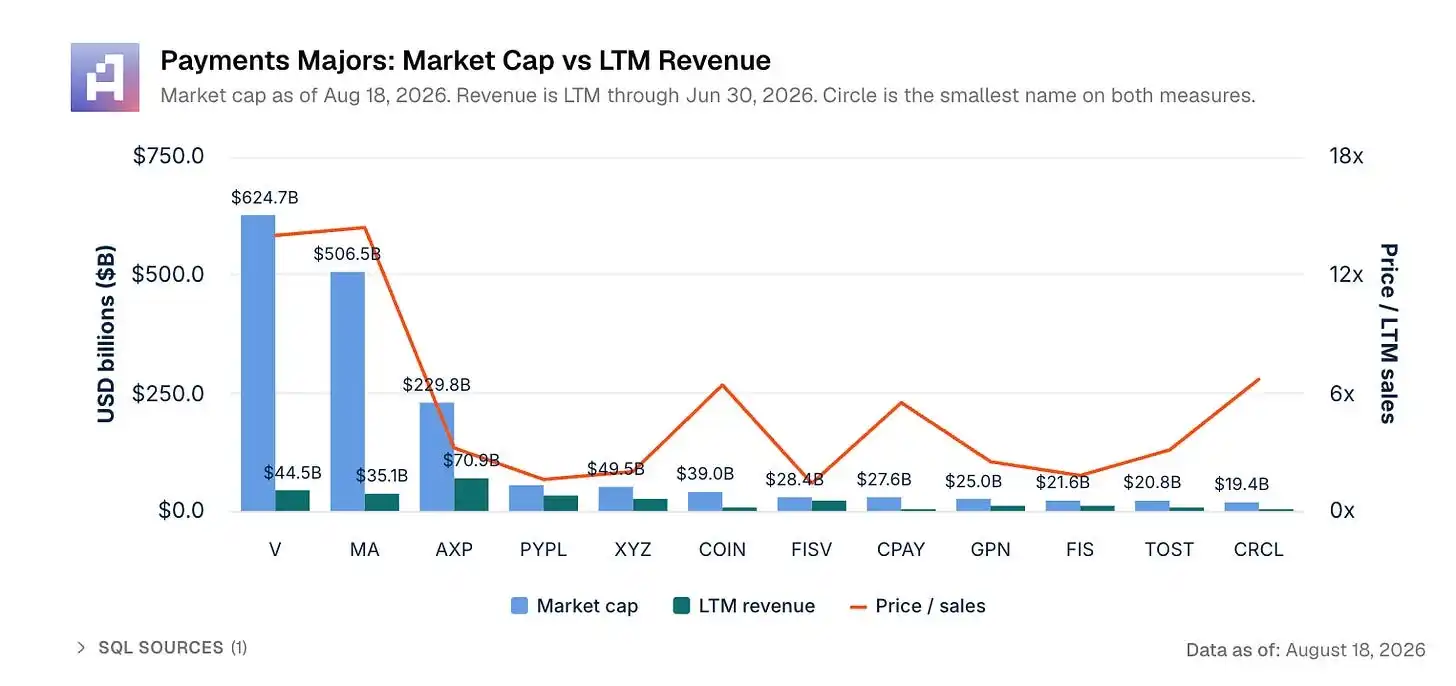
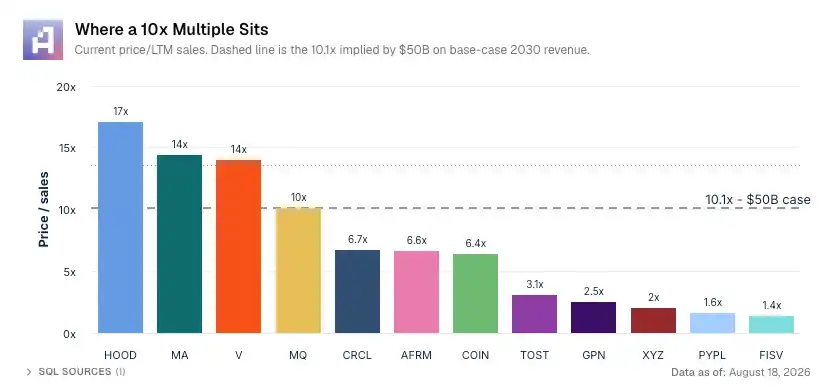
Circle's valuation compared to payment peers. There is a clear gap between credit card networks and other companies. If Circle builds the next-generation, full-stack payment system, its market cap and valuation would be closer to credit card networks, charging basis points on transaction volume, rather than relying on float.
Envisioning a $50 Billion Circle

Today, Circle's annualized revenue is approximately $2.8 billion, with a valuation of $18 billion, a P/S ratio of 6.7x—far below payment networks (14x) and high-growth fintechs like HOOD (17x). Its valuation multiple is almost identical to COIN's, which is primarily viewed as a crypto exchange.

The market sees Circle as a company tied to the crypto cycle, with rate-sensitive revenue. Circle will shed this label and its fragile revenue structure, allowing for a higher valuation multiple—10x is conservative and reasonable.

If our prediction is correct and, as we assume, liquidity and network effects create a strong moat, with stablecoin supply reaching $1 trillion by 2030, USDC share at 20%, and interest rates at 2%, CRCL could generate $4 billion in interest income.

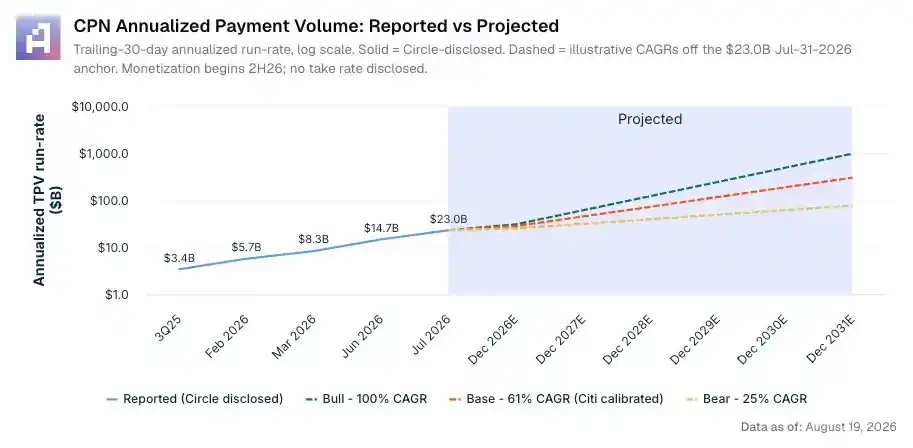
In terms of revenue diversification, Circle's key growth products are gaining momentum, such as the Circle Payments Network. Despite persistent low crypto prices and flat stablecoin supply, transaction volume on the Circle Payments Network is growing at an explosive pace, with the latest disclosed annualized volume as of July 2026 reaching $23 billion—up 6.8x year-over-year (admittedly from a small base) and 70% quarter-over-quarter. If growth stays at a 60-65% CAGR, transaction volume would reach approximately $200 billion by 2030. At a 20 basis point take rate, this would generate an additional $400 million in revenue.
Looking at the Arc chain, if it reaches the scale of Tron (another stablecoin-focused chain), Arc would generate $500 million in fees.

The above estimates bring CRCL's revenue close to $5 billion, with 20% coming from the rapidly growing payment/settlement-related business lines. This mix gives investors reason to assign a higher valuation multiple. Combining the above revenue growth and multiple expansion, we get $5 billion multiplied by 10 equals $50 billion. A $50 billion market cap for CRCL is not a fantasy.


Связанные с этим вопросы

QWhat are the three main factors that the author believes support Circle's strong moat and undervalued position?

A1. The stablecoin market will grow at a 40% CAGR, exceeding $1 trillion by 2030. 2. The market exhibits winner-takes-most dynamics due to liquidity and network effects, making it hard for competitors like the Open Standard alliance to gain share. 3. The market prices Circle as a mere stablecoin issuer, not as a full-stack monetary platform with a high-growth payment network.

QWhy does the author argue that the stablecoin market is a winner-takes-most environment, and how does this benefit Circle?

AThe author argues that achieving deep liquidity across multiple blockchains, applications, and exchanges is a massive hurdle. Circle's first-mover advantage has allowed it to build this critical liquidity and network effect, creating a significant barrier for new entrants like the Open Standard alliance, which would have to build liquidity from scratch.

QAccording to the article, what are the three key requirements for a successful consortium like the Open Standard (OUSD), and how does OUSD currently measure up?

AThe three requirements are: 1. Aligned incentives among members. 2. Clear governance. 3. A sense of existential pressure for members. The author states that based on current information, Open Standard only meets about one-third of these necessities, citing weak governance and lack of commitment from some announced 'partners' as key weaknesses.

QWhat is the core difference between how the market currently values Circle and how the author believes it should be valued?

AThe market currently values Circle as a stablecoin issuer whose revenue is primarily interest income tied to Federal Reserve policy, giving it a low, cyclical valuation multiple similar to a crypto exchange like Coinbase. The author argues Circle should be valued as a high-growth, full-stack monetary platform and payment network, deserving a valuation multiple closer to established payment networks, which trade at higher revenue multiples.

QWhat are the key revenue projections and assumptions that lead the author to a potential $50 billion valuation for Circle by 2030?

AThe author's $50B valuation scenario assumes: 1. $1T total stablecoin supply by 2030, with USDC holding a 20% share and generating $4B in interest income at a 2% yield. 2. Circle Payments Network growing at a 60-65% CAGR to $200B in transaction volume, generating an additional $400M in revenue at a 20 bps take rate. 3. The Arc blockchain generating $500M in fees if it scales to Tron's size. This totals ~$5B in diversified revenue, which at a conservative 10x multiple (justified by its growing payment business mix) yields a $50B valuation.

Похожее

Биткоин преодолел $72 тыс. Что будет дальше

Цена биткоина (BTC) резко выросла на $8 тыс. за сутки, преодолев отметку в $72 тыс. впервые с начала лета. Росту способствовали два ключевых фактора: решение Министерства финансов США об увеличении выкупа долгосрочных гособлигаций, что удешевляет деньги и повышает привлекательность рисковых активов, а также публичное упоминание криптовалют президентом Дональдом Трампом. Эксперты считают, что фундаментальным драйвером стали действия Минфина, в то время как заявления Трампа оказали эмоциональный эффект. Рост также был усилен массовым закрытием коротких позиций (шортов). Однако, сохраняются сдерживающие факторы: жёсткая риторика ФРС, низкая активность в сетях и конкуренция с другими классами активов. Аналитики ожидают умеренного продолжения роста. В случае закрепления выше $71.5-72 тыс., следующей целью может стать уровень $75-78 тыс., а в позитивном сценарии — $80-82 тыс. Ключевой зоной поддержки остаётся диапазон $69-70 тыс. Общий консенсус — рынок получил позитивный импульс, но для подтверждения нового восходящего тренда необходимо устойчивое закрепление на достигнутых уровнях.

cryptonews.ru2 мин. назад

Биткоин преодолел $72 тыс. Что будет дальше

cryptonews.ru2 мин. назад

Голос разработчиков Optimism лишил пользователей аирдропа на $49 млн

19 августа сообщество Optimism одобрило перенос 546,9 млн OP (около $49,7 млн) из резерва для будущих аирдропов пользователям в новый Strategic Ecosystem Fund для развития экосистемы. Решение было принято с перевесом голосов после того, как команда разработчиков Test in Prod внесла решающие 8,486 млн OP за 17 минут до закрытия голосования. Средства фонда будут направлены на развитие OP Mainnet и корпоративного направления OP Enterprise, включая партнёрства с блокчейнами, протоколами и финансовыми компаниями. Optimism Foundation обосновала это сменой стратегии с привлечения широкой аудитории на фокус на работу с крупными организациями. Инициатива вызвала споры. Test in Prod поддержала её, сославшись на необходимость конфиденциальности в конкурентной борьбе за корпоративных клиентов. Однако платформа L2BEAT и ряд делегатов раскритиковали предложение, указав на недостаточную детализацию целей использования средств, широкие полномочия фонда и отмену ранее заявленных планов по аирдропам для пользователей.

cryptonews.ru2 мин. назад

Голос разработчиков Optimism лишил пользователей аирдропа на $49 млн

cryptonews.ru2 мин. назад

Bitdeer заключает сделку по AI-облачным вычислениям на $400 млн для объекта в Малайзии

Криптомайнинговая компания Bitdeer через свое подразделение Bitdeer AI заключила пятилетнее соглашение с неназванным клиентом «высокой кредитоспособности» о бронировании около 50% мощностей своего центра обработки данных A102 в Малайзии еще до его ввода в эксплуатацию. Сделка, общая стоимость которой оценивается примерно в 400 миллионов долларов, начнет приносить выручку в первом квартале 2027 года. Bitdeer AI планирует увеличить мощности для облачных вычислений в сфере ИИ до 350 мегаватт к началу 2028 года. Это часть стратегии компании по диверсификации бизнеса в сферу инфраструктуры ИИ и высокопроизводительных вычислений. Ранее в августе Bitdeer подписала 16-летний договор аренды мощностей в Норвегии на сумму 4,7 миллиарда долларов. Новость положительно повлияла на котировки акций Bitdeer, которые выросли на 7%.

cointelegraph18 мин. назад

Bitdeer заключает сделку по AI-облачным вычислениям на $400 млн для объекта в Малайзии

cointelegraph18 мин. назад

Биткоин (BTC) и альткоины переживают огромный рост! Но Glassnode по-прежнему не убеждена в этом: компания предупредила инвесторов и объяснила критические уровни!

Вчера крипторынок показал мощный рост: биткоин преодолел $72 000, а Ethereum, Solana и XRP выросли на двузначные проценты. По данным Bloomberg, это связано с ожиданиями роста ликвидности в США и благоприятной регуляторной риторикой. Однако аналитическая компания Glassnode сохраняет осторожность. По её оценке, восстановление биткоина — это краткосрочный подъём, а не разворот тренда. BTC остаётся ниже ключевых уровней стоимости ($68 500 и $75 800), что указывает на слабость рынка. Хотя некоторые индикаторы, такие как приток в ETF, стабилизировались, отрицательная премия Coinbase свидетельствует о недостаточном восстановлении спотового спроса в США. Glassnode считает, что для уверенного подтверждения восходящего тренда биткоину необходимо устойчиво преодолеть критические уровни издержек и продемонстрировать усиление спроса на спотовом рынке.

cryptonews.ru37 мин. назад

Биткоин (BTC) и альткоины переживают огромный рост! Но Glassnode по-прежнему не убеждена в этом: компания предупредила инвесторов и объяснила критические уровни!

cryptonews.ru37 мин. назад

Стимулирующий эффект выкупа казначейских облигаций США иссяк, долгосрочные облигации США расширили падение, фьючерсы на Nasdaq снижаются, спотовое золото упало на 1% в течение дня, цены на нефть растут

Эффект от программы обратного выкупа долгосрочных казначейских облигаций Минфина США, направленной на сдерживание роста доходности, оказался кратковременным. После первоначального улучшения настроений на рынке давление вернулось: фьючерсы на Nasdaq 100 упали, доходность 30-летних облигаций выросла до 5.25%, а спот-золото потеряло 1%. Рост цен на нефть (WTI +3%) вновь актуализировал инфляционные риски для инвесторов. Эксперты сравнивают действия Минфина с операцией "Твист" ФРС, но скептически оценивают долгосрочную эффективность таких мер на фоне фундаментальных проблем: высокого уровня госдолга, инфляционного давления и геополитической напряженности (ситуация вокруг Ирана). Ослабление доллара предоставило пространство для укрепления азиатских валют. На азиатских рынках наблюдался рост, подогретый масштабными программами возврата капитала акционерам южнокорейских компаний, таких как SK Hynix и Samsung Electronics.

marsbit47 мин. назад

Стимулирующий эффект выкупа казначейских облигаций США иссяк, долгосрочные облигации США расширили падение, фьючерсы на Nasdaq снижаются, спотовое золото упало на 1% в течение дня, цены на нефть растут

marsbit47 мин. назад

Торговля

Спот
活动图片