Here’s why the CLARITY Act’s ethics deal may be so hard to reach

cointelegraphОпубликовано 2026-07-28Обновлено 2026-07-28

Введение

The long-awaited US Digital Asset Market Clarity Act (CLARITY) faces a major hurdle over its ethics provisions, potentially derailing the bill. While there is broad agreement on the need for clearer digital asset rules, negotiators are divided. Democrats argue the current proposal's ethics rules are too weak and object to relying solely on the Department of Justice for enforcement, preferring state attorneys general have a role. They express concerns about conflicts of interest, citing President Trump's substantial crypto ventures. Republicans defend the provisions as historically strong and insist federal law should be enforced uniformly by the DOJ. The latest draft would ban senior federal officials from issuing digital assets while in office, with restrictions expiring in 2029. Despite the impasse, many observers believe a compromise is still possible. Industry representatives warn that rejecting the bill could leave no regulatory framework at all, whereas passing it would provide crucial certainty. The debate has now narrowed to finalizing ethics enforcement, seen as a sign of progress on the broader bill.

The long-awaited US Digital Asset Market Clarity Act (CLARITY) has hit another snag.

This time, it’s not software developers or the turf war between federal regulators at stake, but the thornier question of ethics — ironic, given many politicians’ demonstrable disdain for them.

After months of negotiations and what Coinbase’s chief executive Brian Armstrong called “thousands of hours of work on both sides,” disagreement over a code of conduct could make or break CLARITY once and for all.

Pretty much everyone agrees the United States needs clearer rules around digital assets. But negotiators are divided over whether the bill’s ethics provisions are strong enough, and, more importantly, who should enforce them.

Democrats worry the current proposal relies too heavily on the Department of Justice, arguing state attorneys general should be able to step in if the DOJ fails to enforce the law.

In a joint statement Wednesday, seven Democratic senators said the Republican proposal “falls short.”

“Key provisions including those addressing ethics for elected officials, consumer protection, illicit finance, conflicts of interest and market integrity must be strengthened,” the senators said.

For their part, Republicans are pushing to keep enforcement of the ethics provisions with the DOJ, arguing that federal rules should be enforced through a single national framework. Attorney and former Republican Senate candidate John Deaton said Wednesday:

“The CLARITY Act is federal legislation... The Department of Justice - not fifty different state AGs with fifty different political incentives and fifty different interpretations - is the appropriate body to enforce federal law.”

Can lawmakers find a middle path before the bill reaches the Senate floor, or has the ethics debate become CLARITY’s biggest obstacle yet?

What the latest ethics proposal actually does

The latest Senate draft made public Wednesday would prohibit the president, vice president, members of Congress and other senior federal officials and their spouses from issuing or sponsoring digital assets while in office.
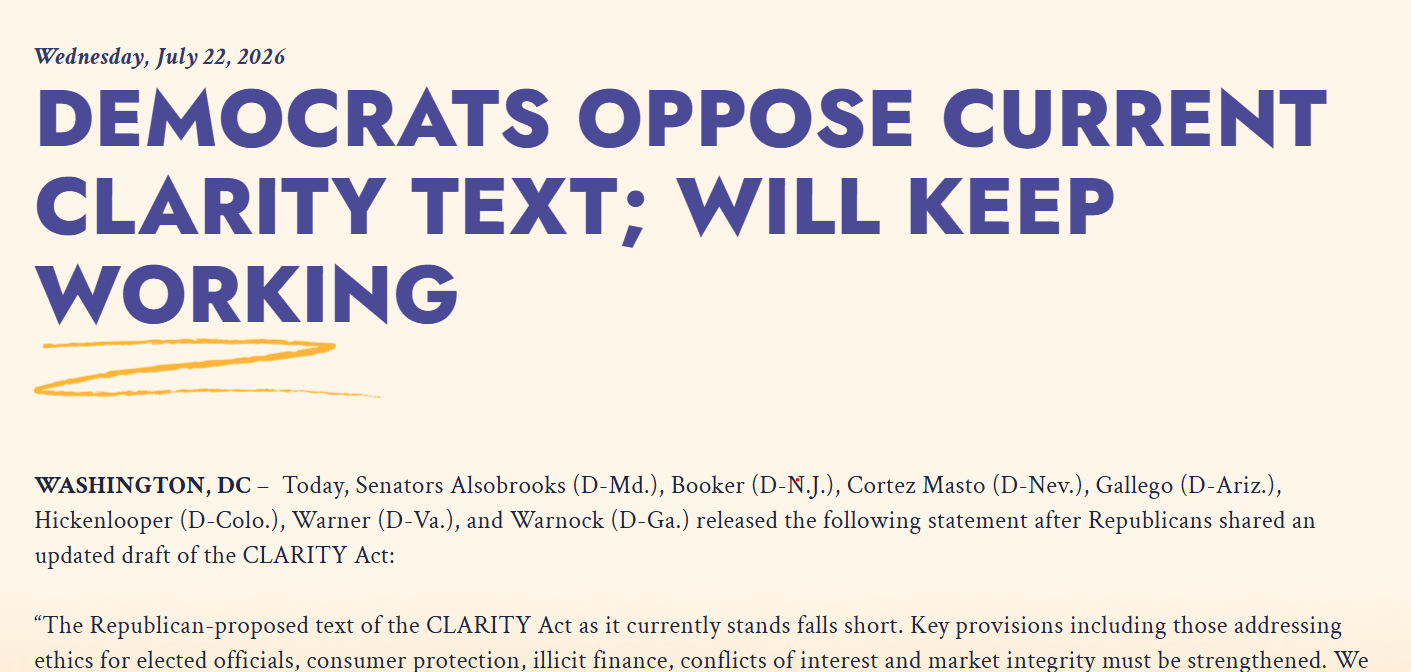
Democrats oppose current CLARITY text. Source: Senator Ruben Gallego

That means future presidential meme coins would be off the table, at least temporarily, with no Trump 2.0 or Melania 2.0-style token launches while the restrictions are in play.

Related: CLARITY Act could help CFTC deal with prediction markets: Lawyer

The proposal would also prevent crypto platforms from listing assets issued or sponsored by covered officials.

Restrictions would expire in 2029, after President Donald Trump’s current term ends, though covered officials would still be permitted to own cryptocurrencies.

Democrats say current proposal falls short

Democrats have made it clear the text needs additional work before gaining their support, but getting CLARITY over the line isn’t doomed; they’ve also signaled a willingness to see the bill through to the end.

“We have been working in good faith with our Republican colleagues for the past year and will continue doing so to get this over the finish line,” the senators said.

Senator Angela Alsobrooks said negotiators were “fairly close” to reaching an agreement during a Semafor event on Wednesday, despite warning the ethics provisions remained a dealbreaker. The Maryland Democrat said:

“Although I have been supportive to this point, I absolutely will not support on the floor any legislation that does not include provisions around ethics.”

Her main concern is not only the substance of the rules, but who would enforce them.

“It’s an absolute that we cannot completely rely on the DOJ, given what we’ve seen of their inability and their unwillingness to enforce the law,” Alsobrooks said.

The debate has been fueled by Trump’s rapidly expanding crypto business interests spanning meme coins, World Liberty Financial and other digital asset holdings.

Related: Trump claims he can ‘future proof’ crypto regulation with CLARITY Act

The President’s crypto ventures have reportedly generated $1.4 billion on paper, prompting Democrats to argue stronger safeguards are needed to address potential conflicts of interest.

Senator Elizabeth Warren has focused on whether the restrictions go far enough, with the Massachusetts Democrat saying that the latest draft “does nothing to stop President Trump from making his next $1.4 billion from crypto.”

Former SEC official Amanda Fischer also argued the draft would still allow Trump to benefit from his existing projects, with limited restrictions on future crypto income streams.

Republicans say proposal already unprecedented

Republicans reject the idea that the ethics provisions are weak. Senator Bernie Moreno described the draft as containing “the most powerful ethics language in US history,” pushing back against Democratic claims that the provisions are insufficient.
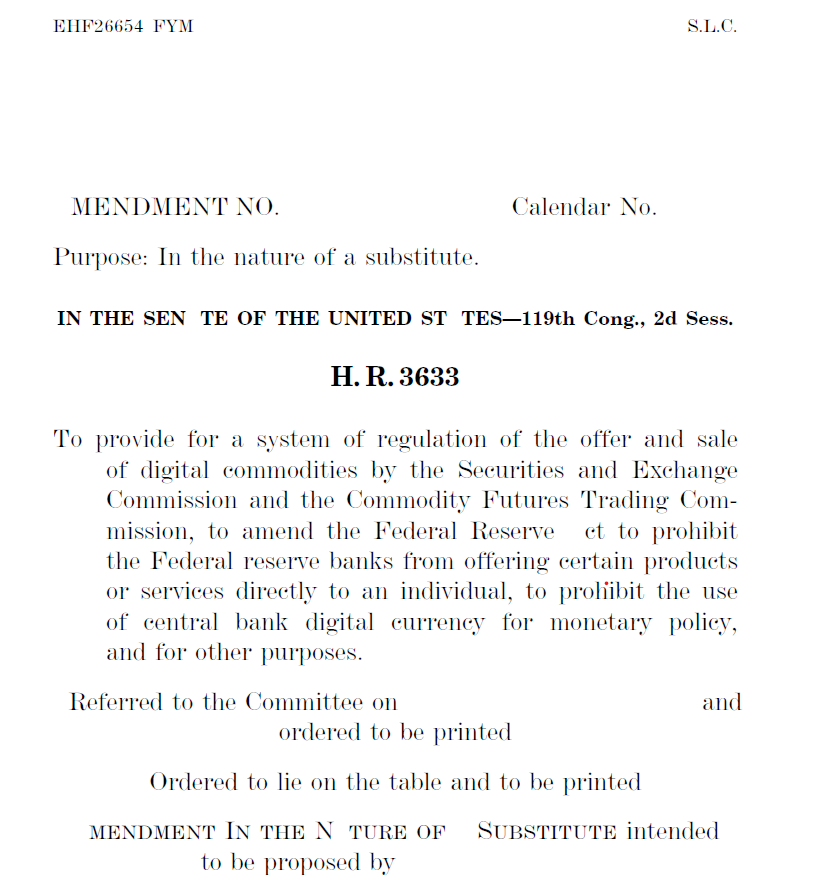
The latest CLARITY Act text. Source: US Congress.

Patrick Witt, a former White House and Senate counsel, said Democratic opposition appeared to rest on one of two positions: either that ethics rules without state attorneys general are “meaningless,” or that they fail to penalize President Trump for past crypto activity.

“If you hold position (1), then you are basically saying that ALL current federal ethics laws are meaningless because none of them are enforceable by state AGs,” he said. “If you hold position (2), then there is literally nothing that can be done to appease you because what you are advocating for is blatantly unconstitutional.”

Others argue that, even if the legislation is imperfect, passing it would be preferable to preserving the status quo. Andreessen Horowitz co-founder Chris Dixon said the US has a similar opportunity to the early internet era, when lawmakers established rules that allowed innovation to flourish rather than forcing new technology into outdated regulatory frameworks.

While acknowledging that “no law is perfect,” Dixon argued the CLARITY Act would deliver long-overdue consumer protections and provide regulatory certainty for blockchain innovation in the US.

Can lawmakers find a middle path?

Despite stumbling over the ethics hurdle, most industry and policy observers still believe a deal remains in reach.

Kristin Smith, former chief executive of the Blockchain Association and now president of the Solana Policy Institute, sees that the latest draft is already a meaningful compromise.

“The new text includes a substantive, one-of-a-kind ethics provision, a necessary step to win the support of Senate Democrats,” Smith told Cointelegraph.

“But ethics is far from the only thing at stake. The Senate has added a full disclosure regime, an entire illicit finance section, and improved spot market regulation.”

Smith warned that rejecting the bill in pursuit of stronger ethics language could leave lawmakers stuck with no market structure legislation at all.

“There is no version of a ‘no’ vote that produces a stronger bill,” she said. “A ‘no’ vote produces no bill at all: no disclosure regime, no illicit finance protections, no spot market improvements, no ethics provisions, nothing.”

Vincent Chok, co-founder and chief executive of stablecoin issuer First Digital, said the fact negotiations have narrowed to ethics rather than the broader structure of the bill is itself a sign of progress.

“The core debate is no longer whether digital assets need a regulatory framework, but how to finalize one that commands broad support,” Chok told Cointelegraph.

He said that while no regulatory framework is likely to be perfect from day one, businesses can adapt to clear rules that evolve over time. Prolonged uncertainty makes long-term investment and product development far more difficult, he said.

Salman Banaei, head of public policy at Plume, a blockchain network focused on tokenized real-world assets, also believes a compromise remains possible, although he cautioned that the White House’s initial ethics proposal “is not a good starting point.”

For now, both sides appear to agree on one thing: a compromise is still possible, but exactly what it looks like remains the biggest unanswered question.

Magazine: Will the crypto lobby’s $189M campaign get CLARITY over the line?

Трендовые криптовалюты

Связанные с этим вопросы

QWhat is the main obstacle currently delaying the passage of the CLARITY Act?

AThe main obstacle is a disagreement over the bill's ethics provisions, specifically regarding their strength and, more importantly, who should enforce them (the Department of Justice vs. state attorneys general).

QWhat specific activities does the latest Senate draft of the CLARITY Act prohibit for senior federal officials?

AThe draft would prohibit the president, vice president, members of Congress, other senior federal officials, and their spouses from issuing or sponsoring digital assets while in office. It also prevents crypto platforms from listing such assets.

QWhy do Democrats argue that the Department of Justice should not be the sole enforcer of the ethics rules?

ADemocrats argue they cannot completely rely on the DOJ due to its perceived inability and unwillingness to enforce the law. They believe state attorneys general should be able to step in if federal enforcement fails.

QAccording to the article, what is a key Republican argument for keeping enforcement solely with the DOJ?

ARepublicans argue that the CLARITY Act is federal legislation and should be enforced through a single national framework by the Department of Justice, rather than by fifty different state attorneys general with varying political incentives and interpretations.

QDespite the ethics debate, why do some industry observers believe a compromise on the CLARITY Act is still possible?

AObservers believe a compromise is possible because the debate has narrowed to ethics, showing progress on the broader regulatory framework. They note the current draft already contains significant compromises and warn that rejecting it would result in no new market structure legislation at all.

Похожее

Завтра ждите новостей: на этот раз Банк Японии объявит о своем решении по процентной ставке! Какое влияние это окажет на биткоин?

За день до объявления Банком Японии решения по процентной ставке японская иена укрепилась почти на 3% по отношению к доллару, что стало самым резким падением пары USD/JPY со времён валютной интервенции властей в начале года. Это вызвало предположения о возможном повторном вмешательстве правительства для поддержки национальной валюты, которая ранее опустилась до минимума за почти 40 лет. В период с конца апреля по конец мая Япония уже потратила около 11,73 трлн иен (примерно 73,2 млрд долларов) на валютные интервенции, чтобы сдержать ослабление иены. Сейчас внимание рынка сосредоточено на предстоящем решении Банка Японии по ставкам и будущих сигналах по монетарной политике. Ожидается, что жёсткая позиция регулятора может оказать дополнительную поддержку иене. В то же время резкое укрепление японской валюты может создать краткосрочное давление на биткоин, повысив риск закрытия позиций в кэрри-трейде, когда инвесторы занимают иену по низкой ставке для инвестиций в криптовалюту.

cryptonews.ru1 мин. назад

Завтра ждите новостей: на этот раз Банк Японии объявит о своем решении по процентной ставке! Какое влияние это окажет на биткоин?

cryptonews.ru1 мин. назад

Биткоин стабилен, поскольку любимый ФРС показатель инфляции PCE впервые за шесть лет показал месячное снижение

Биткоин (BTC) демонстрировал стабильность в четверг, несмотря на публикацию данных по инфляции PCE (индекс личных потребительских расходов), предпочитаемому Федеральной резервной системой показателю. В июне годовой рост PCE составил 3,7%, что соответствует ожиданиям рынка и впервые за шесть месяцев показало месячное снижение, прервав локальную восходящую тенденцию. Однако аналитики отмечают, что инфляция почти вдвое превышает целевой показатель ФРС в 2%. Основные фондовые индексы США выросли в этот день, а напряженность на рынке, вызванная распродажей акций полупроводниковых компаний, ослабла, что поддержало криптовалюты. Глава по инвестициям Bitwise Мэтт Хауган прогнозирует, что в будущем биткоин станет менее чувствительным к изменениям процентных ставок ФРС, поскольку ожидаемые корректировки будут более умеренными по сравнению с прошлыми резкими колебаниями. ФРС на своем последнем заседании оставила ставки без изменений, при этом отмечается растущее расхождение во мнениях внутри комитета.

cointelegraph46 мин. назад

Биткоин стабилен, поскольку любимый ФРС показатель инфляции PCE впервые за шесть лет показал месячное снижение

cointelegraph46 мин. назад

Bernstein раскрыла детали сделки Core Scientific с AMD на $14 млрд

Аналитики Bernstein раскрыли детали сделки между Core Scientific и AMD, оценив ее потенциал более чем в $14 млрд выручки за 15 лет. Соглашение предусматривает выделение 530 МВт мощности для ИИ, при этом AMD выступает кредитным гарантом для части инфраструктуры. Конструкция сделки, включающая прямую аренду по модели triple-net и поддержку облачного провайдера, снижает риски и стоимость финансирования для Core Scientific. AMD также получила варранты на покупку акций майнера. Среднегодовая выручка по контракту оценивается в $0,9 млрд, что несколько ниже последних аналогов в отрасли, однако маржа для AMD приближается к 100%. Капитальные затраты Core Scientific составят около $6 млрд, часть из которых планируется покрыть проектными облигациями. Bernstein рассматривает эту сделку как подтверждение тренда: бывшие биткоин-майнеры активно трансформируются в операторов ИИ-инфраструктуры, а производители чипов, такие как AMD и Nvidia, становятся их ключевыми якорными арендаторами. Ранее Core Scientific уже выплатила $41,9 млн для расторжения майнингового контракта с Block, ускоряя диверсификацию в сферу ИИ.

cryptonews.ru1 ч. назад

Bernstein раскрыла детали сделки Core Scientific с AMD на $14 млрд

cryptonews.ru1 ч. назад

Hyperscale Data продала 100 BTC для финансирования центра обработки данных ИИ в Мичигане

Крипто-майнинговая компания Hyperscale Data продала около 100 биткоинов и получила кредит под залог BTC для финансирования строительства центра обработки данных для искусственного интеллекта в Мичигане. Вырученные средства направлены на строительство и закупку ключевого оборудования. Центр создаётся в рамках ранее заключённого 10-летнего соглашения с неназванным провайдером инфраструктуры ИИ на 20 мегаватт мощности. Контракт, включающий опционы на продление, потенциально может принести более $1,2 млрд выручки, а при расширении его общая стоимость может превысить $3 млрд. Ранее известная как Ault Alliance, компания сменила название в 2024 году, сохранив майнинговый бизнес. После продажи у неё осталось около 1006 BTC, что делает её 44-м крупнейшим публичным корпоративным держателем биткоинов.

cointelegraph1 ч. назад

Hyperscale Data продала 100 BTC для финансирования центра обработки данных ИИ в Мичигане

cointelegraph1 ч. назад

Gumi и SBI запускают криптовалютный фонд на 3 миллиарда иен, а Япония открывает двери для спотовых ETF

Японская компания gumi Inc. совместно с финансовой группой SBI запускает криптовалютный фонд SBI Crypto Fund I, который начнет работу 1 августа 2026 года с целью привлечь 3 миллиарда иен. Фонд будет инвестировать в Bitcoin и основные альткоины, используя стейкинг, хеджирование и ребалансировку. Запуск фонда происходит на фоне реформ японского законодательства, которые переклассифицируют криптовалюты в финансовые инструменты и открывают путь для будущих спотовых ETF, а также предусматривают ужесточение наказаний за незаконную деятельность. Параллельно наблюдается рост интереса со стороны корпораций и пользователей: число счетов на криптобирже SBI VC Trade превысило 2 миллиона, а компании активнее используют криптовалюты для снижения зависимости от слабой иены.

cryptonews.ru1 ч. назад

Gumi и SBI запускают криптовалютный фонд на 3 миллиарда иен, а Япония открывает двери для спотовых ETF

cryptonews.ru1 ч. назад

Торговля

Спот

Популярные статьи

Как купить S

Добро пожаловать на HTX.com! Мы сделали приобретение Sonic (S) простым и удобным. Следуйте нашему пошаговому руководству и отправляйтесь в свое крипто-путешествие.Шаг 1: Создайте аккаунт на HTXИспользуйте свой адрес электронной почты или номер телефона, чтобы зарегистрироваться и бесплатно создать аккаунт на HTX. Пройдите удобную регистрацию и откройте для себя весь функционал.Создать аккаунтШаг 2: Перейдите в Купить криптовалюту и выберите свой способ оплатыКредитная/Дебетовая Карта: Используйте свою карту Visa или Mastercard для мгновенной покупки Sonic (S).Баланс: Используйте средства с баланса вашего аккаунта HTX для простой торговли.Третьи Лица: Мы добавили популярные способы оплаты, такие как Google Pay и Apple Pay, для повышения удобства.P2P: Торгуйте напрямую с другими пользователями на HTX.Внебиржевая Торговля (OTC): Мы предлагаем индивидуальные услуги и конкурентоспособные обменные курсы для трейдеров.Шаг 3: Хранение Sonic (S)После приобретения вами Sonic (S) храните их в своем аккаунте на HTX. В качестве альтернативы вы можете отправить их куда-либо с помощью перевода в блокчейне или использовать для торговли с другими криптовалютами.Шаг 4: Торговля Sonic (S)С легкостью торгуйте Sonic (S) на спотовом рынке HTX. Просто зайдите в свой аккаунт, выберите торговую пару, совершайте сделки и следите за ними в режиме реального времени. Мы предлагаем удобный интерфейс как для начинающих, так и для опытных трейдеров.

1.7k просмотров всегоОпубликовано 2025.01.15Обновлено 2026.06.02

Как купить S

Sonic: Обновления под руководством Андре Кронье – новая звезда Layer-1 на фоне спада рынка

Он решает проблемы масштабируемости, совместимости между блокчейнами и стимулов для разработчиков с помощью технологических инноваций.

2.4k просмотров всегоОпубликовано 2025.04.09Обновлено 2025.04.09

Sonic: Обновления под руководством Андре Кронье – новая звезда Layer-1 на фоне спада рынка

HTX Learn: Пройдите обучение по "Sonic" и разделите 1000 USDT

HTX Learn — ваш проводник в мир перспективных проектов, и мы запускаем специальное мероприятие "Учитесь и Зарабатывайте", посвящённое этим проектам. Наше новое направление .

1.9k просмотров всегоОпубликовано 2025.04.10Обновлено 2025.04.10

HTX Learn: Пройдите обучение по "Sonic" и разделите 1000 USDT

Обсуждения

Добро пожаловать в Сообщество HTX. Здесь вы сможете быть в курсе последних новостей о развитии платформы и получить доступ к профессиональной аналитической информации о рынке. Мнения пользователей о цене на S (S) представлены ниже.

活动图片