Hyperliquid Pre-IPO Contract Priced at $7.2 for CXMT, Foreign Capital Intervenes in Chinese Storage Narrative via DeFi

marsbitОпубликовано 2026-07-16Обновлено 2026-07-16

Введение

On the eve of Changxin Technologies' (CXMT) highly anticipated STAR Market IPO, a novel DeFi platform is enabling a pre-market price discovery. Trade.xyz has deployed a CXMT perpetual contract on the Hyperliquid blockchain, currently trading around $7.2 USDC (implying a market cap of ~$482B). This marks the first time such a "pre-IPO" derivative has targeted a Chinese A-share company. The article highlights several key drivers: overseas investors, restricted by China's 500,000 yuan (~$69,000) STAR Market access threshold, are using this contract as a direct entry point to bet on the "China storage substitution" narrative. Changxin, the world's fourth-largest DRAM supplier, is seen as a major beneficiary of the current AI-driven memory chip shortage. Furthermore, the 24/7, leveraged, and shortable nature of the perpetual contract contrasts with A-shares' T+1 settlement and lack of short-selling mechanisms for such stocks, potentially offering a hedging tool. While the $3.5 trillion implied valuation aligns with optimistic analyst projections, the article notes a critical divergence from similar contracts for U.S. listings like SpaceX: due to capital controls, direct arbitrage between the A-share and the on-chain contract is virtually impossible, meaning a price gap may persist. Nonetheless, the very existence of this parallel market underscores intense global investor interest in China's semiconductor rise, complementing the landmark IPO itself, which aims to raise up to $92...

Author: Claude, Shenchao TechFlow

Shenchao Guide: Changxin Technology's STAR Market IPO is priced at 8.66 yuan/share, raising 57.9 billion yuan, with subscriptions starting on July 16. On the eve of subscription, Trade.xyz deployed a CXMT perpetual contract on Hyperliquid. The current trading price is 7.2 USDC (approximately 52 yuan/share). The 24-hour trading volume is $1.32 million, open interest is $2.41 million, and the implied market cap is about 3.5 trillion yuan, at the upper end of institutional expectations of 2-3 trillion yuan. This is the first time a pre-IPO contract on-chain has targeted a STAR Market IPO, and it's the most direct entry point for overseas investors to intervene in the "Chinese Storage Substitution" narrative.
Changxin Technology hasn't rung the bell at the Shanghai Stock Exchange, but price discovery in the crypto market has already begun.

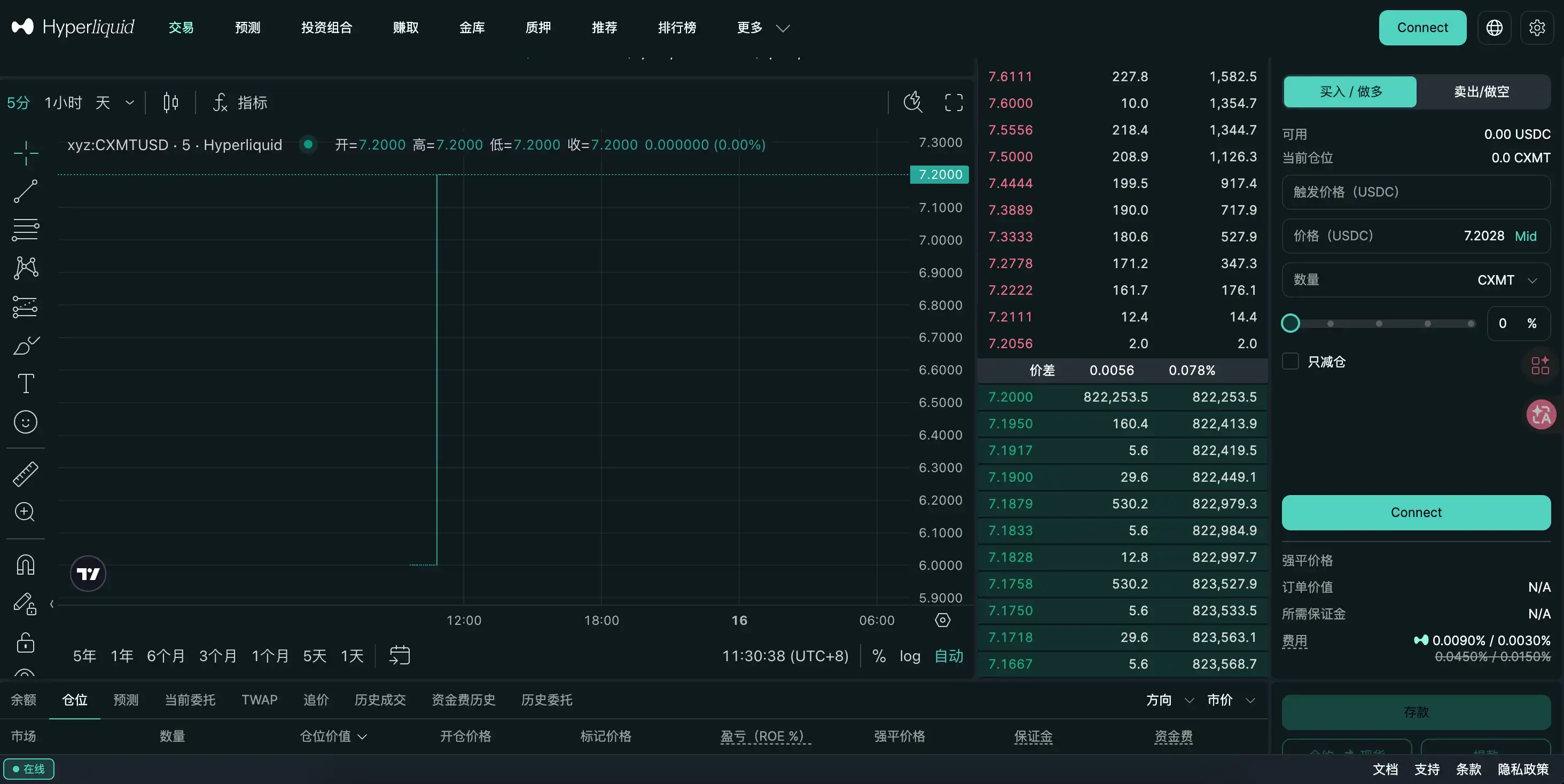
According to a Bloomberg report on July 15, Trade.xyz deployed a Changxin Technology (CXMT) perpetual contract on the Hyperliquid blockchain, with contract code xyz:CXMTUSD. As of writing, the contract's 24-hour trading volume is approximately $1.32 million, open interest is about $2.41 million, and the funding rate is 0.0014%. The price has risen from an initial mark price of around $6 to $7.2, a 20% increase in 24 hours.

This is not Hyperliquid's first attempt at pre-IPO pricing. In May this year, before AI chip company Cerebras went public, the Hyperliquid pre-IPO contract price differed from the Nasdaq opening price by only 1.3%. In June, on SpaceX's IPO day, the on-chain contract saw a single-day trading volume of $1.38 billion. However, targeting a STAR Market-listed company is a first.

$7.2 Equals Approximately 52 Yuan/Share, Implied Market Cap of ~3.5 Trillion Yuan

The contract tracks the per-share price in USDC, using the same logic as the pre-IPO contracts for SpaceX and Cerebras.

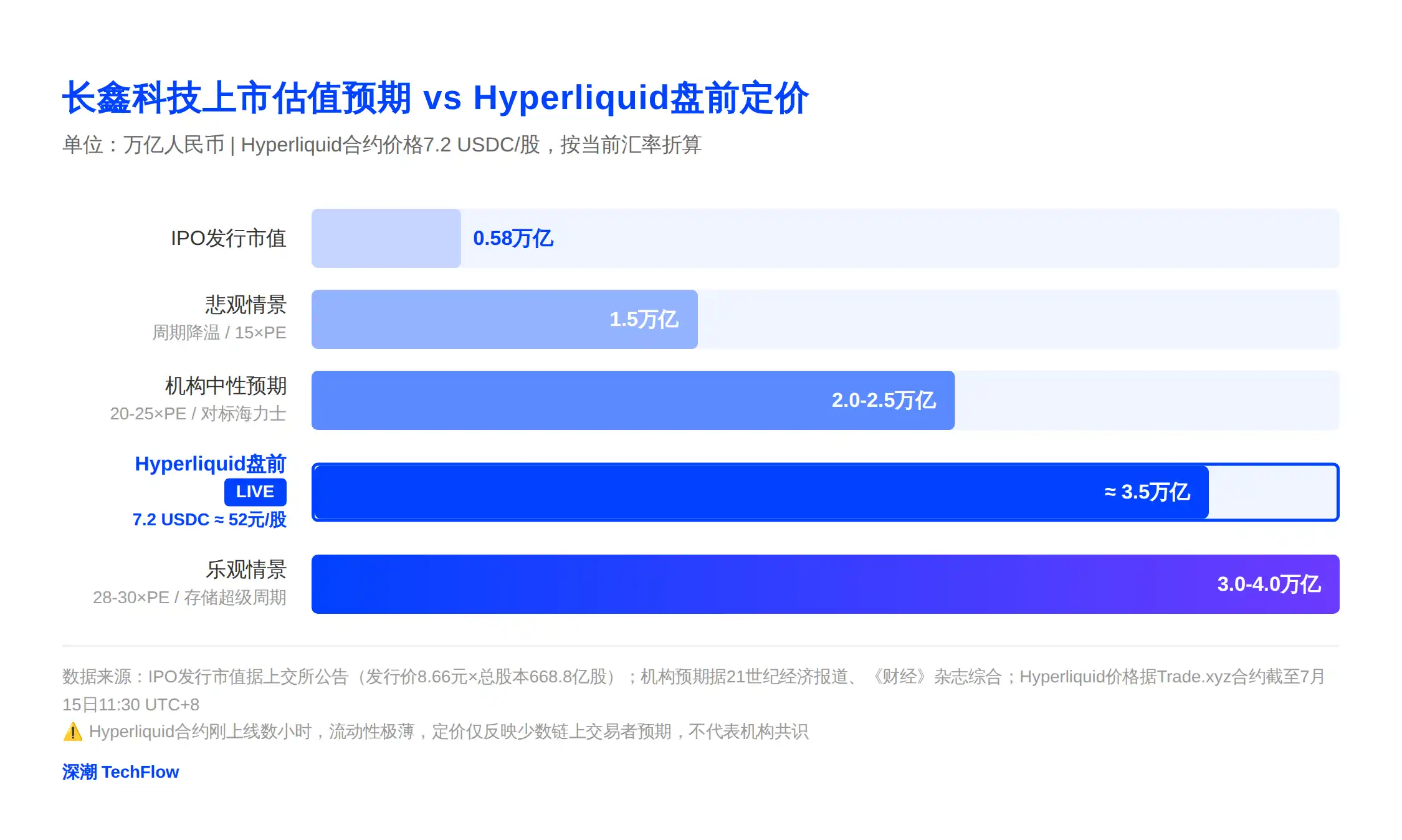
Converted at the current exchange rate, $7.2 is approximately 52 yuan/share. Multiplying by the total post-issuance shares of 66.88 billion, the implied total market capitalization is about 3.5 trillion yuan, roughly 6 times the IPO issuance market cap of 579.2 billion yuan.

This pricing falls within the optimistic range of sell-side institutional expectations. The 21st Century Business Herald quoted investment banking sources saying that Changxin Technology's post-listing valuation is expected to reach 2 to 2.5 trillion yuan; Caijing Magazine, synthesizing calculations from multiple institutions, gave an optimistic scenario of 3 to 4+ trillion yuan. Hyperliquid's pre-market pricing of 3.5 trillion yuan sits between the upper end of the neutral range and the lower end of the optimistic range.

Another interpretation: If these on-chain traders' judgment is accurate, Changxin Technology's stock price may open around 50 yuan on its first trading day, about 6 times the 8.66 yuan issue price. The average first-day gain for STAR Market IPOs in the first half of this year was 489%, so a 6x opening is not unrealistic.

With less than 24 hours since the contract launched, the $1.32 million trading volume and $2.41 million open interest represent preliminary liquidity for the on-chain market, but there's still an order-of-magnitude gap compared to the $1.38 billion single-day trading volume on SpaceX's listing day. This price reflects the directional judgment of early participants, not institutional-grade pricing.
A-Shares Can't Be Sold on Purchase Day, No Short Selling: Perpetual Contracts Naturally Fill the Gap

Why would crypto traders care about a Chinese A-share? The views of some investors on overseas social media platforms might explain. The structural limitations of the A-share market are precisely the opportunity for perpetual contracts.

There are two structural limitations in the A-share market. T+1 settlement means you cannot sell on the same day you buy, and short selling (securities lending) is not available for individual STAR Market stocks. For a stock like Changxin Technology, which may experience massive volatility on its first trading day, A-share holders face an awkward situation: even if they profit from the daily limit-up, they cannot lock in that profit on the same day, fully exposed to the risk of a high-open low-close the next day.

The perpetual contracts on Hyperliquid don't have these restrictions. They trade 24/7, allow both long and short positions, and leverage is adjustable. In theory, investors holding Changxin Technology A-shares could open short positions on Hyperliquid to hedge overnight risks.

However, the absence of an arbitrage path is a real issue. Cerebras and SpaceX listed on Nasdaq, allowing global investors to freely arbitrage between the underlying stock and the contract, leading to rapid price convergence. Changxin Technology is listing on the Shanghai Stock Exchange's STAR Market. The 500,000 yuan asset threshold and QFII quota restrictions prevent the vast majority of overseas retail investors from directly buying the underlying shares.

A price gap may persist long-term between the contract price and the actual A-share trading price, for which investors need to price in an additional premium.

Foreign Capital Can't Buy A-Shares, DeFi Becomes the Entry Point for the "Chinese Storage Substitution" Narrative

Blockchain.News explicitly stated in its report: The CXMT contract provides overseas traders with a channel to bypass the STAR Market's 500,000 yuan threshold.

This demand isn't fabricated. Changxin Technology is the world's fourth-largest DRAM supplier, with a 7.7% global market share in Q1. SemiAnalysis predicts it may surpass Micron to become the world's third-largest by year-end. Apple has begun testing Changxin Technology's DRAM chips for devices in the Chinese market (according to the Financial Times report on July 8). Expected net profit attributable to shareholders for the first half of 2026 is 50 to 57 billion yuan, with a profit margin of about 70%, on par with SK Hynix's 73% and Samsung's 81%.

For a company like this going public, global storage industry investors are paying attention, but most can't buy it. Crypto research firm Citrini has repeatedly recommended Hyperliquid's perpetual contract scenario in paid research reports, while also being bullish on Changxin Technology.

Given foreign capital's inability to directly participate in A-shares, the Hyperliquid contract may become the most convenient channel for them to engage with the "Chinese Storage Substitution" theme.

From a broader perspective, this is the first time DeFi infrastructure is being used to create a parallel pricing market for a STAR Market target. Hyperliquid's HIP-3 framework allows any entity staking 500,000 HYPE tokens (worth approximately $28 million) to deploy a perpetual contract. Trade.xyz, utilizing this mechanism, has successively launched pre-IPO contracts for companies like SpaceX, Cerebras, OpenAI, and Anthropic, generating over $1.46 billion in cumulative trading volume. After TradingView integrated data sources from Hyperliquid and Trade.xyz on July 2, price charts for on-chain perpetual contracts have entered mainstream market terminals.

It's worth noting that Hyperliquid's Policy Center and TradeXYZ recently met with the SEC's Crypto Assets and Cyber Unit to discuss cryptocurrency regulation. Based on the current regulatory trajectory, US regulation is the primary compliance focus for the platform; the Chinese regulatory risk brought by A-share targets is not currently within its consideration.

(Note: Hyperliquid is not available to users in China.)

57.9B in Fundraising, 66B H1 Net Profit: Changxin Technology Itself is the Event of the Year

Returning to the A-share context, even without the Hyperliquid contract, Changxin Technology's IPO itself is already a landmark event in the 2026 Chinese capital market.

The issue price is 8.66 yuan/share. Based on the initial issuance of 6.688 billion shares, it's expected to raise 57.9 billion yuan, nearly double the original plan of 29.5 billion yuan. If the over-allotment option is fully exercised, the fundraising amount will reach 66.6 billion yuan, making it the largest IPO in Asia this year and the largest semiconductor IPO in A-share history. The price-to-earnings (P/E) ratio is 308.92x, far exceeding the industry average of 76.32x. However, the market isn't concerned because the Q1 net profit of 33 billion yuan is rapidly diluting the valuation. The company expects revenue of 110 to 120 billion yuan and net profit attributable to shareholders of 50 to 57 billion yuan for the first half of 2026, representing year-over-year growth exceeding 2244%.

More importantly, timing. The global DRAM market is in a rare super-cycle boom. Samsung, SK Hynix, and Micron are shifting significant capacity to HBM high-bandwidth memory required for AI servers, leading to tight supply of consumer-grade DRAM. In Q1, DRAM contract prices surged 90% to 95% quarter-over-quarter, the largest single-quarter increase in history. Changxin Technology focuses on consumer-grade DDR5 and LPDDR5X products, with a monthly capacity of 200,000 to 300,000 wafers. It is one of the few global manufacturers expanding production of consumer-grade DRAM against the trend, capturing the capacity gap strategically left by the three giants.

On the A-share IPO subscription side, all 71 new IPOs in the first half of this year rose on their debut, with STAR Market IPOs averaging a 489% first-day gain. Retail investors can participate in the online subscription on July 16, subscription code 787825, with an estimated listing date of July 27.

For A-share investors, the July 16 subscription is the main gate. For overseas investors, Hyperliquid's CXMT contract has opened a side door. After the official listing on July 27, whether the contract price can quickly converge to the actual trading price like Cerebras will be a key test to see if this model can be replicated for A-shares. But even if the price doesn't converge, the mere existence of this parallel market itself demonstrates that global capital's interest in the Chinese storage substitution narrative is more than just talk.


Связанные с этим вопросы

QWhat is the key innovation highlighted in the article regarding Hyperliquid's deployment of the CXMT perpetual contract?

AThe key innovation is that it's the first time a pre-listing perpetual contract on-chain has targeted a company (Changxin Technology) conducting an IPO on China's A-share STAR Market, creating a parallel pricing market for overseas investors unable to access it directly.

QAccording to the article, what are the two main structural limitations of China's A-share market that create an opportunity for the CXMT perpetual contract on Hyperliquid?

AThe two main limitations are the T+1 settlement rule (preventing same-day selling of purchased shares) and the inability to short sell stocks on the STAR Market. These create hedging needs that the 24/7, two-way trading on Hyperliquid can address.

QWhat does the current CXMT contract price of 7.2 USDC imply for Changxin Technology's potential post-IPO market capitalization, and how does this compare to institutional expectations?

AThe 7.2 USDC price (~52 RMB/share) implies a total market capitalization of approximately 3.5 trillion RMB. This figure is at the upper end of institutional expectations, which ranged from 2-2.5 trillion RMB to an optimistic 3-4 trillion RMB or more.

QHow does the article suggest the CXMT perpetual contract serves overseas investors interested in the 'China storage substitution' narrative?

AThe article suggests the contract provides the most direct and accessible entry point for overseas investors to gain exposure to the 'China storage substitution' narrative, as they are largely unable to directly invest in Changxin Technology's A-shares due to the STAR Market's 500,000 RMB asset threshold and QFII quota restrictions.

QWhat is the significance of the convergence (or lack thereof) between the CXMT contract price on Hyperliquid and the actual trading price on the STAR Market after July 27th, according to the article?

AThe convergence (or lack thereof) will be a key test for whether this model of on-chain pre-listing contracts can be successfully replicated for A-share stocks. Successful convergence would validate the price discovery mechanism, but even without convergence, the existence of this parallel market demonstrates significant global capital interest in the narrative.

Похожее

После трёх кварталов падения: получится ли у крипторынка стабилизироваться в третьем квартале?

Криптовалютный рынок пережил худший квартал с 2022 года, общая капитализация упала на 12,6% до $2,1 трлн, а дневные объемы торгов снизились на 20,9%. Впервые за три года сократилась и капитализация стейблкоинов. Основные факторы спада — отток средств из биткоин-ETF, распродажа биткоинов корпоративным казначейством Strategy и ужесточение монетарной политики ФРС. Второй квартал завершился чистым оттоком $46,7 млрд из ETF, при этом в июне отток достиг рекордных $45 млрд. Ключевым событием третьего квартала станет заседание ФРС 28–29 июля. Мягкий сигнал может поддержать биткоин в диапазоне $68 000–84 000 и вернуть приток в ETF, тогда как жесткая риторика способна сместить торговый диапазон к $50 000–56 000. Законодательная неопределенность также давит на рынок: прогресс по закону CLARITY Act, определяющему регуляторные границы, замедлился, и вероятность его принятия в 2026 году упала до 40–45%. Несмотря на общий спад, два сегмента показали рост: объемы на рынках предсказаний выросли на 48,7%, а торговля токенизированными коллекционными предметами увеличилась на 143%. Сектор RWA продолжает стабильно развиваться, достигнув $28,1 млрд. Рынок, вероятно, миновал фазу острой распродажи, но для устойчивого восстановления необходимы ясность от ФРС и регуляторный прогресс.

marsbitВчера 08:38

После трёх кварталов падения: получится ли у крипторынка стабилизироваться в третьем квартале?

marsbitВчера 08:38

BIT Торговые часы: BTC по-прежнему под давлением 200 EMA на недельном графике, после отскока возможен перезапуск нисходящего движения; секторы хранения данных и полупроводников, выросшие ночью, начали падение в вечерней сессии

**Краткий обзор рынка: BTC под давлением, коррекция на рынке акций, внимание к данным и событиям** Рынок криптовалют демонстрирует осторожное восстановление. Bitcoin торгуется около $66 000, сталкиваясь со значительным сопротивлением в районе $68 000, где сосредоточены объемные "застрявшие" позиции. Ключевые технические уровни — 200-недельная скользящая средняя (~$63 333) и 200-недельная EMA (~$68 328). Аналитики отмечают низкую ликвидность, характерную для летнего периода. На фондовом рынке после сильного роста во вторник наблюдается коррекция. Фьючерсы на основные индексы США снижаются. Акции полупроводниковой и памяти, которые резко выросли накануне, падают в ночных торгах. Исключением стал SMCI, который вырос более чем на 15% после оптимистичного прогноза. На общий настрой негативно влияют рост цен на нефть (более $91 за баррель Brent) и доходности государственных облигаций США (10-летние — около 4,64%), что возрождает инфляционные опасения. Азиатские рынки показали нестабильную динамику. Индекс KOSPI в Корее вырос на 0,74%, а японский Nikkei 225 снизился на 0,18%. Основной риск для региона — ослабление японской иены до минимумов с 1986 года, что повышает вероятность вмешательства властей. **Ключевые события для наблюдения:** * **24 июля:** Финансовые отчеты Alphabet (Google), Tesla, IBM. Событие AMD, посвященное ИИ. * **25 июля:** Решение по процентной ставке ЕЦБ и пресс-конференция Кристин Лагард. Финансовые отчеты Intel, American Airlines, Honeywell и других. Данные по числу первичных заявок на пособие по безработице в США.

marsbitВчера 08:30

BIT Торговые часы: BTC по-прежнему под давлением 200 EMA на недельном графике, после отскока возможен перезапуск нисходящего движения; секторы хранения данных и полупроводников, выросшие ночью, начали падение в вечерней сессии

marsbitВчера 08:30

Бывший глава CFTC и президент Circle Тарберт: призывает к долгосрочной стратегии, но сам выводит $30 млн

Бывший председатель CFTC и президент Circle Хит Тарберт, публично пропагандируя долгосрочное видение компании для инвесторов на фоне падения акций на 70% с пиковых значений, сам активно распродавал свои акции CRCL. С момента IPO Circle он по плану 10b5-1 продал более 360 тысяч акций, выручив около 30 миллионов долларов, и при этом ни разу не докупал акции на открытом рынке. Эта разница между его публичными заявлениями и личными действиями вызвала критику. Карьера Тарберта демонстрирует классическое использование «вращающейся двери» между регулирующими органами и частным сектором. Уйдя с поста председателя CFTC в 2021 году, через 27 дней он занял должность главного юрисконсульта в маркет-мейкере Citadel Securities, который в тот момент находился под пристальным вниманием из-за скандала с акциями GameStop. Позже, уже работая в Citadel, Тарберт выступал за расширение полномочий CFTC на крипторынок, в то время как его работодатель планировал выход на этот рынок. В 2023 году Тарберт присоединился к Circle, где его опыт и связи сыграли ключевую роль в успешном проведении IPO компании в 2025 году. Однако его последующие массовые продажи акций, совпавшие с падением котировок и его же призывами к долгосрочным инвестициям, ставят под сомнение искренность его уверенности в будущем компании. Критики видят в его карьере образец превращения регуляторного опыта и политических связей в личную выгоду, в то время как риски несут обычные инвесторы, верящие его нарративам.

marsbitВчера 08:07

Бывший глава CFTC и президент Circle Тарберт: призывает к долгосрочной стратегии, но сам выводит $30 млн

marsbitВчера 08:07

Gate Research: Взлет «уолл-стритизации» криптофинансовых продуктов — это конкуренция или интеграция?

**Аналитический обзор Gate Research Institute: Волна "уолл-стритизации" криптофинансовых продуктов — конкуренция или интеграция?** Создание биткоина в 2009 году было ответом на финансовый кризис и стремлением построить децентрализованную систему без доверенных посредников. Однако к 2026 году значительная часть биткоинов (около 7,14%) хранится через ETF таких гигантов, как BlackRock. Это символизирует глубокую интеграцию традиционных финансов (TradFi) и крипторынка. С появлением биткоин-ETF, фьючерсов, RWA (токенизированных реальных активов) и государственных облигаций на блокчейне, традиционные институты получают всё больше влияния на выпуск, ценообразование, кастодию и дистрибуцию криптоактивов. Однако это не одностороннее поглощение, а взаимодополняющая конвергенция. Криптосфера приносит TradFi глобальную 24/7 ликвидность и программируемость, а TradFi предоставляет криптосфере регулируемые каналы, институциональное доверие и массовый доступ. Яркий пример — две противоположные, но ведущие к одной цели траектории: * **Путь А:** Криптобиржи, такие как Gate, начинают с токенизированных акций и CFD, а затем напрямую подключаются к инфраструктуре традиционных брокеров, предлагая реальную торговлю акциями США, Гонконга и Кореи за стейблкоины. * **Путь Б:** Традиционные брокеры, такие как Robinhood, интегрируют криптоактивы, а затем создают собственные Layer 2 для токенизации своих акций, стремясь к круглосуточной торговле. Обе стратегии нацелены на создание **универсального финансового аккаунта будущего** — единой точки доступа к акциям, криптовалютам, ETF, токенизированным облигациям и другим активам. Ключевой конкурентной борьбой становится не между CEX и брокерами, а между этими "супераккаунтами". Параллельно, слой RWA и токенизированных гособлигаций растёт даже на медвежьем рынке, становясь "прослойкой" для объединения капиталов. Хотя этот рынок (около $150 млрд токенизированных казначейских облигаций) ещё мал по сравнению с традиционным ($30 трлн), он демонстрирует устойчивый структурный тренд, привлекающий крупнейшие финансовые институты (JPMorgan, DTCC и др.). **Вывод:** "Уолл-стритизация" — это не поражение идеалов децентрализации, а формирование новой гибридной модели. Децентрализованные протоколы продолжают работать на базовом уровне, в то время как на уровне приложений и пользовательского опыта формируется более эффективный, глобальный и свободный объединённый рынок капитала, где активы TradFi и DeFi торгуются бок о бок в одном интерфейсе. Уолл-стрит не завоевала криптосферу, а криптосфера не обошла Уолл-стрит — они совместно строят новые финансовые рельсы.

marsbitВчера 08:04

Gate Research: Взлет «уолл-стритизации» криптофинансовых продуктов — это конкуренция или интеграция?

marsbitВчера 08:04

S&P Dow Jones и Pantera выпускают криптоиндекс, биткоин оставлен за бортом из-за «отсутствия прибыли»

Стандард энд Пурс (S&P Dow Jones Indices) совместно с Pantera Capital запускает индекс S&P Pantera Digital Asset Index. Новый индекс включает 18 токенов, но исключает биткоин, XRP и мем-токены. Критерием отбора послужила «финансовая жизнеспособность», по аналогии с S&P 500: протокол должен демонстрировать положительный доход в течение нескольких кварталов и распределять стоимость среди держателей токенов. Это первое применение фундаментального подхода к оценке криптоактивов со стороны крупнейшего в мире провайдера индексов. В первую пятерку активов вошли Ethereum (ETH), BNB, Solana (SOL), TRON (TRX) и Hyperliquid (HYPE). Pantera отмечает, что совокупный годовой доход всех протоколов индекса превышает $30 млрд. Биткоин был исключен по трем причинам: он рассматривается как монетарный актив, доступный через отдельные ETF; он не генерирует доход протокола; а смешивание его в индексе с доходными активами затрудняет фундаментальный анализ для институциональных инвесторов. Пока индекс является эталонным, но Pantera ведет переговоры о создании на его основе ETF и других инвестиционных продуктов. Компания также отмечает значительный разрыв на рынке: многие институциональные инвесторы готовы к аллокации в криптоактивы, но им не хватает структурированных продуктов, фокусирующихся на активах с реальной экономической деятельностью.

marsbitВчера 08:02

S&P Dow Jones и Pantera выпускают криптоиндекс, биткоин оставлен за бортом из-за «отсутствия прибыли»

marsbitВчера 08:02

Торговля

Спот
活动图片




