When the World Cup Collides with Agents: From Web2 to Web3, How Are Wallets Evolving into Agentic Wallets?

marsbitОпубликовано 2026-06-19Обновлено 2026-06-19

Введение

World Cup as a Catalyst for Agentic Wallets: From Web2 to Web3 This article explores how the World Cup provides a real-world scenario for observing the evolution of digital wallets from simple asset managers towards "Agentic Wallets"—intelligent, AI-powered interfaces. Using the example of prediction markets like Polymarket, it illustrates how AI Agents can lower the barrier to Web3 interaction. Instead of navigating complex DApps, users can express intent in natural language (e.g., "I think Portugal will win") within platforms like Discord or web pages. The Agent then interprets this intent, finds the relevant market, and seamlessly guides the user through the on-chain transaction via their wallet. The core shift is from wallets as mere "function menus" for signing transactions to "intent interpreters" that understand user goals. The article highlights parallel developments in traditional finance, such as Mastercard's "Agent Pay" and WeChat Pay's AI tests, which focus on granting AI controlled, authorized, and auditable payment capabilities. This underscores a broader trend of AI entering the financial layer. However, the article emphasizes that the primary challenge for Agentic Wallets in Web3 is not automation but establishing clear security boundaries. Unlike traditional systems with chargebacks, on-chain transactions are often irreversible. Therefore, future wallets must ensure users retain ultimate control and comprehension. They need to transparently communicate an ...

The World Cup is an excellent scenario for observing changes in wallets.

Daily fan discussions about team qualifications, changes in championship odds, etc., become tradable, priced behaviors in prediction markets like Polymarket. Therefore, World Cup prediction events integrated by mainstream Web3 wallets, viewed over a longer timeline, can indeed be considered a lightweight entry point and starting point for users to engage with on-chain interactions (Extended reading: The World Cup Frenzy, Prediction Markets Take the Stage: How Are Polymarkets Tearing Open a Portal for Mass Adoption?).

Simultaneously, another earlier but more imaginative change is worth noting: when AI Agents begin to enter the wallet scenario, the way users interact with the on-chain world is also poised to change.

For instance, in this World Cup-related exploration, imToken started experimenting with integrating AI Agents into actual use cases. Features like the web-based proxy and the one in Discord can help users more naturally complete betting transactions based on specific prediction needs, allowing users to no longer operate solely within the wallet app but to easily participate in prediction markets in scenarios like Discord or web pages, seamlessly guided back on-chain by the Agent.

This could very well be an early form of the Agentic Wallet—the future Web3 wallet might not be limited to a wallet application but will likely be an 'AI wallet form' that is as ubiquitous as possible.
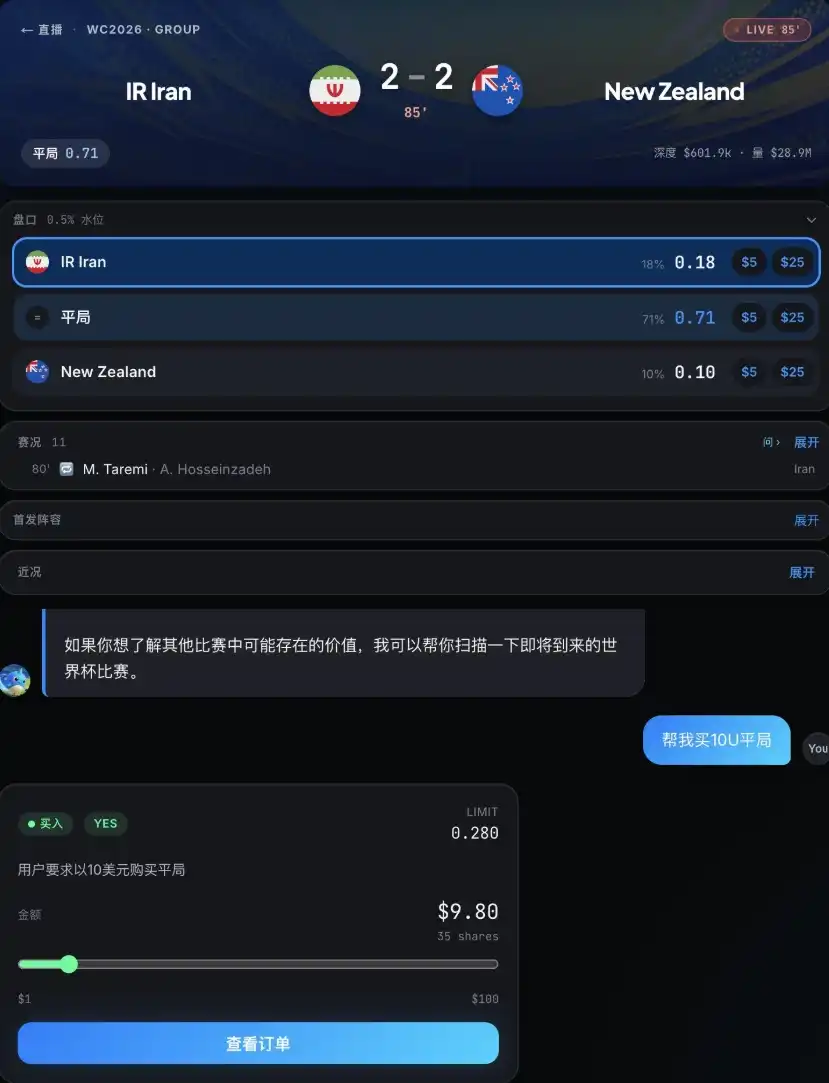
I. The World Cup Experiment: When Agents Start Understanding 'Intent'

Returning to our perennial question, over the past decade, the core problem wallets solved was clear: where assets are stored, who controls the private key, and who signs transactions.

For example, when users open imToken, it's mainly to check balances, perform transfers/interactions, and manage multi-chain assets. Consequently, wallets at this stage resemble asset and signature gateways. It's sufficient for users to know what they plan to do and then use the wallet to complete the final step.

But the change in the Agentic era lies in the fact that users might not initially know what they need to click.

In a World Cup scenario, an average user might not first think, 'I need to open Polymarket, find a specific market, evaluate the odds, and complete the transaction.' They are more likely to say, 'What are the highlights of tonight's match?', 'I'm confident Portugal will qualify; are there relevant markets?', 'Is this betting line already too low?', or 'If I just want to participate with a small amount, what's the process?'

Previously, these questions might have been scattered across WeChat groups, social media discussions, or search engines, requiring users to piece information together and execute step by step. However, with Agent intervention, the interaction method has changed significantly: users only need to express a general intent, and the Agent will proactively break it down into a path, with the wallet then responsible for turning that path into a series of on-chain actions.

So, this is definitely not as simple as adding a chat box to the wallet.

The real change is that wallets are starting to evolve from 'function menus' into 'intent interpreters.' Previously, wallets primarily required users to decide whether to transfer, swap, stake, or connect to a DApp? Future wallets might be more straightforward, requiring users to simply tell them in natural language what they want to accomplish.

This is why a mass event like the World Cup is well-suited as an entry point for Agentic Wallets. It naturally provides context, users naturally have the desire to express themselves, and they naturally need to make judgments. The Agent doesn't need to start by managing complex asset portfolios for users, especially those involving intricate asset management with higher risks. It can first help users find interaction paths within a specific scenario before handing final control back to the wallet and the user.

The web-based and Discord-based proxies capable of on-chain interaction mentioned at the beginning of the article, which imToken piloted, are typical examples. They bring wallet capabilities to a lighter-weight entry point, allowing users to find interaction paths through an Agent on an event page, within a World Cup scenario, without necessarily first opening the app or entering the traditional DApp browser.

This indicates that the boundaries of wallets are expanding outward.

Previously, wallet entry points were relatively clear: users opened the app, entered the asset page, clicked functions, and connected to DApps. Future wallet entry points might be scattered across more places, such as web pages, Discord, Telegram, AI chat boxes, event pages, developer tools, or even a lightweight wallet interface generated by the user.

From this perspective, World Cup predictions are not the main point; the key is that they allow wallets, for the first time, to more naturally position themselves ahead of 'user intent.'

II. From Agent Pay: AI is Entering the Payment Layer

If viewed only within the Crypto sphere, Agentic Wallets might still be easily understood as a narrative concept—AI helping users watch markets, find opportunities, and make trades, sounding reminiscent of the last wave of AI Agent hype.

But Mastercard's launch of Agent Pay for Machines on June 10th suddenly made this matter extend beyond Web3.

Mastercard's definition of Agent Pay is clear: enabling trusted AI Agents to participate in payments with user authorization, including how Agents are identified, authorized, verified within the payment network, and how merchants, issuers, and users know a transaction was assisted by an Agent.
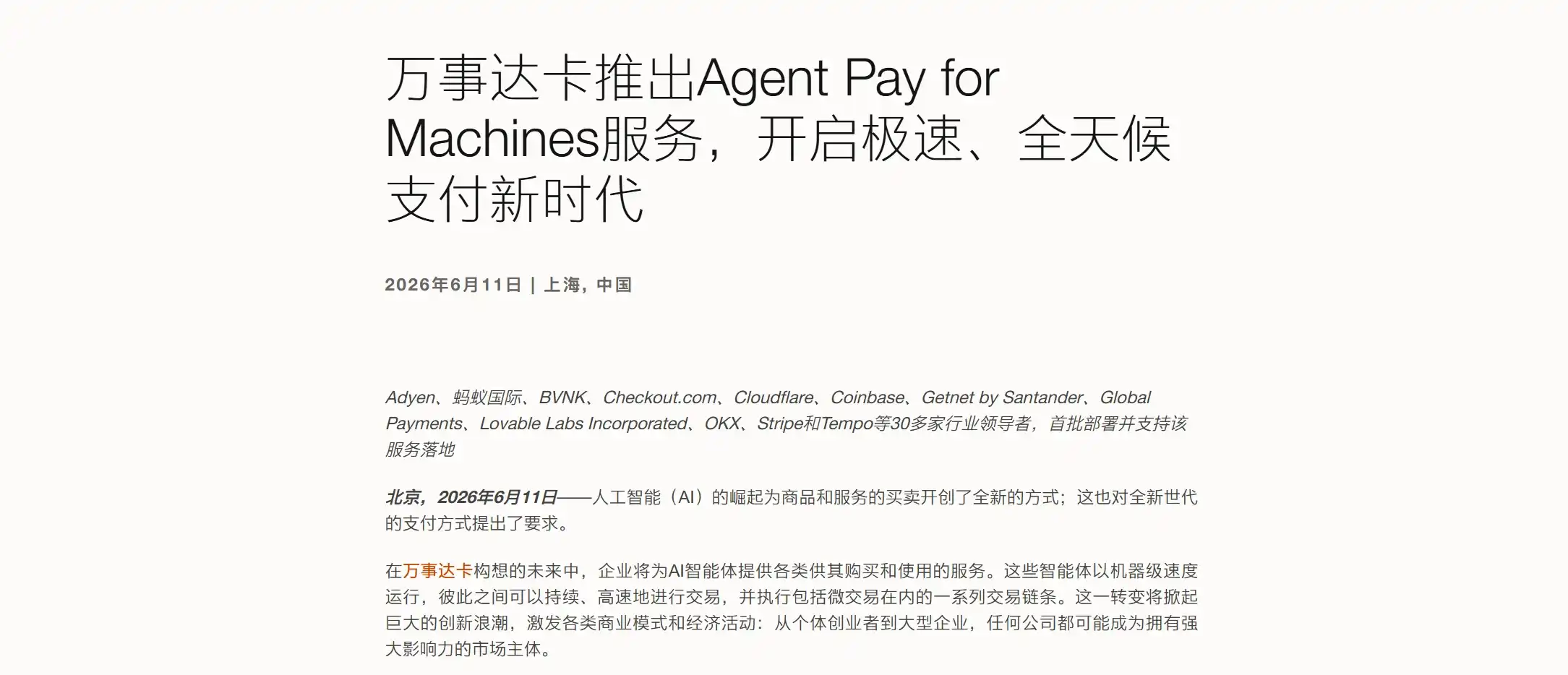
This is highly similar to the problems faced by Web3 wallets.

When AI only helps you write copy, the cost of errors is usually manageable. But once AI starts participating in asset interactions, the problem shifts: does it actually have permission? Is its understanding of user intent accurate? Are the services it calls trustworthy? Does the transaction it initiates exceed boundaries? If the outcome doesn't match user expectations, who provides recourse?

Mastercard's answer is to redesign the 'trusted Agent's' identity, tokens, authorization, risk control, and dispute handling within the payment network.

This signal is crucial. If the Agentic concept in the Web3 circle still carries a bit of geeky imagination, the fact that traditional financial giants are starting to design payment infrastructure for Agentic Commerce indicates this has entered a more realistic business context.

Looking closer, domestic payment giants are also moving in this direction. WeChat Pay is testing AI payment features in collaboration with Tencent's intelligent agent product WorkBuddy, such as launching an 'AI Exclusive Card' within the WeChat wallet. Based on disclosed information, the core of such products is not to let AI spend money arbitrarily but to set boundaries for intelligent agent payments through methods like recharge limits, payment authorization scopes, and password verification confirmations.

This logic aligns with Mastercard's Agent Pay: AI can participate in payments, but it must be identified, authorized, restricted, and audited.

Web3 wallets face the on-chain version of the same problem. The difference is that traditional payment systems emphasize the network, merchants, issuers, and compliance responsibilities; on-chain wallets emphasize private keys, signatures, authorizations, contract calls, and user self-custody.

Precisely because of this, Agentic Wallets cannot simply copy the traditional payment path. After all, in traditional payments, users can rely on banks, card networks, merchants, dispute resolution, and risk control systems. But in the on-chain world, once a transaction is on-chain, there's often no undo button.

The higher the efficiency brought by AI Agents, the more critical the last line of security defense borne by the wallet becomes. Therefore, future wallets cannot just let Agents 'do things'; they must ensure Agents 'can only operate within user-allowed boundaries.'

This is also why Web3 might actually be more suitable for discussing Agentic Wallets.

III. The Agentic Era: How Are Wallets Redefining On-Chain Interaction?

When many discuss AI Agents, they easily drift towards an extreme imagination: in the future, AI will automatically trade for me, manage my finances, find airdrops, and arbitrage.

This direction is certainly attractive, but for wallets, the real difficulty is not 'automation' but 'a sense of boundaries.'

Because a wallet is not an ordinary application. In ordinary apps, if AI recommends the wrong song, writes the wrong passage, or clicks the wrong page, it's at most an experience issue. But in a wallet, if AI misunderstands an instruction, calls the wrong contract, or grants excessive permissions, it could become a real asset risk (Extended reading: Sign Isn't Just Signing: When an AI Agent Signs for You, Who Holds the Control?).

Therefore, the primary question for Agentic Wallets is not 'how much can AI do for the user?' but 'how does the user know what AI is doing?'

This is also why imToken has consistently emphasized control over the past few years. From self-custody wallets to multi-chain asset management, to today's AI co-creation and Agent exploration, the truly continuous thread isn't about having more and more features, but about users always being able to understand, confirm, and control their digital world.

In the Agentic era, this thread becomes more concrete.

Wallets need to let users understand who this Agent is, what capabilities it can call, how long the authorization lasts, whether it can operate across DApps, when it requires my reconfirmation, whether I can pause or revoke it with one click... These questions might sound tedious, but they are the foundation upon which Agentic Wallets can truly be established.

Because the power of an AI Agent lies precisely in its ability to simplify complex processes. The user says one thing, and the Agent can break it down into a dozen-step execution path. This is good for experience but also a challenge for security. The longer the path and the more intermediate steps, the more the wallet needs to bring key nodes back into the user's view.

Good wallet interactions in the future might not involve showing users more technical details, but translating complex transactions into language users can understand:

  • You are authorizing a specific Agent to call a specific contract within the next 24 hours;
  • This operation can use at most a certain amount of USDC;
  • It can only access World Cup-related prediction markets, not touch your other assets;
  • Each transaction exceeding a certain amount requires reconfirmation;
  • Authorization automatically expires after a set period;
  • You can pause this Agent anytime within the wallet;

This might sound like a distant future, but it's already starting from some small scenarios. The World Cup prediction event is one event-based entry point, and imToken's pilot web-based Agent and Discord Agent are community-based entry points.

Especially at times like these, wallets cannot retreat to the background.

Трендовые криптовалюты

Связанные с этим вопросы

QWhat is the main change in the way users interact with the blockchain when AI Agents enter the wallet scene, as discussed in the article?

AThe main change is the shift from users knowing exactly which functions to execute (like transfer, swap, or staking) to users expressing their general intent in natural language. The AI Agent then interprets this intent, breaks it down into actionable steps, and guides the user to complete the corresponding on-chain actions seamlessly.

QAccording to the article, why is the World Cup a suitable entry point for observing the development of Agentic Wallets?

AThe World Cup is suitable because it provides a natural context where users have a strong desire to express opinions, make judgments, and participate in prediction markets. This setting allows AI Agents to help users find interaction paths within a specific, low-risk scenario before tackling more complex asset management, making the transition to Agentic Wallets more user-friendly and gradual.

QWhat key challenge must Agentic Wallets address, as highlighted by the comparison with Mastercard's Agent Pay and traditional payment systems?

AThe key challenge is establishing clear boundaries and control for AI Agents. While AI can enhance efficiency, it must be properly identified, authorized, restricted, and audited, especially when handling financial transactions. Unlike traditional payment systems with built-in safeguards, on-chain transactions are often irreversible, making it crucial for wallets to ensure users understand, confirm, and maintain control over what the Agent is doing.

QWhat is the core principle that should remain consistent for wallets from self-custody to the Agentic era, as emphasized in the article?

AThe core consistent principle is that users must always be able to understand, confirm, and control their digital world. In the Agentic era, this translates to features that let users know who the Agent is, what permissions it has, the duration of its authorization, when reconfirmation is needed, and the ability to pause or revoke its access at any time.

QHow is the physical or conceptual 'entrance' of the wallet changing with the advent of Agentic Wallets?

AThe wallet's 'entrance' is expanding and becoming more ubiquitous. Instead of being confined to a dedicated wallet application, wallet capabilities are beginning to appear in various interfaces like web pages, Discord, Telegram, AI chatboxes, activity pages, and developer tools. This allows users to initiate and complete on-chain interactions from more diverse and lightweight starting points.

Похожее

Андре Кронье покидает совет директоров Sonic Labs на фоне падения токена

Известный разработчик DeFi Андре Кронье покинул совет директоров Sonic Labs (бывшей Fantom Foundation), вместе с ним ушли ещё два директора. Эти изменения в руководстве произошли на фоне резкого падения курса нативного токена проекта S/FTM, который торгуется примерно на 97% ниже своего исторического максимума. Отставки поднимают вопросы о корпоративном управлении в Sonic Labs, который занимается высокоскоростным масштабированием виртуальной машины Ethereum (EVM). Несмотря на кадровые перестановки, разработчики заявляют, что технические планы и сроки запуска протокола остаются без изменений. Новый генеральный директор сосредоточен на реструктуризации операционной деятельности. Для сообщества DeFi эта ситуация подчёркивает характерную волатильность и проблемы управления в быстроразвивающихся блокчейн-экосистемах. Дальнейшая стабильность и направление развития проекта будут зависеть от прозрачности и чёткой коммуникации со стороны нового руководства.

bitcoinist3 ч. назад

Андре Кронье покидает совет директоров Sonic Labs на фоне падения токена

bitcoinist3 ч. назад

Kraken интегрирует торговлю через солана-децентрализованную биржу прямо в основное приложение

Криптобиржа Kraken интегрировала в своё основное приложение возможность торговли через децентрализованные биржи (DEX) в сети Solana. Это позволяет клиентам в США и более чем 100 странах торговать более чем 2500 токенами на основе Solana, не покидая приложение Kraken. Пользователям больше не нужны отдельные кошельки или мнемонические фразы, что упрощает доступ к ликвидности Solana DEX. Ключевым преимуществом является прямой доступ к ранним активам и токенам новых проектов, которые ещё не представлены на традиционных централизованных биржах. Интеграция объединяет удобство и безопасность централизованной платформы с широким выбором токенов и децентрализованной ликвидностью. Объявление было сделано 20 июня 2026 года.

bitcoinist4 ч. назад

Kraken интегрирует торговлю через солана-децентрализованную биржу прямо в основное приложение

bitcoinist4 ч. назад

Медведи Эфириума сохраняют контроль, так как ETH отскакивает от сопротивления линии тренда

Последний отскок Ethereum не убедил аналитиков в завершении нисходящего тренда. По мнению TheSignalyst, ETH сохраняет медвежий настрой, оставаясь ниже нисходящей красной линии тренда и формируя серию более низких максимумов и минимумов. На графике видно, что цена отклонилась от зоны сопротивления, объединяющей линию тренда и горизонтальный структурный уровень, что усиливает давление продавцов. Ключевая зона поддержки находится между $1 350 и $1 500. Контролируемый откат в этот диапазон может вызвать реакцию, но уверенный прорыв ниже ослабит структуру ETH. В настоящее время ETH находится между значимой поддержкой и линией сопротивления, ограничивающей восстановление, что указывает на техническое сжатие рынка. Борьба Ethereum с сопротивлением также важна для всего альткойн-рынка, поскольку слабость ETH часто снижает аппетит к риску в DeFi и малокапитализированных активах. Для подтверждения разворота быкам необходим четкий прорыв выше сопротивления.

bitcoinist5 ч. назад

Медведи Эфириума сохраняют контроль, так как ETH отскакивает от сопротивления линии тренда

bitcoinist5 ч. назад

TechFlow Разведслужба: Шансы на IPO Anthropic превышают 80%, Иран вновь перекрывает Ормузский пролив, вызывая волатильность цен на нефть

Технологические новости: ожидается IPO Anthropic в 2026 году, рынок обсуждает сосуществование её заявленной ценности в области безопасности ИИ с потенциальной триллионной оценкой. Набирают популярность виртуальные инфлюенсеры, созданные ИИ. Маск заявляет о необходимости астрономических инвестиций в антиматерию для межзвёздных путешествий. Крипто/Web3: Иран объявил о закрытии Ормузского пролива, вызвав волатильность на нефтяном рынке, однако данные о движении судов показывают неоднозначную картину. Одновременно Иран возобновил погрузку нефти на острове Харг, что может увеличить предложение. На рынке чипов: Goldman Sachs предупреждает о возможном приближении к пределу кредитования масштабных расходов на ИИ-инфраструктуру. Корпоративные новости: Cloudflare представил функцию временных аккаунтов для ИИ-агентов. Google сообщает, что более 50% его трафика теперь использует IPv6. Hyundai Motor Group планирует полный выкуп Boston Dynamics. Рынок акций: частные инвесторы активно вкладываются в акции SpaceX. В Европе зафиксирован первый с 2008 года дефолт по акциям CLO. Макроэкономика: Украина атаковала нефтяные объекты в Крыму и Краснодарском крае. Nomura предупреждает о возможном резком ужесточении политики ФРС. Общая тенденция: глобальная ликвидность сокращается на фоне роста предельных издержек в энергетике, кредитовании и технологиях, в то время как капитал продолжает искать новые масштабные возможности для роста.

marsbit6 ч. назад

TechFlow Разведслужба: Шансы на IPO Anthropic превышают 80%, Иран вновь перекрывает Ормузский пролив, вызывая волатильность цен на нефть

marsbit6 ч. назад

Соотношение ETH/BTC упало до уровней начала 2023 года на фоне дебатов о стоимости Ethereum

Курс ETH/BTC упал до уровня начала 2023 года, достигнув отметки 0.027. По сравнению с пиком 2021 года в 0.088 это означает, что Ethereum сейчас выглядит исторически дешевым по отношению к Bitcoin. Аналитик Woetoe задается вопросом, является ли это возможностью для контрарианских инвестиций или признаком структурного снижения. Одновременно с этим график ETH/USDT указывает на риск коррекции. По данным SwallowAcademy, после агрессивного недельного открытия цена может откатиться, при этом была нарушена структура рынка. План предполагает возможную продажу при повторном тестировании зоны $1723 с целью коррекции до $1660. Таким образом, сложилась противоречивая ситуация: Ethereum кажется недооцененным относительно Bitcoin, но при этом испытывает давление на долларовой паре. Для быков ETH первоочередной задачей является не обсуждение оценки, а восстановление технической силы и возобновление роста относительно BTC.

bitcoinist6 ч. назад

Соотношение ETH/BTC упало до уровней начала 2023 года на фоне дебатов о стоимости Ethereum

bitcoinist6 ч. назад

Торговля

Спот
Фьючерсы

Популярные статьи

Как купить F

Добро пожаловать на HTX.com! Мы сделали приобретение Synfutures (F) простым и удобным. Следуйте нашему пошаговому руководству и отправляйтесь в свое крипто-путешествие.Шаг 1: Создайте аккаунт на HTXИспользуйте свой адрес электронной почты или номер телефона, чтобы зарегистрироваться и бесплатно создать аккаунт на HTX. Пройдите удобную регистрацию и откройте для себя весь функционал.Создать аккаунтШаг 2: Перейдите в Купить криптовалюту и выберите свой способ оплатыКредитная/Дебетовая Карта: Используйте свою карту Visa или Mastercard для мгновенной покупки Synfutures (F).Баланс: Используйте средства с баланса вашего аккаунта HTX для простой торговли.Третьи Лица: Мы добавили популярные способы оплаты, такие как Google Pay и Apple Pay, для повышения удобства.P2P: Торгуйте напрямую с другими пользователями на HTX.Внебиржевая Торговля (OTC): Мы предлагаем индивидуальные услуги и конкурентоспособные обменные курсы для трейдеров.Шаг 3: Хранение Synfutures (F)После приобретения вами Synfutures (F) храните их в своем аккаунте на HTX. В качестве альтернативы вы можете отправить их куда-либо с помощью перевода в блокчейне или использовать для торговли с другими криптовалютами.Шаг 4: Торговля Synfutures (F)С легкостью торгуйте Synfutures (F) на спотовом рынке HTX. Просто зайдите в свой аккаунт, выберите торговую пару, совершайте сделки и следите за ними в режиме реального времени. Мы предлагаем удобный интерфейс как для начинающих, так и для опытных трейдеров.

541 просмотров всегоОпубликовано 2024.12.21Обновлено 2026.06.02

Как купить F

Обсуждения

Добро пожаловать в Сообщество HTX. Здесь вы сможете быть в курсе последних новостей о развитии платформы и получить доступ к профессиональной аналитической информации о рынке. Мнения пользователей о цене на F (F) представлены ниже.

活动图片