Will UNI Reach $100 in Four Years? Can Standard Chartered's Prediction Come True?

marsbitОпубликовано 2026-06-17Обновлено 2026-06-17

Введение

TL;DR: Standard Chartered Bank predicts UNI token will reach $100 by 2030, based on the growth of tokenized assets fueling demand for open DeFi liquidity and Uniswap's potential to capture fees from that trading. However, institutional tokenized products like BlackRock's BUIDL fund show that strict access controls and permissioned systems remain major barriers. Standard Chartered's $100 price target for Uniswap's (UNI) governance token by 2030 projects massive growth from current levels. The bank's thesis hinges on tokenized real-world assets (RWA) reaching trillions in value and a significant portion flowing into open, decentralized markets for trading and liquidity, rather than remaining in closed, permissioned systems. Uniswap's position as a leading decentralized exchange (DEX) infrastructure could allow it to capture a major share of this future trading activity. A key challenge is whether tokenized assets like bonds, funds, and stocks will trade openly on DEXs or be restricted to controlled, institutional platforms. The case of BlackRock's BUIDL fund exemplifies this tension: while it uses Uniswap's technology for settlements, trading is strictly limited to pre-approved, whitelisted institutional participants. This hybrid model provides DeFi efficiency but maintains traditional access barriers. For UNI to achieve such a high valuation, Uniswap must not only see increased trading volume from tokenized assets but also implement effective value-capture mechanisms for to...

Original Author: Liam Akiba Wright

Original Compilation: Luffy, Foresight News

TL;DR:

  • According to reports, Standard Chartered Bank has released a research report on Uniswap, setting a $100 price target for the UNI token by 2030.
  • Standard Chartered's core logic is that tokenized assets will drive demand for open DeFi liquidity, and Uniswap is expected to capture substantial trading volume and earn fees.
  • However, most institutional-grade tokenized products are permissioned. Products like BlackRock's BUIDL demonstrate that access barriers still exist within the DeFi space.

Standard Chartered Bank has set a year-end 2030 price target of $100 for the UNI token. This prediction implies that the price of this leading decentralized exchange governance token will far exceed its current market valuation.

Standard Chartered's argument is that future tokenized assets will require decentralized trading platforms to convert fragmented on-chain financial instruments into tradable liquidity.

Standard Chartered estimates that by 2028, the total size of global tokenized assets could reach $4 trillion; by 2030, the proportion of tokenized assets flowing into the DeFi market is projected to increase from the current ~3.5% to 30%. Based on this estimate, the asset size hosted by the DeFi market in 2030 could exceed $2 trillion.

Currently, banks, asset management firms, transfer agents, and compliance platforms are all entering the asset tokenization space. But if these assets require 24/7 trading, flexible collateralization, and cross-product composability that single institutions' proprietary systems cannot provide, then open, decentralized protocols will capture the liquidity dividend.

Given the current market environment, a core industry question emerges: Will on-chain assets such as tokenized treasuries, funds, stocks, and stablecoins become liquidity assets in open, decentralized markets, or will they remain confined to strictly permissioned, fully controlled closed systems for circulation and settlement?

Growth Prospects Depend on Open Liquidity

Standard Chartered's valuation target is built on layered assumptions: First, the tokenized asset market achieves significant expansion. Second, a considerable portion of tokenized assets evolve beyond merely being compliant, ownership-registered assets sitting on-chain to become actively traded within DeFi markets. Finally, Uniswap can capture enough of the related trading volume, driving up the value of the UNI token. The core of this entire logic shifts the focus from the asset issuance phase to the liquidity trading phase.

Standard Chartered had previously identified asset tokenization as a long-term, major opportunity. In a 2024 report co-published with consultancy Synpulse, it predicted that the global real-world asset tokenization market could reach $30.1 trillion by 2034, with trade finance being a core application area. The report also mentioned that tokenization would spawn new DeFi applications and business models.

Citi's tokenization report from June 2026 had a similar market size projection but also highlighted countervailing factors: its base case forecasted a $5.5 trillion tokenized asset market by 2030, with an optimistic scenario of $8.2 trillion. The report also noted that hybrid models might dominate, with institutions controlling issuance, distribution, and settlement channels.

The divergence between these two paths directly determines Uniswap's growth potential. If the tokenized asset market continues to grow, but value remains locked within bank platforms, transfer agent systems, broker networks, and compliant trading markets, the development space for open DeFi will be very limited.

Conversely, if various tokenized financial instruments, stablecoins, and collateral assets require cross-category free trading, the status of protocols like Uniswap will be greatly elevated.

DeFiLlama data confirms Uniswap's foundational ability to meet this demand. At the time of writing, the protocol's multi-chain total value locked is approximately $2.89 billion, with fee revenue exceeding $50 million over the past 30 days.

Current data only represents the base operational scale but is sufficient to illustrate that Uniswap is positioned as liquidity infrastructure.

For institutions, there is a clear practical difference between the two. Issuing a fund token is one process; building a trading venue that allows that token to be freely exchanged for stablecoins, collateral, and other tokenized assets is a separate, independent business.

The gap between these two processes determines whether automated market makers like Uniswap become essential infrastructure or remain merely peripheral access channels.

This reveals that the choice of trading venue is equally important as asset issuance. Liquidity determines whether tokenized products can form tradable markets, reusable collateral, and settleable assets; otherwise, they remain merely static ownership certificates within compliant systems.

BlackRock's BUIDL: Connecting to DeFi, but Building Access Gates

BlackRock's BUIDL Institutional Digital Liquidity Fund is a current real-world case highlighting this tension. In February this year, Uniswap Labs and compliance platform Securitize jointly announced that BlackRock's USD Institutional Digital Liquidity Fund, BUIDL, was available on the UniswapX trading channel.

This integration uses a request-for-quote (RFQ) mechanism and is open only to whitelisted users and pre-vetted, qualified participants.

Previous CryptoSlate reporting on BUIDL pinpointed the core contradiction: While BUIDL holders can exchange for USDC via UniswapX, trading access has strict eligibility barriers.

The transaction flow relies on DeFi technology, but asset circulation is limited to approved institutional participants.

BlackRock's initial issuance rules for BUIDL fully embody this controlled model: the product is only for accredited investors, with a minimum investment of $5 million; assets can only be transferred to pre-approved parties, and it is not listed for trading on any exchange.

RWA.xyz data shows that as of June 16, BUIDL's total asset size was approximately $2.37 billion, held by only 108 entities.

Combined with the access rules, this paints a picture of the current tokenization industry: large-scale tokenized products can be created on-chain, but participation rights are highly concentrated and subject to full permissioning control.

Standard Chartered's investor roadshow materials from May 2026 also used BUIDL's connection to Uniswap as a case study to argue that decentralized platforms could be used for asset distribution and trading.

Even though the full UNI valuation report hasn't been made public, this roadshow material positions Uniswap as supporting infrastructure for institutional digital assets, which is the foundational support for the $100 price target.
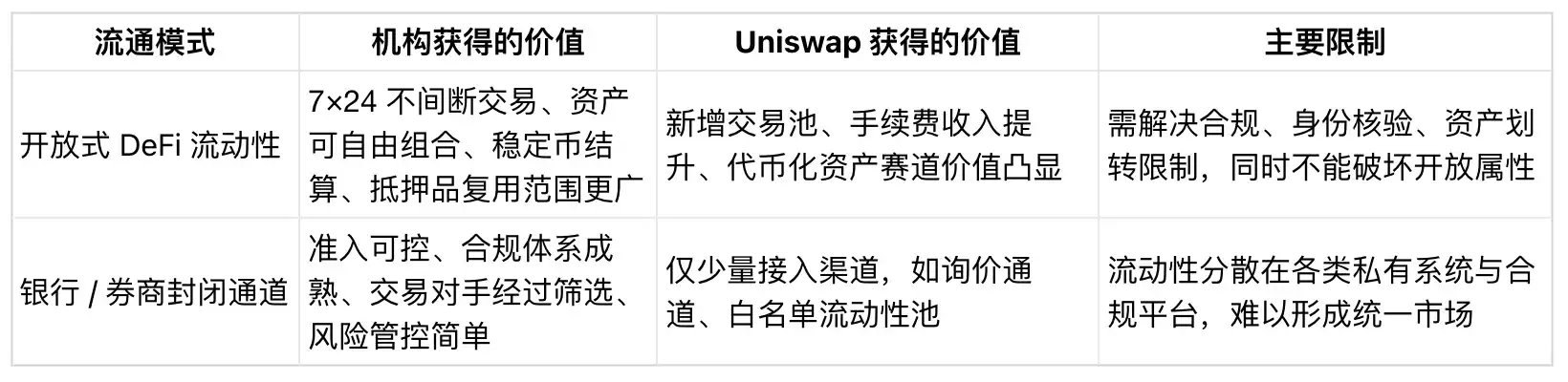
The BlackRock BUIDL model sits between the two extremes, utilizing Uniswap technology at its base but maintaining institutional access controls throughout. This design builds a bridge to DeFi infrastructure without fully immersing tokenized assets into a permissionless, open liquidity pool.

The liquidity solutions acceptable for institutional assets will likely adopt this hybrid model first: leveraging DeFi infrastructure for trading and settlement while imposing hard restrictions on user identity, asset transfers, and counterparties.

UNI Still Lacks a Value Capture Mechanism

Even if Uniswap facilitates more real-world tokenized asset trading, it doesn't guarantee direct benefits for UNI token holders, as the protocol still lacks a stable value capture mechanism.

The UNI tokenomics upgrade proposal passed by the community on the Tally platform previously clarified protocol fee distribution and UNI burn mechanisms while also proposing that Uniswap become the default trading hub for tokenized assets.

This plan provides an implementation path for the valuation logic but hinges on multiple prerequisites: community governance decisions, fee adjustments, institutional commercial partnerships, and real trading volume growth—none of which can be missing.

Standard Chartered's $100 price target not only far exceeds current market levels but even surpasses UNI's all-time high from 2021. This target cannot rely solely on asset issuance growth; it requires real, sustained trading volume, stable fee revenue, and a clear linkage mechanism between protocol development and token value.

The core tension in the institutional tokenization space is that banks and asset managers need decentralized capabilities like on-chain settlement, 24/7 transfers, programmable collateral, and stablecoin payments, yet insist on KYC verification, asset transfer restrictions, designated counterparties, and control over secondary market development.

The Financial Stability Board's research report on tokenization also reflects this cautious stance. It notes that the overall scale of tokenization is still small and that the industry faces multiple issues, including closed access, insufficient cross-platform interoperability, limited settlement assets, and fragmented trading platforms.

These frictions are the core obstacles preventing tokenized assets from becoming general-purpose liquidity assets in DeFi.

If these industry barriers persist long-term, Uniswap will remain merely a peripheral integration channel for institutional tokenization systems. If related pain points gradually ease, the protocol could become a central trading venue for tokenized funds, stablecoins, and native crypto assets.

Ultimately, the core of Standard Chartered's valuation prediction depends on where tokenized liquidity ultimately flows. The $100 target represents significant upside potential, but the more crucial signal is this: a traditional Wall Street investment bank now acknowledges that DeFi protocols have a chance to share in the institutional tokenization wave.

The BlackRock BUIDL case has already proven that asset managers can use DeFi technology while maintaining strict circulation controls; Citi's outlook on tokenization also suggests that Wall Street will likely build hybrid systems, keeping issuance, distribution, and settlement firmly in institutional hands; and the various industry pain points highlighted by the Financial Stability Board emphasize that interoperability and settlement systems remain core industry challenges.

Future market signals will come from more tokenized asset integration cases. If new assets all adopt isolated, whitelisted RFQ channels, open DeFi will only capture a small market share. If cross-asset unified liquidity pools gradually materialize and custom control rules diminish, Uniswap's position in the tokenization space will no longer be confined to native cryptocurrency swaps.


Трендовые криптовалюты

Связанные с этим вопросы

QWhat is Standard Chartered Bank's target price for the UNI token by 2030, and what is the core logic behind this prediction?

AStandard Chartered Bank has set a target price of $100 for the UNI token by the end of 2030. The core logic is that the tokenization of assets will drive demand for open DeFi liquidity, with Uniswap well-positioned to capture significant trading volume and earn fees from this influx.

QWhat are the two divergent paths for tokenized assets highlighted in the article, and how do they impact Uniswap's growth potential?

AThe two paths are: 1) Tokenized assets remain largely within closed, permissioned systems controlled by institutions like banks and custodians. 2) Tokenized assets flow into open, decentralized markets requiring cross-asset trading and composability. Uniswap's growth potential is severely limited in the first scenario but significantly enhanced in the second, as it could become a core liquidity hub.

QUsing the example of BlackRock's BUIDL fund, explain the current hybrid approach institutions are taking towards DeFi infrastructure.

ABlackRock's BUIDL fund utilizes UniswapX's technology for its trading mechanism but implements strict permissioned access (e.g., whitelisted users, pre-approved participants). This demonstrates a hybrid approach where institutions leverage DeFi infrastructure for its technical benefits (e.g., 24/7 settlement) while maintaining full control over user access, asset transfers, and counterparty restrictions.

QWhat key challenge does the article identify regarding UNI's ability to capture value from Uniswap's potential growth in tokenized asset trading?

AA key challenge is that Uniswap currently lacks a stable and direct value-capture mechanism for UNI token holders. Even if the protocol processes more transactions from tokenized assets, UNI holders don't automatically benefit. The success of the recently passed UNI tokenomics upgrade proposal, which includes fee distribution and a burn mechanism, is crucial but depends on multiple factors like governance decisions and actual trading volume growth.

QAccording to the article, what is the fundamental factor that will determine whether Standard Chartered's $100 UNI price target is achievable?

AThe fundamental factor is where the liquidity from tokenized assets ultimately flows. The target depends on whether a significant portion of tokenized financial instruments (like tokenized funds, stocks, and stablecoins) move into open, permissionless DeFi liquidity pools rather than being restricted to closed, institutionally controlled systems. The degree of market fragmentation and interoperability issues will be decisive.

Похожее

Андре Кронье покидает совет директоров Sonic Labs на фоне падения токена

Известный разработчик DeFi Андре Кронье покинул совет директоров Sonic Labs (бывшей Fantom Foundation), вместе с ним ушли ещё два директора. Эти изменения в руководстве произошли на фоне резкого падения курса нативного токена проекта S/FTM, который торгуется примерно на 97% ниже своего исторического максимума. Отставки поднимают вопросы о корпоративном управлении в Sonic Labs, который занимается высокоскоростным масштабированием виртуальной машины Ethereum (EVM). Несмотря на кадровые перестановки, разработчики заявляют, что технические планы и сроки запуска протокола остаются без изменений. Новый генеральный директор сосредоточен на реструктуризации операционной деятельности. Для сообщества DeFi эта ситуация подчёркивает характерную волатильность и проблемы управления в быстроразвивающихся блокчейн-экосистемах. Дальнейшая стабильность и направление развития проекта будут зависеть от прозрачности и чёткой коммуникации со стороны нового руководства.

bitcoinist3 ч. назад

Андре Кронье покидает совет директоров Sonic Labs на фоне падения токена

bitcoinist3 ч. назад

Kraken интегрирует торговлю через солана-децентрализованную биржу прямо в основное приложение

Криптобиржа Kraken интегрировала в своё основное приложение возможность торговли через децентрализованные биржи (DEX) в сети Solana. Это позволяет клиентам в США и более чем 100 странах торговать более чем 2500 токенами на основе Solana, не покидая приложение Kraken. Пользователям больше не нужны отдельные кошельки или мнемонические фразы, что упрощает доступ к ликвидности Solana DEX. Ключевым преимуществом является прямой доступ к ранним активам и токенам новых проектов, которые ещё не представлены на традиционных централизованных биржах. Интеграция объединяет удобство и безопасность централизованной платформы с широким выбором токенов и децентрализованной ликвидностью. Объявление было сделано 20 июня 2026 года.

bitcoinist4 ч. назад

Kraken интегрирует торговлю через солана-децентрализованную биржу прямо в основное приложение

bitcoinist4 ч. назад

Медведи Эфириума сохраняют контроль, так как ETH отскакивает от сопротивления линии тренда

Последний отскок Ethereum не убедил аналитиков в завершении нисходящего тренда. По мнению TheSignalyst, ETH сохраняет медвежий настрой, оставаясь ниже нисходящей красной линии тренда и формируя серию более низких максимумов и минимумов. На графике видно, что цена отклонилась от зоны сопротивления, объединяющей линию тренда и горизонтальный структурный уровень, что усиливает давление продавцов. Ключевая зона поддержки находится между $1 350 и $1 500. Контролируемый откат в этот диапазон может вызвать реакцию, но уверенный прорыв ниже ослабит структуру ETH. В настоящее время ETH находится между значимой поддержкой и линией сопротивления, ограничивающей восстановление, что указывает на техническое сжатие рынка. Борьба Ethereum с сопротивлением также важна для всего альткойн-рынка, поскольку слабость ETH часто снижает аппетит к риску в DeFi и малокапитализированных активах. Для подтверждения разворота быкам необходим четкий прорыв выше сопротивления.

bitcoinist5 ч. назад

Медведи Эфириума сохраняют контроль, так как ETH отскакивает от сопротивления линии тренда

bitcoinist5 ч. назад

TechFlow Разведслужба: Шансы на IPO Anthropic превышают 80%, Иран вновь перекрывает Ормузский пролив, вызывая волатильность цен на нефть

Технологические новости: ожидается IPO Anthropic в 2026 году, рынок обсуждает сосуществование её заявленной ценности в области безопасности ИИ с потенциальной триллионной оценкой. Набирают популярность виртуальные инфлюенсеры, созданные ИИ. Маск заявляет о необходимости астрономических инвестиций в антиматерию для межзвёздных путешествий. Крипто/Web3: Иран объявил о закрытии Ормузского пролива, вызвав волатильность на нефтяном рынке, однако данные о движении судов показывают неоднозначную картину. Одновременно Иран возобновил погрузку нефти на острове Харг, что может увеличить предложение. На рынке чипов: Goldman Sachs предупреждает о возможном приближении к пределу кредитования масштабных расходов на ИИ-инфраструктуру. Корпоративные новости: Cloudflare представил функцию временных аккаунтов для ИИ-агентов. Google сообщает, что более 50% его трафика теперь использует IPv6. Hyundai Motor Group планирует полный выкуп Boston Dynamics. Рынок акций: частные инвесторы активно вкладываются в акции SpaceX. В Европе зафиксирован первый с 2008 года дефолт по акциям CLO. Макроэкономика: Украина атаковала нефтяные объекты в Крыму и Краснодарском крае. Nomura предупреждает о возможном резком ужесточении политики ФРС. Общая тенденция: глобальная ликвидность сокращается на фоне роста предельных издержек в энергетике, кредитовании и технологиях, в то время как капитал продолжает искать новые масштабные возможности для роста.

marsbit6 ч. назад

TechFlow Разведслужба: Шансы на IPO Anthropic превышают 80%, Иран вновь перекрывает Ормузский пролив, вызывая волатильность цен на нефть

marsbit6 ч. назад

Соотношение ETH/BTC упало до уровней начала 2023 года на фоне дебатов о стоимости Ethereum

Курс ETH/BTC упал до уровня начала 2023 года, достигнув отметки 0.027. По сравнению с пиком 2021 года в 0.088 это означает, что Ethereum сейчас выглядит исторически дешевым по отношению к Bitcoin. Аналитик Woetoe задается вопросом, является ли это возможностью для контрарианских инвестиций или признаком структурного снижения. Одновременно с этим график ETH/USDT указывает на риск коррекции. По данным SwallowAcademy, после агрессивного недельного открытия цена может откатиться, при этом была нарушена структура рынка. План предполагает возможную продажу при повторном тестировании зоны $1723 с целью коррекции до $1660. Таким образом, сложилась противоречивая ситуация: Ethereum кажется недооцененным относительно Bitcoin, но при этом испытывает давление на долларовой паре. Для быков ETH первоочередной задачей является не обсуждение оценки, а восстановление технической силы и возобновление роста относительно BTC.

bitcoinist6 ч. назад

Соотношение ETH/BTC упало до уровней начала 2023 года на фоне дебатов о стоимости Ethereum

bitcoinist6 ч. назад

Торговля

Спот
Фьючерсы

Популярные статьи

Как купить T

Добро пожаловать на HTX.com! Мы сделали приобретение Threshold Network Token (T) простым и удобным. Следуйте нашему пошаговому руководству и отправляйтесь в свое крипто-путешествие.Шаг 1: Создайте аккаунт на HTXИспользуйте свой адрес электронной почты или номер телефона, чтобы зарегистрироваться и бесплатно создать аккаунт на HTX. Пройдите удобную регистрацию и откройте для себя весь функционал.Создать аккаунтШаг 2: Перейдите в Купить криптовалюту и выберите свой способ оплатыКредитная/Дебетовая Карта: Используйте свою карту Visa или Mastercard для мгновенной покупки Threshold Network Token (T).Баланс: Используйте средства с баланса вашего аккаунта HTX для простой торговли.Третьи Лица: Мы добавили популярные способы оплаты, такие как Google Pay и Apple Pay, для повышения удобства.P2P: Торгуйте напрямую с другими пользователями на HTX.Внебиржевая Торговля (OTC): Мы предлагаем индивидуальные услуги и конкурентоспособные обменные курсы для трейдеров.Шаг 3: Хранение Threshold Network Token (T)После приобретения вами Threshold Network Token (T) храните их в своем аккаунте на HTX. В качестве альтернативы вы можете отправить их куда-либо с помощью перевода в блокчейне или использовать для торговли с другими криптовалютами.Шаг 4: Торговля Threshold Network Token (T)С легкостью торгуйте Threshold Network Token (T) на спотовом рынке HTX. Просто зайдите в свой аккаунт, выберите торговую пару, совершайте сделки и следите за ними в режиме реального времени. Мы предлагаем удобный интерфейс как для начинающих, так и для опытных трейдеров.

872 просмотров всегоОпубликовано 2024.03.29Обновлено 2026.06.02

Как купить T

Обсуждения

Добро пожаловать в Сообщество HTX. Здесь вы сможете быть в курсе последних новостей о развитии платформы и получить доступ к профессиональной аналитической информации о рынке. Мнения пользователей о цене на T (T) представлены ниже.

活动图片