When Even the Shovel Sellers Borrow to Buy Shovels: The US Stock AI Sector Evaporates Trillions in a Week, as the Market Begins Pricing AI's 'Bill'

marsbitОпубликовано 2026-06-11Обновлено 2026-06-11

Введение

Last week saw a sharp sell-off in the US AI sector, erasing trillions in market value despite companies reporting record financials. Key events included Alphabet's massive equity raise despite having over $1.2 trillion in cash, Broadcom's stock plummeting after its quarterly report, a 4% Nasdaq drop, and Oracle's stock falling even after posting record revenue and backlog. The market's focus shifted from stellar income statements to cash flow and balance sheets, questioning the massive and increasingly leveraged capital expenditures required to fund the AI infrastructure race. Analysts point out that while growth is strong, profitability and the visibility of AI monetization are now under scrutiny. The financing chain stretches from cash-rich giants like Alphabet raising debt and equity, to chipmakers like Broadcom facing margin pressure, to cloud providers like Oracle with negative free cash flow funding via debt, and finally to unprofitable AI labs like OpenAI and Anthropic—who are the ultimate customers for much of this infrastructure. The market is beginning to price the risk of this concentrated, leveraged bill coming due, with the upcoming SpaceX IPO serving as the next test for this financing ecosystem.

Author: Ada, Deep Tide TechFlow

Over the past week, the US stock AI sector presented a strange picture, with records being broken one after another and stocks being sold off one after another.

On June 1, Alphabet, sitting on hundreds of billions in cash, announced one of the largest equity financings in history; On June 3 after market close, Broadcom delivered its best-ever quarterly report, only for its stock to crash the next day; On June 5, the Nasdaq plunged 4% in a single day, with the semiconductor sector shedding roughly $1 trillion in market value in one session; On June 10 after market close, Oracle reported record revenue and backlog, yet its stock still fell; On June 11, the pricing moment arrived for what is set to be the largest SpaceX IPO in history. The financial numbers themselves are not the issue; the problem is the way these numbers are being achieved: more and more money is being borrowed into this AI infrastructure race through increasingly complex means. When the market began tallying up this bill, even record-breaking numbers couldn't save stock prices.

The Same Script: Record First, Then Get Sold Off

Broadcom went first. According to its earnings report and multiple media outlets, for its fiscal Q2 ended May 3, Broadcom's revenue reached $22.219 billion, up 48% year-over-year; AI chip revenue was $10.8 billion, surging 143% year-over-year; and earnings per share exceeded Wall Street expectations. But the market focused solely on one gap: the company's AI chip revenue guidance for the next quarter is $16 billion, below analyst expectations, and CEO Hock Tan did not raise the full-year AI revenue target, mentioning that Google might diversify its chip supply chain. Nonetheless, Broadcom's stock plummeted about 15% the next day, erasing nearly $280 billion in market value in a single day, making it one of the largest single-day market cap losses in Wall Street history.

Oracle's turn came a week later. According to its earnings report and CNBC, for its fiscal Q4 ended May 31, Oracle's revenue was $19.2 billion, up 21% year-over-year; cloud infrastructure revenue was $5.8 billion, up 93% year-over-year; adjusted EPS was $2.11, beating analyst expectations of $1.95. The backlog was even more staggering: Remaining Performance Obligations (RPO) reached $638 billion, skyrocketing 363% year-over-year, far exceeding analyst expectations of $595.7 billion. Yet the stock also didn't find favor, dropping about 9% in after-hours trading.

Sandwiched between these two earnings reports was a broad sell-off on June 5. According to TheStreet and CNBC, the Nasdaq Composite Index fell 4% that day, its worst single-day performance since the April 2025 tariff turmoil, triggered by Broadcom's cautious AI chip outlook, with AMD and Intel leading the decline across the entire semiconductor sector.

It is worth noting that the June 5 plunge wasn't solely about "AI skepticism." That day, US non-farm payrolls added 172,000 jobs, far exceeding expectations, pushing up rate hike expectations and triggering a rotation from high-valuation growth stocks into defensive sectors like healthcare and consumer staples. AI stocks, having the highest valuations, fell the hardest. In other words, macroeconomic interest rates and sector rotation were one driver, while concerns over AI capital expenditures were another. The two factors compounded, rather than having a single cause.

What's Being Sold Off Isn't the Income Statement, It's the Cash Flow Statement

Putting these three market segments together reveals a commonality: the income statement is still recording "record-breaking" numbers, but the market has already switched to reading the cash flow statement and the balance sheet. The pricing focus has shifted from "how much was earned" to "how much more will be burned and borrowed to earn this."

Oracle is the most straightforward case study. According to its earnings report, for the full FY2026, operating cash flow reached a record $32 billion, up 54% year-over-year, but free cash flow was negative $23.7 billion. For the year, the company has already raised $43 billion in debt and $5 billion in equity. What truly broke investor sentiment was its forward-looking language. According to CNBC, Oracle plans to raise approximately $40 billion more in FY2027 through a combination of debt and equity. A company that just raised nearly $50 billion, with negative free cash flow, and now forecasts another $40 billion financing round—when this appears alongside "record-breaking" numbers, the market chose to price the former.

Broadcom's logic is similar, but manifests elsewhere. According to Barron's, Broadcom lowered its Q3 gross margin guidance from 77% to 74%, attributing it to a higher revenue mix from lower-margin AI chips. Coupled with a retreat from "selling complete systems" to "selling only chips," and customers demanding chip leases to pass on financing pressure, the market sees a business with explosive growth, but deteriorating margins and capital intensity.

Goldman Sachs provided a framework for this shift. According to its research report, investors' tolerance for capital expenditure growth depends on earnings strength and the visibility of AI monetization; the same report noted that Alphabet's stock rose due to raising its profit guidance, while Meta's fell due to flat guidance. The market is no longer indiscriminately rewarding "growth," but differentiating winners from losers based on "the ability to monetize."

The Financing Chain Takes Center Stage: Even the Most Cash-Rich Players Are Borrowing

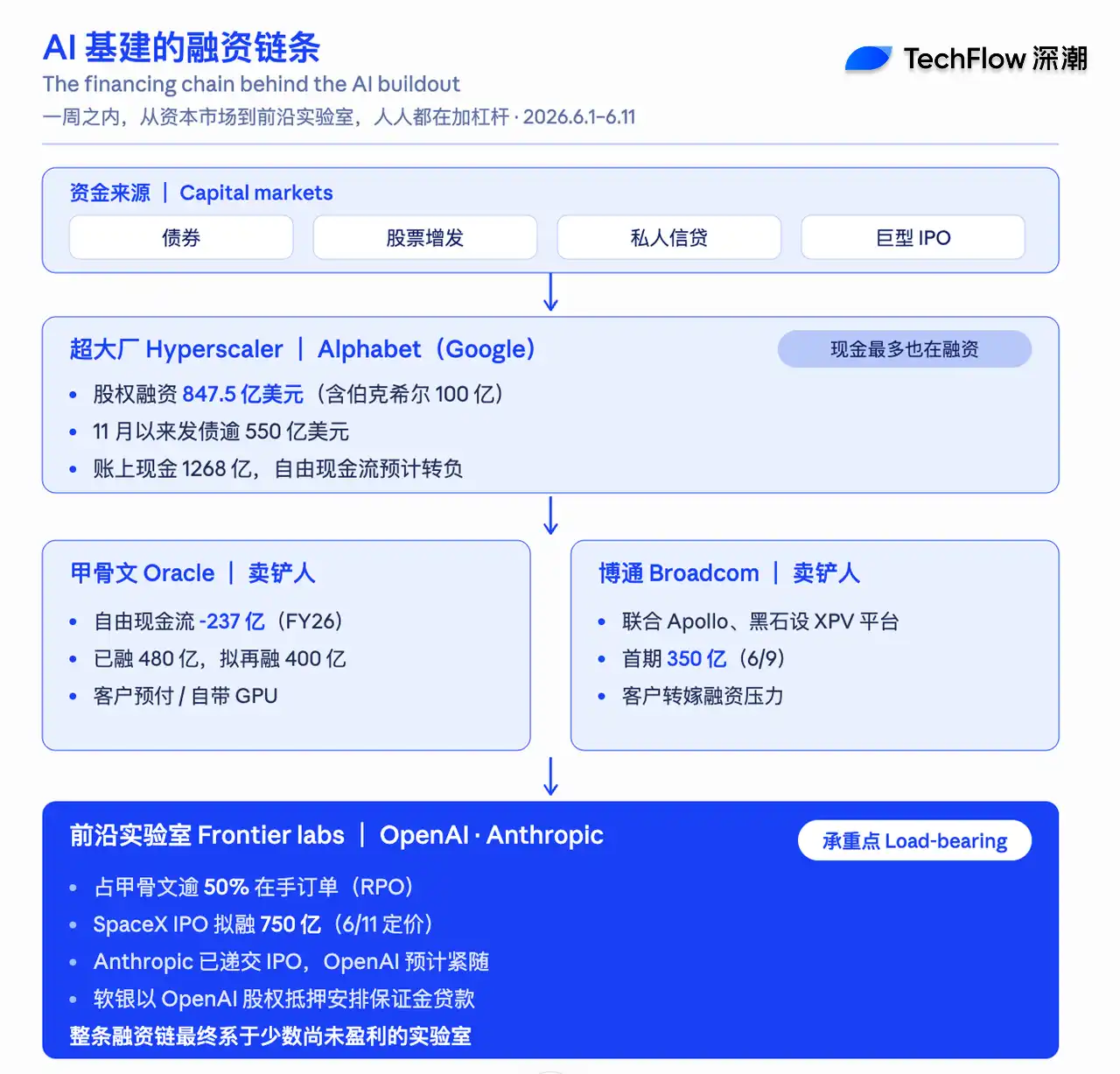
If the income statement is the surface, the financing chain is the true protagonist of this past week. From the very upstream to the very downstream, almost every link is paying for this same AI infrastructure build-out by leveraging up or diluting equity.

The most convincing case study is Alphabet. According to its SEC filing, on June 1, it announced an $80 billion equity financing; on June 2, it upsized and priced the deal at $84.75 billion, including a $10 billion private investment from Berkshire Hathaway. The anomaly is that this company is not short on cash at all. According to multiple media reports, Alphabet had $126.8 billion in cash as of March 2026, annual operating cash flow of $174 billion, and has issued over $55 billion in new debt since November. Despite this, Melius Research estimates Google's free cash flow will turn negative in the coming years. Investor Dan Niles' commentary on this is that capital is not infinite, and the fact that Google, with "the strongest technology stack in all of AI," still needs to raise massive amounts of financing precisely illustrates the intensity of this round of investment.

Looking downstream, every link on the chain is doing the same. New cloud vendor Oracle has negative free cash flow, relies on dual-track debt and equity financing, and asks customers to prepay for GPU costs or bring their own GPUs to reduce its own construction capital outlay; the chip "shovel sellers" like Broadcom, on June 9, partnered with Apollo and Blackstone to establish the AI XPV Platform, with an initial $35 billion targeting over 20 gigawatts of computing power by 2028, serving frontier labs including Anthropic and OpenAI. And at the very end of the chain, the labs are simultaneously employing even more aggressive tools: there were previous reports of SoftBank arranging margin loans secured by OpenAI equity; now SpaceX is rushing towards a Nasdaq IPO targeting $75 billion, Anthropic has confidentially filed for an IPO, and OpenAI is expected to follow closely.

The total scale of this investment is also rapidly inflating. According to CreditSights, the combined capital expenditure for mega-cap companies in 2026 is estimated at around $750 billion, up about 67% from 2025; Goldman Sachs' alternative metric puts the 2026 capex forecast for mega-caps at $518 billion, revised up from $314 billion at the start of the year. Whichever metric is used, the direction is consistent: expenditures are accelerating, the portion that can be covered by operating cash flow is shrinking, and the gap needs to be filled by capital markets.
The Chain's Pressure Point Rests on a Few Unprofitable Labs

Leverage itself isn't terrifying; what's terrifying is who the leverage ultimately rests upon. Pulling this financing chain to its end reveals that its pressure point is highly concentrated.

Oracle's $638 billion backlog seems impregnable, but according to Bank of America, over 50% comes from OpenAI alone; simultaneously, Oracle also disclosed that most of the RPO growth in the past two quarters came from large AI contracts, with customers either prepaying GPU costs or procuring GPUs themselves before handing them to Oracle. Broadcom's six major custom chip customers are similarly concentrated among a handful like Google, Meta, Anthropic, and OpenAI. In other words, from the financing of the mega-caps, to the orders of the "shovel sellers," to the injection of private credit and insurance funds, the ultimate payer for the entire chain converges onto a small group of unprofitable frontier labs like OpenAI and Anthropic, who are themselves queuing up for funding.

The record-breaking revenue is real, and the $638 billion backlog is real; but the buyers of these orders are highly concentrated, are themselves sustained by financing, and the leverage of the entire chain is being re-examined by the market. This past week, the market did not deny AI's growth; it simply started demanding to see clearly who will pay the bill for this growth, and how. SpaceX is set to price after market close on June 11 and list on the Nasdaq at $135 per share, with a valuation of approximately $1.77 trillion on June 12. Whether this largest-ever IPO can be digested smoothly will be the next stress test for this financing chain.


Трендовые криптовалюты

Связанные с этим вопросы

QWhat were the main reasons behind the significant sell-off in the AI sector of the U.S. stock market over the past week?

AThe sell-off was driven by a combination of macroeconomic factors and sector-specific concerns. The stronger-than-expected U.S. non-farm payrolls data raised interest rate expectations, triggering a rotation from high-valuation growth stocks (like AI) into defensive sectors. Simultaneously, the market began to reassess the massive capital expenditure required for AI infrastructure. Companies like Broadcom and Oracle reported record revenues but also signaled the need for continued heavy investment and financing, leading to a market focus on negative free cash flow and growing debt, which caused their stock prices to fall despite strong earnings.

QHow did the market's valuation focus shift for AI companies like Oracle and Broadcom, according to the article?

AThe market's valuation focus shifted from the income statement (profit and revenue growth) to the cash flow statement and balance sheet. Investors are no longer just rewarding 'record' earnings; they are now pricing in the significant capital required to generate those earnings. For example, Oracle's record $638 billion backlog and revenue were overshadowed by its negative free cash flow and plans for further large-scale debt and equity financing. For Broadcom, the market focused on the declining gross margin guidance and the increased capital intensity of its AI chip business, even as AI revenue soared.

QWhy did Alphabet, despite having a massive cash reserve, conduct a major equity financing round?

AAlphabet announced an $84.75 billion equity financing round even with $1268 billion in cash and strong annual operating cash flow because, according to analyst estimates (like from Melius Research), its free cash flow is projected to turn negative in the coming years due to the immense intensity of AI infrastructure investment. As noted by investor Dan Niles, this move by a company with the 'strongest technology stack in AI' highlights the enormous scale of capital required for this buildout, suggesting that even the most cash-rich players need to tap external funding to sustain the AI arms race.

QWhat is the common weak point or 'pressure point' in the AI infrastructure financing chain identified in the article?

AThe common weak point or 'pressure point' in the AI financing chain is its heavy reliance on a small group of unprofitable, frontier AI labs like OpenAI and Anthropic. A significant portion of the record orders for companies like Oracle (over 50% from OpenAI alone) and Broadcom's major custom chip customers are concentrated with these labs. These labs are themselves dependent on continued fundraising (e.g., private credit, impending IPOs) to pay their bills. This creates a concentrated risk where the entire chain's viability depends on the financial health and ability of a few non-profitable entities to keep raising capital.

QWhat upcoming event does the article suggest will be the next major test for the AI financing chain?

AThe article suggests that SpaceX's upcoming IPO, scheduled to price on June 11 and list on Nasdaq on June 12 with a target valuation of approximately $1.77 trillion, will be the next major test for the AI financing chain. As the largest IPO in history, its success in being absorbed by the market will serve as a crucial indicator of investor appetite and capacity to fund the massive capital requirements at the end of the AI infrastructure investment chain.

Похожее

SpaceX, ИИ и XRP: Почему следующий перенос богатства может быть другим?

Финансовый мир вступает в фазу, ориентированную не на спекулятивные циклы, а на строительство новой экономической инфраструктуры. Ожидания публичного размещения акций SpaceX отражают поиск капиталом новых рубежей, таких как космическая инфраструктура, спутниковые сети и центры обработки данных. Это, наряду с развитием искусственного интеллекта (ИИ), формирует повышенный структурный спрос на промышленные товары. Блокчейн-технологии могут занять ключевую роль в этой новой системе не как спекулятивные активы, а как слой для расчетов в реальном времени. Активы, ориентированные на платежи и межсетевое взаимодействие, такие как XRP и XLM, могут стать важными для трансграничных расчетов и машинных платежей, что подчеркивается связями между их создателями и космической отраслью (например, Vast и SpaceX). Ключевой становится конвергенция ИИ и блокчейна. По мере того как автономные ИИ-агенты начинают совершать транзакции, растет потребность в инфраструктуре для мгновенных расчетов и управления идентификацией, которую могут обеспечить распределенные реестры. Четкое регулирование цифровых активов ускоряет институциональное внедрение. Таким образом, формируется картина структурного перехода: капитал направляется в космическую и ИИ-инфраструктуру, что стимулирует спрос на товары, а блокчейн-сети позиционируются как финансовый слой для расчетов между этими новыми системами.

marsbit52 мин. назад

SpaceX, ИИ и XRP: Почему следующий перенос богатства может быть другим?

marsbit52 мин. назад

Обратный отсчет до GPT-5.6: Прощай с иллюзией единого API, итерации вычислительной мощности не сравнятся с одним согласованием

В середине июня 2026 года ряд событий, включая ограничения для модели Fable 5, открытый исходный код GLM-5.2 и утечку информации о GPT-5.6, указывают на переломный момент в индустрии ИИ. Логика развития отрасли претерпевает существенные изменения: во-первых, «пригодность к использованию» становится важнее «передовых технологий», формируется «двухколейная» система сосуществования контролируемых закрытых и локальных открытых моделей; во-вторых, конкуренция смещается от «языкового интеллекта» к «пространственному интеллекту (моделям мира)», требующему огромных вычислительных мощностей; в-третьих, «независимость от модели» становится критически важной для разработчиков приложений для обеспечения непрерывности бизнеса в условиях транснациональных регуляторных рисков. Инцидент с Fable 5 (Anthropic), доступ к которой для неамериканских пользователей был ограничен через 72 часа после запуска, демонстрирует, что технологическое лидерство может быть ограничено нормативными требованиями. В ответ открытое сообщество, как показывает выпуск GLM-5.2 с лицензией MIT, предлагает стабильные, экономичные и локально развертываемые альтернативы, сокращающие затраты и снижающие зависимость. В свою очередь, OpenAI, судя по утечкам, фокусирует GPT-5.6 на развитии «пространственного интеллекта» и «моделей мира», пытаясь создать новое технологическое преимущество в областях, требующих высокой вычислительной мощности, таких как 3D-моделирование и робототехника. Ключевой вывод: в новой эре оценивать инфраструктуру ИИ необходимо не только по техническим показателям, но и по устойчивости к нормативным требованиям. Для разработчиков жизненно важно создавать архитектуры, не зависящие от конкретной модели, чтобы обеспечить быстрый переход между поставщиками и поддержание непрерывности бизнеса.

marsbit2 ч. назад

Обратный отсчет до GPT-5.6: Прощай с иллюзией единого API, итерации вычислительной мощности не сравнятся с одним согласованием

marsbit2 ч. назад

Закончится ли скоро «битва субсидий на токены» между ИИ-гигантами?

Токены ИИ, используемые в подписках, на самом деле сильно субсидируются: в дорогих тарифах стоимость потреблённых токенов может в 70 раз превышать абонентскую плату. Основные игроки, такие как OpenAI и Anthropic, активно привлекают инвестиции и готовятся к IPO, но их бизнес-модель сталкивается с фундаментальной проблемой — отсутствием «эффекта привязки» (lock-in) пользователей. В отличие от интернет-сервисов, таких как такси или доставка еды, токены легко заменяемы, и пользователи могут быстро переключиться на более дешёвый аналог. Билл Марис, основатель Google Ventures, отмечает, что Google, обладая огромной прибылью от рекламы, может снизить цену токенов на 80%, оказывая давление на конкурентов, которые зависят от внешнего финансирования. Это делает ценовую войну не средством достижения монополии, а скорее бесконечной «игрой на выживание», где цель — остаться за игровым столом. Вероятный сценарий — превращение токенов в стандартизированную инфраструктуру, подобную электричеству или интернет-трафику, где цены стремятся к себестоимости, а прибыль становится минимальной. Это означает, что эпоха крупных субсидий может продлиться, и пользователи продолжат получать мощные ИИ-сервисы по относительно низкой цене, но сами компании-разработчики вряд ли достигнут сверхвысокой прибыльности в долгосрочной перспективе.

marsbit2 ч. назад

Закончится ли скоро «битва субсидий на токены» между ИИ-гигантами?

marsbit2 ч. назад

За пределами поля: Игра на прибыль вокруг чемпионата мира

**За пределами поля: Игры на прибыль вокруг Чемпионата мира по футболу 2026** Чемпионат мира — это не только фестиваль для фанатов, но и глобальное окно для спекуляций. Турнир концентрирует внимание, эмоции и капитал, создавая целую экосистему для азартных игр. Основные сферы: 1. **Прогнозные рынки (Polymarket, Kalshi):** Набирают популярность, опережая традиционные букмекеров. Торговля контрактами на исходы событий привлекла миллиарды долларов, порождая истории о крупных выигрышах и потерях. 2. **Традиционные спортивные ставки:** Остаются основой с ожидаемым оборотом свыше $500 млрд. В США ставки на футбол временно становятся ключевым видом спорта для букмекерских платформ. 3. **Акции ("концептуальные акции"):** Котировки компаний, связанных с потреблением (например, корейские сети фастфуда, японские бренды), резко колеблются в зависимости от успехов национальных сборных, отражая настроения фанатов. 4. **Перепродажа билетов:** Рынок билетов превратился в арену для спекуляций. Цены на вторичном рынке сильно зависят от команд, матчей и локаций. Появились даже схемы продажи "права на покупку" билетов (FIFA RTB) и "короткие" продажи без наличия билета. 5. **Коллекционные предметы и мерч:** Ограниченные серии товаров (например, тематические футболки Нью-Йорка) и классические коллекционные предметы (наклейки Panini) становятся объектами перепродажи с высокой наценкой. Распространена и продажа поддельной атрибутики. 6. **Криптовалюты:** Волна мем-токенов на тему ЧМ на блокчейне Solana привлекла спекулянтов, но большинство проектов не имеют реальной ценности и являются схемами "накачки и сброса", ведущими к большим потерям. 7. **Информационные услуги:** Зарабатывают на потребности в данных для спекуляций. Примеры: сайты для отслеживания динамики цен на билеты (SeatSidekick) и платные Telegram-каналы с прогнозами на ставки. Итог: Пока на поле разыгрываются матчи, за его пределами разворачивается масштабная финансовая игра, где истинными победителями часто становятся не те, кто угадал счет, а те, кто вовремя понял, куда направляются внимание и деньги миллионов.

marsbit3 ч. назад

За пределами поля: Игра на прибыль вокруг чемпионата мира

marsbit3 ч. назад

Заявление о фонде Hyperliquid ETF привлекает внимание, поскольку нарратив HYPE набирает обороты на X

Сводка (на русском): Сообщение в X от AlphaOnChain от 20 июня 2026 года привлекло внимание к теме ETF на Hyperliquid (HYPE). В посте утверждается, что три ETF на HYPE, запущенные в мае 2026 года, уже аккумулировали совместные активы на сумму 158 миллионов долларов США. Согласно данным, крупнейшими продуктами являются ETF Bitwise HYPE (88 млн долларов) и 21Shares HYPE ETF (66 млн долларов). Этот слух подчеркивает растущий интерес рынка к альткойн-нарративу HYPE. Hyperliquid известен своей экосистемой, ориентированной на децентрализованную торговлю perpetual-контрактами и инфраструктуру бирж. Возможный приток средств в ETF-продукты может указывать на то, что институциональный и розничный спрос начинает смещаться за пределы биткойна и Ethereum в сторону более рискованных активов. Ключевая оговорка статьи заключается в необходимости проверки данных. Поскольку информация исходит из социальных сетей, а не из официальных заявлений эмитентов или данных фондов, к цифрам следует относиться с осторожностью. Публикация скорее отражает растущее внимание к нарративу Hyperliquid, а не является подтвержденным фактом. Для трейдеров важно это различие: краткосрочные движения могут быть вызваны ажиотажем в соцсетях, но устойчивый рост, как правило, требует подтвержденного спроса, ликвидности и развития экосистемы.

bitcoinist4 ч. назад

Заявление о фонде Hyperliquid ETF привлекает внимание, поскольку нарратив HYPE набирает обороты на X

bitcoinist4 ч. назад

Торговля

Спот
Фьючерсы

Популярные статьи

Как купить BILL

Добро пожаловать на HTX.com! Мы сделали приобретение Billions Network (BILL) простым и удобным. Следуйте нашему пошаговому руководству и отправляйтесь в свое крипто-путешествие.Шаг 1: Создайте аккаунт на HTXИспользуйте свой адрес электронной почты или номер телефона, чтобы зарегистрироваться и бесплатно создать аккаунт на HTX. Пройдите удобную регистрацию и откройте для себя весь функционал.Создать аккаунтШаг 2: Перейдите в Купить криптовалюту и выберите свой способ оплатыКредитная/Дебетовая Карта: Используйте свою карту Visa или Mastercard для мгновенной покупки Billions Network (BILL).Баланс: Используйте средства с баланса вашего аккаунта HTX для простой торговли.Третьи Лица: Мы добавили популярные способы оплаты, такие как Google Pay и Apple Pay, для повышения удобства.P2P: Торгуйте напрямую с другими пользователями на HTX.Внебиржевая Торговля (OTC): Мы предлагаем индивидуальные услуги и конкурентоспособные обменные курсы для трейдеров.Шаг 3: Хранение Billions Network (BILL)После приобретения вами Billions Network (BILL) храните их в своем аккаунте на HTX. В качестве альтернативы вы можете отправить их куда-либо с помощью перевода в блокчейне или использовать для торговли с другими криптовалютами.Шаг 4: Торговля Billions Network (BILL)С легкостью торгуйте Billions Network (BILL) на спотовом рынке HTX. Просто зайдите в свой аккаунт, выберите торговую пару, совершайте сделки и следите за ними в режиме реального времени. Мы предлагаем удобный интерфейс как для начинающих, так и для опытных трейдеров.

384 просмотров всегоОпубликовано 2026.05.07Обновлено 2026.06.02

Как купить BILL

Обсуждения

Добро пожаловать в Сообщество HTX. Здесь вы сможете быть в курсе последних новостей о развитии платформы и получить доступ к профессиональной аналитической информации о рынке. Мнения пользователей о цене на BILL (BILL) представлены ниже.

活动图片