Are We in the Start of Bull Market? Leveraging On-Chain Data to Contextualize Key Market Trends

BitcoinistОпубликовано 2022-08-16Обновлено 2022-08-17

Введение

On top of that, if the historical record is any guide, market sentiment has rarely been this negative. None of these trends seem structural or new, which suggests an appealing setup for long-term holders.

Following the crypto market crash in the second quarter of 2022, the crypto market posted a partial recovery in July: The Bitwise 10 Large Cap Crypto Index rose 37%, after falling 63% in Q2. Although the broader market outlook is still uncertain, we see some signs of selling pressure exhausting itself.

In this column, we leverage on-chain data on bitcoin (BTC) and ethereum (ETH), the two largest crypto assets, to evaluate where we are in the crypto market cycle. Specifically, we examine three key trends: geographical flows, positioning by investor type, and market sentiment.

Crypto is especially suitable for such explorations because all transactions are recorded pseudonymously in a public ledger (aka the blockchain). By combining blockchain transaction data with additional datasets, it is possible to infer critical market trends in a way that is not possible for more traditional asset classes.

Geographical Flows: The Crypto Accumulation Trend by North American Entities—A Defining Trend of the Past Bull Market—Dipped and Stalled in Q2 2022

One amazing thing about on-chain data is that you can determine, to a reasonable degree, the geographical source of buying and selling pressure in crypto. By crossing blockchain transaction data, known addresses belonging to specific crypto entities, and web traffic flows, one can estimate which countries or regions are sending and receiving assets.

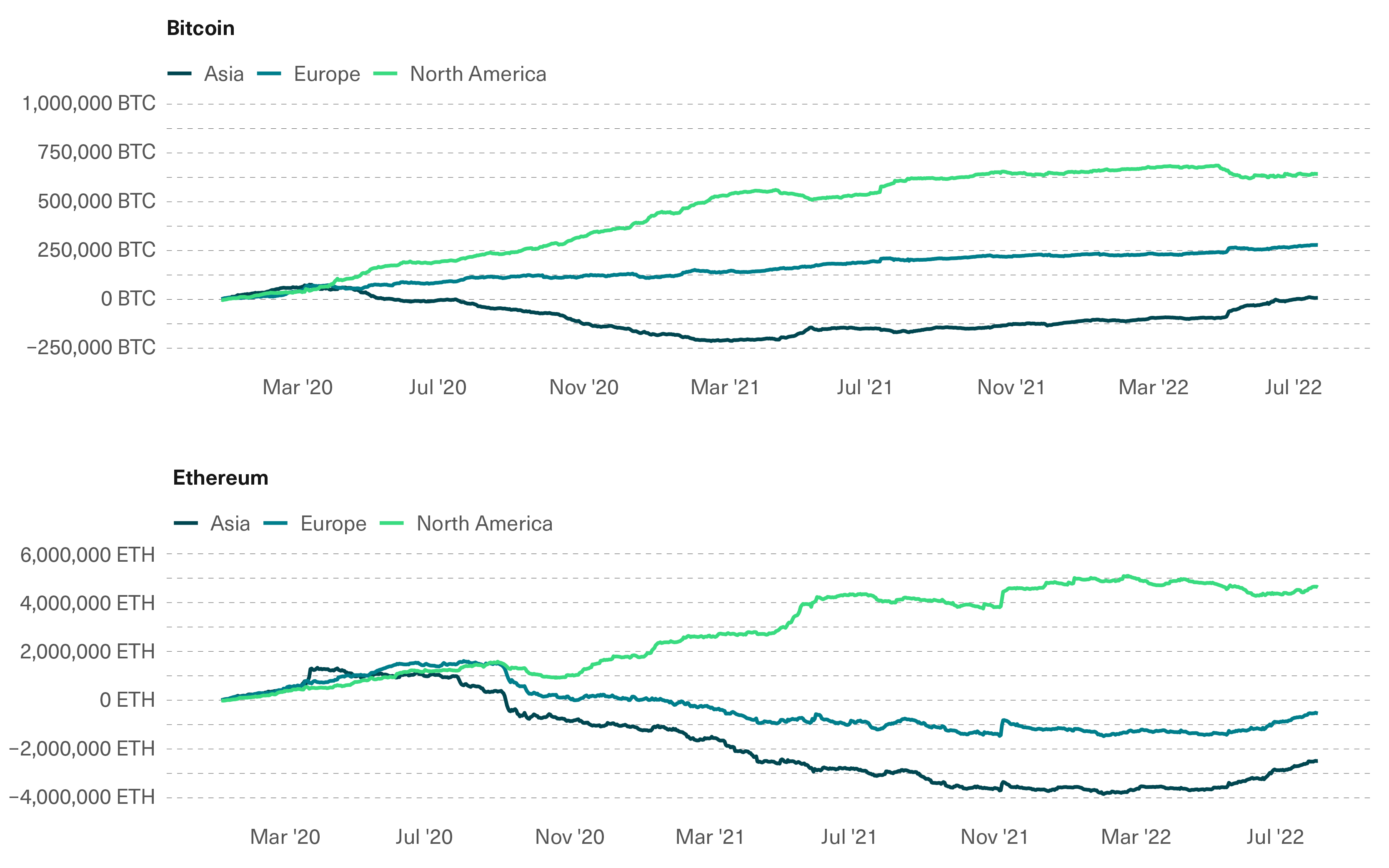
A defining trend of the crypto bull market over the past couple of years has been the accumulation of crypto by North American (mainly U.S.) entities, with outflows coming from the Asian markets. According to Chainalysis’ data, between January 1, 2020 and November 9, 2021, when the crypto market reached its all-time high, the net flow into North American entities was north of 645,000 BTC and 4.5 million ETH, over 3% of the total outstanding supply of each asset.

However, as the chart below shows, this trend has not only tapered off since then but also slightly reversed during last quarter’s crypto crash. Since May, when the market deterioration became more acute, the cumulative net flow into North American entities decreased by as much as 9.6% and 9.9% for BTC and ETH respectively, while the same metric for Asian and European entities was by and large on the rise. This is consistent with evidence from key players: Just two days ago, Coinbase, the leading North American crypto exchange, reported that a majority of Q2 trading volume took place in offshore exchanges, while the share of total crypto market capitalization held on its platform dipped from 11.2% in Q1 to 9.9% in Q2.

North American Entities Recorded Crypto Outflows in Q2 While Asian and European Ones Continued to Show Inflows

Bitcoin (top chart) and ethereum (bottom chart) cumulative net flows for select regions. Data in native units from January 1, 2020 to July 25, 2022.
Source: Bitwise Asset Management with data from Chainalysis

Positioning by Investor Type: Outflows From Larger Entities, Inflows Into Smaller Ones

Another way to slice and dice blockchain data is to cluster it into entities by the size of their crypto holdings. 

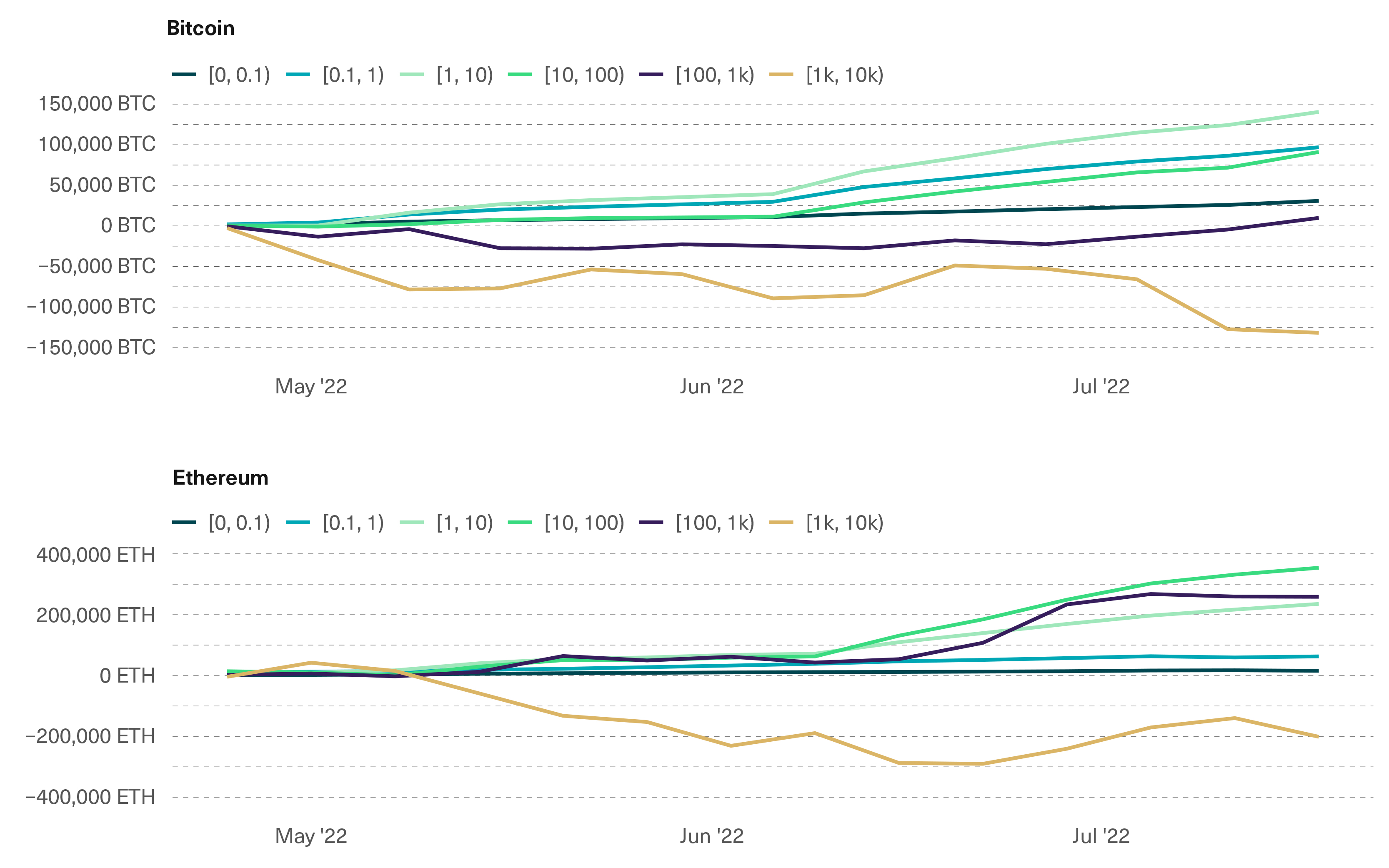
Zooming in on entities with relatively low turnovers (to capture “investors” vs. “traders”), we can see the accumulated flows into entities that hold between 0 and 0.1 BTC or ETH, between 0.1 and 1, and so on. In this section, we’ll be focusing on entities that have a relatively low turnover, which are more likely to be investors instead of traders, and will exclude the entities with extremely large holdings, which are more likely to be exchanges.

As crypto prices started to tank more sharply in May, larger entities have been registering outflows while relatively smaller entities have been seeing inflows. The trend is stronger for BTC than for ETH: Since May, smaller investors have accumulated about 2% of the total BTC supply but less than 0.5% of the total ETH supply.


This trend also marks a pause from the crypto bull market of the last two years, in which larger entities drove the lion’s share of crypto accumulation. The fact that this trend has been stronger for BTC than for ETH confirms our perception that the latter has been gaining traction in larger investors’ minds, as excitement around the upcoming Merge upgrade and ethereum’s scalability roadmap continues to build.

Outflows From Exchanges and Other Larger Entities Into Smaller Entities

Bitcoin (top chart) and ethereum (bottom chart) accumulation trends by investor size. Data in native units from May 1 to July 18, 2022.
Source: Bitwise Asset Management with data from Chainalysis

Market Sentiment: Implied Unrealized Losses Suggest the Worst Is Behind Us

The third and final analysis to consider is implied unrealized profit, or the current profit or loss of every held position, in entities that hold bitcoin or ethereum.

This metric has historically been most useful as a contrarian indicator: The higher the percentage of holders sitting on unrealized losses, the more likely the market is close to capitulation, and therefore the more favorable the timing for potential buyers is. As the old stock market proverb goes: “Buy at the roar of cannons and sell at the sound of trumpets.”

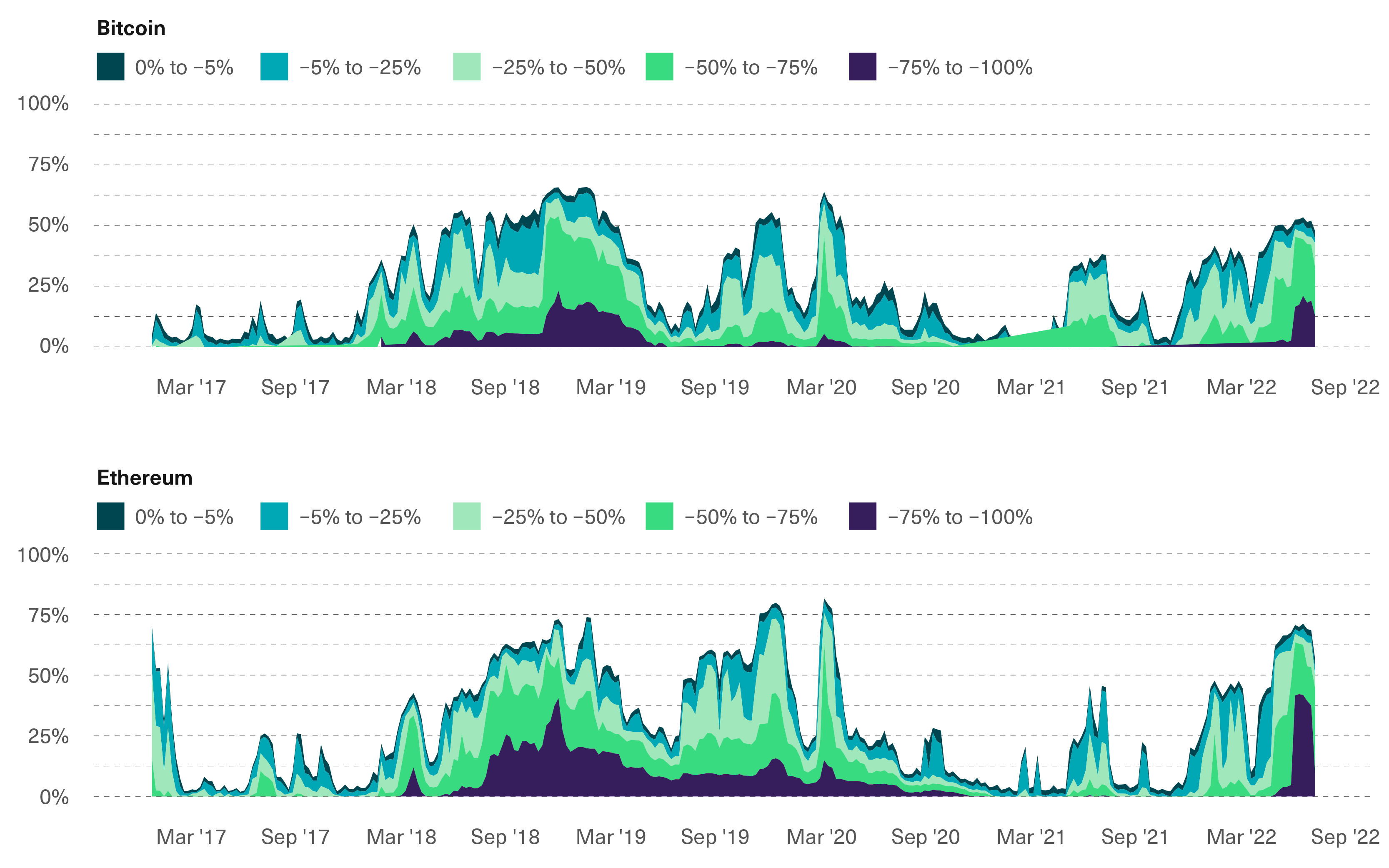
The chart below shows the percentage of the total BTC and ETH supply that sits on an unrealized loss, broken down by the loss size (between 0 and -5%, between -5% and -25%, and so on).

The percentage of the supply currently in losses stands at a tad below 50% for BTC and at over 60% for ETH. Perhaps even more striking, the entities that are currently sitting on losses of over 50% currently comprise over 40% for both BTC and ETH.

Since 2017, such levels were seen only during the March 2020 COVID crash, the 2019 correction, and the worst parts of the 2018 crypto winter. Although further demand shocks cannot be ruled out, the historical record suggests when investor sentiment is this negative, reversals can happen relatively quickly.

The Percentage of Supply Currently in the Red Has Parallels Only to the 2018 Crypto Winter and the COVID Crisis

Bitcoin (top chart) and ethereum (bottom chart) percentage of supply by ranges of unrealized loss. Data from January 1, 2020 to July 18, 2022.
Source: Bitwise Asset Management with data from Chainalysis

Conclusion

It is worth noting that on-chain data is not perfect. Geographical flows can be estimated only for entities that are known to be based in a specific location, and are based on web traffic data, which might not reflect actual transaction volume accurately. Positioning by investor type cannot be detected for entities that don’t touch the blockchain directly, and no blockchain analytics company fully describes the behavior of all entities that hold crypto assets. On top of that, market sentiment indicators make assumptions about each holder’s cost basis that might not be fully accurate.

Having said that, we think this data can provide key context in understanding where crypto markets sit. The key trends highlighted (geographical flows, changes in investor position by size, and market sentiment) suggests that dips in accumulation appetite by larger investors, mostly North America-based, likely were influential in the Q2 crypto market crash. On top of that, if the historical record is any guide, market sentiment has rarely been this negative. None of these trends seem structural or new, which suggests an appealing setup for long-term holders.


Похожее

Высокий суд Австралии одержал крупную победу для ASIC в деле о криптодоходности Block Earner

Высший суд Австралии единогласно поддержал позицию Комиссии по ценным бумагам и инвестициям (ASIC) в деле против компании Block Earner. Суд постановил, что её продукт "Earner" с фиксированной доходностью, предлагавшийся в 2022 году, является финансовым продуктом и деривативом по существующему законодательству. Это означает, что для его предложения требовалась лицензия на предоставление финансовых услуг (AFSL). Дело возвращено в Федеральный суд для определения штрафных санкций. Данное решение создаёт важный прецедент, проясняя применение традиционного финансового регулирования к криптовалютным продуктам, предлагающим структурированную доходность. Оно подтверждает, что экономическая сущность продукта важнее его названия. Регуляторы теперь имеют чёткие правовые основания рассматривать подобные продукты как инвестиционные инструменты, требующие лицензирования. Хотя оспариваемый продукт более не предлагается, это решение затрагивает многие существующие и планируемые криптопродукты в Австралии и отражает глобальный тренд на подчинение крипто-доходных продуктов установленным регуляторным режимам. Для индустрии это означает необходимость переоценки соответствия продуктов законодательству, а для потребителей — напоминание о рисках, связанных с нелицензированными доходными продуктами.

bitcoinist2 ч. назад

Высокий суд Австралии одержал крупную победу для ASIC в деле о криптодоходности Block Earner

bitcoinist2 ч. назад

Blockchain.com расширяет доступ к токенизированным акциям через Ondo Finance

Блокчейн-кошелек Blockchain.com расширяет доступ к токенизированным акциям и ETF США через интеграцию с Ondo Finance. Партнерство позволяет соответствующим критериям пользователям, особенно за пределами США, получать доступ к традиционным финансовым активам напрямую через привычный криптокошелек, минуя традиционные брокерские платформы. Ondo Finance, известный игрок на рынке токенизированных реальных активов (RWA), обеспечивает технологическую и регуляторную основу для этих активов. Эта интеграция является частью общей тенденции, когда криптоплатформы стремятся сделать токенизированные традиционные активы такими же простыми в использовании, как и обычные криптотокены. Однако широкому внедрению все еще могут препятствовать вопросы регулирования, хранения активов и их выкупа.

bitcoinist4 ч. назад

Blockchain.com расширяет доступ к токенизированным акциям через Ondo Finance

bitcoinist4 ч. назад

CPU возвращается за игровой стол: начинается «игра на повышение» стоимостью 170 миллиардов долларов

6 июня 2026 года на выставке Computex NVIDIA анонсировала свой первый процессор Vera CPU, что знаменует серьезный вход компании на рынок серверных процессоров. Это событие подчеркивает растущую ключевую роль CPU в эпоху ИИ-агентов, когда задачи, связанные с выводом (инференсом) и управлением, требуют все большей вычислительной мощности и эффективности процессоров. Рынок серверных процессоров переживает бум. Прогнозы, такие как отчет UBS, предполагают, что его объем может вырасти с примерно 300 млрд долларов в 2025 году до 1700 млрд долларов к 2030 году. Основной драйвер роста — ИИ-агенты, которые выполняют сложные многошаговые задачи, требующие интенсивной работы CPU для управления потоками данных, вызова инструментов и обработки контекста. В таких сценариях нагрузка на CPU может достигать 70-90%, а соотношение CPU к GPU в системах стремится к 1:1, в отличие от 1:8 в эпоху обучения моделей. Это привело к изменению спроса и даже к росту цен на серверные CPU впервые за более чем десятилетие. AMD и Intel столкнулись с дефицитом мощностей. Спрос разделился на высокопроизводительные CPU для работы внутри стоек с GPU и более умеренные, но массовые CPU для развертывания независимых узлов агентов. Новая конкурентная динамика привлекла новых игроков, таких как NVIDIA с ее ARM-архитектурой, и открыла возможности для китайских производителей CPU, таких как Hygon (HaiGuang). Их рост поддерживается как общим рыночным бумом, так и политикой импортозамещения (программа «синьчуан»), требующей замены иностранного оборудования в государственном секторе к 2027 году. Таким образом, в центре следующего этапа развития ИИ находится не только GPU, но и эффективное взаимодействие CPU и GPU, что переопределяет ландшафт полупроводниковой индустрии.

marsbit4 ч. назад

CPU возвращается за игровой стол: начинается «игра на повышение» стоимостью 170 миллиардов долларов

marsbit4 ч. назад

Технологический поток Разведуправления: Директор по ИИ AMD публично раскритиковал Claude Code, заявив, что он «стал глупее и ленивее», Трамп заявил о полном прекращении огня в Ормузском проливе, но в проливе осталось около 80 морских мин

Эксклюзив Wired: SK Telecom, стратегический партнер Anthropic, находится под проверкой экспортного контроля США из-за возможного трансфера технологий модели Mythos. GLM-5.2 от китайской Z.AI: модель, по заявлениям, близкая по производительности к Claude Opus, полностью обходится без чипов Nvidia. В сфере чипов: MIT создает собственную ОС для изучения работы процессоров; ASML опровергает заявления США о поставках передовых EUV-установок в Китай; Amazon планирует продавать свои AI-чипы Trainium/Inferentia сторонним компаниям. Безопасность: обнаружено 10 тыс. репозиториев на GitHub, распространяющих вредоносное ПО; Apple исправила критическую уязвимость прослушки в Beats Studio Buds. На рынке: акции полупроводниковых компаний резко выросли (Intel +10.6%, Micron +8.7%); SpaceX упала на 3.56%. Геополитика и экономика: Несмотря на заявление Трампа о перемирии, в главном фарватере Ормузского пролива остается около 80 необезвреженных мин, что удерживает 80 супертанкеров с 80 млн баррелей нефти. Иран отменил дипломатическую поездку в Швейцарию. Основной контекст: Временная "разрядка" в геополитике контрастирует с глубокой и долгосрочной реструктуризацией глобальных технологических и полупроводниковых цепочек, где независимость от доминирующих игроков становится ключевым трендом.

marsbit4 ч. назад

Технологический поток Разведуправления: Директор по ИИ AMD публично раскритиковал Claude Code, заявив, что он «стал глупее и ленивее», Трамп заявил о полном прекращении огня в Ормузском проливе, но в проливе осталось около 80 морских мин

marsbit4 ч. назад

Южная Корея предпринимает шаги по регулированию трансграничных криптовалютных переводов в рамках новой системы

Южная Корея планирует включить финтех-компании в новую систему лицензирования трансграничных переводов виртуальных активов, которая должна быть введена в декабре. Согласно поправкам в Закон о валютных операциях, компаниям, осуществляющим такие переводы, необходимо будет зарегистрироваться в Министерстве экономики и финансов и отчитываться через национальную систему валютной отчётности. Это сделано для того, чтобы вывести криптовалютные переводы из-под неформального надзора и снизить риски отмывания денег. Изначально ожидалось, что доступ к системе получат в основном криптобиржи, такие как Upbit и Bithumb. Однако регуляторы, включая Банк Кореи, рассматривают возможность расширения круга участников, включив в него нетрадиционные криптоплатформы и финтех-фирмы, если они смогут эффективно осуществлять переводы. Министерство экономики и финансов и Банк Кореи совместно с отраслевыми участниками разрабатывают финальные правила реализации рамок регулирования до их запуска в декабре. Это происходит на фоне усиления надзора за цифровыми активами в стране, включая разработку правил для токенизированных ценных бумаг.

TheNewsCrypto6 ч. назад

Южная Корея предпринимает шаги по регулированию трансграничных криптовалютных переводов в рамках новой системы

TheNewsCrypto6 ч. назад

Торговля

Спот
Фьючерсы
活动图片