380,000 Apps Exposed, 2,000+ Apps Leaked Secrets: AI Programming Turns 'Intranet' into Public Internet

marsbitОпубликовано 2026-05-11Обновлено 2026-05-11

Введение

Israeli cybersecurity firm RedAccess uncovered a severe data exposure trend linked to "vibe coding" or AI-powered software development tools. Their research found approximately 38,000 publicly accessible web applications built with platforms like Lovable, Base44, Netlify, and Replit. Of these, an estimated 2,000 apps exposed sensitive corporate and personal data, including medical records, financial information, internal strategic documents, and customer chat logs. In some cases, access even granted administrative privileges. The core issue stems from default privacy settings that make applications public by default, combined with a lack of built-in security controls (like authentication) in the AI-generated code. This allows employees without security expertise—"citizen developers"—to easily create and deploy applications that bypass standard corporate security reviews. The exposed apps, often indexed by search engines, are trivially discoverable. While some platform providers (Replit, Lovable, Wix/Base44) argue that security configuration is the user's responsibility and question the validity of some findings, security researchers confirm the widespread reality of such exposures. This pattern, also noted in prior studies, highlights a critical security gap as AI democratizes app creation, potentially leading to massive, unintentional data leaks.

“Vibe coding tools are leaking vast amounts of personal and corporate data.” Recently, while researching the trend of "shadow AI," researchers from the Israeli cybersecurity startup RedAccess discovered that AI tools used by developers to build software quickly have exposed medical records, financial data, and internal documents from Fortune 500 companies to the open web.

RedAccess CEO Dor Zvi stated that researchers found approximately 380,000 publicly accessible applications and other assets created by developers using tools like Lovable, Base44, Netlify, and Replit. Among these, about 5,000 contained sensitive corporate information, and upon further inspection, nearly 2,000 applications appeared to expose private data. Axios independently verified multiple exposed apps, and WIRED also separately confirmed these findings.

40% of AI-Coded Apps Expose Sensitive Data,

Some Even Have Admin Privileges

As AI increasingly takes over the work of modern programmers, the cybersecurity field has long warned that automated coding tools are bound to introduce a large number of exploitable vulnerabilities into software. However, when these vibe coding tools allow anyone to create and host web applications with just a click, the problem is not just vulnerabilities, but the almost complete lack of any security protection, including highly sensitive corporate and personal data.

It is understood that the RedAccess team analyzed thousands of vibe coding web applications created using AI software development tools like Lovable, Replit, Base44, and Netlify. They found that over 5,000 of these had almost no security mechanisms or authentication. Many such web applications can be directly accessed along with their data by anyone who obtains their URL. Some had minimal barriers to entry, such as requiring registration with any email address.

Among these 5,000 AI-coded apps accessible to anyone simply by entering the URL in a browser, Zvi found that nearly 2,000 appeared to expose private data upon further inspection. Zvi said that approximately 40% of the apps exposed sensitive data, including medical information, financial data, corporate presentations and strategic documents, and detailed logs of user conversations with chatbots.

Screenshots of web applications he shared (some of which were verified to still be online and exposed) showed details including a hospital's work assignment information (containing doctors' personally identifiable information), a company's detailed advertising procurement data, another company's market entry strategy presentation, a retailer's complete chatbot conversation logs (including customers' full names and contact details), a shipping company's freight records, and various sales and financial data from multiple companies. Zvi also stated that in some cases, these exposed applications could potentially allow him to gain administrative access to systems, or even delete other administrators.

Zvi mentioned that RedAccess found it surprisingly easy to search for vulnerable web applications. Lovable, Replit, Base44, and Netlify all allow users to host web applications on the AI companies' own domains, rather than on the user's own domain. Therefore, researchers could identify thousands of applications built using these vibe coding tools by simply searching Google and Bing using these company domains combined with other keywords.

In the case of Lovable, Zvi also discovered a large number of phishing websites impersonating major corporations. These sites appeared to be created using the AI coding tool and hosted on the Lovable domain, including brands like Bank of America, Costco, FedEx, Trader Joe’s, and McDonald's. Zvi also pointed out that the 5,000 exposed apps discovered by RedAccess were only those hosted on the AI coding tools' own domains. There could potentially be tens of thousands more applications hosted on user-purchased domains.

Security researcher Joel Margolis noted that verifying whether real data is actually exposed in an unprotected AI-coded web app is not always straightforward. He and his colleagues previously discovered an AI chat toy that exposed 50,000 conversations with children on a website with minimal security. He said the data in vibe coding applications could be just placeholders, or the app itself might be only a proof-of-concept (POC). Wix's Brodie also believed that the two examples provided to Base44 looked like test sites or contained AI-generated data.

Nevertheless, Margolis believes the problem of data exposure from AI-built web apps is very real. He stated that he frequently encounters the type of exposure Zvi described. "Someone on the marketing team wants to build a website; they are not engineers and probably have little security background or knowledge," he pointed out. AI coding tools will do what you ask, but if you don't ask them to do it securely, they won't do it proactively.

“People Can Create at Will,”

But the Default Settings Are the Problem

Less than two weeks before RedAccess's research was published, another incident occurred: Cursor, running the Claude Opus 4.6 model, deleted PocketOS's entire production database and all volume-level backups in 9 seconds via an API call to infrastructure provider Railway.

Zvi bluntly stated, "People can create something at will and then use it directly in a production environment, representing a company to use it, without needing any permission. There's almost no boundary to this behavior. I don't think we can make the whole world receive security education." He added that his mother also uses Lovable for vibe coding, "but I don't think she considers role-based access control."

RedAccess researchers found that the privacy settings of multiple vibe coding platforms default applications to being public unless users manually change them to private. Many such applications are also indexed by search engines like Google, making it possible for anyone surfing the web to stumble upon them unintentionally.

Zvi believes that current AI web application development tools are creating a new wave of data exposure, rooted in the same combination of user error and insufficient security safeguards. However, a more fundamental issue than any specific security flaw is that these tools enable a whole new category of people within organizations to create applications. They often lack security awareness and bypass the company's existing software development processes and pre-deployment security review mechanisms.

"Anyone in the company, at any time, can generate an application, completely bypassing any development process or security checks. People can use it directly in a production environment without asking anyone's opinion. And that's exactly what they are doing," Zvi said. "The end result is that corporations are essentially leaking private data through these vibe coding applications. This is one of the largest-scale incidents ever, where people are exposing corporate or other sensitive information to anyone in the world."

In October last year, Escape.tech scanned 5,600 public vibe coding applications and also found that over 2,000 had high-risk vulnerabilities, over 400 exposed sensitive information (including API keys and access tokens), and 175 cases involving personal data breaches (including medical records and bank account information). All vulnerabilities found by Escape existed in real production systems and could be discovered within hours. In March this year, the company completed an $18 million Series A funding round led by Balderton, with one of its core investment rationales being the security gaps created by AI-generated code.

Gartner's "Predicts 2026" report pointed out that by 2028, the prompt-to-app approach adopted by "citizen developers" will increase software defect volume by 2,500%. Gartner believes a major new characteristic of such defects is that AI-generated code is syntactically correct but lacks an understanding of overall system architecture and complex business rules. The cost of fixing these "deep-context errors" will erode budgets originally intended for innovation.

Responses and Rebuttals from the Platforms

Currently, three AI coding companies have contested the claims made by RedAccess researchers, stating that the information shared was insufficient and they were not given enough time to respond. However, Zvi said that for dozens of exposed web applications, they proactively contacted the suspected owners. Executives from the companies stated they take such reports seriously, while also noting that the apps being publicly accessible does not necessarily mean there is a data breach or security vulnerability. Nonetheless, these companies did not deny that the web applications discovered by RedAccess were indeed publicly exposed.

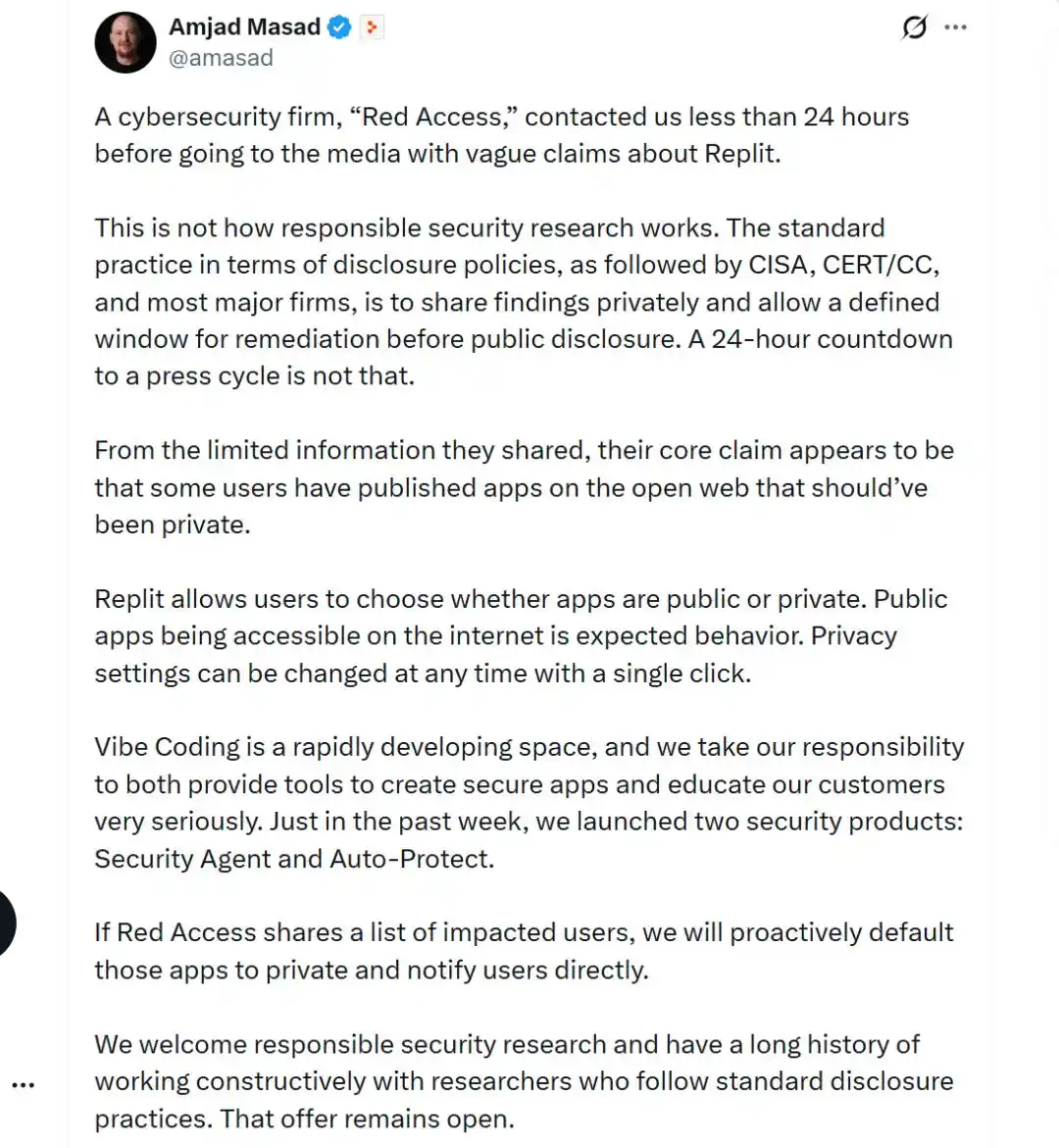
Replit's CEO, Amjad Masad, stated that RedAccess only gave them 24 hours to respond before disclosure. In his response on X, he wrote, "Based on the limited information they shared, the core claim from RedAccess appears to be: some users have published apps that should be private to the open internet. Replit allows users to choose whether their app is public or private. Public apps being accessible on the internet is expected behavior. Privacy settings can also be changed with one click at any time. If RedAccess shares the list of affected users, we will proactively default those apps to private and notify users directly."
A spokesperson for Lovable responded in a statement, "Lovable takes reports of data exposure and phishing websites very seriously, and we are actively obtaining the necessary information to investigate. This matter is currently ongoing. It should also be noted that Lovable provides developers with tools to build applications securely, but the ultimate responsibility for how an application is configured lies with the creator."

In the previously published CVE-2025-48757, it was recorded that Supabase projects generated by Lovable had insufficient or even missing Row-Level Security (RLS) policies. Some queries completely bypassed access control checks, leading to data exposure in over 170 production environment applications. The AI was responsible for generating the database layer but did not generate the security policies that should have restricted data access. Lovable contested the CVE classification, stating that protecting application data is the customer's own responsibility.

Blake Brodie, Head of Public Relations at Wix, the parent company of Base44, stated in a declaration: "Base44 provides users with robust tools to configure the security of their applications, including access control and visibility settings." She added, "Turning these controls off is an intentional and simple action that any user can perform. If an application is publicly accessible, that reflects a user's configuration choice, not a platform vulnerability."

Brodie also pointed out, "It's very easy to fabricate apps that appear to contain real user data. Without providing us with any verified cases, we cannot assess the veracity of these allegations." In response, RedAccess countered that they did provide relevant examples to Base44. RedAccess also shared several anonymized communication records showing that Base44 users thanked the researchers for alerting them to their apps' exposure issues, after which the apps were secured or taken down.

It is understood that Wiz Research independently discovered last July that Base44 had a platform-level authentication bypass vulnerability. The exposed API interface allowed anyone to create a "verified account" in a private application using only a publicly visible `app_id`. This vulnerability was akin to standing at the locked door of a building, shouting out a room number, and having the door automatically open. Wix fixed the vulnerability within 24 hours of Wiz's report, but the incident exposed an issue: on these platforms, millions of applications are created by users who often assume the platform has handled security for them, but the actual authentication mechanisms are very weak.

Reference Links:

https://www.wired.com/story/thousands-of-vibe-coded-apps-expose-corporate-and-personal-data-on-the-open-web/

https://www.axios.com/2026/05/07/loveable-replit-vibe-coding-privacy

https://venturebeat.com/security/vibe-coded-apps-shadow-ai-s3-bucket-crisis-ciso-audit-framework

This article is from the WeChat public account "AI Frontline" (ID: ai-front), author: Hua Wei

Связанные с этим вопросы

QWhat is the main security issue reported in the article regarding AI coding tools?

AThe article reports that AI-powered 'vibe coding' tools like Lovable, Base44, Netlify, and Replit are leading to the exposure of private corporate and personal data on the open web. Researchers found approximately 38,000 publicly accessible applications, with nearly 2,000 of them exposing sensitive data like medical records, financial information, and internal corporate documents due to a lack of security controls and default public settings.

QWhich specific types of sensitive data were found to be exposed by the vulnerable AI-coded applications?

AThe exposed data included hospital work assignments with doctors' personally identifiable information (PII), a company's detailed ad-buying data, market-entry strategy presentations, full chatbot conversation logs from a retailer containing customers' full names and contact details, shipping company cargo records, and various sales and financial data from multiple companies. In some cases, the exposed applications could even grant administrative system access.

QAccording to the article, what is a fundamental cause of this data exposure problem beyond specific technical flaws?

AA fundamental cause is that these AI development tools empower a new class of users within organizations ('citizen developers') to create applications. These users often lack security awareness and can bypass traditional corporate software development lifecycles and pre-deployment security reviews. The tools allow anyone to quickly build and deploy applications to production without requiring permission or security checks.

QHow did the AI coding companies mentioned (Replit, Lovable/Wix) respond to the findings of data exposure?

ACompanies like Replit and Lovable/Wix (owner of Base44) disputed the research methodology, citing insufficient information and short response times. They generally argued that their platforms provide tools for users to configure security (like privacy settings) and that publicly accessible applications reflect user configuration choices, not platform vulnerabilities. They emphasized that the ultimate responsibility for securing an application lies with its creator.

QWhat broader industry prediction does the article cite related to the security impact of AI-generated code?

AThe article cites a Gartner prediction from its '2026 Predictions' report stating that by 2028, 'prompt-to-app' methods adopted by citizen developers will cause a 2500% increase in software defects. A key characteristic of these defects is that while AI-generated code is syntactically correct, it lacks understanding of overall system architecture and complex business rules, leading to costly 'deep-context errors'.

Похожее

The Value Distribution of Stablecoins

**Summary: The Value Distribution of Stablecoins** The article argues that stablecoins are evolving from mere trading tools into broader channels for dollar access. It divides the stablecoin ecosystem into four layers to analyze how value is distributed: 1. **Issuance Layer:** Mints stablecoins, holds reserve assets, and captures the spread between reserve yield and user costs (e.g., Tether, Circle). This layer currently earns the largest profit margin. 2. **Infrastructure Layer:** Connects stablecoins to the traditional financial system, handling fiat on/off-ramps, banking integration, compliance (KYC/AML), and asset management (e.g., Bridge, BVNK). This is the "unglamorous" but critical work, building the essential bridges between crypto and real-world finance. 3. **Acquiring/Distribution Layer:** Integrates stablecoins into merchant systems, manages payment flows, and provides enterprise financial software (e.g., Stripe, Coinbase). They act as the access point for businesses. 4. **Application Layer:** The end-users and businesses that ultimately use stablecoins for payments, settlements, or as a store of value. They benefit from convenience but have little pricing power. The core thesis is that while the issuance layer currently dominates profits, the often-overlooked **infrastructure layer holds significant long-term potential**. The real challenge and barrier to mass adoption is not the on-chain transfer of stablecoins (which is simple), but the complex "last mile" integration into existing business workflows, banking systems, and regulatory frameworks across different countries. Companies in this layer are currently in a "land grab" phase, investing heavily to build networks, secure bank partnerships, and establish compliance pathways. While their position is currently pressured by the profitable issuers above and distribution platforms below, the article suggests that if stablecoins become a default financial rail for businesses, the infrastructure providers who have done the hard work of integration will ultimately gain strong pricing power and become entrenched, essential players.

marsbit17 мин. назад

The Value Distribution of Stablecoins

marsbit17 мин. назад

The Value Distribution of Stablecoins

The Value Distribution of Stablecoins The article argues that stablecoins are evolving from a mere trading tool into a broad "dollar channel." It analyzes the industry's value chain through four layers: 1. **Issuance Layer (e.g., Tether, Circle):** The top layer that mints stablecoins, holds reserve assets, and captures the thickest interest rate spread. 2. **Infrastructure Layer (e.g., Bridge, BVNK):** Connects stablecoins to the traditional financial system, handling critical but complex "dirty work" like fiat on/off-ramps, banking integration, compliance (KYC/AML), and cross-border settlement. 3. **Acquiring/Distribution Layer (e.g., Stripe, Coinbase):** Embeds stablecoins into merchant systems, manages payment flows, and integrates with enterprise software. 4. **Application Layer:** End-users and businesses that ultimately use stablecoins for payments, settlement, or storing value. The author posits that while the issuance layer currently captures the most profit, the most overlooked and potentially critical layer is infrastructure. The core challenge for stablecoin adoption isn't the on-chain transfer (which is simple), but bridging the gap between blockchain and the real-world financial system. This involves solving practical problems for businesses: fiat conversion, reconciliation, tax handling, and user onboarding. Infrastructure companies are currently in a difficult "land-grab" phase—building networks, securing banking relationships, and achieving compliance country-by-country. They face pressure from both the profitable issuance layer above and distribution platforms below. However, the author suggests this layer is building a crucial moat. Once stablecoins become a default business rail, the infrastructure players who have done the hard work of integration may gain significant, durable value and pricing power.

链捕手21 мин. назад

The Value Distribution of Stablecoins

链捕手21 мин. назад

Why Is Nvidia Borrowing $20 Billion When It's Not Short of Cash?

Nvidia's recent announcement to issue at least $20 billion in senior notes, despite holding a strong cash position with over $48.6 billion in free cash flow last quarter, is not a sign of financial need. Instead, it represents a strategic move to leverage its high credit rating (recently upgraded to AA by S&P) to secure low-cost, long-term debt. This capital will support long-term AI infrastructure investments, data centers, R&D, supply chain prepayments, and strategic investments, while allowing the company to continue aggressive shareholder returns through stock buybacks and dividends. The decision reflects a mature capital management strategy: using debt to finance long-term growth assets is more efficient and less dilutive to shareholders than equity financing. It signals that Nvidia, like other tech giants (Alphabet, Meta, Amazon), is entering a new phase of heavy AI capital expenditure, shifting from a pure growth story to a story about capital allocation, credit strength, and long-term ecosystem positioning. The key question for investors is whether Nvidia can maintain its high cash flow generation and ensure that returns from these AI investments justify the cost of capital over the long term. The bond issuance amplifies its expansion capabilities but also ties its valuation more closely to the broader AI investment cycle's sustainability and profitability.

marsbit56 мин. назад

Why Is Nvidia Borrowing $20 Billion When It's Not Short of Cash?

marsbit56 мин. назад

How to Do Research Well: Deliberately Practice the Real Skills That Matter

No one truly teaches you how to do research. You're often given a desk, a pre-selected problem, and vague instructions to "create something new." Consequently, many people reverse-engineer the job based on visible outputs—papers, posts, announcements—learning only how to *appear* like a researcher rather than how to *become* one. True research capability is built from stacking small, trainable skills, nearly all of which can be developed through deliberate practice. **Pick Your Own Problem:** Most researchers absorb problems from advisors or trends, lacking the underlying reasoning. Choosing a problem you genuinely care about, as John Schulman advises, leads to original work. Develop "taste" like a muscle: predict experiment outcomes, guess paper results from methods, and track which findings remain important over time. **Upgrade Your Inputs:** Relying on shared reading lists (arXiv hot lists, filtered group chats) leads to unoriginal conclusions. Undervalued old literature often holds crucial insights (e.g., MoE, LSTM, backpropagation). Richard Sutton's "The Bitter Lesson" or Claude Shannon's 1952 talk on creative thinking are more predictive than lengthy modern surveys. Breadth matters as much as depth: draw from neuroscience, mechanism design, hardware knowledge, and honest statistics. Read papers directly, especially appendices and limitations sections. **Write Everything Down:** As Paul Graham noted, writing exposes flaws in seemingly mature ideas. Writing is the cheapest defense against self-deception. Following Feynman's principle, Darwin programmatically wrote down facts contradicting his theory to combat memory bias. Maintain a detailed log of hypotheses, setups, predictions, results, and updated understandings. Reviewing past logs fosters essential humility.

marsbit2 ч. назад

How to Do Research Well: Deliberately Practice the Real Skills That Matter

marsbit2 ч. назад

Торговля

Спот
Фьючерсы

Популярные статьи

Неделя обучения по популярным токенам (2): 2026 может стать годом приложений реального времени, сектор AI продолжает оставаться в тренде

2025 год — год институциональных инвесторов, в будущем он будет доминировать в приложениях реального времени.

1.8k просмотров всегоОпубликовано 2025.12.16Обновлено 2025.12.16

Неделя обучения по популярным токенам (2): 2026 может стать годом приложений реального времени, сектор AI продолжает оставаться в тренде

Обсуждения

Добро пожаловать в Сообщество HTX. Здесь вы сможете быть в курсе последних новостей о развитии платформы и получить доступ к профессиональной аналитической информации о рынке. Мнения пользователей о цене на AI (AI) представлены ниже.

活动图片