Crypto VCs Pivot to AI: A 'Coming of Age' Ceremony Beginning with a Collapse of Belief

比推Опубликовано 2026-02-05Обновлено 2026-02-05

Введение

In a personal reflection, the author expresses sadness over Kyle Samani, a partner at crypto VC firm Multicoin Capital, publicly announcing his departure from the crypto industry to focus on AI, longevity tech, and robotics. Kyle was known for his thesis-driven, opinionated, and often controversial investment style—publicly criticizing Ethereum’s scaling roadmap, backing Solana early, and supporting DePIN projects like Helium. Despite mistakes (EOS, FTX exposure), he was transparent about losses and decisions. His exit feels symbolic: an honest, sharp voice leaving crypto. Before deleting the tweet, Kyle stated that crypto is primarily an asset ledger with limited use beyond finance, marking a shift from evangelist to realist—a “loss of faith” rather than just market loss. The author contrasts crypto’s current state—filled with memecoins, gambling, and technical debates—with AI’s rapid, tangible progress. Yet, they choose to stay, seeing crypto as a permissionless, open field for upward mobility and financial infrastructure innovation (e.g., stablecoins, DeFi, RWA), while remaining open to future possibilities.

Author: Dora B Dream, Deep Tide TechFlow

Original Title: Kyle Left the Crypto Industry, and I'm a Bit Sad


*This article expresses personal opinions.

On the morning of February 5th, a day that began with a market crash, I was scrolling through Twitter as usual when a departure announcement from Kyle Samani, a partner at the well-known crypto VC firm Multicoin, suddenly appeared in my feed. My finger paused on the screen for a few seconds. My heart sank. Why him?

I know Kyle, or more accurately, I know *of* him.

Back in 2020, during my junior year of college, I read Multicoin's "pitch" paper for the first time. It was eye-opening. The concept of being "Thesis-Driven" was imprinted in my mind.

I realized VCs could write like this—not using vague, PPT-style phrases like "we see long-term value in the XX sector," but thinking like traders, directly providing clear bullish and bearish logic, avoiding ambiguity, and presenting sharp, distinct viewpoints.

Kyle's persona on Twitter has always been distinct: aggressive, mean, offending countless people.

He dared to publicly criticize Ethereum's scaling roadmap when everyone was bullish on it. He dared to place firm bets on Solana when others dismissed it. He dared to promptly, transparently disclose losses and复盘 decision-making after the FTX collapse, where Multicoin suffered significant losses.

Many in the Western crypto circle dislike him, finding him *too arrogant*. But I've always felt the industry needs people like him.

Now he's gone. Pivoting to AI, longevity technology, robotics. I suddenly felt a pang of sadness: If even Kyle doesn't want to play anymore, what's wrong with this industry?

When Kyle Left

What makes me sad isn't just another VC pivoting to AI—who isn't talking about AI these days?

What makes me sad is that it's specifically Multicoin's Kyle, someone I viewed as very resolute.

What is the investment logic of most Crypto VCs? Spray and pray, bet on sectors, say nice things but never make a definitive judgment, or just follow others' leads.

Open the investment reports of those famous firms; it's always "we believe in a decentralized future," "we are optimistic about innovation in the XX field," but you never see a firm statement like "we think Project A will outperform Project B."

This isn't prudence; it's worldliness. No matter who wins, they can always say, "See, we were positioned early."

Kyle, or rather Multicoin, wasn't like that. He dared to make "life-or-death judgments."

He publicly declared Ethereum's sharding roadmap a dead end as early as 2017. He once bet on EOS and failed. In 2018, he placed his bets on Solana. In 2020, he strongly supported Helium, believing DePIN was the only viable non-financial use case for Crypto.

Yes, he missed many opportunities and made big mistakes—EOS and FTX are bloody lessons. But he never hid them, disclosing losses transparently and owning up to every error he should.

He wasn't the smartest VC, nor the gentlest evangelist, but he was one of the most "real" ones. His departure symbolizes a certain kind of "honesty and sharpness" fading from this industry.

That Instantly Deleted Tweet

What struck me even more was the tweet he sent just before leaving, though he deleted it instantly.

He said: "Crypto is not fundamentally as interesting as many crypto enthusiasts want it to be. I used to believe in the Web3 vision, I used to believe in dApps. I no longer do. Blockchains are primarily asset ledgers. They can reshape finance, but their potential in other areas is limited."
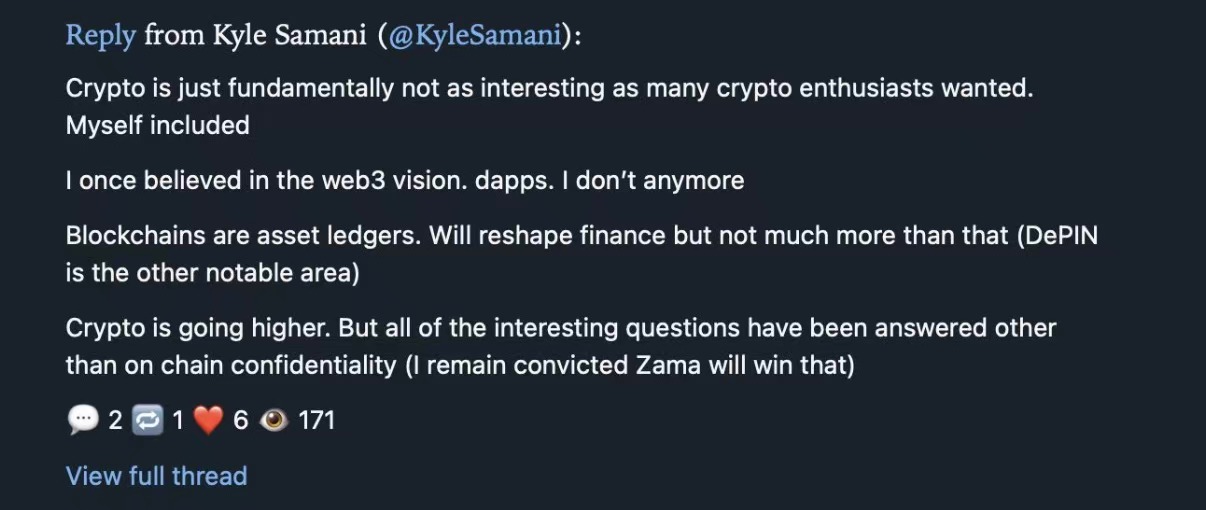
Why delete it instantly? Because saying it out loud makes you a "heretic."

Why couldn't he resist posting it? It's the conclusion reached by someone trapped between faith and reality, after spending 8 years and investing hundreds of millions of dollars.

I understand this feeling all too well because it mirrors my own journey this past year.

What did we believe in when we entered in 2021? That decentralized social would颠覆 Twitter. That on-chain identity (DID) would let users control their data. That GameFi would let players truly "own their assets." Back then, everyone on Twitter timelines was discussing "how Web3 will change the world." Every new project felt like a gateway to the future.

What is the reality in 2025? Friend.tech died. Lens Protocol has no users. ENS has become a tool for speculation; no one actually uses DID beyond wallet addresses. The collapses of Axie and StepN proved "X to Earn" is just a Ponzi scheme in disguise.

But Kyle didn't否定 everything. He still sees value in stablecoins, DeFi, RWA (these financial applications), and projects like Helium (DePIN). He's still betting on technologies like Zama's fully homomorphic encryption.

The question is: Do these things still require "faith"? Or just rational calculation?

Some see Kyle's departure as a betrayal. In my eyes, it's a process of "disenchantment"—transitioning from a Crypto Evangelist to a Crypto Realist. This transformation might be the necessary coming-of-age ceremony the entire industry must undergo.

Last Time We Lost Money, This Time We're Losing Confidence

When FTX imploded in 2022, the entire industry hit rock bottom. Luna went to zero, Three Arrows Capital破产, the market was halved and halved again. But back then, everyone still held onto a belief: The market crashed, but we weren't wrong. If we persevere, the bull market will prove us right.

Back then, we still believed in Ethereum's "endgame narrative"—from PoW to PoS, from a single chain to modularity—thinking it was the necessary path to the "world computer."

We still believed in Solana's "performance revolution," thinking that high-performance chains would surely win if they could just survive the bear market.

We still believed in Web3's "paradigm shift," believing the next chapter of the internet必然 was decentralization.

What about now, in 2025?

Objectively, the data is much better than the last trough. BTC briefly surpassed $100,000, ETFs were approved, and Crypto's ties with Wall Street grew stronger.

But the subjective feeling is completely opposite. Prices are higher, but confidence is lower.

The "culprit," or perhaps the "revealing mirror," is AI.

When ChatGPT launched in 2023, everyone was discussing "how AI will change the world." What was Crypto discussing at the same time? "Should L2 sequencers be decentralized?" One was talking about a productivity revolution; the other was arguing over technical details.

The subsequent two years saw AI progress at a dizzying pace: Gemini, Claude, ChatGPT—a three-way battle, with new developments daily. Lately, everyone is obsessed with OpenClaw.

And Crypto? There are more and more L2s and chains, but no one can clearly explain "why we need 100 L2s." Even Vitalik has reflected on past roadmap mistakes. NFT, GameFi, SocialFi have all had their moments, but they were all flashes in the pan.

By now, the biggest innovation of this cycle has turned out to be Meme Coins and "reinventing gambling."

I often ask myself late at night: AI is redefining productivity with technology. Crypto is redistributing wealth with financial games. The former creates; the latter transfers. What are we actually building?

Kyle's departure is, at its core, a "value choice."

He chose to chase AI, longevity tech, robotics—fields that are truly "expanding human frontiers." Crypto, at least for now,更像 is a high-stakes casino.

But I'm Not Ready to Leave Yet

After saying all this, you might think I'm about to announce my exit too.

But no, I still want to "gamble" one more time.

Kyle can leave because he is already financially free and can pursue grander dreams. But for young people like me, Crypto still represents: a relatively fair channel for "upward mobility," a "permissionless" testing ground that doesn't require diplomas, background, or connections—just cognition and courage. It's an emerging industry not yet completely monopolized by the elite class.

More importantly, perhaps the grand Web3 narrative has failed, but that doesn't mean Crypto is worthless.

The revolution in financial infrastructure has already happened. The daily settlement volume of stablecoins has surpassed Visa. DeFi allows people worldwide to use financial services and RWA 24/7.

Most crucially: I haven't figured out my own answer yet.

Kyle spent 8 years concluding "Crypto is just an asset ledger."

But I'm still just a rookie; what right do I have to make that judgment now?

Maybe in a few years, I'll leave like he did. But for now, I want to stay at the table to see if this industry still holds some unseen possibilities.

Years from now, Crypto might no longer be the "disrupt-everything" revolution but rather the value settlement layer for the AI era.

When that time comes, I'll order a coffee and chat about the scenery I saw along the way.


Twitter:https://twitter.com/BitpushNewsCN

Bitpush TG Discussion Group:https://t.me/BitPushCommunity

Bitpush TG Subscription: https://t.me/bitpush

Original article link:https://www.bitpush.news/articles/7609106

Связанные с этим вопросы

QWhy did Kyle Samani's departure from the crypto industry resonate so deeply with the author?

ABecause Kyle represented a rare combination of honesty, sharpness, and a willingness to make bold, public judgments in an industry often filled with vague, non-committal statements. His departure felt like the loss of a 'real' and aggressive voice that the author believed the industry needed.

QWhat was the core belief that Kyle Samani expressed in his since-deleted tweet?

AHe expressed that cryptocurrency is not as revolutionary as many enthusiasts hope. He no longer believes in the Web3 vision or dApps, concluding that blockchain is primarily a ledger for assets with significant potential mainly in finance, but limited potential in other fields.

QHow does the author contrast the current state of the AI and Crypto industries?

AThe author contrasts them by stating that AI is focused on a 'productivity revolution,' creating new things and pushing the boundaries of human capability with rapid, tangible progress. In contrast, much of Crypto's recent innovation has been in 'Meme Coin and reinventing gambling,' which is more about wealth transfer than creation, leading to a crisis of confidence despite higher prices.

QDespite the author's sense of disillusionment, what reasons do they give for staying in the crypto industry?

AThe author cites that crypto still offers a relatively fair path for social mobility ('class leap'), a permissionless testing ground that doesn't require traditional credentials, and that the financial infrastructure revolution (e.g., stablecoins, DeFi) is already real. They feel it's too early in their own journey to make a final judgment and want to see if there are still unseen possibilities.

QWhat does the author mean by calling Kyle's departure a '祛魅' (disenchantment) and the industry's 'adult ceremony'?

AIt means that Kyle's shift from a 'Crypto Evangelist' to a 'Crypto Realist' represents a loss of naive faith and a transition to a more mature, sober, and pragmatic understanding of the technology's actual capabilities and limitations, which the author believes is a necessary growing-up phase for the entire industry.

Похожее

После трёх кварталов падения: получится ли у крипторынка стабилизироваться в третьем квартале?

Криптовалютный рынок пережил худший квартал с 2022 года, общая капитализация упала на 12,6% до $2,1 трлн, а дневные объемы торгов снизились на 20,9%. Впервые за три года сократилась и капитализация стейблкоинов. Основные факторы спада — отток средств из биткоин-ETF, распродажа биткоинов корпоративным казначейством Strategy и ужесточение монетарной политики ФРС. Второй квартал завершился чистым оттоком $46,7 млрд из ETF, при этом в июне отток достиг рекордных $45 млрд. Ключевым событием третьего квартала станет заседание ФРС 28–29 июля. Мягкий сигнал может поддержать биткоин в диапазоне $68 000–84 000 и вернуть приток в ETF, тогда как жесткая риторика способна сместить торговый диапазон к $50 000–56 000. Законодательная неопределенность также давит на рынок: прогресс по закону CLARITY Act, определяющему регуляторные границы, замедлился, и вероятность его принятия в 2026 году упала до 40–45%. Несмотря на общий спад, два сегмента показали рост: объемы на рынках предсказаний выросли на 48,7%, а торговля токенизированными коллекционными предметами увеличилась на 143%. Сектор RWA продолжает стабильно развиваться, достигнув $28,1 млрд. Рынок, вероятно, миновал фазу острой распродажи, но для устойчивого восстановления необходимы ясность от ФРС и регуляторный прогресс.

marsbitВчера 08:38

После трёх кварталов падения: получится ли у крипторынка стабилизироваться в третьем квартале?

marsbitВчера 08:38

BIT Торговые часы: BTC по-прежнему под давлением 200 EMA на недельном графике, после отскока возможен перезапуск нисходящего движения; секторы хранения данных и полупроводников, выросшие ночью, начали падение в вечерней сессии

**Краткий обзор рынка: BTC под давлением, коррекция на рынке акций, внимание к данным и событиям** Рынок криптовалют демонстрирует осторожное восстановление. Bitcoin торгуется около $66 000, сталкиваясь со значительным сопротивлением в районе $68 000, где сосредоточены объемные "застрявшие" позиции. Ключевые технические уровни — 200-недельная скользящая средняя (~$63 333) и 200-недельная EMA (~$68 328). Аналитики отмечают низкую ликвидность, характерную для летнего периода. На фондовом рынке после сильного роста во вторник наблюдается коррекция. Фьючерсы на основные индексы США снижаются. Акции полупроводниковой и памяти, которые резко выросли накануне, падают в ночных торгах. Исключением стал SMCI, который вырос более чем на 15% после оптимистичного прогноза. На общий настрой негативно влияют рост цен на нефть (более $91 за баррель Brent) и доходности государственных облигаций США (10-летние — около 4,64%), что возрождает инфляционные опасения. Азиатские рынки показали нестабильную динамику. Индекс KOSPI в Корее вырос на 0,74%, а японский Nikkei 225 снизился на 0,18%. Основной риск для региона — ослабление японской иены до минимумов с 1986 года, что повышает вероятность вмешательства властей. **Ключевые события для наблюдения:** * **24 июля:** Финансовые отчеты Alphabet (Google), Tesla, IBM. Событие AMD, посвященное ИИ. * **25 июля:** Решение по процентной ставке ЕЦБ и пресс-конференция Кристин Лагард. Финансовые отчеты Intel, American Airlines, Honeywell и других. Данные по числу первичных заявок на пособие по безработице в США.

marsbitВчера 08:30

BIT Торговые часы: BTC по-прежнему под давлением 200 EMA на недельном графике, после отскока возможен перезапуск нисходящего движения; секторы хранения данных и полупроводников, выросшие ночью, начали падение в вечерней сессии

marsbitВчера 08:30

Бывший глава CFTC и президент Circle Тарберт: призывает к долгосрочной стратегии, но сам выводит $30 млн

Бывший председатель CFTC и президент Circle Хит Тарберт, публично пропагандируя долгосрочное видение компании для инвесторов на фоне падения акций на 70% с пиковых значений, сам активно распродавал свои акции CRCL. С момента IPO Circle он по плану 10b5-1 продал более 360 тысяч акций, выручив около 30 миллионов долларов, и при этом ни разу не докупал акции на открытом рынке. Эта разница между его публичными заявлениями и личными действиями вызвала критику. Карьера Тарберта демонстрирует классическое использование «вращающейся двери» между регулирующими органами и частным сектором. Уйдя с поста председателя CFTC в 2021 году, через 27 дней он занял должность главного юрисконсульта в маркет-мейкере Citadel Securities, который в тот момент находился под пристальным вниманием из-за скандала с акциями GameStop. Позже, уже работая в Citadel, Тарберт выступал за расширение полномочий CFTC на крипторынок, в то время как его работодатель планировал выход на этот рынок. В 2023 году Тарберт присоединился к Circle, где его опыт и связи сыграли ключевую роль в успешном проведении IPO компании в 2025 году. Однако его последующие массовые продажи акций, совпавшие с падением котировок и его же призывами к долгосрочным инвестициям, ставят под сомнение искренность его уверенности в будущем компании. Критики видят в его карьере образец превращения регуляторного опыта и политических связей в личную выгоду, в то время как риски несут обычные инвесторы, верящие его нарративам.

marsbitВчера 08:07

Бывший глава CFTC и президент Circle Тарберт: призывает к долгосрочной стратегии, но сам выводит $30 млн

marsbitВчера 08:07

Gate Research: Взлет «уолл-стритизации» криптофинансовых продуктов — это конкуренция или интеграция?

**Аналитический обзор Gate Research Institute: Волна "уолл-стритизации" криптофинансовых продуктов — конкуренция или интеграция?** Создание биткоина в 2009 году было ответом на финансовый кризис и стремлением построить децентрализованную систему без доверенных посредников. Однако к 2026 году значительная часть биткоинов (около 7,14%) хранится через ETF таких гигантов, как BlackRock. Это символизирует глубокую интеграцию традиционных финансов (TradFi) и крипторынка. С появлением биткоин-ETF, фьючерсов, RWA (токенизированных реальных активов) и государственных облигаций на блокчейне, традиционные институты получают всё больше влияния на выпуск, ценообразование, кастодию и дистрибуцию криптоактивов. Однако это не одностороннее поглощение, а взаимодополняющая конвергенция. Криптосфера приносит TradFi глобальную 24/7 ликвидность и программируемость, а TradFi предоставляет криптосфере регулируемые каналы, институциональное доверие и массовый доступ. Яркий пример — две противоположные, но ведущие к одной цели траектории: * **Путь А:** Криптобиржи, такие как Gate, начинают с токенизированных акций и CFD, а затем напрямую подключаются к инфраструктуре традиционных брокеров, предлагая реальную торговлю акциями США, Гонконга и Кореи за стейблкоины. * **Путь Б:** Традиционные брокеры, такие как Robinhood, интегрируют криптоактивы, а затем создают собственные Layer 2 для токенизации своих акций, стремясь к круглосуточной торговле. Обе стратегии нацелены на создание **универсального финансового аккаунта будущего** — единой точки доступа к акциям, криптовалютам, ETF, токенизированным облигациям и другим активам. Ключевой конкурентной борьбой становится не между CEX и брокерами, а между этими "супераккаунтами". Параллельно, слой RWA и токенизированных гособлигаций растёт даже на медвежьем рынке, становясь "прослойкой" для объединения капиталов. Хотя этот рынок (около $150 млрд токенизированных казначейских облигаций) ещё мал по сравнению с традиционным ($30 трлн), он демонстрирует устойчивый структурный тренд, привлекающий крупнейшие финансовые институты (JPMorgan, DTCC и др.). **Вывод:** "Уолл-стритизация" — это не поражение идеалов децентрализации, а формирование новой гибридной модели. Децентрализованные протоколы продолжают работать на базовом уровне, в то время как на уровне приложений и пользовательского опыта формируется более эффективный, глобальный и свободный объединённый рынок капитала, где активы TradFi и DeFi торгуются бок о бок в одном интерфейсе. Уолл-стрит не завоевала криптосферу, а криптосфера не обошла Уолл-стрит — они совместно строят новые финансовые рельсы.

marsbitВчера 08:04

Gate Research: Взлет «уолл-стритизации» криптофинансовых продуктов — это конкуренция или интеграция?

marsbitВчера 08:04

S&P Dow Jones и Pantera выпускают криптоиндекс, биткоин оставлен за бортом из-за «отсутствия прибыли»

Стандард энд Пурс (S&P Dow Jones Indices) совместно с Pantera Capital запускает индекс S&P Pantera Digital Asset Index. Новый индекс включает 18 токенов, но исключает биткоин, XRP и мем-токены. Критерием отбора послужила «финансовая жизнеспособность», по аналогии с S&P 500: протокол должен демонстрировать положительный доход в течение нескольких кварталов и распределять стоимость среди держателей токенов. Это первое применение фундаментального подхода к оценке криптоактивов со стороны крупнейшего в мире провайдера индексов. В первую пятерку активов вошли Ethereum (ETH), BNB, Solana (SOL), TRON (TRX) и Hyperliquid (HYPE). Pantera отмечает, что совокупный годовой доход всех протоколов индекса превышает $30 млрд. Биткоин был исключен по трем причинам: он рассматривается как монетарный актив, доступный через отдельные ETF; он не генерирует доход протокола; а смешивание его в индексе с доходными активами затрудняет фундаментальный анализ для институциональных инвесторов. Пока индекс является эталонным, но Pantera ведет переговоры о создании на его основе ETF и других инвестиционных продуктов. Компания также отмечает значительный разрыв на рынке: многие институциональные инвесторы готовы к аллокации в криптоактивы, но им не хватает структурированных продуктов, фокусирующихся на активах с реальной экономической деятельностью.

marsbitВчера 08:02

S&P Dow Jones и Pantera выпускают криптоиндекс, биткоин оставлен за бортом из-за «отсутствия прибыли»

marsbitВчера 08:02

Торговля

Спот
活动图片





