After five weeks in hiding, the disgraced founders of Three Arrows Capital spoke extensively about the spectacular implosion of their once high-flying hedge fund, saying their bungled crypto speculation unleashed cascading margin calls on loans that should never have been made.
Su Zhu and Kyle Davies, both 35, first became friends in high school. They built 3AC into a crypto-trading behemoth before its collapse bankrupted creditors and exacerbated a selloff that foisted steep losses on mom-and-pop owners of Bitcoin and other tokens. At times contrite and at times defensive, Davies and Zhu, speaking from an undisclosed location, described a systemic failure of risk management in which easy-flowing credit worsened the impact of wrong-way bets.
They acknowledged the collapse triggered widespread pain, but mostly talked around questions about the effect on others in the industry. Instead, they stressed they suffered deep losses while denying allegations they pulled money out of 3AC before it all blew up. “People may call us stupid. They may call us stupid or delusional. And, I’ll accept that. Maybe,” Zhu said. “But they’re gonna, you know, say that I absconded funds during the last period, where I actually put more of my personal money back in. That’s not true.”
Advisers in charge of liquidating the fund said in July 8 filings that Zhu and Davies hadn’t cooperated with them and that the founders’ whereabouts were unknown. Zhu said death threats had forced them into hiding. “That does not mean that we haven’t been communicating with all relevant authorities,” said Zhu in the telephone interview with Davies and two lawyers from Solitaire LLP. “We have been communicating with them from day one.”
The two declined to say where they were but one of the lawyers on the call said their ultimate destination is the United Arab Emirates, which has emerged as a hot spot for crypto.
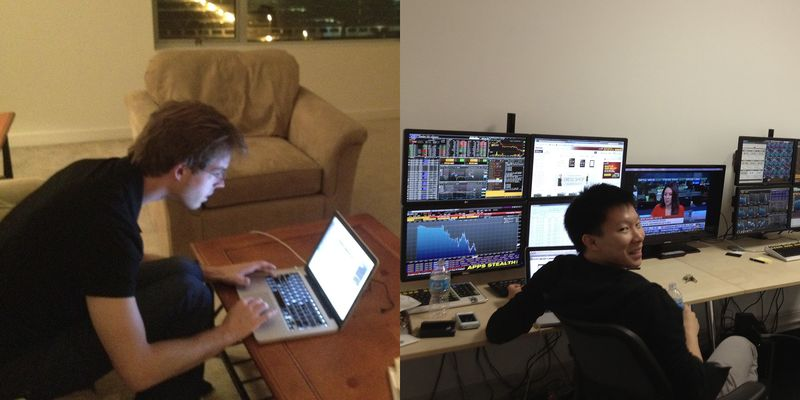
Kyle Davies, left, and Su Zhu, right, in May 2021Source: Three Arrows Capital
In a wide-ranging interview, the former Credit Suisse traders detailed the events leading to their fund’s implosion, which itself set off a chain reaction that has cost institutions and small-time speculators billions of dollars.
“The whole situation is regrettable,” Davies said. “Many people lost a lot of money.”
Leveraged Bets Meet Crypto Winter
Creditors of the fund, recently registered in the British Virgin Islands, filed paperwork saying they’re owed more than $2.8 billion in unsecured claims. That figure is expected to rise significantly, court papers show. To date, liquidators overseeing the insolvency have gained control of assets worth at least $40 million.
Zhu and Davies, long among the most vociferous crypto bulls in an industry known for extremes, put on trades – turbocharged by leverage – that put 3AC at the center of a series of implosions that convulsed the crypto market as prices retreated this year from their highs last fall. “We positioned ourselves for a kind of market that didn’t end up happening,” Zhu said.
“We believed in everything to the fullest,” added Davies. “We had all of our, almost all of our assets in there. And then in the good times we did the best. And then in the bad times we lost the most.”
At the same time, they claim, they weren’t outliers. They describe a confluence of interrelated one-way bets and accommodative borrowing arrangements that all blew up at once, leading not just to their fund’s demise but to bankruptcy, distress and bailouts at firms like Celsius Network, Voyager Digital and BlockFi.
“It’s not a surprise that Celsius, ourselves, these kind of firms, all have problems at the same time,” Zhu said. “We have our own capital, we have our own balance sheet, but then we also take in deposits from these lenders and then we generate yield on them. So if we’re in the business of taking in deposits and then generating yield, then that, you know, means we end up doing similar trades.”
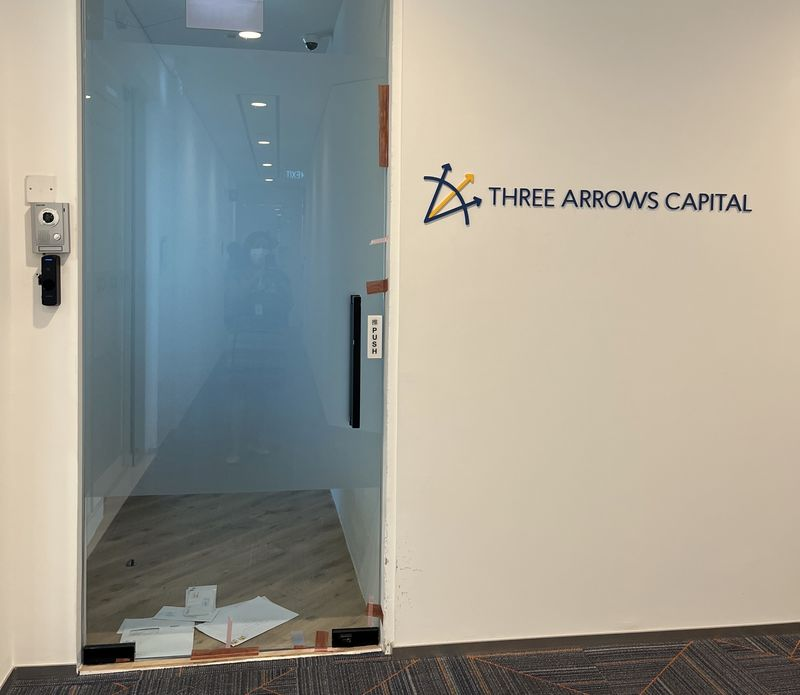
Mail piles up at Three Arrows’ office in Singapore.Source: Bloomberg
Efforts by Zhu and Davies to deflect blame are a sharp contrast to the pair’s previously relentless campaign of cheer-leading cryptoassets and belittling critics. Nerves were raked anew this week by creditor claims that the founders put a down payment on a $50 million yacht before the fund went under, a claim Zhu said is part of a smear campaign.
The boat “was bought over a year ago and commissioned to be built and to be used in Europe,” Zhu said, adding the yacht “has a full money trail.” He rejected the perception that he enjoyed an extravagant lifestyle, noting that he biked to work and back every day and that his family “only has two homes in Singapore.”
“We were never seen in any clubs spending lots of money. We were never seen, you know, kind of driving Ferraris and Lamborghinis around,” Zhu said. “This kind of smearing of us, I feel, is just from a classic playbook of, you know, when this stuff happens, when funds blow up, then you know, these are kind of the headlines that people like to play.”
The Long Arm of Luna
Davies and Zhu acknowledged heavy losses related to trades in Luna and the now-defunct algorithmic stablecoin TerraUSD, saying they were caught by surprise at the speed of the collapse of these tokens.
“What we failed to realize was that Luna was capable of falling to effective zero in a matter of days and that this would catalyze a credit squeeze across the industry that would put significant pressure on all of our illiquid positions,” Zhu said.
In retrospect, Zhu said, the firm may have been too close to Terra’s founder, Do Kwon.
“We began to know Do Kwon on a personal basis as he moved to Singapore. And we just felt like the project was going to do very big things, and had already done very big things,” he said in describing the firm’s miscalculations. “If we could have seen that, you know, that this was now like, potentially like attackable in some ways, and that it had grown too, you know, too big, too fast.”
“It was very much like a LTCM moment for us, like a Long Term Capital moment,” Zhu said. “We had different types of trades that we all thought were good, and other people also had these trades,” Zhu said. “And then they kind of all got super marked down, super fast.”
One of those trades involved an Ethereum-linked token called staked ETH, or stETH -- designed to be a tradable proxy for Ether and widely used in decentralized finance. While every stETH is meant to be redeemable for one Ether once long-awaited upgrades of the Ethereum blockchain take effect, the turmoil sparked by Terra’s collapse caused its market value to fall below that level. This, in turn -- in Zhu’s telling -- caused other investors to put on trades that could benefit from the widening gap.
“Because Luna just happened, it, it was very much a contagion where people were like, OK, are there people who are also leveraged long staked Ether versus Ether who will get liquidated as the market goes down?” Zhu said. “So the whole industry kind of effectively hunted these positions, thinking that, you know, that because it could be hunted essentially.”
Still, the fund was able to continue borrowing from large digital-asset lenders and wealthy investors -- until, that is, they blew themselves up.
After Luna’s implosion, Zhu said lenders were “comfortable” with 3AC’s financial situation, and that they allowed them to keep trading as “as if nothing was wrong.” As courts filings have now revealed, many of these loans had required only a very small amount of collateral.
“So I just think that, you know, throughout that period, we continued to do business as usual. But then yeah, after that day, when, you know, Bitcoin went from $30,000 to $20,000, you know, that, that was extremely painful for us. And that was in, that ended up being kind of the nail in the coffin.”
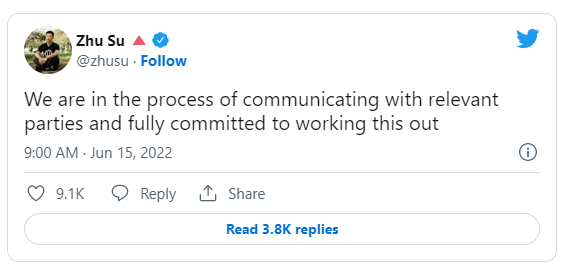
Zhu said that “if we were more on our game, we would’ve seen that the credit market itself can be a cycle and that, you know, we may not be able to access additional credit at the time that we need it. If, if it kind of, you know, it hits the fan.”
Locked in to GBTC
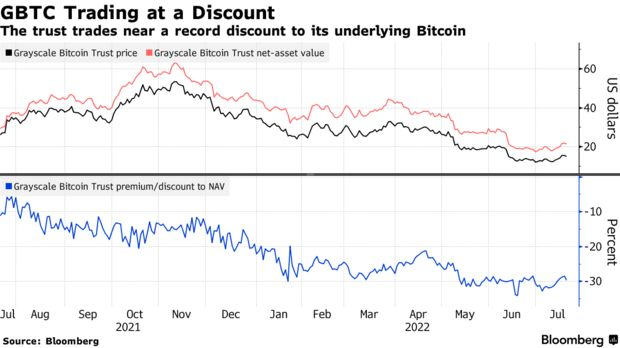
Another bullish trade that came back to bite 3AC was through the Grayscale Bitcoin Trust, or GBTC. The closed-end fund allows people who can’t or don’t want to hold Bitcoin directly to instead buy shares in a fund that invests in them. For a while, GBTC was one of the few US-regulated crypto products, so it had the market to itself. It was so popular that its shares traded at a persistent premium to the value of the Bitcoin it held on the secondary market.
Grayscale allowed big investors like 3AC to purchase shares directly by giving Bitcoin to the trust. These GBTC holders could then sell the shares to the secondary market. That premium meant any sales could net an attractive profit for the big investors. At the time of its last filing at the end of 2020, 3AC’s was the largest holder of GBTC, with a position then worth $1 billion.
The strategy had a snag, though: The shares bought directly from Grayscale were locked up for six months at a time. And starting in early 2021, that restriction became a problem. GBTC’s price slipped from a premium into a discount—a share was worth less than the Bitcoin backing it—as it faced stiffer competition from similar products. As the months went on, the discount got wider and wider and the so-called GBTC arbitrage trade no longer worked – especially hurting investors that used leverage to try to enhance returns.
The trust trades near a record discount to its underlying Bitcoin
In Zhu and Davies’ telling, it was partly their own success that helped propel both GBTC and the herd mentality around the trade.
“We managed to do it at the right window when it was a very big profit,” Zhu said. “And then like others copied us into that trade later on and then lost not just the money, but also went into negative. Because everyone did it, then the trust went to discount and then it went to a far bigger discount than anyone thought possible.”
In response to questions about what went wrong at the firm, Zhu cited overconfidence born of a multiyear bull market that infused not just him and Davies but nearly all of the industry’s credit infrastructure, where lenders saw their values swell by virtue of financing firms like his.
“There was always an understanding of what they were getting themselves into -- this was a risky firm,” Zhu said. “For us, if you go to our website, we’ve always had massive disclaimers about crypto risk. We’ve never once pitched ourselves as risk-free, like a simple yield.”
When crypto markets first started buckling in May, “we met all margin calls,” he said. “And, and so people understood that there was a risk involved.”
Moreover, lenders to the firm “benefited immensely when we were doing well, because as we were doing well, they could say, look, I make $200 million a year from Three Arrows’ financing business, give me a 10x multiple on that,” he said. “And now my own company’s worth $2 billion more. All these kinds of things. And so, like the risk departments were very relaxed about like the kind of risks that we were taking.”
So where from here? For now, the two co-founders are now transiting into Dubai. Zhu’s main hope is to get a calm, and orderly liquidation for their complex book of private assets.
“For Kyle and I, there’s so many crazy people in crypto that kind of made death threats or all this kind of noise,” Zhu said. “We feel that it’s just the interest for everyone if we can be physically secured and keep a low profile.”
“Given that we had planned to move the business to Dubai, we have to go there soon to assess whether we move there as originally planned or if the future holds something different for us,” Zhu added. “For now, things are very fluid and the main emphasis is on aiding the recovery process for creditors.”
As for Davies, “I have a feeling my next year is planned for me,” he said.
— With assistance by Vildana Hajric, Suvashree Ghosh, and Justina Lee