Much to the chagrin of cryptocurrency investors across the ecosystem, the bear market has officially set in and brought with it devastating price collapses that have left relatively few unscathed.
As the popular topic of conversation now centers on bearish predictions of how low Bitcoin will go and how long this iteration of the crypto winter will last, those with more experience on the matter know that it’s virtually impossible to predict the bottom and it would be wise to apply those energies elsewhere.
Instead of focusing on the when of the end, perhaps it’s more constructive to explore what events might help pull the market out of the bear market depths and put it on a path to its next up cycle.
Here’s a look at five potential catalysts that could pull the crypto market out of its current malaise.
A successful Ethereum merge
One of the most highly anticipated developments of the past five years has been the ongoing transition of the Ethereum network from proof-of-work to proof-of-stake.
While the process has been a drawn-out one that has faced numerous setbacks, the official switch is now closer than ever following the successful completion of the Merge trial on the public test network Sepolia.
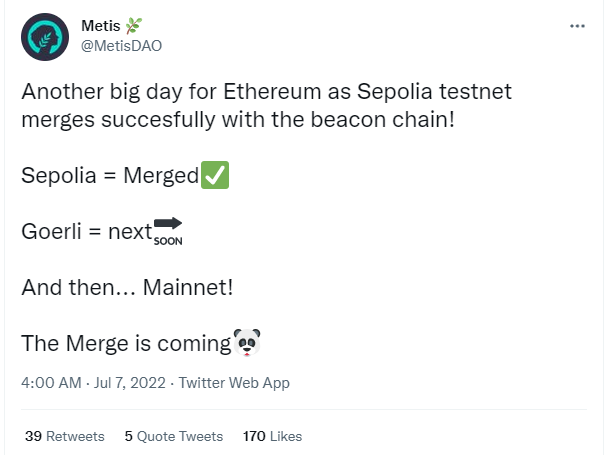
It’s possible that the building hype around the Ethereum Merge could help pull the crypto market out of its bearish state should the transition go off without a hitch, especially if it helps lead to more scalability and a faster user experience. As it stands right now, the Merge is set to take place in August 2022.
It should be noted that a successful Merge could also lead to a “buy the rumor, sell the news” type of event where prices briefly pump due to the euphoria of crypto holders, only to fall back down once the dire state of the global financial system comes back to the forefront.
Approval of a spot Bitcoin ETF
Another event that has been rumored for years that could spark a crypto revival is the passage of a spot Bitcoin exchange-traded fund (ETF) for United States markets.
Ever since 2017, when the first BTC ETF proposed by the Winklevoss twins was denied by the U.S. Securities and Exchange Commission (SEC), there has been one rejection after another for any physically-backed Bitcoin ETF proposal put forward.
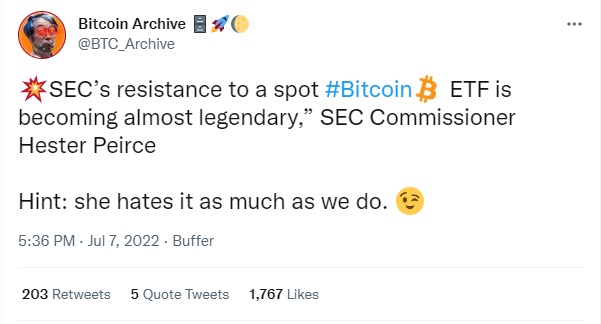
Reasons for the rejection typically revolve around the charge that cryptocurrency markets are easily manipulated and the proper safeguards are not in place to protect investors.
If a spot ETF were to be approved, it would render this long-running objection moot and bring a new level of legitimacy to Bitcoin and the crypto asset class as a whole. This has the potential to usher in a new wave of institutional adoption that could bring about the end of the crypto winter as new funds flow into the market.
The Fed reverses course
“Don’t fight the Fed” is a common expression investors use to explain one of the most influential forces on global financial markets. After multiple years of easy money policies and near-zero interest rates, the U.S. Federal Reserve approved an interest rate hike of 0.25%, the first-rate hike in more than three years.
Since then, the Fed has implemented two additional rate hikes of 0.5% and 0.75%, bringing the current benchmark interest rate to a range of 1.5% to 1.75%.
During the same period of time, risk assets around the world have been falling in price, with Bitcoin declining from $48,000 at the end of March to its current price, which is trading near support at $20,000.
The historic rise in the cryptocurrency and legacy markets that was witnessed in 2021 was largely driven by the easy money policies of the Fed, and it’s highly likely that a return to such policies would once again see funds flow into the crypto ecosystem.
Major adoption of Bitcoin as legal tender
2021 saw El Salvador become the first country in the world to adopt Bitcoin as a legal tender for use by its citizens. In April of 2022, the Central African Republic (CAR) became the second country to do so, pointing to a growing trend.
While the use of BTC as a legal form of tender has been a long-running goal of crypto proponents and the decisions by El Salvador and CAR are worth celebrating, its adoption by such small players on the world stage has done little to promote more mainstream acceptance.

That would likely change, however, if a larger market such as Japan or Germany were to open up to officially promoting the use of BTC by their citizens for their daily purchases.
Recent developments on the global stage, including conflicts and food shortages, are pushing governments to do things they never considered, and it’s not outside the realm of possibility that a larger economy could turn to Bitcoin as a currency of last resort as fiat currencies continue to lose their purchasing power.
Integration as a payment option by a large company
A common excuse as to why people don’t use Bitcoin or cryptocurrencies for their everyday purchases is because it’s not really accepted anywhere.
While there are options available for accessing the value held in crypto, such as debit cards and online payment integrations with platforms like Shopify, the ability to make purchases by conducting transactions directly on a blockchain network is relatively limited.
On several occasions, Elon Musk has demonstrated that the mere mention of integrating blockchain-based payments can spark a market rally for the token in question.

Based on this and other examples of price pumps that followed speculation about a major adoption announcement, it’s likely that crypto payments being integrated by a major company such as Amazon or Apple could spark a bullish wave of momentum.