Ripple CTO Schwartz Revisits NSA Past And Satoshi Speculation

bitcoinistОпубликовано 2025-10-24Обновлено 2025-10-24

Введение

Ripple chief technology officer David “JoelKatz” Schwartz has resurfaced a years-long thread of speculation around Bitcoin’s origins and his own...

Trusted Editorial content, reviewed by leading industry experts and seasoned editors. Ad Disclosure

Ripple chief technology officer David “JoelKatz” Schwartz has resurfaced a years-long thread of speculation around Bitcoin’s origins and his own pre-Ripple work with US government agencies, clarifying once again that he neither possessed “high level” intelligence nor claims special insight into Satoshi Nakamoto’s identity—while acknowledging that a US intelligence provenance for Bitcoin is “not a terrible theory.”

The renewed attention follows a fresh exchange on X on October 23, 2025, in which Schwartz responded to questions about prior employment and nondisclosure obligations—context that traces back to an October 24, 2022 thread where he weighed in on Satoshi debates and litigation risk tied to public claims about identity. “There is nothing defamatory about saying that Craig Wright is not Satoshi, just as there is nothing defamatory about saying that I am not Satoshi,” Schwartz wrote in 2022, adding, “There is nothing inherently wrong with not being Satoshi.”

In the same 2022 exchange, after community member @XRPcryptowolf joked “David Schwartz is Satoshi confirmed jk lol” and floated the notion that “Satoshi is really the CIA or NSA,” the Ripple CTO replied: “That’s not a terrible theory. If the NSA or the CIA happened to stumble on how to make bitcoin, it might make sense that they would implement and deploy it to eliminate the risk that someone hostile to the US would do it first and potentially made billions of dollars.”

Ripple CTO Shuts Down Satoshi Claims

The 2025 follow-ups drilled into Schwartz’s own past work and what, if anything, it implies. In response to a commenter’s claim—“Well, you’ve worked at the NSA, getting high level information, by your own words.” The Ripple CTO flatly rejected the characterization, indirectly doubling down that he isn’t (part of) Satoshi Nakamoto: “I never got anything even remotely resembling high level information. I had to certify that the thing I was working on would meet the NSA’s requirements without even being allowed to see most of them.”


He then shared vignettes about the compartmentalization he encountered. “One requirement that I was allowed to see was that you had to be able to stop it from processing classified data if you lost control over it. I was puzzled—if you lost control over it, by definition you can’t stop it, right? It was explained to me that that’s…” He also noted signage he wasn’t permitted to have explained: “They wouldn’t even tell me why there’s little signs all over the place (generally on entrances or containers) that can be set to ‘OPEN’ or ‘CLOSED’ and what ‘OPEN’ and ‘CLOSED’ mean on those signs.”

Schwartz further recounted how, at one point, he recognized the user interface of “one thing I worked on” not through briefings but “because late one night I happened to have the Discovery Channel on and saw our UI on a screen.” He clarified the lineage of that code: “To be precise, that was work I did (on the same core code) for NATO shortly before I adapted it for the NSA. I don’t remember how I found out what the NSA was using it for. I don’t think I should reveal the exact uses, but they’re pretty boring.”

Asked when his nondisclosure agreement would expire, he answered: “I have no idea. They didn’t let me keep a copy and I don’t remember—if I ever even knew. I just hope nobody really cares any more. Plus, I never really knew anything all that secret.”

The through-line between the 2022 and 2025 messages is clear: a willingness to treat state-origin hypotheses for Bitcoin as plausible without endorsing them. “There is nothing inherently wrong with not being Satoshi,” the Ripple CTO emphasized in 2022. By 2025, his clarifications around the nature of his NSA and NATO work add color but not conspiracy: process-driven engineering inside a tightly siloed environment, limited visibility into end use, and no privileged window into intelligence secrets.

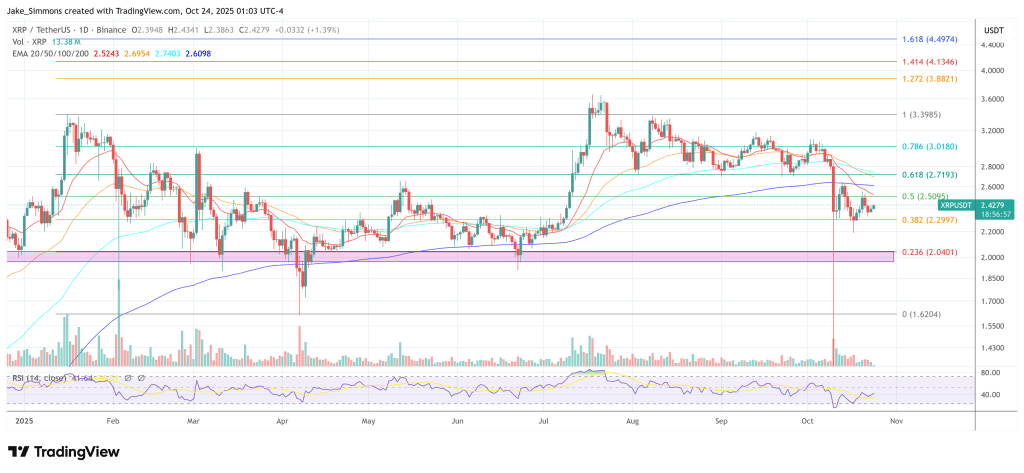
At press time, XRP traded at $2.42.
XRP price
XRP bulls face the 0.5 Fib, 1-day chart | Source: XRPUSDT on TradingView.com
Featured image created with DALL.E, chart from TradingView.com
Editorial Process for bitcoinist is centered on delivering thoroughly researched, accurate, and unbiased content. We uphold strict sourcing standards, and each page undergoes diligent review by our team of top technology experts and seasoned editors. This process ensures the integrity, relevance, and value of our content for our readers.

Jake Simmons has been a Bitcoin enthusiast since 2016. Ever since he heard about Bitcoin, he has been studying the topic every day and trying to share his knowledge with others. His goal is to contribute to Bitcoin's financial revolution, which will replace the fiat money system. Besides BTC and crypto, Jake studied Business Informatics at a university. After graduation in 2017, he has been working in the blockchain and crypto sector. You can follow Jake on Twitter at @realJakeSimmons.

Похожее

Retail Investors' 'Lead Brother' Serenity vs. Newly Minted Stock God Leopold: How Are the Two Top Hunters Mining AI's 'Physical Limits'?

The article profiles two prominent figures, Serenity and Leopold Aschenbrenner, who are gaining attention for their unconventional investment strategies focused on the physical constraints of the AI boom, moving beyond mainstream software narratives. Serenity, an anonymous online trader, advocates a "shiso leaf" theory. He targets small-cap companies with monopolies on critical, overlooked components in the AI hardware supply chain, such as specific semiconductor materials. His deep, technical analysis of bottlenecks in areas like co-packaged optics (CPO) has reportedly yielded massive returns, though his anonymity and focus on illiquid micro-cap stocks pose significant risks for followers. Leopold Aschenbrenner, a former OpenAI researcher, founded a multi-billion dollar hedge fund. His macro thesis argues that physical infrastructure—power grids, land, data centers—is the true bottleneck for AI growth, lagging far behind chip production. Consequently, his fund employs an infrastructure arbitrage strategy: heavily investing in storage and compute infrastructure companies while placing massive bearish bets (put options) against major semiconductor stocks, betting their valuations will correct as physical constraints become apparent. While their methods differ—Serenity drills into microscopic supply chain details, while Leopold takes a macroscopic, infrastructure-focused view—both share a core belief: the real power and investment alpha in the AI era lie in controlling scarce physical resources, not just software. The article concludes by noting the inherent risks in both approaches, such as liquidity issues for micro-caps and timing risks for macro bets, but suggests they signal a broader market re-evaluation of AI's foundational assets.

marsbit5 ч. назад

Retail Investors' 'Lead Brother' Serenity vs. Newly Minted Stock God Leopold: How Are the Two Top Hunters Mining AI's 'Physical Limits'?

marsbit5 ч. назад

Who Will Make Money in the Age of Agents?

In the Agents era of blockchain, traditional value capture theories face challenges. The "Fat Protocol" theory, dominant since 2016, suggested protocols capture most value as their tokens are essential for network use. However, the proliferation of interchangeable L1s, L2s, and modular layers has eroded protocol scarcity and pricing power. Conversely, the "Fat App" theory posits that applications capturing user relationships (like wallets and exchanges) become the primary value layer by controlling distribution and transaction flows. This aligns with the current "Great Repricing" cycle. Agents disrupt this logic. As software users, they lack brand loyalty, prioritize cost and efficiency, and switch between platforms seamlessly. This undermines the front-end UX moats that "Fat Apps" rely on. The article explores several potential futures: 1. **Headless Applications:** Current leading apps could strip their front-ends and become backend API infrastructure for Agents, preserving their role. 2. **Protocol Resurgence:** If integration becomes trivial, Agents might bypass aggregators and interact directly with protocols, reviving "Fat Protocol" dynamics. 3. **Pricing Power Collapse:** Agents' rational, frictionless routing could commoditize the entire stack, compressing margins toward cost and leaving little profit for intermediaries. 4. **Unprecedented Activity:** Agents may enable new, high-frequency, machine-to-machine economic activities, expanding the total value pie even if margins are thin. 5. **A New, Unnamed Model:** Historically, major tech shifts (like the internet's attention economy) create unforeseen business models. The Agents era may spawn entirely new ways to capture value. The most likely outcome is a coexistence where "Fat Apps" continue to serve human users valuing UX, while a separate, Agent-driven economy emerges governed by different rules—where loyalty is based on factors like liquidity, latency, and settlement guarantees rather than brand.

marsbit6 ч. назад

Who Will Make Money in the Age of Agents?

marsbit6 ч. назад

Торговля

Спот
Фьючерсы
活动图片