DeFi regulation fight derails U.S. crypto bill, odds of passage collapse to 17%

ambcryptoОпубликовано 2025-10-19Обновлено 2025-10-20

Key Takeaways 

Will the upcoming meeting resolve the Democrats hold-out?

This could be the end-goal, but market expectation was very low.

What’s the bone of contention in Congress? 

The controversial DeFi regulation proposal by Democrats irked the industry and Republicans at large. 


The crypto market structure regulation has hit the fan amid Congress fall-out. This followed a push by the Senate Democrats to regulate decentralized finance (DeFi).

Republicans, in response, withdrew from engagements, further putting the year-end deadline for passage of the bill into limbo.

Now, crypto executives will meet with the pro-crypto Senate Democrats on the 22nd of October, likely to resolve the stalemate. 

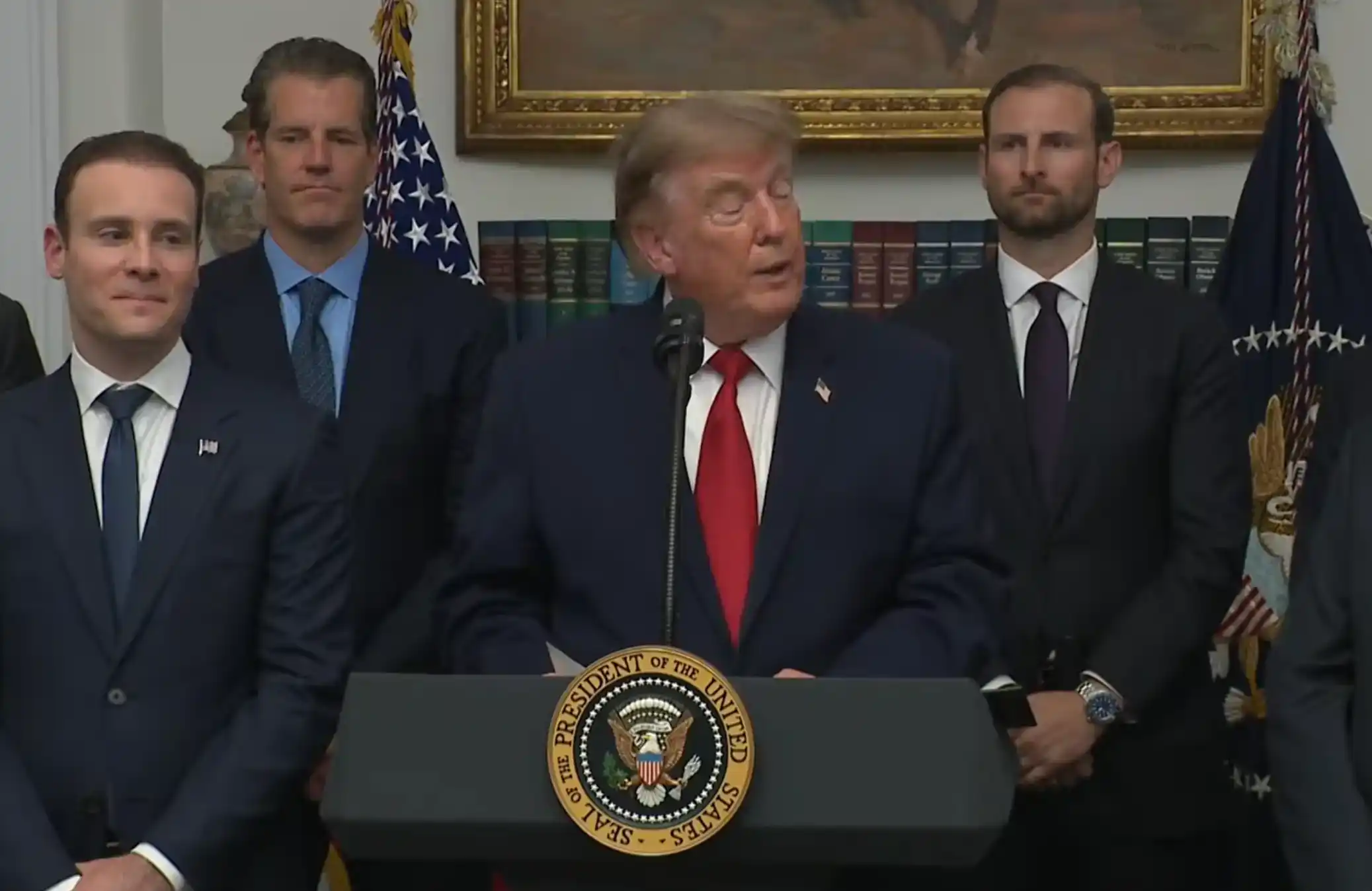
According to former FOX Business reporter Eleanor Terrett, the crypto leaders will include Coinbase CEO Brian Armstrong, Galaxy’s Mike Novogratz, Uniswap [UNI] CEO Hayden Adams, and others. 

Democrats’ hard stance

For closure, the Senate’s version of the crypto market structure bill has not made it out of the committee yet. 

The stand-off between Republicans and Democrats on the scope and certain key areas has complicated the path forward for the bill.

Pro-crypto Senate Democrats, led by Reuben Gallego, blamed Republicans for ‘crashing out.’ 

Jacques Petit, spokesman for the Sen. Gallego, told Politico that, 

“They (Republicans) asked for paper and substance, and we delivered. They then turned around and leaked our proposal and pretend to be surprised that our parties have policy differences.”

In response, the representative for Senate Banking Chair, Tim Scott, slammed Democrats, adding that the proposal wasn’t in a “good faith” for the market structure bill. 

“The document was not written in legislative text, included multiple incoherent policy ideas, and was not a good-faith effort to engage on market structure.”

For Blockchain Association, the umbrella body that champions for crypto advocacy, the proposal was “dissapointing.”

Crypto bill

Source: X

Worth pointing out that the stalled draft is totally separate from the one advanced from the House (the CLARITY Act) in July.

A harmonized version, if achieved, should pass a Senate floor vote. After that, it will go back to the House before hitting the president’s desk to be signed into law.

Republicans had initially planned to advance the bill from committee by the 30th of October and pass it to law by the end of the year.

But with the chaos, Polymarket showed there was only 17% chance it could become a law by the end of 2025. That’s a 60% drop in market expectations seen mid-July. 

Crypto bill

Source: Polymarket

Share

Похожее

Large Language Models Ace All Exams, Yet Move Farther from AGI: What Does This Paper Reveal?

The article discusses the ongoing challenge of defining and achieving Artificial General Intelligence (AGI). It notes that industry leaders have set vague, often profit- or time-based benchmarks for AGI, while the concept itself lacks a consensus definition—a situation the article compares to a "Rorschach test." It highlights a recent 2025 paper by researcher Michael Timothy Bennett, who proposes a new, measurable definition. Bennett frames AGI not as mimicking human performance on tests, which current large language models (LLMs) have already mastered, but as an "artificial scientist." A true AGI, according to this view, should be able to widely and efficiently adapt to new environments and tasks within real-world constraints (like computational and energy limits), focusing on the *discovery of new knowledge* rather than the replication of existing data. The author contrasts this with the current dominant approach of "scale-maxing"—massively scaling up data, parameters, and compute. While powerful, this method leads to models that fail on out-of-distribution problems and lack core intelligent abilities: they are passive learners, cannot reason causally, and cannot actively experiment or balance exploration with exploitation. The article argues that Bennett's framework offers a crucial shift. It makes AGI a quantifiable engineering problem and proposes new evaluation "adaptation benchmarks" that test an AI's ability to actively learn in novel scenarios. The conclusion is that achieving AGI will require a fundamental reset—a fusion of multiple methodologies beyond simple scaling, moving AI from mimicking patterns to embodying the scientific spirit of inquiry and discovery.

marsbit1 ч. назад

Large Language Models Ace All Exams, Yet Move Farther from AGI: What Does This Paper Reveal?

marsbit1 ч. назад

Pope Issues First AI Encyclical: 40,000 Words, 10 Key Points, Clarifying AI Anxiety

Pope Leo XIV's historic encyclical "Magnifica Humanitas," released in May 2026, marks the Catholic Church's first major document addressing artificial intelligence. The 40,000-word text moves beyond theological abstraction to confront practical AI anxieties affecting society. It argues that AI is no longer a mere tool but an embedded environment influencing daily decisions in areas like employment, healthcare, justice, and information, often without users' awareness. The encyclical presents ten core concerns. It highlights that the central issue isn't just regulation, but who holds the underlying *power*—control over data, compute, and platforms—often concentrated in private entities. It warns that even developers cannot fully explain AI systems, creating accountability gaps. While AI can simulate human interaction and creativity, it cautions against treating it as a moral agent capable of bearing true responsibility or forming genuine relationships. Key risks identified include AI's role in opaque decision-making for jobs or welfare, the amplification of persuasive disinformation, and the potential for education to focus on tool use over critical thinking. The document stresses that work has value beyond efficiency, and AI should enhance human capabilities, not merely replace roles. It firmly states that irreversible decisions, especially involving life and death, must remain under human judgment. Ultimately, the encyclical frames AI's challenge as anthropological, not just technological. As AI simulates uniquely human capacities like judgment and creation, it forces a re-examination of what makes human action meaningful: our capacity for responsibility, vulnerability, and bearing real consequences. The Pope concludes that technology is never neutral; its development and deployment are shaped by human values and choices, making an inclusive, ethically grounded dialogue essential for its future.

marsbit1 ч. назад

Pope Issues First AI Encyclical: 40,000 Words, 10 Key Points, Clarifying AI Anxiety

marsbit1 ч. назад

Торговля

Спот
Фьючерсы
活动图片