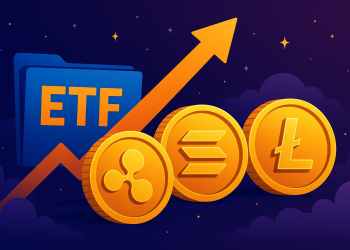
Canary Awaits SEC Greenlight on XRP And Solana ETFs Amid Shutdown

TheCryptoTimesОпубликовано 2025-10-10Обновлено 2025-10-10

Canary Capital is edging closer to the U.S. Securities and Exchange Commission (SEC) approval for its XRP and Solana (SOL) exchange-traded funds after filing updated registration statements on Friday. 

The firm disclosed a 0.50% sponsor fee for both the Canary XRP ETF and the Canary Marinade SOL ETF, a reduction from the 0.95% set for its earlier HBAR and Litecoin products. Bloomberg ETF analyst Eric Balchunas noted that Canary’s Solana ETF includes staking but won’t distribute staking rewards, signaling final preparations for approval.

The filing comes as several issuers, including those pursuing DOGE and LTC funds, await regulatory clarity under new SEC Chair Paul Atkins, whose crypto-friendly stance has accelerated listing reforms. New standards introduced this quarter could let multiple crypto ETFs list simultaneously without the lengthy 19b-4 process.

However, the U.S. government shutdown has disrupted that momentum. The SEC missed its October 2 deadline for Canary’s Litecoin ETF decision, and while the agency’s new S-1 framework removes strict timelines, it also adds uncertainty. 

SEC readies crypto ETF batch approvals

Canary’s adjustments highlight its persistence in navigating the shifting regulatory landscape. The lowered fees and expanded ETF lineup position it to compete with issuers like Bitwise, which recently set a 0.20% fee for its Solana product, intensifying the race to attract retail and institutional investors seeking exposure to digital assets through regulated channels.

The firm’s progress with XRP and Solana builds on its delayed Litecoin ETF, reflecting a broader strategic push rather than a setback. By focusing on multi-asset approvals under the new administration, Canary is betting on efficiency and compliance as the SEC adapts to a more structured crypto market.

If the SEC batches pending crypto ETFs as expected, Canary could be among the first issuers to launch under the reformed process, marking a turning point for regulated digital-asset products. Its persistence through regulatory gridlock underscores a larger trend: crypto ETFs are shifting from speculation to inevitability, signaling the next phase of institutional adoption.

Also read: DTCC Adds Canary Trump Coin ETF (TRPC) to Listings


Mobile Only Image

Похожее

Altcoin: The ETF Boom Explodes – XRP, SOL, LTC, HBAR, DOGE, LINK, and the Emergence of New Opportunities

While the spotlight has been on Solana (SOL) ETFs, which have attracted approximately $682 million in inflows, XRP ETFs have quietly surpassed them with $874 million, despite launching later. Simultaneously, a new wave of altcoin ETFs for LTC, HBAR, DOGE, and LINK has entered the market, each recording modest but stable inflows since their debut. Seven separate Solana ETFs have generated $618.62 million in net inflows, holding $915.08 million in assets under management, representing about 1.15% of Solana's market cap. In contrast, four XRP ETFs have attracted $874.28 million, with Canary's XRPC leading at $357 million. The newly launched altcoin ETFs for LINK, HBAR, LTC, and DOGE have collectively seen $133.46 million in net inflows. Grayscale's GLNK attracted $40.90 million, Canary's LTCC (Litecoin) drew $7.67 million, and its HBR (HBAR) ETF recorded $82.04 million. Two DOGE ETFs brought in $2.85 million. This expansion signals a new market phase of diverse choices and intense competition. However, these new altcoin ETFs remain far behind the established Bitcoin and Ethereum ETFs in terms of total capital. Amid this ETF boom, Bitcoin Hyper (HYPER) is emerging as a potential altcoin outside the traditional ETF scope. It's a Bitcoin Layer-2 project built on the Solana Virtual Machine (SVM), combining Solana's speed with Bitcoin's security. Having raised nearly $29 million in its presale, it offers a fixed supply of 21 billion tokens and 40% staking APY, positioning itself to unlock Bitcoin's potential in DeFi.

bitcoinist21 мин. назад

Altcoin: The ETF Boom Explodes – XRP, SOL, LTC, HBAR, DOGE, LINK, and the Emergence of New Opportunities

bitcoinist21 мин. назад

Polymarket Revival: The Mainstreaming of Crypto Prediction Markets and Future Prospects

Polymarket, a crypto-based prediction market platform, has made a significant comeback in 2025 by re-entering the U.S. market through regulatory-compliant means, including the acquisition of regulated trading and清算 entities. This resurgence is further supported by institutional capital investment and integration with mainstream platforms like the MetaMask wallet, allowing users to trade directly without leaving their wallets. Mainstream financial data platforms have also begun displaying prediction market data, increasing market visibility. Once viewed primarily as a gambling or speculative platform, Polymarket is increasingly recognized as a mechanism for information pricing in financial markets. Widespread participation from both retail and institutional users has made its probability assessments of future events more representative and liquid. Prediction market data is now being incorporated by traditional financial media and data platforms, highlighting its growing potential. However, challenges remain. Prediction markets are not always accurate, with studies showing limited predictive reliability in certain contexts. Questions about platform neutrality and business models have emerged, such as the employment of internal market makers, which could undermine trust. Information asymmetry and insider risks are inherent, potentially disadvantaging ordinary users when some participants access information early. Regulatory, tax, and disclosure requirements also present ongoing uncertainties. The revival and transformation of Polymarket signify a broader shift of prediction markets from niche experiments toward mainstream financial infrastructure. By converting public expectations into tradable probabilities, these markets may complement traditional analysis and polling, providing real-time, decentralized signals in areas like macroeconomics, policy, technology, and geopolitics. As traditional financial institutions invest in compliance and structured products, DeFi is evolving beyond an alternative asset pool to resemble traditional financial infrastructure. Prediction market applications are expanding beyond crypto to potentially include stocks, macroeconomic indicators, sports events, and tech product launches, tightening the link between crypto and the real world. If platforms like Polymarket continue on a path of compliance, stable operation, and integration with mainstream financial services, they could become next-generation market infrastructures—event-driven financial tools alongside stocks, bonds, and options. Key factors for development include platform neutrality, prediction accuracy, regulatory environment, participant diversity, and the maturity of related financial products. In summary, Polymarket’s comeback represents a move of prediction markets from the fringe into the core of financial systems, reflecting deeper changes in how information is priced and how financial infrastructure is rebuilt. This shift brings not only new trading methods but also potential changes in how investors perceive and engage with future events and asset valuation.

cointelegraph_中文58 мин. назад

Polymarket Revival: The Mainstreaming of Crypto Prediction Markets and Future Prospects

cointelegraph_中文58 мин. назад

Торговля

Спот
Фьючерсы
活动图片