三步掌控美联储:揭秘特朗普重塑美国央行的清晰路线图

marsbitОпубликовано 2025-08-26Обновлено 2025-08-27

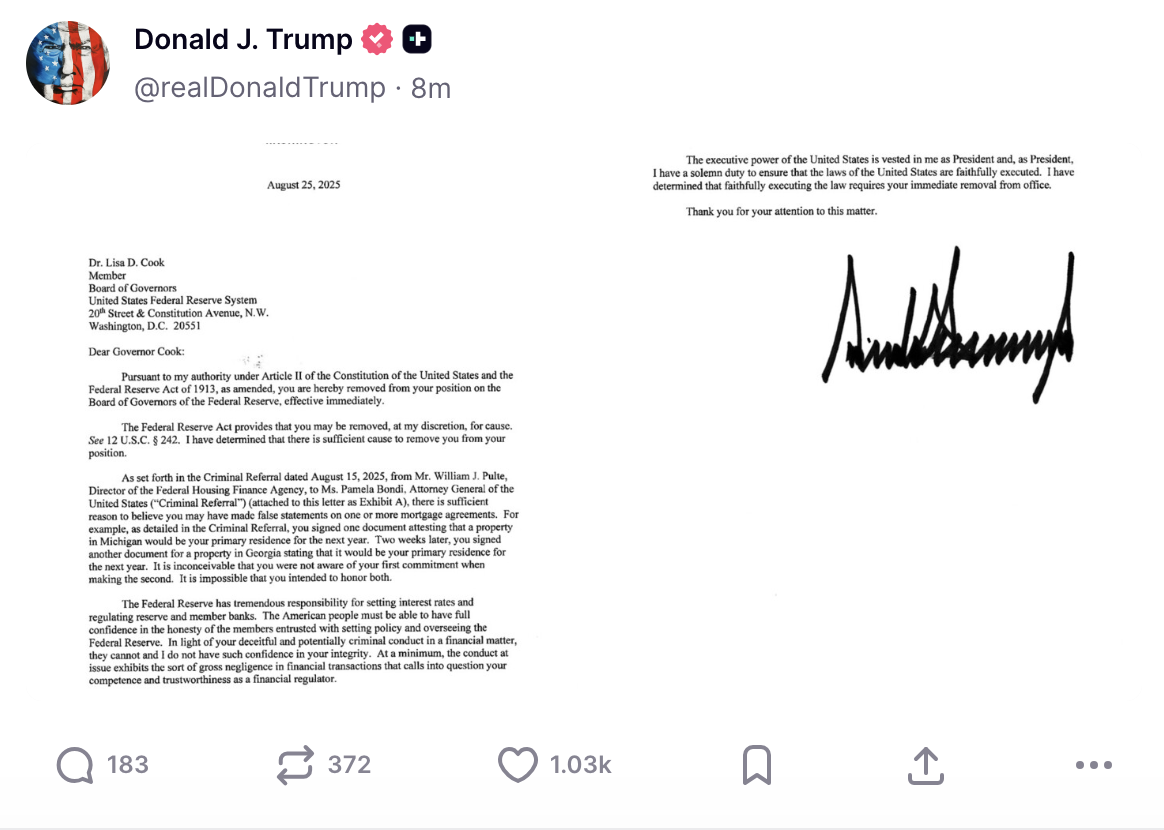
周二晚间,一条社交媒体帖子打破了华盛顿一个多世纪以来的政治默契。美国总统唐纳德·特朗普以他惯有的戏剧性方式,宣布了一个史无前例的决定:即刻解除美联储理事丽莎·库克(Lisa Cook)的职务。
利率

消息传出,全球金融市场应声而动。华尔街的交易屏幕上,美股期货转为下跌,黄金则作为避险资产闻风上涨。市场的反应并非针对一次简单的人事变动,而是源于一种更深层次的恐惧:这并非一次心血来潮的政治报复,而是一场旨在从根本上重塑美国央行的系统性计划的第一步——一个清晰的“三步走”路线图的正式开启。

这个计划的目标只有一个:将美联储的独立性彻底瓦解,把决定美元利率的权力牢牢掌握在白宫手中。

第一步:夺取理事会——从罢免库克开始

计划的第一步,也是最关键的一步,是在由七名成员组成的美联储理事会中,获得稳定的多数控制权。

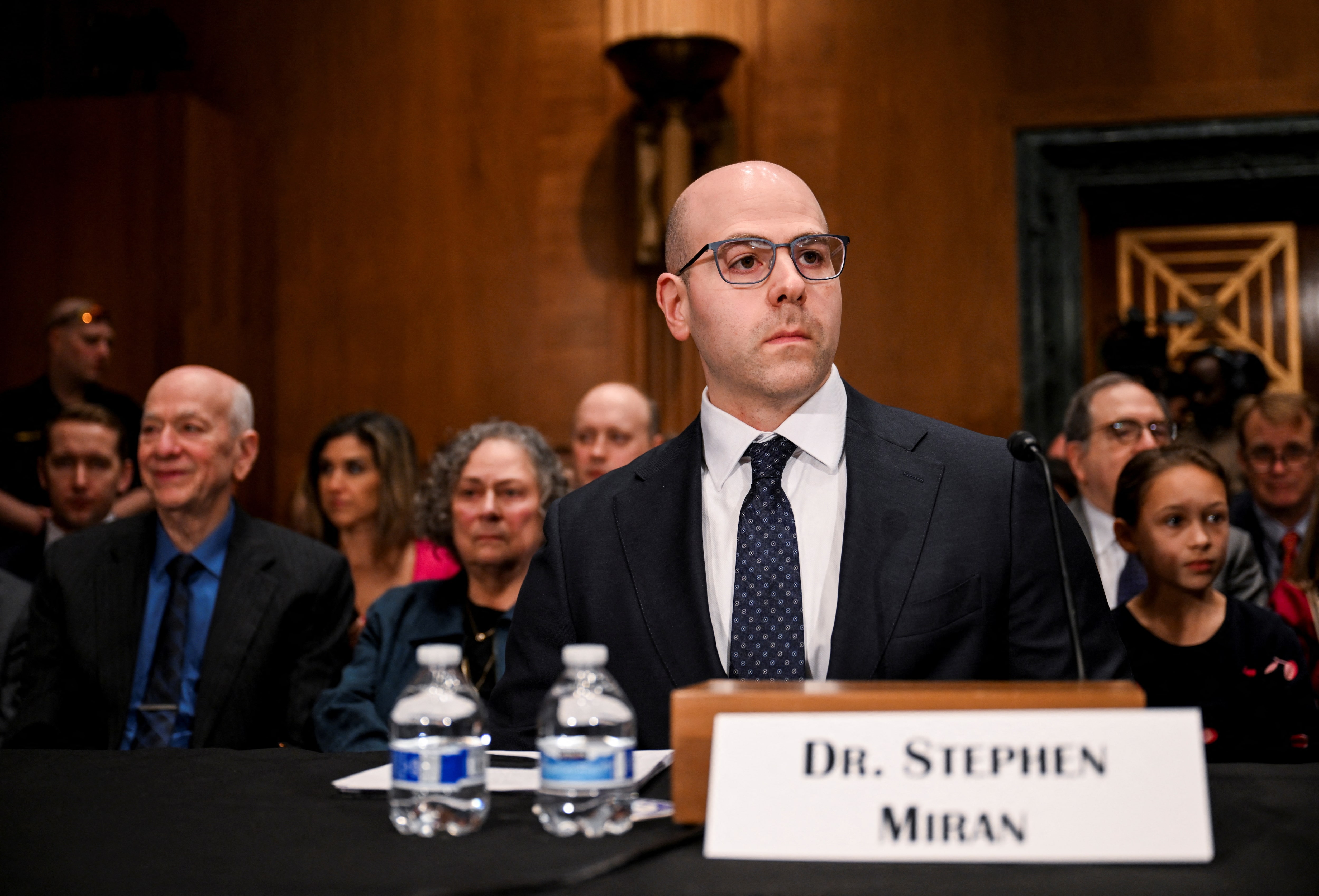
美联储理事会是整个美联储体系的权力核心,而特朗普的布局早已开始。在他当前的任期内,他已经成功任命了两位理事。近期,随着前总统拜登任命的理事阿德里亚娜·库格勒(Adriana Kugler)提前辞职,特朗普迅速提名了他的经济顾问斯蒂芬·米兰(Stephen Miran)来填补这第三个席位。
利率

至此,特朗普距离控制理事会仅一步之遥。而罢免丽莎·库克,正是为了腾出这至关重要的第四个席位。一旦成功,特朗普将能够任命四名自己人,在七人理事会中占据多数,从而在理论上掌控美联储的所有重大决策。

当然,这一步的执行充满了法律风险。特朗普的解职理由——库克在加入美联储前的抵押贷款申请中涉嫌欺诈——被广泛视为一个政治借口。库克已迅速提起诉讼,一场围绕《联邦储备法》中“因故解职”条款的模糊性解释的法律大战已不可避免。这场官司极有可能直达最高法院,其判决将定义未来美国总统的权力边界。但在特朗普的剧本里,发起这场法律战本身,就是通往第一步目标必须走的路。


第二步:征服FOMC——釜底抽薪式的权力延伸

一旦完成了第一步,即控制了美联储理事会,特朗普的计划将迅速进入第二阶段:通过理事会,间接控制真正决定利率走向的联邦公开市场委员会(FOMC)。

FOMC是全球金融市场最关注的决策机构,由7名美联储理事和5名地区联储主席共同组成,共12个投票席位。表面上看,即便控制了全部7名理事,也无法完全主导FOMC。但“新美联储通讯社”、《华尔街日报》记者Nick Timiraos揭示了特朗普更深层次的策略。

根据法律,12家地区联储的主席由各自地区的董事会任命,但最终需要获得华盛顿的美联储理事会批准。Timiraos分析指出,如果特朗普在明年3月前成功控制了理事会,他的“多数派”便可以拒绝重新任命那些任期届满、且与白宫政策不同调的地区联储主席。

这是一种釜底抽薪式的权力延伸。通过否决地区联储主席的任命,一个被特朗普掌控的理事会能够逐步“清洗”FOMC中的独立声音,确保最终在利率决策会议上,白宫的意志能够畅通无阻。这将彻底打破自1913年美联储成立以来,保护其独立性的关键防火墙。


第三步:执行新政——打造一个“降息多数派”

完成了前两步的权力布局后,计划的最终目标便水到渠成:让美联储的货币政策完全服务于其政治议程,打造一个坚定的“降息多数派”。

特朗普的政策偏好从未掩饰。他在内阁会议上直言不讳:“人们现在支付的利率太高了。这是我们唯一的问题。”他渴望一个能够为他大幅降息的美联储,以此来刺激经济增长、提振房地产市场,并为他的政治议程创造一个繁荣的经济背景。

一个被完全掌控的美联储,将成为总统推行其经济政策最强大的工具。届时,利率的制定将不再主要依据通胀和就业等经济数据,而是更多地考虑白宫的短期政治需求。


历史的警钟与加密世界的“回响”

特朗普这套环环相扣的计划,之所以引发巨大的恐慌,是因为它触及了现代经济一个最核心的原则:中央银行的独立性。历史已经反复敲响警钟,从1970年代尼克松施压美联储导致的美国大通胀,到土耳其、阿根廷等国因央行独立性丧失而陷入的货币危机,教训惨痛。

而这场发生在2025年的权力对决,正在加密世界引发深刻的“回响”。比特币自诞生之日起,其核心叙事之一就是对中心化金融体系不信任的对冲。当中本聪在创世区块中嵌入银行濒临破产的报纸标题时,就奠定了其对抗脆弱中心化机构的基调。

如今,当世界储备货币的“守护者”——美联储——其独立性受到公然挑战时,比特币的价值主张显得尤为突出。加密世界的支持者认为,当货币政策可以因一位总统的政治需求而随时改变时,一种由代码规定、发行节奏固定、不受任何人控制的资产,其吸引力便会指数级增长。

更值得注意的是,特朗普对金融监管机构的重塑并非孤例。就在库克事件发酵的同时,美国商品期货交易委员会(CFTC)正经历高层离职潮,而特朗普一直致力于让支持加密货币的共和党领导人加入他的政府。这一系列动作,无论其初衷如何,都在客观上为加密行业带来了更友好的监管预期,同时也让传统金融体系的不确定性进一步凸显。

无论最终结果如何,这场风暴本身已经对美元和美国金融体系的信誉造成了损害。在一个全球多极化、技术日新月异的时代,每一次对传统金融体系稳定性的冲击,都可能在客观上推动人们去探索新的可能性。正如《华爾街日報》的警告言犹在耳:这个国家,终将为此感到后悔。而对于正在崛起的数字资产世界来说,这或许又是一个证明其存在价值的时刻。
Похожее

End of the 'Gray Era' for Hong Kong and US Stock Trading Accounts: Where Can Your Money Go Now?

Hong Kong and US stock “grey account opening era” ends, where can your money go? In a coordinated regulatory crackdown starting May 22nd, Hong Kong's SFC and China's securities regulator have targeted the previously common but legally ambiguous practice of mainland Chinese investors opening accounts with Hong Kong brokers to trade Hong Kong and US stocks. The SFC issued a stern circular after a review of 12 brokerages, citing major deficiencies including inadequate due diligence, acceptance of suspicious or forged documents, and weak management of cross-border relationships. New requirements mandate mainland clients to submit a written declaration confirming their investment funds originate from *outside* mainland China, the account has never been closed for using suspicious documents, and agreeing to information disclosure. Brokers must immediately close accounts opened with suspicious documents and dormant accounts. Simultaneously, Chinese authorities launched a two-year campaign to rectify illegal cross-border securities activities. Key internet brokers like Futu, Tiger Brokers, and Longbridge are facing penalties, with existing accounts allowed only to sell/withdraw funds, not add new ones. The impact is immediate. Reports from social media and financial news outlets confirm that individuals traveling to Hong Kong to open accounts are now required to sign the new declaration. However, even after signing, applications are frequently rejected. The declaration shifts compliance responsibility to the client and acts as a filter, as most mainland investors' funds do not legally meet the "from outside China" criterion. Major brokers like Futu and Tiger have stopped accepting new mainland clients. A few, such as uSmart Securities, Fosun Wealth, and Cheerful Investment, still offer limited channels, but approvals have tightened significantly. Crucially, funding must now come exclusively from the investor's own bank account in Hong Kong or a qualified jurisdiction, blocking previous workarounds like using money changers or stablecoins. For mainland investors, compliant pathways still exist but are narrower. Individuals with overseas status (students, work visa holders) and verifiable offshore funds may still qualify. Official channels like Stock Connect, QDII, and the Cross-boundary Wealth Management Connect remain fully compliant options, albeit with product and quota limitations. On-chain alternatives exist but carry their own regulatory uncertainties and often exclude mainland users. The crackdown signals the end of the lax expansion period for Hong Kong brokers targeting mainland clients. While investment opportunities persist, the era of easy, low-compliance access is over. Investors must now carefully assess their eligibility and understand that signing the new declaration carries personal legal liability.

Odaily星球日报44 мин. назад

End of the 'Gray Era' for Hong Kong and US Stock Trading Accounts: Where Can Your Money Go Now?

Odaily星球日报44 мин. назад

SpaceX's $1.75 Trillion IPO: A Quick Guide to 17 Related Stocks

**Title: SpaceX's $1.75 Trillion IPO: Analysis of 17 Related Stocks** SpaceX is set to IPO on Nasdaq with a $1.75 trillion valuation. The real value driver is Starlink, contributing 61% of Q1 revenue with high margins. Its valuation heavily depends on future execution, including user growth despite falling ARPU. Key stocks have already surged pre-IPO. Tesla (TSLA, +10%) is a primary beneficiary due to deep integration with SpaceX in chip design and AI. Rocket Lab (RKLB, +89%) is seen as a "mini-SpaceX," but faces risk from potential Neutron rocket delays. AST SpaceMobile (ASTS) competes in the same satellite-to-phone market as Starlink. Firefly (FLY, +70%) is a strong government contractor in lunar services. Partners like EchoStar (SATS), Planet Labs (PL), and T-Mobile (TMUS) will see revaluation. Suppliers like Qualcomm (QCOM, +57%) are critical ecosystem "picks and shovels." Investment vehicles like DXYZ (+80%) hold significant SpaceX stakes but trade at high premiums, which may collapse post-IPO. Redwire (RDW) is highlighted as an under-the-radar "pick and shovel" play in space components, with growth in defense contracts and microgravity pharmaceuticals. The article warns that much of the positive news is already priced in, and a post-IPO sell-off is possible. Large IPOs often underperform initially. Key risks include Starship delays, ARPU decline, and unforeseen black swan events affecting Elon Musk or space operations. Investors are advised to focus on companies with solid fundamentals and manage overall sector exposure carefully.

marsbit46 мин. назад

SpaceX's $1.75 Trillion IPO: A Quick Guide to 17 Related Stocks

marsbit46 мин. назад

Conversation with VanEck CEO: Memory Chip Stocks Are a Bubble, Bitcoin Will Stay but Token Ecosystems Will Disappear

In this podcast, VanEck CEO Jan van Eck discusses his investment outlook centered on three key long-term ("10-year macro") themes: AI-driven compute demand, India's economic rise, and excessive government debt in developed nations. Regarding AI and semiconductors, van Eck believes Nvidia has transformed into a foundational "host" for AI infrastructure, possessing deep moats in software, scale, and power efficiency, making it a core holding. However, he views the recent surge in memory chip stocks as a bubble driven by temporary supply-demand imbalances and pricing power, lacking Nvidia's competitive durability. On asset management, he emphasizes that while ETFs are scale-driven tools, the decisions on which ETFs to own and how to allocate remain highly active. He expresses greatest concern over fixed-income market illiquidity and the risk of a loss of confidence in government debt sustainability. Van Eck is bullish on gold's long-term role as a global monetary alternative and highlights the dramatic policy-driven growth in nuclear energy investment. He is strongly positive on India due to its demographic trends and pro-business reforms. Discussing crypto, he labels 2026 the "year of the corporate-controlled chain," where traditional finance adopts blockchain's best features (like 24/7 operation and programmability) but retains control. He predicts a permanent "crypto winter" for many projects, with only Bitcoin, stablecoins, and the core blockchain concept surviving long-term. He sees the U.S. stablecoin bill as marginally impactful, enabling tech firms to compete with, but not replace, banks. Finally, he views the upcoming SpaceX IPO as a significant, positive liquidity event for markets and advises investors to maintain a long-term, macro perspective when making asset allocation decisions.

marsbit57 мин. назад

Conversation with VanEck CEO: Memory Chip Stocks Are a Bubble, Bitcoin Will Stay but Token Ecosystems Will Disappear

marsbit57 мин. назад

Торговля

Спот
Фьючерсы
活动图片