US DOJ Disbands Crypto Enforcement Unit Amid Trump Administration’s Regulatory Shift – Report

bitcoinistОпубликовано 2025-04-09Обновлено 2025-04-09

Введение

The US Department of Justice (DOJ) is reportedly disbanding the National Cryptocurrency Enforcement Unit (NCET) to comply with President Donald...

Trusted Editorial content, reviewed by leading industry experts and seasoned editors. Ad Disclosure

The US Department of Justice (DOJ) is reportedly disbanding the National Cryptocurrency Enforcement Unit (NCET) to comply with President Donald Trump’s regulatory shift towards digital assets.

DOJ Disbands Crypto Enforcement Unit

On Monday evening, the DOJ notified its staff that the NCET, the unit dedicated to crypto investigations, would be disbanded “effective immediately,” a Fortune report claims. The news media outlet reviewed a four-page memo announcing the decision and criticizing the previous administration’s crackdown on the industry.

US Deputy Attorney General Todd Blanche wrote, “The Department of Justice is not a digital assets regulator. However, the prior Administration used the Justice Department to pursue a reckless strategy of regulation by prosecution.”

Blanche, the second-ranking official in the DOJ, explained that the crypto enforcement unit’s disbandment was part of the agency’s actions to “comply with Trump’s January executive order on digital assets,” aiming to establish regulatory clarity for the crypto sector.

Moreover, the Deputy Attorney General told the DOJ employees in the memo to focus on “prosecuting individuals who victimize digital asset investors” instead of crypto exchanges, mixers, and “offline wallets,” the report states.

The NCET was a joint task force established in October 2021 under the Biden administration and has been active since February 2022. It was formed with prosecutors from the agency’s money laundering and cybercrime units and attorneys from other district offices.

The enforcement unit worked on some of the most prominent crypto-related cases, including the Avraham Eisenberg lawsuit and Tornado Cash, which was recently delisted from the US Department of the Treasury’s Office of Foreign Assets Control (OFAC)’s Specially Designated Nationals (SDN) list.

The US New Regulatory Era

The DOJ move follows the Trump administration’s efforts to develop clear regulatory guidelines to protect investors and develop the industry. The US Securities and Exchange Commission (SEC) has reportedly taken similar actions to end the previous “regulation by enforcement” approach.

As reported by Bitcoinist, the SEC downsized its special unit for crypto enforcement actions in February. Five sources told The New York Times that the Commission’s special unit members were reassigned to other SEC departments.

The division was created in 2017 during the first Trump administration and comprised lawyers and staff dedicated to bringing industry-related enforcement actions. However, it significantly grew under Gary Gensler’s supervision.

The SEC’s enforcement unit nearly doubled its size to 50 dedicated positions in May 2022, bringing over 100 crypto-related actions during the Biden administration, allegedly “related to fraudulent and unregistered crypto asset offerings and platforms.”

It’s worth noting that the Commission, under acting chair Mark Uyeda, created a Crypto Task Force to review the agency’s approach toward digital assets. The task force, led by Commissioner Hester Peirce, is taking a “more enjoyable and less risky” approach than the SEC’s strategy in the last decade.

As part of these efforts, the regulatory agency is hosting four digital assets-dedicated roundtables in the coming months. Recent reports revealed that representatives from major industry players, like Coinbase and Uniswap Labs, will attend the first roundtable, scheduled for April 11.
crypto, bitcoin, btc, btcusdt

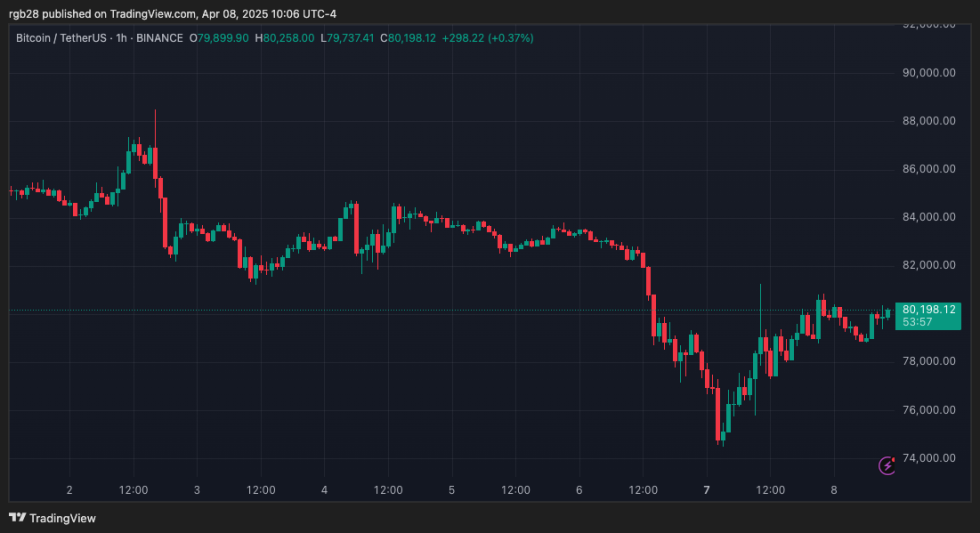
Bitcoin (BTC) trades at $80,198 in the one-week chart. Source: BTCUSDT on TradingView
Featured Image from Unsplash.com, Chart from TradingView.com
Editorial Process for bitcoinist is centered on delivering thoroughly researched, accurate, and unbiased content. We uphold strict sourcing standards, and each page undergoes diligent review by our team of top technology experts and seasoned editors. This process ensures the integrity, relevance, and value of our content for our readers.

Rubmar is a crypto enthusiast who likes learning and improving constantly. She enjoys reporting on the latest news and developments in the crypto industry. Rubmar also enjoys scrapbooking, crafting, simulation games, and watching football.

Похожее

Large Language Models Ace All Exams, Yet Move Farther from AGI: What Does This Paper Reveal?

The article discusses the ongoing challenge of defining and achieving Artificial General Intelligence (AGI). It notes that industry leaders have set vague, often profit- or time-based benchmarks for AGI, while the concept itself lacks a consensus definition—a situation the article compares to a "Rorschach test." It highlights a recent 2025 paper by researcher Michael Timothy Bennett, who proposes a new, measurable definition. Bennett frames AGI not as mimicking human performance on tests, which current large language models (LLMs) have already mastered, but as an "artificial scientist." A true AGI, according to this view, should be able to widely and efficiently adapt to new environments and tasks within real-world constraints (like computational and energy limits), focusing on the *discovery of new knowledge* rather than the replication of existing data. The author contrasts this with the current dominant approach of "scale-maxing"—massively scaling up data, parameters, and compute. While powerful, this method leads to models that fail on out-of-distribution problems and lack core intelligent abilities: they are passive learners, cannot reason causally, and cannot actively experiment or balance exploration with exploitation. The article argues that Bennett's framework offers a crucial shift. It makes AGI a quantifiable engineering problem and proposes new evaluation "adaptation benchmarks" that test an AI's ability to actively learn in novel scenarios. The conclusion is that achieving AGI will require a fundamental reset—a fusion of multiple methodologies beyond simple scaling, moving AI from mimicking patterns to embodying the scientific spirit of inquiry and discovery.

marsbit1 ч. назад

Large Language Models Ace All Exams, Yet Move Farther from AGI: What Does This Paper Reveal?

marsbit1 ч. назад

Pope Issues First AI Encyclical: 40,000 Words, 10 Key Points, Clarifying AI Anxiety

Pope Leo XIV's historic encyclical "Magnifica Humanitas," released in May 2026, marks the Catholic Church's first major document addressing artificial intelligence. The 40,000-word text moves beyond theological abstraction to confront practical AI anxieties affecting society. It argues that AI is no longer a mere tool but an embedded environment influencing daily decisions in areas like employment, healthcare, justice, and information, often without users' awareness. The encyclical presents ten core concerns. It highlights that the central issue isn't just regulation, but who holds the underlying *power*—control over data, compute, and platforms—often concentrated in private entities. It warns that even developers cannot fully explain AI systems, creating accountability gaps. While AI can simulate human interaction and creativity, it cautions against treating it as a moral agent capable of bearing true responsibility or forming genuine relationships. Key risks identified include AI's role in opaque decision-making for jobs or welfare, the amplification of persuasive disinformation, and the potential for education to focus on tool use over critical thinking. The document stresses that work has value beyond efficiency, and AI should enhance human capabilities, not merely replace roles. It firmly states that irreversible decisions, especially involving life and death, must remain under human judgment. Ultimately, the encyclical frames AI's challenge as anthropological, not just technological. As AI simulates uniquely human capacities like judgment and creation, it forces a re-examination of what makes human action meaningful: our capacity for responsibility, vulnerability, and bearing real consequences. The Pope concludes that technology is never neutral; its development and deployment are shaped by human values and choices, making an inclusive, ethically grounded dialogue essential for its future.

marsbit1 ч. назад

Pope Issues First AI Encyclical: 40,000 Words, 10 Key Points, Clarifying AI Anxiety

marsbit1 ч. назад

Торговля

Спот
Фьючерсы
活动图片