‘Odds Increasing’ Of US Bitcoin Buy In 2025 – Galaxy Analyst

bitcoinistОпубликовано 2025-04-08Обновлено 2025-04-08

Введение

Alex Thorn, Head of Research at Galaxy Digital, expressed a marked shift in his outlook regarding potential United States government...

Trusted Editorial content, reviewed by leading industry experts and seasoned editors. Ad Disclosure

Alex Thorn, Head of Research at Galaxy Digital, expressed a marked shift in his outlook regarding potential United States government purchases of Bitcoin in 2025. Writing on Sunday via X, Thorn underscored what he described as an evolving picture, stating, “It does seem increasingly likely that the USA is making progress on the logistics and mechanics of the strategic reserve. We had predicted in dec 2024 that in 2025 the US would formally hodl BTC but not purchase, but we now see the odds increasing that US govt will make at least one purchase in 2025.”

Thorn pointed to recent comments from the Trump administration as the reason for the change: “See Bessent’s comment to tucker carlson, drumbeat from sacks and hines,” as well as the upcoming deadline for the BTC audit: “Keep in mind monday is deadline from SBR EO for govt agencies to complete audit of their bitcoin / digital assets holdings. Not clear they will release anything publicly on this but likely progress being made.”

US Bitcoin Purchase In 2025?

Thorn’s reference to “Bessent’s comment” alludes to remarks made by US Treasury Secretary Scott Bessent in a recent interview with Tucker Carlson. When Carlson asked why gold is being shipped around the world right now, Bessent, after a brief reply about gold, abruptly pivoted to Bitcoin.

Steven Lubka, head of private wealth at Swan, recounted via X, “Bessent was asked ‘Why is Gold moving around the world right now?’ And after giving a one line answer, he immediately of his own accord started saying ‘there are a lot of different stores of value over time. Bitcoin is becoming a store of value. Gold has been a store of value over time.’ This is quite the signpost for those with eyes to see.”

These comments arrive on the heels of the executive order signed by President Trump on March 6, formally establishing the US Strategic Bitcoin Reserve (SBR). The order repurposes any BTC the government obtains through forfeitures and seizures, placing it under direct federal control as part of a long-term strategic asset.
Under the same directive, the Treasury and Commerce Departments are tasked with formulating strategies for acquiring additional Bitcoin “provided the methods remain budget neutral and do not impose incremental costs on United States taxpayers.”

According to Robert “Bo” Hines, Executive Director of the Presidential Council of Advisers for Digital Assets, one possibility under examination is using gold certificates, which the Federal Reserve Bank of St. Louis values at a statutory price of $42.22 per troy ounce—significantly lower than the spot price of over $3,000 per ounce.

Speaking at the Digital Assets Summit on March 18, Hines reiterated the Trump administration’s commitment to Bitcoin and offered further insight into how much BTC the government may ultimately seek to secure, invoking an analogy to gold reserves. “I’ve been asked all the time, it’s like, how much do you want? I said, well, that’s like asking a country, how much gold do you want? Right. I mean, as much as we can get.”

Hines’s remarks were echoed by David Sacks—also known as the “Crypto Czar”—who has publicly championed greater government involvement in digital assets.

At press time, BTC traded at $77,570.
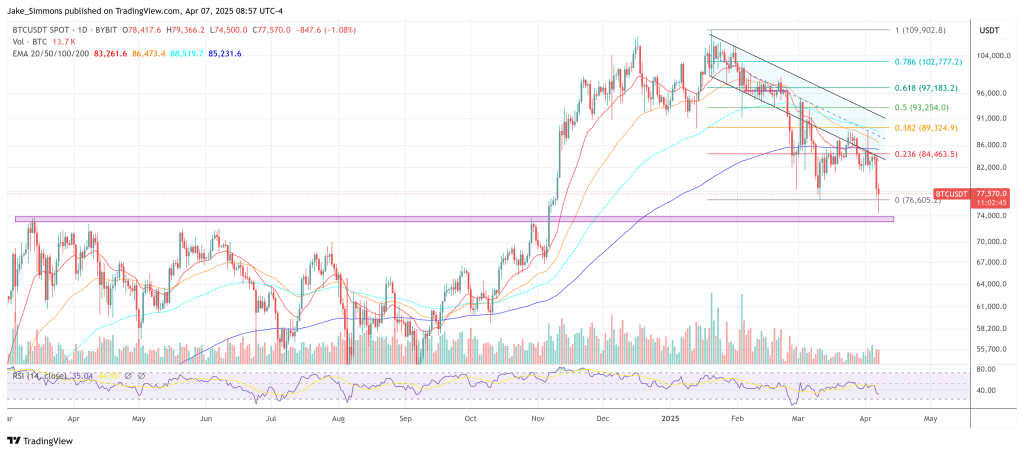
Bitcoin price
BTC stabilizes above $77,000, 1-day chart | Source: BTCUSDT on TradingView.com
Featured image created with DALL.E, chart from TradingView.com
Editorial Process for bitcoinist is centered on delivering thoroughly researched, accurate, and unbiased content. We uphold strict sourcing standards, and each page undergoes diligent review by our team of top technology experts and seasoned editors. This process ensures the integrity, relevance, and value of our content for our readers.

Jake Simmons has been a Bitcoin enthusiast since 2016. Ever since he heard about Bitcoin, he has been studying the topic every day and trying to share his knowledge with others. His goal is to contribute to Bitcoin's financial revolution, which will replace the fiat money system. Besides BTC and crypto, Jake studied Business Informatics at a university. After graduation in 2017, he has been working in the blockchain and crypto sector. You can follow Jake on Twitter at @realJakeSimmons.

Похожее

Retail Investors' 'Lead Brother' Serenity vs. Newly Minted Stock God Leopold: How Are the Two Top Hunters Mining AI's 'Physical Limits'?

The article profiles two prominent figures, Serenity and Leopold Aschenbrenner, who are gaining attention for their unconventional investment strategies focused on the physical constraints of the AI boom, moving beyond mainstream software narratives. Serenity, an anonymous online trader, advocates a "shiso leaf" theory. He targets small-cap companies with monopolies on critical, overlooked components in the AI hardware supply chain, such as specific semiconductor materials. His deep, technical analysis of bottlenecks in areas like co-packaged optics (CPO) has reportedly yielded massive returns, though his anonymity and focus on illiquid micro-cap stocks pose significant risks for followers. Leopold Aschenbrenner, a former OpenAI researcher, founded a multi-billion dollar hedge fund. His macro thesis argues that physical infrastructure—power grids, land, data centers—is the true bottleneck for AI growth, lagging far behind chip production. Consequently, his fund employs an infrastructure arbitrage strategy: heavily investing in storage and compute infrastructure companies while placing massive bearish bets (put options) against major semiconductor stocks, betting their valuations will correct as physical constraints become apparent. While their methods differ—Serenity drills into microscopic supply chain details, while Leopold takes a macroscopic, infrastructure-focused view—both share a core belief: the real power and investment alpha in the AI era lie in controlling scarce physical resources, not just software. The article concludes by noting the inherent risks in both approaches, such as liquidity issues for micro-caps and timing risks for macro bets, but suggests they signal a broader market re-evaluation of AI's foundational assets.

marsbit8 ч. назад

Retail Investors' 'Lead Brother' Serenity vs. Newly Minted Stock God Leopold: How Are the Two Top Hunters Mining AI's 'Physical Limits'?

marsbit8 ч. назад

Торговля

Спот
Фьючерсы
活动图片