Digital Assets On The Table: Kamala Harris Promises To Invest In America’s Future

bitcoinistОпубликовано 2024-09-23Обновлено 2024-09-23

Введение

Vice President Kamala Harris, who recently vowed to embrace the development of artificial intelligence and cryptocurrencies, shook the political stratum....

Vice President Kamala Harris, who recently vowed to embrace the development of artificial intelligence and cryptocurrencies, shook the political stratum.

Speaking in New York City at a high-profile fund-raising event, she sold her economic agenda, which promises to strengthen innovation while safeguarding consumer protections.

Harris stressed that when elected, she would work with stakeholders ranging from labor groups and small business founders to major corporations.

Her point is simple: America’s future is to be invested in by embracing modern technologies like digital assets.

A Vision For Innovation

Harris’s emphasis on an enabling environment for AI and crypto comes at a pivotal moment. The tech space is growing at a rapid pace, and more people feel that the US has to move ahead at the same pace as the rest of the world.

By encouraging investment in those sectors, Harris wants to make America an innovation hub. She had said, “We will partner together to invest in America’s competitiveness while promising to create a collaborative ecosystem that allows for technological growth.”

The vice president is playing not only the economic card but also the consumer-protection and investor-safeguarding one at the same time. Harris is pushing for clear and effective rules to foster the development of the emerging industries without stifling innovation.

For many voters seeking change but avoiding taking that leap of faith on new technologies, this combined innovation and protection appeal could be a winning package.

Kamala Harris: Crypto’s Brightest Hope?

The timing of Harris’s statements couldn’t be better for the cryptocurrency market. After her comments, the price of Bitcoin rose on optimism among investors. More people are now convinced that her support can change things for the sector, which has received much criticism from regulators lately.

Public endorsement by Harris could improve the perception of crypto as a sustainable investment opportunity and encourage more to engage with digital assets.

As of today, the market cap of cryptocurrencies stood at $2.18 trillion. Chart: TradingView.com

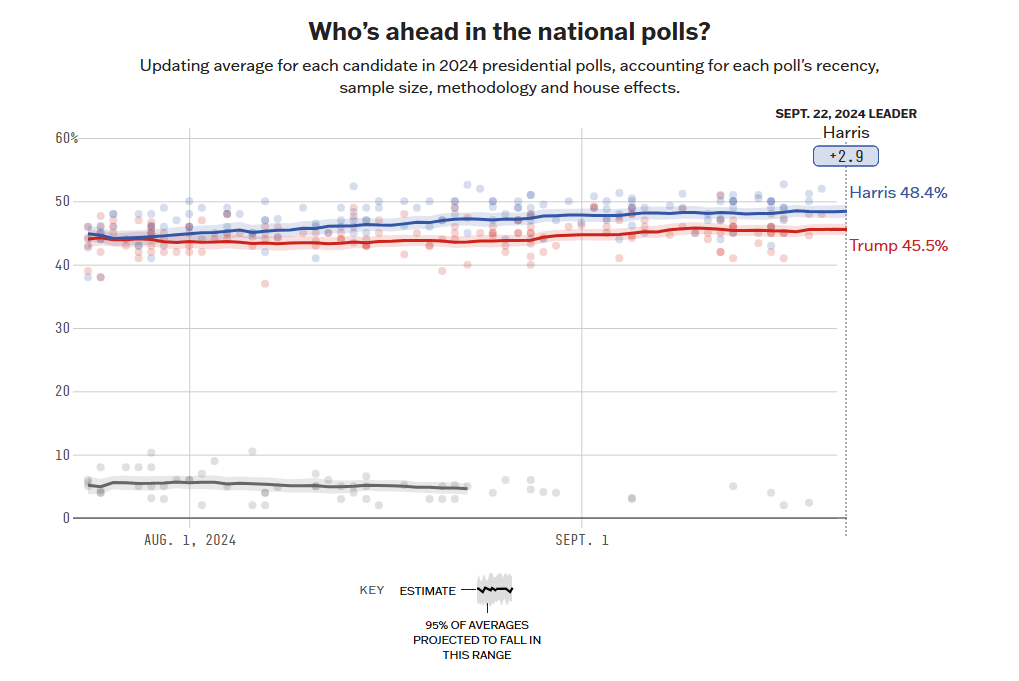
Interestingly, recent polls show that she might be helping herself by actively supporting the sectors as they are slowly starting to get her an electoral edge. The probability of Harris winning the presidency, based on data from 538, has risen to 48.4% as that of former President Trump is still at 45%.

This new trend shows how appreciation of digital currencies might generally appeal to a broader electorate with, of course, younger voters more disposed towards digital currencies.
The Way Forward

As Harris continues her campaign, the focus on AI and cryptocurrency will likely intensify. She appears to present herself more as a political figure aware of the need to embrace technological advancement but assures measures for protection in place before the public. This balance may play a key role in her policy direction should she become president.

Of course, challenges remain as well. The crypto industry remains under regulatory uncertainty, and most stakeholders eagerly look forward to clarity on how policies would likely unfold under a new administration.

Harris’s promise of clear regulations is appealing, but this has to be translated into action in policies that spur growth without compromising safety.

In her drive to back AI and cryptocurrencies, Kamala Harris has significantly altered the political lexicon on the subject of technology. Harris will be an advocate for innovation at the same time as she promises consumer protection with the aim of creating an environment where both succeed.

It will be interesting to see how the voters’ outlook will translate during election time into her proposals and shape the course that digital assets take in America in the future.

Featured image from Los Angeles Times, chart from TradingView

Christian Encila

Christian Encila

Christian, a journalist and editor with leadership roles in Philippine and Canadian media, is fueled by his love for writing and cryptocurrency. Off-screen, he's a cook and cinephile who's constantly intrigued by the size of the universe.

Похожее

NVIDIA Begins Adding Soap to the Bubble

NVIDIA is taking on a dual role: not just as a leading chip supplier, but as a massive capital allocator across the entire AI supply chain. In 2026, the company has committed over $40 billion in investments within five months, targeting everything from optical fiber manufacturing and data center operations to foundational AI model development. This investment spree, described as a systematic "sprinkler" approach, primarily funds companies that are major buyers of NVIDIA's own GPUs. Critics, including analysts from Goldman Sachs, label this a "circular revenue" loop—comparable to a supplier financing a customer to buy more of its products. A prominent example is NVIDIA's investment in OpenAI, which is expected to generate around $13 billion in revenue for NVIDIA, much of which may be reinvested back into OpenAI. While CEO Jensen Huang dismisses the "circular financing" critique as "absurd," arguing the investments are confidence votes in long-term generational shifts, some analysts express discomfort. They note that while investments in critical supply chain components like optics are strategically sound, funding new cloud providers like CoreWeave feels like "pre-paying for your own GPUs." The strategy carries significant risks. If the AI investment cycle turns, the market may question how much demand is genuine versus artificially sustained by NVIDIA's own balance sheet. Despite posting record-breaking earnings—$215.9 billion in annual revenue and $120 billion in net profit for FY2026—NVIDIA's stock fell after its report, signaling that "beating expectations" may no longer be enough to assure investors about the duration of the AI spending boom. The article concludes that while a bubble isn't necessarily a fraud, NVIDIA's actions resemble adding soap to a bubble—making it appear more robust and durable. This creates a complex scenario requiring extreme冷静 from investors to distinguish between real structural growth and financial engineering.

marsbit14 мин. назад

NVIDIA Begins Adding Soap to the Bubble

marsbit14 мин. назад

Short Positions Have Been Squeezed Out: Will the Next Leg of the U.S. Stock AI Rally Continue in Seoul?

"Short Squeeze Exhausted: Will the Next Leg of the AI Rally Continue in Seoul?" A Nomura report suggests the US AI stock rally, which saw the S&P 500 rise ~16.6% in 28 days largely driven by 10 key stocks, may be pausing. The fuel from short covering, CTA fund positioning, and volatility-control strategies is nearing its limit. For the rally to continue, new momentum from retail and sentiment-driven FOMO (Fear Of Missing Out) is needed. South Korea's market provided a potential answer on the very day the report was published. The KOSPI index surged 4.32%, triggering a buy-side circuit breaker, led by massive gains in chip giants SK Hynix (+11.98%) and Samsung. This surge is characterized by retail "hynix FOMO" and overseas funds precisely buying into AI themes via chip-focused ETFs, shifting from broad Korean market ETFs. The Korean rally is a high-beta extension of the US AI capital expenditure story, as major cloud providers plan massive infrastructure spending, directly benefiting memory chip leaders. However, this linkage also implies vulnerability. The sustainability of this next leg depends on whether US tech stocks correct, the trajectory of US inflation (with upcoming CPI data key), and geopolitical tensions around the Strait of Hormuz. Seoul has emerged as the new epicenter of the AI trade, but its fate remains tied to these broader macro and market dynamics.

marsbit19 мин. назад

Short Positions Have Been Squeezed Out: Will the Next Leg of the U.S. Stock AI Rally Continue in Seoul?

marsbit19 мин. назад

Borrowing Money from a Hundred Years Later, Building Incomprehensible AI

Tech giants like Alphabet, Amazon, Meta, and Microsoft are undergoing a radical financial transformation due to AI. Their traditional "light-asset, high-free-cash-flow" model is being dismantled by staggering capital expenditures on AI infrastructure—data centers, GPUs, and power. Combined 2026 guidance exceeds $700 billion, a 4.5x increase from 2022, causing free cash flow to plummet (e.g., Amazon's fell 95%). To fund this, they are borrowing unprecedented sums through long-dated, multi-currency bonds (e.g., Alphabet's 100-year bond). The world's most conservative capital—pensions, insurers—is now funding Silicon Valley's most speculative bet. This shift makes these companies resemble heavy-asset industrials (railroads, utilities) rather than software firms, threatening their premium valuations. Historically, such infrastructure booms (railroads, fiber optics) followed a pattern: genuine technology, overbuilding fueled by competitive frenzy, aggressive debt financing, and a crash triggered by financial conditions—not technology failure. The infrastructure remained, but many original builders and financiers did not survive. The core gamble is a "time arbitrage": using cheap debt today to build scale and lock in customers before AI capabilities commoditize. They are betting that AI revenue will materialize before debt comes due. Their positions vary: Amazon is under immediate cash pressure; Meta's path to monetization is unclear; Alphabet has a robust core business buffer; Microsoft has the shortest path from infrastructure to revenue. The contract is set: the most risk-averse global capital has lent its time to Silicon Valley, awaiting a future that is promised but uncertain.

marsbit1 ч. назад

Borrowing Money from a Hundred Years Later, Building Incomprehensible AI

marsbit1 ч. назад

Торговля

Спот
Фьючерсы
活动图片