抱歉,加密兄弟们,加密货币行业的女性比男性多赚15%。。。但有一个陷阱吗?

币界网Опубликовано 2024-07-31Обновлено 2024-07-31

币界网报道:

我们生活在一个性别和平等处于对话和政治话语前沿的时代。女权主义者不需要理解为女性创造一个安全公平的工作环境的重要性。但将这一信息变成现实一直是一个社会挑战,尤其是在摆脱只对男性有利的根深蒂固的观念方面。该死的父权制。

看看美国,它目前正在权衡是选举第一位女总统,带领自由世界走上一条陌生而激进的自由主义道路(如果你读福克斯),还是重新选举一位令人不安的熟悉的传统主义者,带领美国再走四年陈旧的男校厌女症(如果你看CNN,它也恰好喜欢比特币)。

Crypt兄弟

说到男孩、厌女症和性别歧视,加密兄弟在反对父权制不公正的斗争中的声誉并不好。

从马特·达蒙主演的睾酮驱动的广告到在体育赞助中撒下种子,加密世界自豪地建立在兄弟文化之上。

根据Triple-A的数据,只有39%的加密货币持有者是女性。很难量化为什么加密货币对男性更具吸引力,但加密兄弟文化无疑加强了男孩成为男孩的安全港。

然而,男性毒性的堕落程度远高于加密兄弟。至少他们不是歹徒,更糟糕的是,他们不是ACS男孩。

女孩只是想赚更多

然而,尽管加密兄弟倾向于调整他们的AP,但Pantera研究实验室的新数据表明,在美国,加密货币行业的女性实际上比男性多赚15%。

美国加密货币行业全职工作女性的工资中位数为17.2万美元,而男性的工资为15万美元。

Pantera研究人员Matt Stephenson、Ally Zach和Nick Zurck解释说:“我们的分析发现,加密货币员工的性别工资差异与通常观察到的相反。”。
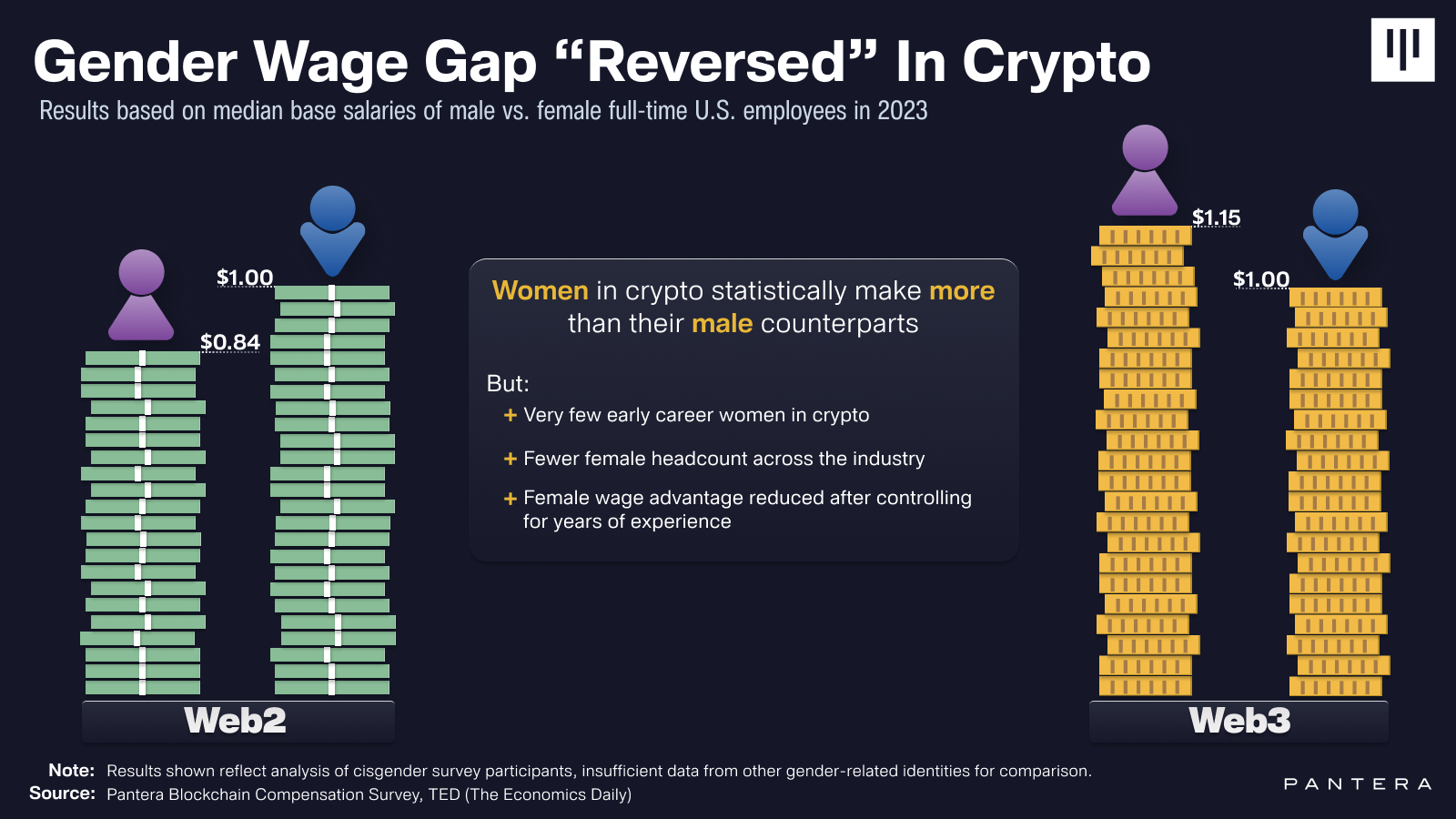
这相当于女性每赚一美元,男性赚1.15美元。在非加密货币角色中,女性每赚一美元,男性赚0.84美元。

Pantera说:“加密货币中相对公平的工资表明了朝着更大的性别平等迈进,标志着这个相当新的领域的进步趋势。”。

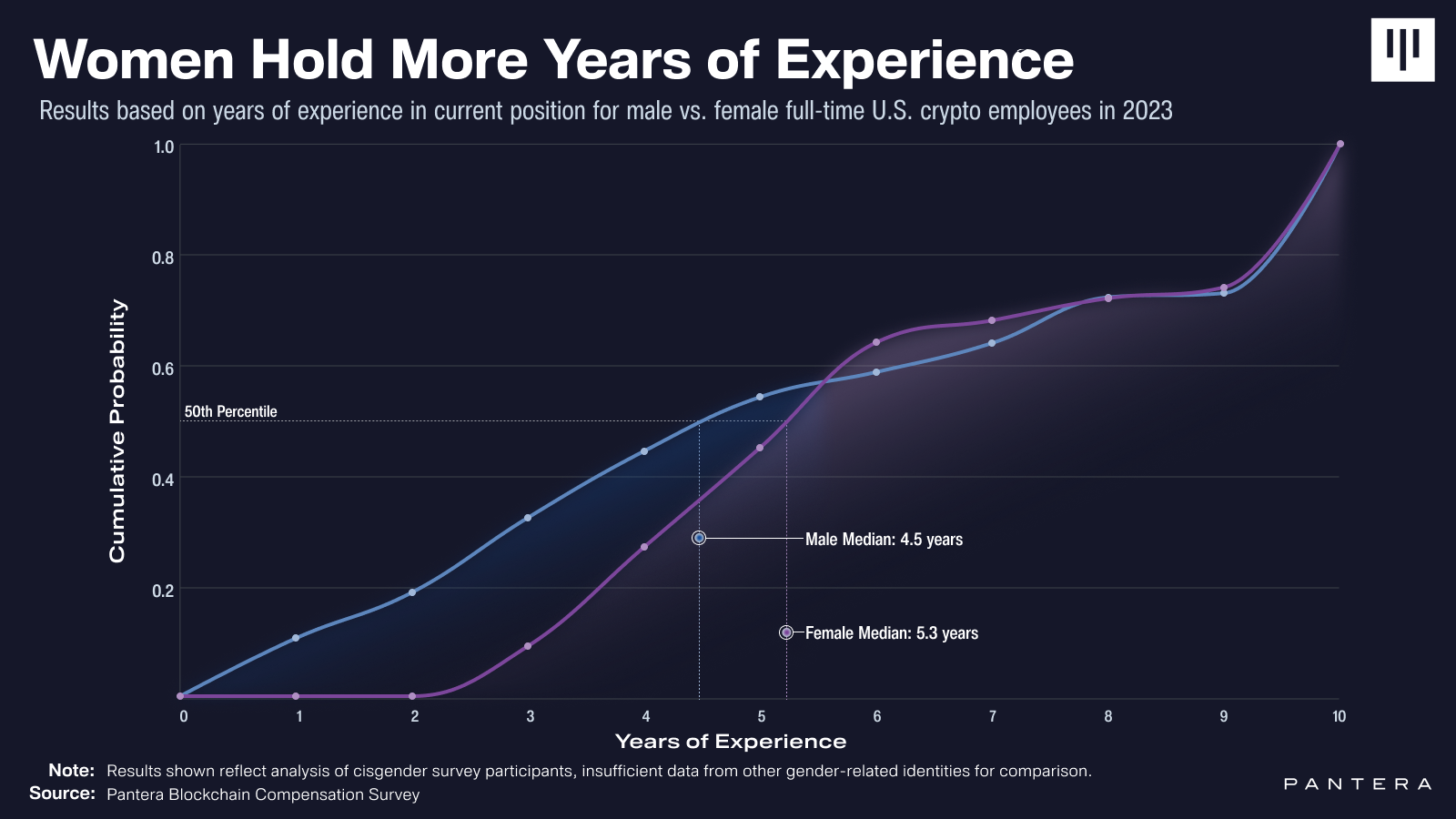
该研究公司表示,这种“逆转”的工资差距可能源于女性更有经验,并且发现自己处于时间跨度更长的中高级职位。

Pantera说:“相比之下,在向加密货币行业过渡的过程中,有更大比例的男性担任入门级职位。”。
始终倾听女性的声音

因为我们在Blockhead不是偏执的笨蛋,我们认为最好听听女性在加密货币性别不平衡问题上的声音。经过多年的家庭关系经验,我们还了解到,倾听女性伴侣的声音是任何关系的基础。。。或者只是一般的生存。在向太空中的女性盟友介绍了这些发现后,我们也不出所料地学到了一两件事。

Rebecca Poon在多家加密货币公司担任客户解决方案总监,她的职业生涯令人敬畏。她说,女性越来越多地获得了她们应得的收入。

潘对Blockhead说:“全世界对性别平等的认识越来越高,许多公司都在重视和实施更公平、更透明的薪酬结构。”。“这导致女性获得的薪酬准确反映了她们的贡献和技能,最终为这些公司树立了积极的品牌形象。”

潘强调:“当然,女性在做出决定之前,通常会花大量时间研究和理解细节。许多女性来自金融和技术领域,她们的技能受到高度重视。”。

潘说,在客户关系这一特定领域,女性只是拥有更好的技能。“我认为这在很大程度上是因为女性以建立强大的支持网络和有效合作而闻名。在快速增长的加密货币领域,建立联系和发展伙伴关系至关重要,这些技能受到高度重视,可以获得更高的薪水。”

The Sandbox新加坡地区经理Belinda Lim表示,进入加密货币行业的女性技能似乎要强大得多。

林说:“加密货币行业的女性人数较少,通常是由选择这个行业的真正有能力的女性组成的。在一个由男性主导的舞台上战斗是自然选择,更多的入门级工作都是男性。”。“这种比较听起来不太对,就像比较苹果和橘子一样。”

了解到女性在加密货币领域的收入高于男性,这让一位专门从事加密货币通信和营销的高级行业专业人士感到震惊。

“听到这个消息我真的很惊讶,”一位希望匿名的加密货币高级营销主管说。“我可以看到,加密货币领域仍然是超级男性主导的,尤其是在高管和创始人层面,至少在亚洲是这样。你参加任何加密货币活动或Web3研讨会,都会觉得95%是男性。”

与林一样,这位营销专家表示,这可能是“因为很多初级或入门级员工都是男性,他们拖累了男性的平均工资。”

她建议:“也许女性正在加入这个行业,担任中高层职位。”。

Katashe创始人(前“Tezos Lady”)Katherine Ng在得知女性收入高于男性时也“非常非常惊讶”。

“说到加密货币的经验,那些在该领域早期采取大胆行动并承担更高风险的人,无论男女,都有机会获得更高的回报,”她说。

“我很幸运能从比特币热潮中受益,尽管由于我厌恶风险,我并没有全力以赴。然而,我对技术创新的坚定信念促使我将1-2%的财富分配给加密货币,这是我自2016/7年进入该领域以来投资组合中回报最高的。”

“我尽量不去关注这种不平衡的负面影响,而是更多地关注建立我热爱的可持续企业,并倡导我希望看到的变革。在我的招聘实践中,我优先考虑DEI优先(多样性、公平性和包容性优先)的方法,以确保我所建立的团队中的性别平衡。”

“我坚信同工同酬,不分性别。我的政策是根据个人的技能和表现进行补偿,没有偏见。这种方法帮助我建立了强大、多元化的团队,推动创新和成功。”

吴还指出,“亚洲在追赶方面还有很长的路要走”,并提请我们注意数据显示,“东南亚女性的平均收入比男性低30%至40%。

此外,根据一项研究,亚洲的平均性别薪酬差距为15%。澳大利亚和新西兰等成熟市场的差距更大,为19.3%,高于全球平均水平16.1%。


其他地方


活动

Coinfest Asia(8月22日至23日,巴厘岛)

准备好在亚洲最大的Web3节上与来自2000多家公司的6000多人联系。立即使用Blockhead的10%折扣码获取门票:CA24BLOCKHEAD


Token2049

不要错过早鸟票的价格,直到7月31日!使用Blockhead的独家折扣码BLOCKHEAD10可再享受10%的折扣。

这一切都发生在LinkedIn上

你知道吗,你现在可以直接在你的领英上收到Blockhead有趣的每日通讯?订阅我们的领英通讯,了解Web3世界的最新消息和见解!

对于该行业最热门的活动,也可能偶尔会有专门针对订阅者的折扣码。所以一定要报名!

在LinkedIn上订阅

Похожее

After Losing 97% of Its Market Value, iQiyi Attempts to Use AI to Forcefully Extend Its Lifespan

After losing 97% of its market value since its 2018 peak, iQiyi is aggressively pivoting to AI in a desperate attempt to survive. At its 2026 World Conference, CEO Gong Yu announced an "AI Artist Library" with over 100 virtual performers and a new AIGC platform, "NaDou Pro," promising faster production and lower costs. This shift comes as the company faces severe financial distress: its market cap sits near delisting thresholds at $1.36 billion, with significant losses, declining membership revenue, and depleted cash flow. The AI strategy has sparked controversy. Top actors have issued legal threats against unauthorized digital replicas, while in Hengdian, over 134,000 background actors are seeing their already scarce job opportunities vanish as AI replaces them for background roles. iQiyi's move represents a fundamental shift from being a high-cost content buyer to a landlord" to becoming a "platform capitalist" that transfers production risk to creators. This contrasts with competitors like Douyin (TikTok's Chinese counterpart), which is investing heavily in *real* actor-led short dramas, betting that authentic human connection retains users better than AI-generated content. The article draws a parallel to the 1920s transition to "talkies," which made cinema musicians obsolete but ultimately enriched the art form. In contrast, iQiyi's AI drive is framed not as an artistic evolution but as a cost-cutting measure that could degrade storytelling, replacing genuine human emotion with algorithmically calculated stimulation and potentially numbing audiences' capacity for empathy. The core question remains: can a company focused solely on financial survival preserve the art of storytelling?

marsbit3 мин. назад

After Losing 97% of Its Market Value, iQiyi Attempts to Use AI to Forcefully Extend Its Lifespan

marsbit3 мин. назад

Only a 50% Chance of Passing This Year, Can the CLARITY Bill Succeed Before the Midterm Elections?

The CLARITY Act, which passed the House in July 2025 with strong bipartisan support (294-134), faces a critical juncture in the Senate. The Senate Banking Committee is expected to hold a markup soon, but key issues remain unresolved, including stablecoin yield provisions, DeFi regulations, and securing full Republican committee support. Other contentious points involve the Blockchain Regulatory Certainty Act (BRCA), ethics amendments for government officials, and SEC-related matters. The legislative calendar is tight, with limited time before the midterm elections. If the committee markup is delayed beyond mid-May, the chances of passage in 2026 drop significantly. Senator Cynthia Lummis has warned that failure this year could delay comprehensive crypto market structure legislation until 2030 or later. Galaxy estimates the probability of the CLARITY Act becoming law in 2026 is only about 50%. The bill provides crucial regulatory clarity by defining jurisdictional boundaries between the SEC and CFTC, establishing a path for decentralization, and bringing digital commodity intermediaries under federal regulation. Its passage is seen as vital before potential power shifts in the next Congress, which could bring less favorable leadership to key committees. The timeline is compressed, and the bill must compete for floor time with other priorities like Iran authorization and DHS appropriations. Key hurdles include finalizing the stablecoin yield compromise text, addressing law enforcement concerns about BRCA, and navigating political dynamics around SEC nominations. The outcome of the Banking Committee markup and the level of bipartisan support will be critical indicators of its future success.

marsbit41 мин. назад

Only a 50% Chance of Passing This Year, Can the CLARITY Bill Succeed Before the Midterm Elections?

marsbit41 мин. назад

Dialogue with Xinhuo Chief Economist Fu Peng: Macro Bear Market Expected to End This Year, Prioritize Allocation to Value Assets

Fu Peng, Chief Economist at New Huo Group, discusses the integration of crypto assets into traditional finance, marking a shift from a speculative phase to institutionalization. He highlights the current era as the second major fusion of finance and technology, driven by AI, data, and computing power, with crypto assets becoming part of the FICC+C (Fixed Income, Currencies, Commodities + Crypto) framework. Regulatory clarity in the U.S., such as the GENIUS and Clarity Acts, has paved the way for institutional adoption by defining digital assets as financial instruments. Fu views RWA (Real World Assets) as a tool for asset tokenization rather than a standalone asset class, noting that financial innovation differs between Eastern and Western markets due to cultural approaches to risk and regulation. He emphasizes that stablecoins are essential for future finance, but Asian markets, including Hong Kong, will adopt them cautiously. Macro liquidity now significantly influences crypto markets, as institutional participation increases correlation with traditional assets. Fu suggests the macro-driven bear market may end by year-end, reducing the relevance of Bitcoin’s four-year cycle. For asset allocation, he recommends value-oriented AI stocks for stability, Bitcoin for moderate certainty, and Ethereum for higher volatility.

marsbit49 мин. назад

Dialogue with Xinhuo Chief Economist Fu Peng: Macro Bear Market Expected to End This Year, Prioritize Allocation to Value Assets

marsbit49 мин. назад

Only a 50% Chance of Passing This Year, Can the CLARITY Bill Succeed Before the Midterm Elections?

The CLARITY Act, which passed the U.S. House in July 2025 with strong bipartisan support (294-134), faces a critical juncture in the Senate. The Senate Banking Committee is expected to hold a markup soon, but key issues remain unresolved, including stablecoin yield provisions, DeFi regulations, and securing full Republican committee support. Additional challenges involve the Blockchain Regulatory Certainty Act (BRCA), ethics amendments for government officials, and SEC-related concerns. Galaxy estimates only a 50% chance of the bill becoming law in 2026. The tight legislative calendar, competing priorities like Iran military authorization and DHS appropriations, and the impending midterm elections create significant time pressure. If the bill is not passed before the new Congress convenes in 2027, comprehensive crypto market structure legislation could be delayed until 2030 or later, especially if leadership changes result in less favorable committee chairs. The act provides crucial regulatory clarity by defining the jurisdictional boundaries between the SEC and CFTC, establishing a path for decentralized networks to be classified as non-securities, and bringing digital commodity intermediaries under federal regulation. The outcome of ongoing Senate negotiations, particularly the release of revised text on stablecoin yields, will be a key indicator of its future prospects.

Odaily星球日报52 мин. назад

Only a 50% Chance of Passing This Year, Can the CLARITY Bill Succeed Before the Midterm Elections?

Odaily星球日报52 мин. назад

Four-Dimensional Resonance: Hong Kong Web3 Carnival Sub-Forum Co-Creates Blueprint for Global Financial New Infrastructure

The "Four-Dimensional Resonance: 2026 Global Financial New Infrastructure" forum, a core event of the Hong Kong Web3 Festival, was successfully held at the Hong Kong Convention and Exhibition Centre. Co-hosted by Web3Labs and DeShang Singularity Tech, with joint support from Bitroot, Injective, Microsoft, and Z Oracle, the event gathered policymakers, industry leaders, and investors to explore the integration and innovation of global financial infrastructure, focusing on RWA, AI, DeFi, and compliant payments. Policy speakers, including Hong Kong Legislative Council Member Mr. Wu Jiezhuang, South Korean National Assembly Member Mr. Min Byung-duk, and ACED Chairman Mr. Yun Seok-hun, emphasized the importance of cross-border regulatory collaboration and an open policy environment for fintech innovation. Web3Labs CEO Caspar and DeShang Singularity Tech CEO Chang Shuai highlighted Hong Kong’s role as a financial innovation center and the approaching "singularity moment" for global financial infrastructure. Technical insights were shared by MagnetX, Bitroot, Microsoft, and Injective on topics including AI Agent economies, the evolution of public blockchains, and AI’s transformative role in finance. Key partnerships and initiatives were launched: - GWDC 2026 Korea collaboration between Hong Kong and South Korea. - A strategic agreement between Web3Labs and Microsoft. - The launch of a public anti-fraud alliance by Z Oracle and partners. - The "Injective Rising Star" program to support AI and Web3 projects. Panel discussions delved into AI-driven smart payments, compliant cross-border transactions, and the fusion of RWA and DeFi. Participants agreed that integrating RWA with DeFi is crucial for the next stage of financial infrastructure, enabling a shift from physical to digital finance. The forum underscored Hong Kong’s pivotal role in advancing a globalized and sustainable Asian fintech ecosystem.

marsbit1 ч. назад

Four-Dimensional Resonance: Hong Kong Web3 Carnival Sub-Forum Co-Creates Blueprint for Global Financial New Infrastructure

marsbit1 ч. назад

Торговля

Спот
Фьючерсы
活动图片