2026 Crypto Narrative Predictions: Reputation Dominance, ICO Revival, and Neo-Banking, with Stablecoins as the Ultimate Winner

marsbitОпубликовано 2026-01-08Обновлено 2026-01-08

Введение

The article predicts three major narratives for the crypto space in 2026: reputation, the revival of ICOs, and the rise of crypto neobanks. In an AI-dominated landscape, reputation will become a critical differentiator between humans and bots, serving as a trust filter to identify credible actors and deter bad behavior, sybil attacks, and impersonators. ICOs are expected to make a comeback amid clearer regulations. Unlike past failures and recent flawed models like low-float, high-FDV VC launches, a new wave of reputation-based ICOs could foster the next generation of major crypto projects. Crypto neobanks will challenge traditional finance by offering self-custody accounts, yield-earning opportunities, and instant cross-border stablecoin payments. While no clear winners have emerged, stablecoins may ultimately benefit the most from this shift.

Author:Wazz

Compiled by: Deep Tide TechFlow

Reputation

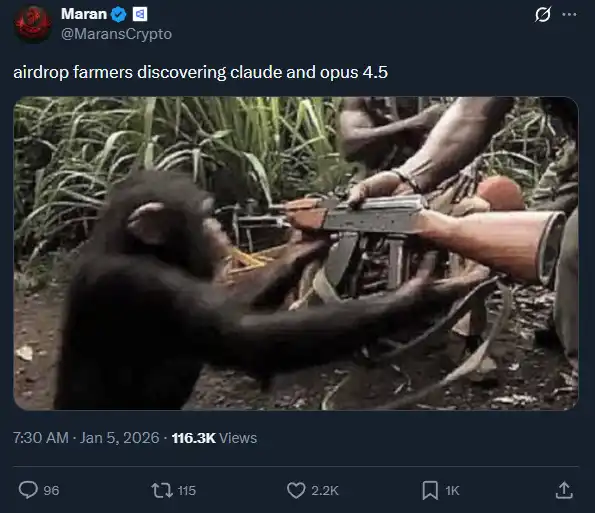
Whether driven by InfoFi, the desire for "ElonBucks," or the lofty life goal of becoming a Key Opinion Leader (KOL) in the crypto space, it's undeniable that our Crypto Twitter (CT) feeds, your favorite token airdrop campaigns, and the testnets you're "farming" are already been flooded with bots. As AI technology continues to advance, this situation will only intensify.

In this chaotic, AI-driven dystopian world, only one thing can distinguish real humans from bots. And no, it doesn't require handing over your biometrics to those "trustworthy" French developers.

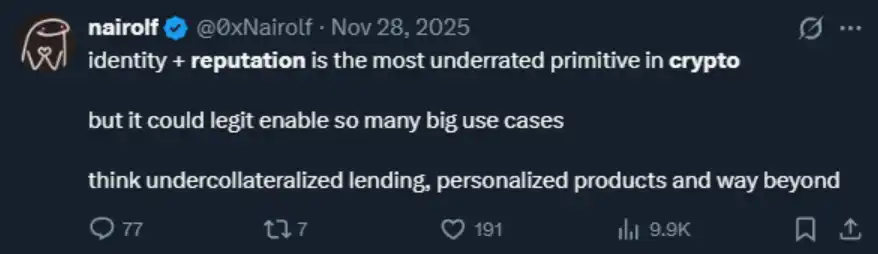
That thing is "Reputation." It cannot be replicated by bots (any bot) because it requires hundreds or even thousands of hours to build and can only be maintained through meaningful social connections. It's called "Reputation." And no, you can't have Grok dress it up in a bikini to embellish it.

Reputation is an unshakable filter; no matter how much your "binary friends" (referring to bots) flatter in the comments, they ultimately cannot pass this threshold.

It helps you identify bad actors, scammers, and imposters (e.g., @ethos_network); it filters out those who are only there to extract value, sybil attackers, and investors with misaligned incentives (e.g., @legiondotcc); and it allows you to find credible, authentic, and influential voices in the crypto space (e.g., @KaitoAI before the InfoFi craze).

In the age of AI, the importance of reputation will become increasingly prominent. It is not only the key to distinguishing humans from machines but also the cornerstone for ensuring the healthy development of the ecosystem. Therefore, in 2026, reputation will become a dominant topic in the crypto space.

The Revival of ICOs

2017 was a frenzied era for the crypto industry. Driven by a regulatory vacuum, Ethereum's innovative ERC-20 standard, and immense speculative desire, thousands of projects successfully raised funds through what is now widely known as Initial Coin Offerings (ICOs).

This fundraising method was extremely efficient but also became a breeding ground for chaotic scams due to its disorder, eventually being halted by major regulators. However, during that era, major projects like BNB, TRX, and ADA were born and still rank among the top ten cryptocurrencies by market cap today.

The ban on ICOs plunged the crypto industry into a "dark age" and forced the entire sector into an experimental phase regarding token distribution and capital raising.

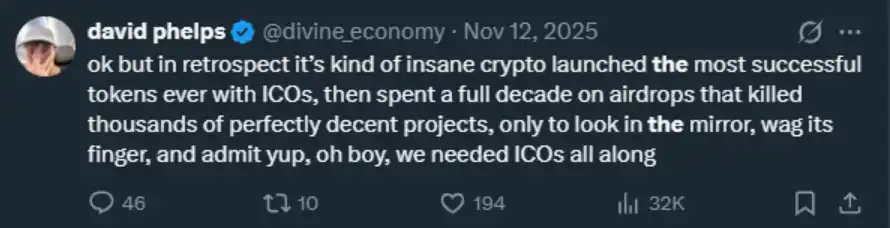
In terms of token distribution, we tried airdrops. Initially, this method achieved good distribution results at low cost and successfully attracted a lot of user attention, but it was eventually overexploited by speculators and industrialized "farmers," draining resources.

In terms of fundraising, we tried the low-circulation, high-FDV (fully diluted valuation) venture capital model. While this method was very beneficial for certain groups (mainly insiders), since most price discovery occurred before the public market, ordinary investors ended up holding the bag, suffering significant losses.

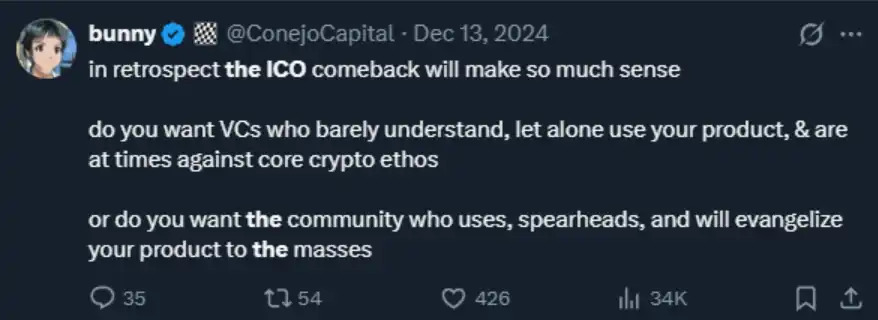
If 2025 is the year of regulatory clarity (which was the main reason ICOs were blocked), then 2026 is likely to become the "Year of the ICO Revival." History may not repeat itself exactly, but it often rhymes—in this new wave of ICOs, we may witness the emergence of some major crypto giants.

This area is becoming one of the most exciting sectors in the crypto industry, with many projects already showing promise, such as the reputation-based ICO project @legiondotcc, as well as @MetaDAOProject and the recently Coinbase-acquired @echodotxyz.

Crypto Neo-Banking

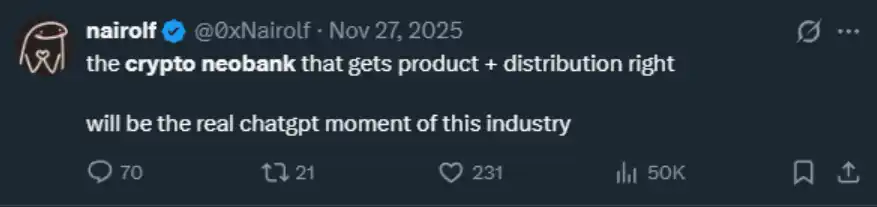
Neobanks have already disrupted traditional banking. Revolut is now one of Europe's most valuable fintech companies, and Nubank is one of the most valuable fintech companies in Latin America. As more digital-native investors emerge, the rise of Crypto Neo-Banking seems natural, especially since it can leverage the same regulatory clarity advantages as ICOs.

Self-custody accounts, yield-bearing accounts, and direct, instant cross-border stablecoin payments are features that distinguish crypto neo-banks from the traditional banking system.

With the proliferation of stablecoins and the provision of larger, more democratized yield opportunities for holders (no more enduring savings accounts with a mere 0.2% annual interest rate), crypto neo-banks will gradually eat into the market share of traditional finance (TradFi).

Although there are no clear winners yet, and I'm not sure if any tokens will benefit, stablecoins might be the ultimate winner. However, in my view, crypto neo-banking will become one of the most important narratives of 2026.

Связанные с этим вопросы

QWhat is predicted to be the dominant narrative in the crypto space by 2026, and why is it considered crucial in the AI era?

AReputation is predicted to be the dominant narrative in the crypto space by 2026. It is considered crucial because it serves as an immutable filter to distinguish real humans from bots, identify bad actors and scammers, and find credible voices in the ecosystem, especially as AI technology advances and bot activity increases.

QWhat event from crypto history is expected to experience a revival in 2026, and what were the two main experimental phases that followed its initial ban?

AThe Initial Coin Offering (ICO) is expected to experience a revival in 2026. The two main experimental phases that followed its initial ban were airdrops (for token distribution) and the low-circulation, high-FDV venture capital model (for fundraising).

QAccording to the article, what are the key features that distinguish crypto neobanks from the traditional banking system?

AThe key features that distinguish crypto neobanks from the traditional banking system are self-custody accounts, yield-bearing accounts, and direct, instant cross-border stablecoin payments.

QWhich asset does the article suggest might be the ultimate winner in the context of the emerging crypto neobanking narrative, and why?

AThe article suggests that stablecoins might be the ultimate winner because their widespread adoption and the ability to provide larger, more democratic yield opportunities for holders will allow crypto neobanks to eat into TradFi's market share.

QName two projects mentioned in the article that are already showing promise in the context of the 'Reputation-based ICO' narrative.

ATwo projects mentioned are @legiondotcc (a reputation-based ICO project) and @MetaDAOProject.

Похожее

La Liga Team Bets $1 Million Against Themselves Before Match: Does Using Prediction Markets for Insurance Comply with Sports Regulations?

A Spanish La Liga club, reportedly Osasuna, purchased insurance against relegation and was linked to a transaction of over $1 million on the prediction market platform Kalshi, betting against its own victory in a crucial season-ending match. While Osasuna confirmed buying €1.2 million insurance for a potential €6 million payout in case of relegation through broker Howden, it did not confirm involvement with Kalshi. The reported trade involved intermediaries like Game Point Capital and Greenlight Commodities, with quant firm Susquehanna as the counterparty. This incident highlights the blurring line between financial hedging and gambling in prediction markets. Such markets allow trading on future event outcomes, like sports results. In the US, Kalshi operates as a regulated event contract market under the CFTC. However, Spanish authorities recently initiated penalties against Kalshi and Polymarket, considering their activities unlicensed gambling. The case raises core questions about prediction markets: who can trade, how insider information is handled, and whether participants can influence outcomes, especially in sports where results are human-driven. While leagues like La Liga and Serie A have partnered with Polymarket in North America, the regulatory clash and potential for conflicts of interest, as seen in this club's alleged transaction, present significant challenges as prediction markets evolve toward institutional risk management.

Foresight News6 мин. назад

La Liga Team Bets $1 Million Against Themselves Before Match: Does Using Prediction Markets for Insurance Comply with Sports Regulations?

Foresight News6 мин. назад

From Shouting 150 Dollars to Liquidating HYPE in Just Three Days, How Much Credibility Does Arthur Hayes Have Left?

How much of Arthur Hayes's market credibility remains? Recently, the "godfather of crypto perpetual swaps" and BitMEX co-founder has faced public criticism, including accusations from on-chain investigator ZachXBT about creating exit liquidity for his followers. Starting last week, Hayes executed multiple sudden sell-offs. He had repeatedly publicly predicted the HYPE token would reach $150. After a $100,000 bet defending Hyperliquid on June 1st, he announced just three days later that he had completely sold his HYPE and NEAR holdings, successfully exiting near the peak. He also sold ZEC and WLD. His sale of WLD appeared to be a classic "pump and dump" maneuver. On June 3rd, he publicly set a $10 target for WLD, causing its price to surge over 35%. By June 6th, he announced he had sold his WLD, citing "anomalous" SpaceX pre-IPO price action, which triggered a sharp price drop. On June 9th, Hayes published a lengthy article explaining his actions, citing factors like rising energy costs and a potential AI bubble burst. Consequently, his family office, Maelstrom, now holds positions in US energy producers and only core crypto assets BTC and ETH, having sold AI-related stocks and non-core cryptocurrencies. This pattern is not new. In 2025, he similarly touted HYPE before selling it at what turned out to be a cycle peak, only to repurchase it at the next cycle's low. Similar scenarios played out with tokens like ETHFI and ENA. Long-term observers have developed a strategy: ignore Hayes's public statements but closely monitor his on-chain actions—be cautious following his buys, but decisively follow his sells. If he continues these tactics, especially as seen with the WLD case, his market credibility risks being permanently damaged. As Hayes himself admitted in his latest article, "I remain an unapologetic gambler."

marsbit24 мин. назад

From Shouting 150 Dollars to Liquidating HYPE in Just Three Days, How Much Credibility Does Arthur Hayes Have Left?

marsbit24 мин. назад

Fundraising is Like a Strange Dance: The 'Absurd Drama' of Silicon Valley Founders' Capital Raises

The article details a series of absurd and revealing anecdotes shared by Silicon Valley founders about their venture capital fundraising experiences, sparked by Greg Isenberg's story of pitching to a sleeping a16z partner. Founders describe surreal pitch meetings: one faced a barefoot, peanut-eating investor who offered triple the requested amount after 30 seconds; another performed a pitch in a VC's parked car; a founder discovered his audience understood no English beyond "yes." These stories highlight the often irrational and performative nature of fundraising. Beyond the absurdity, darker power imbalances are exposed. Stories include investors suggesting founders fire co-founders for their equity, blatant market misjudgments, disrespectful behavior from LPs, and discriminatory remarks. A debate also emerges around "Sequoia's" practice of splitting a round into two valuations. However, the thread isn't solely critical. Positive counter-narratives celebrate supportive VCs who offered crucial advice during crises, respected founders' timelines, and showed simple gestures of respect—like a partner personally fetching coffee before a major pitch. Ultimately, the collective sharing acts as a pressure release, illustrating that fundraising is a complex dance of power, trust, and sometimes sheer theater. It underscores that beyond capital, mutual respect and integrity remain the most enduring foundations of the founder-investor relationship.

marsbit37 мин. назад

Fundraising is Like a Strange Dance: The 'Absurd Drama' of Silicon Valley Founders' Capital Raises

marsbit37 мин. назад

Торговля

Спот
Фьючерсы
活动图片